Cannabis financial due diligence: compliance and growth
2026 update: what rescheduling changed for 280E (reviewed October 2026)
Effective April 22, 2026, a DOJ/DEA final order moved marijuana covered by a qualifying state medical license (and FDA-approved marijuana drugs) to Schedule III. Section 280E only applies to Schedule I and II substances, so state-licensed medical cannabis activity is generally no longer subject to 280E going forward. Adult-use cannabis remains in Schedule I and fully subject to 280E. The DEA proceeding to reschedule all marijuana was temporarily stayed in October 2026, and Treasury/IRS guidance on transition years and mixed medical/adult-use businesses is still pending.
Check where your business stands in about a minute.
Most cannabis business owners assume that standard financial due diligence, the kind used in any regulated industry, is enough to close deals and stay compliant. That assumption is expensive. Poor documentation is a leading red flag in cannabis transactions, and it catches even experienced operators off guard. Cannabis carries a set of financial, tax, and regulatory risks that have no equivalent in any other U.S. industry. The businesses that grow, get funded, and stay out of regulatory trouble are the ones that treat financial due diligence as a living operational practice, not a last-minute deal checklist.
Table of Contents
- What makes cannabis financial due diligence unique?
- Core components: Evidence, controls, and compliance
- Common pitfalls and real risks
- How to apply: Building a diligence-ready operation
- Why most financial due diligence misses the real risk (and how to get it right)
- Take the next step: Empower your cannabis finance journey
- Frequently asked questions
Key Takeaways
| Point | Details |
|---|---|
| Cannabis diligence is specialized | Standard financial review processes miss critical compliance and tax issues unique to cannabis. |
| Documentation is deal-critical | Poor records or missing tax details are the leading reasons deals fail to close in cannabis. |
| 280E and compliance drive value | Ignoring 280E and compliance requirements distorts valuations and creates major financial risk. |
| Proactive prep reduces risk | Investing upfront in evidence readiness and professional support greatly increases closing certainty and compliance. |
What makes cannabis financial due diligence unique?
With the risks made clear, it is important to distinguish what sets cannabis apart from traditional industries. The mechanics look familiar on the surface: data rooms, formal document requests, attorney and accountant review, and financial analysis. But the substance behind each step is radically different.
In most industries, financial review centers on revenue verification, cost structures, and liability exposure. In cannabis, every one of those areas carries a layer of federal illegality, state-specific regulatory risk, and tax treatment that simply does not exist elsewhere. Formal information requests, data rooms, and attorney and accountant review are standard cannabis due diligence steps, but the real differentiator is whether those reviews can produce clean, defensible 280E documentation and tax records.

Section 280E of the Internal Revenue Code disallows ordinary business deductions for companies trafficking in Schedule I or II controlled substances. That means cannabis businesses cannot deduct typical expenses like rent, salaries, and marketing the way any other business can. During due diligence, the inability to produce clear 280E-compliant records is not just a paperwork problem. It signals systemic tax exposure that can kill a deal or trigger IRS scrutiny long after closing.
Here is how cannabis due diligence compares to standard industry practice:
| Due diligence area | Standard industry | Cannabis industry |
|---|---|---|
| Tax documentation | Standard deductions reviewed | 280E compliance required, no ordinary deductions |
| Banking records | Straightforward bank statements | Limited banking access, cash controls critical |
| Regulatory approvals | Industry-specific licenses | State cannabis licenses, real estate restrictions |
| Financial statements | GAAP-compliant audit | Must reflect IRC 471 cost accounting adjustments |
| Deal structure review | Standard M&A process | Must account for federal illegality, license transfer rules |
The red flags in cannabis due diligence are specific. You should watch for:
- Missing or inconsistent point-of-sale records
- Unexplained cash variances in reconciliation files
- No written standard operating procedures for cash handling
- Inability to produce state-filed tax returns reflecting 280E calculations
- Gaps between reported revenue and inventory tracking system data
“The difference between a successful cannabis transaction and a failed one often comes down to one thing: whether the seller built their financial records for the scrutiny they knew was coming.”
For anyone new to the sector, reviewing cannabis due diligence basics before entering a transaction is not optional. It is the foundation for every conversation that follows.
Core components: Evidence, controls, and compliance
Knowing cannabis due diligence is unique, let’s break down the core elements every business must document and control. The businesses that sail through financial review share one trait: their financial evidence is built into their daily operations, not assembled at the last minute.
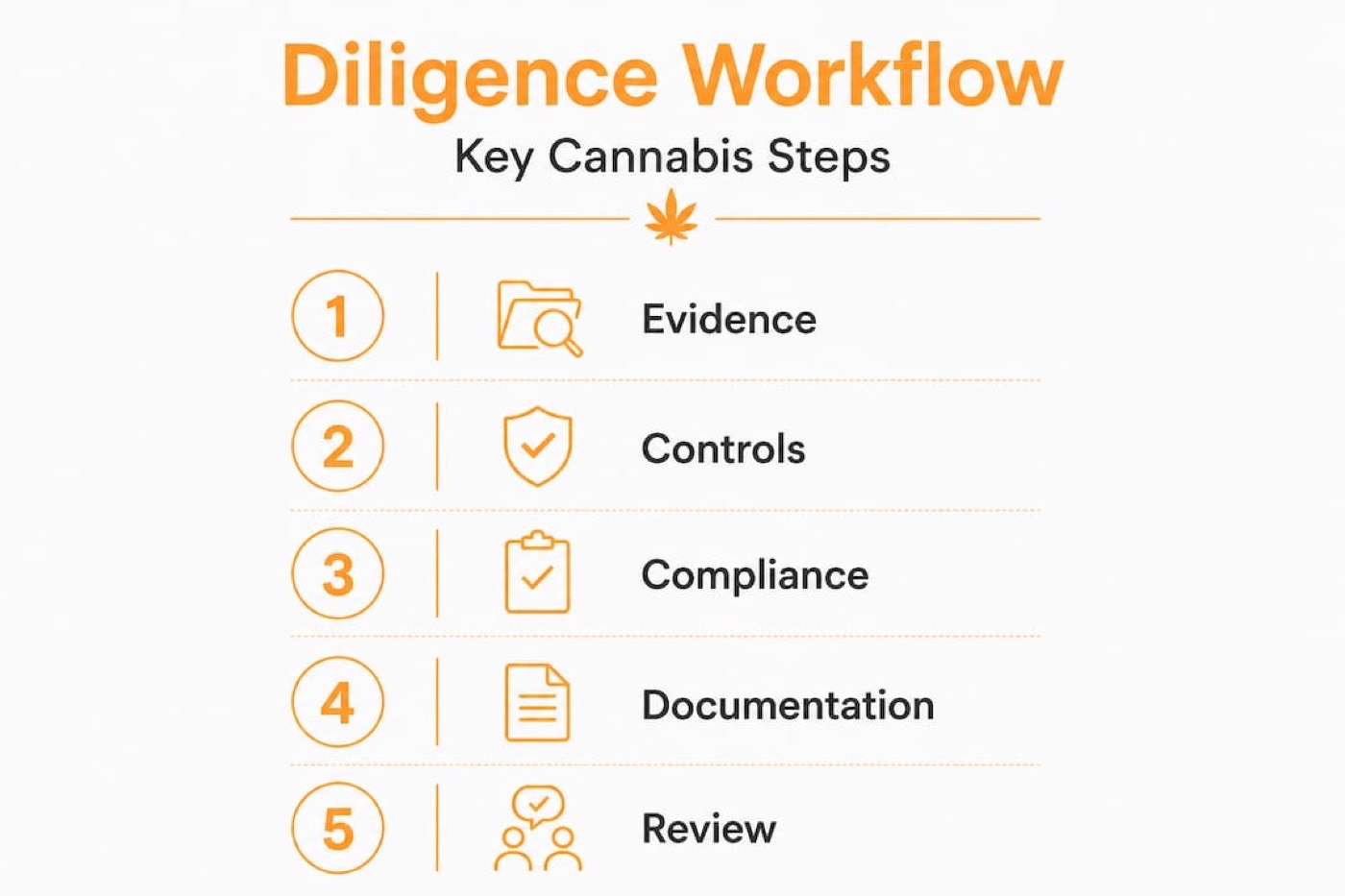
Audit trails, SOPs, and reconciliation evidence are critical, especially for cash controls that affect closing certainty. A buyer, investor, or bank will want to see that your financial controls are systematic, not ad hoc. That means documentation you can pull today, not documents you need to reconstruct after a letter of intent arrives.
Here are the five core evidence types reviewed in every serious cannabis financial diligence process:
- Complete financial statements. Three to five years of profit and loss statements, balance sheets, and cash flow reports. These must be prepared under consistent accounting methods that reflect IRC 471 cost accounting standards.
- Tax filings with 280E schedules. Buyers and lenders want to see how your business calculated cost of goods sold versus disallowed expenses. Sloppy separation between COGS and operating expenses is a major red flag.
- Inventory and point-of-sale reconciliation. Every gram accounted for. Every sale tied to a seed-to-sale tracking record. Discrepancies here suggest either poor controls or intentional misreporting.
- Banking records and cash control logs. In a cash-heavy business, the paper trail for every cash receipt, deposit, and variance matters enormously. Cash controls are a direct test of operational integrity.
- Regulatory filings and license records. All state licenses, renewal histories, inspection reports, and any compliance actions. A license in good standing has real value. One under review does not.
Pro Tip: Synchronize your compliance review calendar with your financial close cycle. When your books are closed and reconciled at the same time your compliance officer is reviewing regulatory filings, you eliminate the gap that creates last-minute surprises during external diligence.
Understanding cannabis compliance essentials is the starting point for building systems that hold up under scrutiny. From there, aligning your financial reporting for compliance with the actual review criteria used by buyers and regulators will put your operation ahead of most businesses in the space.
Common pitfalls and real risks
Mastering the basics is one thing, but understanding how pitfalls derail transactions helps you stay ahead. The most costly mistakes in cannabis financial due diligence are rarely obscure. They are well-known patterns that businesses fall into because they prioritize growth over documentation discipline.
EBITDA without 280E adjustment. This is the most dangerous number in cannabis M&A. Sellers and investors may anchor on EBITDA without adjusting for 280E, which means the effective tax rate and true cash yield of the business are being systematically misrepresented. A business showing $2 million in EBITDA may have an effective federal tax rate north of 70% once 280E is properly modeled. Relying on unadjusted EBITDA means either overpaying as a buyer or underestimating real deal risk as a seller trying to attract capital.
Regulatory and license approval delays. A transaction that looks clean on paper can collapse when a license transfer requires state approval that takes six to nine months, or when an unresolved compliance issue surfaces mid-diligence. Delays and incomplete document readiness can convert paper diligence into real financial losses through missed closings or compliance failures. The gap between the signed letter of intent and the closing table is where undiscovered problems become deal-breaking problems.
Cash handling exposure. Because most cannabis businesses still operate largely in cash due to banking restrictions, cash controls are under intense scrutiny. Missing cash handling logs, unreconciled deposits, or lack of documented armored transport records are enough to make a bank or sophisticated buyer walk away.
Here are the pitfalls that appear most consistently in failed cannabis transactions:
- Treating 280E tax drag as a rounding error in financial models
- Failing to maintain separate cost center records for COGS versus operating expenses
- No formal data room prepared before a deal process begins
- License contingencies not clearly addressed in purchase agreements
- Missing cannabis-specific representations and warranties in deal documents
Pro Tip: Model your 280E tax drag explicitly in every financial projection you share with investors or buyers. Show the pre-280E and post-280E cash position side by side. Buyers who see this analysis done proactively trust the numbers far more than buyers who have to demand it.
Understanding tax compliance risks in depth is the only way to avoid the valuation gaps that make deals fall apart. And if federal rescheduling is on your radar, the 280E rescheduling impact is a critical planning variable for any forward-looking financial model.
How to apply: Building a diligence-ready operation
Now, let’s shift from pitfalls to practical action you can implement in your operations. Being diligence-ready is not a project you start when a deal is on the table. It is a practice you build into how you run your business every month.
Sequencing and readiness, including clean data rooms, up-to-date reconciliations, and organized evidence, directly reduces financial risk and increases deal certainty. Here is how to build that readiness systematically:
- Set up your data room before you need it. Use a secure, organized virtual data room that mirrors what a buyer or lender will expect. Organize it by category: financial statements, tax filings, licenses, SOPs, bank records, and corporate documents.
- Reconcile monthly without exception. Monthly reconciliation between your POS system, inventory tracking system, and bank accounts is not optional. Gaps here are the first thing a diligence team will find.
- Document every cash control procedure in writing. Your cash counting procedures, armored car pickup schedules, vault logs, and variance reporting need to be in writing and followed consistently. Verbal procedures do not survive scrutiny.
- Separate COGS from operating expenses with precision. Work with a cannabis-specialized CPA to ensure your chart of accounts clearly separates cost of goods sold from the expenses that 280E disallows. This is not just a tax strategy. It is the foundation of a credible financial picture.
- Conduct an internal diligence review annually. At least once a year, run a mock diligence exercise. Pull the documents a buyer would request. Identify gaps before they are identified for you.
Documents you should always have ready include:
- Three to five years of reviewed or audited financial statements
- Copies of all current state licenses and renewal records
- Complete tax filings for the past three years
- Written SOPs for cash handling, inventory management, and compliance
- Bank statements and cash reconciliation logs for the trailing twelve months
- Any prior regulatory inspection reports and responses
Working with experienced professionals makes a measurable difference. A cannabis-specific CPA will catch the IRC 471 and 280E issues that a generalist will miss. A compliance consultant will know your state’s license transfer rules cold. Choosing a cannabis accountant with direct experience in transactions and regulatory audits is one of the highest-leverage decisions an operator can make. Equally important is building a cannabis banking workflow that creates consistent, auditable records even when banking relationships are limited or frequently changing.
Why most financial due diligence misses the real risk (and how to get it right)
Here is the uncomfortable reality that most cannabis operators and even some advisors do not want to say out loud: the majority of financial due diligence in this industry is still treated as a box-checking exercise. Gather the documents, load the data room, answer the questions. Done. That mindset is exactly why so many transactions fall apart or, worse, close on bad terms that create post-deal litigation and regulatory pain.
The real risk in cannabis is not that a business lacks documents. It is that the documents exist but do not reflect actual operational reality. A POS report that does not match inventory logs, a tax filing that was prepared without real 280E analysis, or an SOP that nobody follows are all far more dangerous than missing paperwork. They suggest either internal chaos or intentional misrepresentation. Neither is survivable in a serious deal.
Financial work cannot be isolated from regulatory and licensing timelines; evidence readiness is the real measure of whether a business is prepared for external scrutiny. The businesses that consistently close deals and maintain strong regulatory standing are the ones that have integrated compliance, financial, and operational rigor into a single, unified practice. They do not run three separate reviews. They build systems where each function reinforces the others.
Proactive diligence also changes how you are perceived. A seller who walks into a deal with a clean data room, audited financials, a written 280E model, and documented compliance history is negotiating from strength. A seller who scrambles to produce records in response to buyer requests is negotiating from weakness, regardless of how strong the underlying business is.
The role of CPA guidance in cannabis is to shift your organization from reactive to proactive. That shift is where real deal value is created and protected.
Take the next step: Empower your cannabis finance journey
Ready to move from learning to action? Here is how you can reinforce your financial due diligence foundations with expert tools and support.

Cannabis Business Minds offers the specialized resources that cannabis operators and finance professionals need to build truly diligence-ready operations. From in-depth cannabis accounting services that address 280E compliance and IRC 471 cost accounting, to a detailed cost accounting guide that walks you through exact documentation standards, the platform is built for operators who take financial rigor seriously. If you are preparing for a transaction, an audit, or simply want to raise your operational standards, the due diligence compliance guide is the most direct path to closing the gaps that put deals and licenses at risk.
Frequently asked questions
What documents are most often requested in cannabis financial due diligence?
Expect requests for complete financial statements, cash controls, tax filings showing 280E compliance, and regulatory approvals. Formal document review and 280E tax documentation are standard items in any serious cannabis diligence process.
How does 280E affect cannabis financial due diligence?
Section 280E requires careful tax modeling and increases the need for accurate, defensible financial records that separate COGS from disallowed operating expenses. Traditional valuation metrics alone are insufficient without adjusting for 280E’s impact on effective tax rate and real cash yield.
Are banking and cash controls really that important in cannabis due diligence?
Yes, strong banking documentation and cash controls are central to both closing deals and keeping operations compliant. Banking constraints and weak cash controls can derail cannabis transactions and create ongoing operational and regulatory exposure.
What is the main reason cannabis deals fall through during financial due diligence?
Incomplete or poorly maintained financial and compliance documentation leads to failed closings and lost deal value. Missing financial documentation is consistently cited as a leading cause of failed cannabis due diligence across transactions of all sizes.
Recommended
- Master the Cannabis Banking Workflow for Compliance Success – Cannabis Business Minds
- What Is Cannabis Compliance: Impact on U.S. Businesses – Cannabis Business Minds
- How to Choose Cannabis Accountant for Compliance Success – Cannabis Business Minds
- Cannabis Financial Planning Explained: Key U.S. Requirements – Cannabis Business Minds
- How New Hemp Regulations Could Change the THC Market in 2026
This article is general education, not tax, legal or accounting advice. Cannabis rules change quickly; confirm how they apply to you with a qualified cannabis CPA or attorney.