How Schedule 3 rescheduling changes 280E for cannabis
2026 update: what rescheduling changed for 280E (reviewed October 2026)
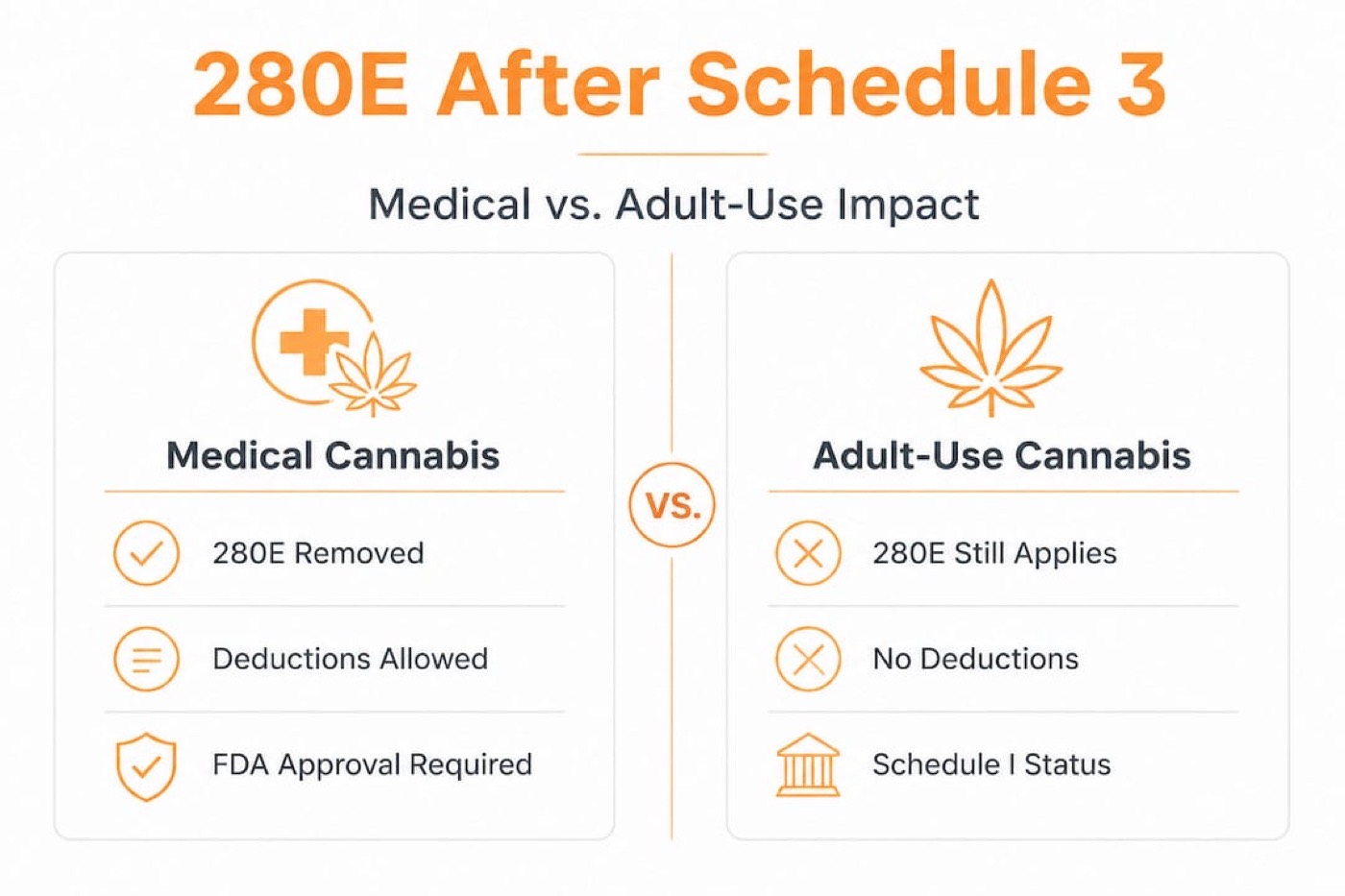
Effective April 22, 2026, a DOJ/DEA final order moved marijuana covered by a qualifying state medical license (and FDA-approved marijuana drugs) to Schedule III. Section 280E only applies to Schedule I and II substances, so state-licensed medical cannabis activity is generally no longer subject to 280E going forward. Adult-use cannabis remains in Schedule I and fully subject to 280E. The DEA proceeding to reschedule all marijuana was temporarily stayed in October 2026, and Treasury/IRS guidance on transition years and mixed medical/adult-use businesses is still pending.
Check where your business stands in about a minute.
The rumor spreading through cannabis boardrooms and accounting offices is that Section 280E is gone. It is not. The DEA’s move to reschedule marijuana from Schedule I to Schedule III under the Controlled Substances Act (CSA) creates meaningful tax relief for a specific slice of the industry, but the vast majority of cannabis businesses will continue operating under one of the most punishing tax rules in the U.S. tax code. Understanding exactly where the line falls, who crosses it, and what you need to do before IRS guidance drops is the difference between a smart tax strategy and a costly audit.
Table of Contents
- Understanding Section 280E and Schedule 3
- Who benefits from Schedule 3? Medical vs. adult-use explained
- How 280E applies to mixed activities and the upcoming IRS rules
- Planning ahead: Steps for cannabis businesses navigating post-Schedule 3 rules
- Our take: The uncomfortable truth about 280E’s future
- Tools and resources for navigating cannabis tax and regulatory changes
- Frequently asked questions
Key Takeaways
| Point | Details |
|---|---|
| 280E not fully repealed | Section 280E is only removed for specific medical cannabis businesses; adult-use remains subject to its restrictions. |
| Schedule 3 benefits are limited | Only FDA-approved and qualifying state-licensed medical cannabis operations receive Schedule 3 relief. |
| IRS guidance is crucial | Upcoming IRS rules will define how businesses must apportion expenses and manage the transition to new tax treatment. |
| Mixed businesses need careful tracking | Cannabis companies with both medical and adult-use operations should separate records to avoid audit risks. |
| Seek expert support | Professional advice, updated accounting systems, and compliance strategies are essential for navigating regulatory changes. |
Understanding Section 280E and Schedule 3
Section 280E of the Internal Revenue Code prohibits businesses from deducting ordinary business expenses when they traffic in Schedule I or Schedule II controlled substances. For cannabis operators, this has meant paying federal income tax on gross profit rather than net income, because expenses like payroll, rent, and marketing cannot be deducted. The cannabis tax impact of this rule has been devastating for many operators, effectively pushing effective tax rates above 70% in some cases.
Schedule 3 rescheduling changes this picture, but only partially. As the Treasury/IRS confirmed, “Section 280E is not ‘going away’ entirely; it is being removed only for certain qualifying medical cannabis products that have been placed in CSA Schedule III.” That is a critical distinction. If your business sells adult-use cannabis, operates without state medical licensing, or handles bulk unprocessed product outside qualifying categories, 280E still applies to you in full.
Here is a side-by-side look at how the tax landscape shifts:
| Business type | Pre-Schedule 3 | Post-Schedule 3 |
|---|---|---|
| State-licensed medical cannabis | 280E applies, no deductions | 280E removed, normal deductions allowed |
| FDA-approved cannabis products | 280E applies | 280E removed |
| Adult-use recreational cannabis | 280E applies | 280E still applies |
| Unlicensed cannabis operations | 280E applies | 280E still applies |
| Mixed medical and adult-use | 280E applies to all | 280E applies only to adult-use portion |
The practical difference between the first two rows and the last three is enormous. A qualifying medical dispensary could see its cannabis tax liability drop dramatically once it can deduct wages, utilities, and administrative costs. An adult-use operator in Colorado or California? Nothing changes.
“The rescheduling of marijuana to Schedule III does not mean cannabis businesses are free from federal tax restrictions. It means a defined subset of qualifying businesses gains relief while others remain fully subject to 280E.”
The key takeaway here is that Schedule 3 rescheduling is not a blanket amnesty. It is a targeted policy shift with narrow eligibility criteria, and misreading it could lead to incorrect tax filings and serious IRS exposure.
Who benefits from Schedule 3? Medical vs. adult-use explained
The dividing line between businesses that benefit and those that do not comes down to two factors: what you sell and how you are licensed. The Treasury/IRS guidance makes clear that “DOJ/DEA action places FDA-approved marijuana and marijuana under qualifying state medical licenses into Schedule III; adult-use remains Schedule I.”
This means the following types of businesses are likely to qualify for 280E relief:
- Dispensaries operating exclusively under a state-issued medical cannabis license
- Cultivators and processors whose products feed only into the medical supply chain
- Businesses selling FDA-approved cannabis-derived medications (such as Epidiolex)
- Vertically integrated operators where medical and adult-use operations are legally separated into distinct entities
Businesses that do not qualify include:
- Recreational dispensaries without a medical license or dual-license structure
- Cannabis delivery services operating only in adult-use markets
- Cultivators supplying exclusively adult-use retailers
- Any operation without proper state licensing, regardless of the products sold
The distinction matters enormously for how you categorize your eligible cannabis expenses and how you structure your business going forward. If you currently operate a dual-license dispensary serving both medical and adult-use customers under one entity, you are in a gray zone that the IRS has not yet fully addressed.
| Business type | 280E status post-rescheduling | Normal deductions allowed? |
|---|---|---|
| Medical-only dispensary | Schedule III, 280E removed | Yes |
| Adult-use-only dispensary | Schedule I, 280E applies | No |
| Dual-license single entity | Mixed, partial 280E | Partial, with apportionment |
| FDA-approved product seller | Schedule III, 280E removed | Yes |
| Unlicensed operator | Schedule I, 280E applies | No |
Your entity tax status plays a direct role in how these rules apply. A C-corporation running both medical and adult-use operations under one roof faces a very different reporting challenge than two separate LLCs, each dedicated to one activity.
Pro Tip: Pull your current licenses and categorize every product line by its regulatory classification right now. Do not wait for IRS guidance to drop before you understand your own exposure. The businesses that move early will be better positioned to take advantage of relief and avoid compliance mistakes.
How 280E applies to mixed activities and the upcoming IRS rules
Here is where things get genuinely complicated. Many cannabis businesses operate across both qualifying and non-qualifying activities. A dispensary might hold a dual license, selling medical flower to patients and recreational edibles to adult customers, all from the same location with shared staff and overhead. How do you split those expenses?

The IRS has not yet issued final rules, but the Treasury/IRS have signaled that they “expect to issue guidance clarifying (1) how 280E applies when a business has multiple activities and (2) a transition rule for rescheduling effects.” Until that guidance arrives, businesses need to operate with a reasonable apportionment methodology and document it thoroughly.
Here are practical steps to prepare for the new mixed-activity rules:
- Separate your revenue streams. Track medical and adult-use sales in distinct ledger accounts, not combined categories. Your point-of-sale system should be configured to tag every transaction by license type.
- Allocate direct costs by activity. If a budtender spends 60% of their time serving medical patients and 40% serving adult-use customers, document that split and apply it to payroll allocations.
- Treat shared overhead carefully. Rent, utilities, and insurance that support both activities will need a defensible allocation method, such as square footage or revenue percentage.
- Create a written allocation policy. Before the IRS issues guidance, having a documented internal policy shows good faith and reduces audit risk.
- Review your expense categories now. Some costs that were previously non-deductible under 280E may become partially deductible, but only if you can prove they relate to qualifying medical activities.
- Model both scenarios. Run your financials under full 280E and under partial 280E to understand the financial impact of different IRS interpretations.
The businesses that will struggle most are those that have never separated their medical and adult-use accounting because they assumed 280E applied uniformly. They were right before, but that assumption is now a liability. Your tax strategy needs to evolve with the regulatory landscape.
Pro Tip: Maintain separate general ledger accounts for every cost center tied to qualifying medical activities. This is not just good accounting practice. It is your primary defense in an IRS examination of how you allocated expenses between Schedule I and Schedule III activities.
Planning ahead: Steps for cannabis businesses navigating post-Schedule 3 rules
Knowing the rules is one thing. Building a plan around them is another. The IRS transition rule is particularly important: “Treasury/IRS guidance will include a transition rule stating rescheduling generally applies first for a business’s full taxable year including the DOJ Final Order’s effective date.” This means the relief does not apply retroactively to prior years, and it kicks in for the entire tax year in which the rescheduling order becomes effective.
Here is a step-by-step action plan for cannabis businesses preparing for this transition:
- Confirm your licensing status. Verify that your state medical license is current and that your products qualify under the DEA’s Schedule III definition. A lapsed or improperly categorized license could disqualify you from relief.
- Consult your tax advisor before filing. Do not amend prior returns based on rescheduling alone. The transition rule applies prospectively, and premature amendments could trigger scrutiny.
- Update your chart of accounts. Your accounting system needs to reflect the new regulatory reality. Create separate accounts for Schedule III qualifying revenue and Schedule I adult-use revenue.
- Review your entity structure. If you operate medical and adult-use under one entity, talk to a cannabis-specialized attorney about whether restructuring into separate entities makes sense for your tax position.
- Monitor IRS announcements actively. The Treasury and IRS have committed to issuing guidance. Subscribe to IRS news releases and work with advisors who track federal cannabis tax developments in real time.
- Model your tax exposure under multiple scenarios. What does your tax bill look like if you qualify for full Schedule III relief? What if only 40% of your revenue qualifies? Build those models now.
Reviewing the tax filing guide for cannabis businesses is a smart starting point for understanding your current obligations before the new rules take effect. And if you have not already reviewed tax planning tips for dispensaries, now is the time to close that gap.
Pro Tip: Engage a CPA or tax attorney who has specific experience with cannabis federal taxation, not just general small business tax work. The nuances of 280E apportionment, cost of goods sold calculations under IRC 471, and the Schedule III transition require specialized knowledge that most generalist tax professionals do not have.
Our take: The uncomfortable truth about 280E’s future
Here is what most articles on this topic will not tell you. Partial relief from 280E is not a win for the majority of cannabis businesses operating in the U.S. today. The recreational market is larger than the medical market in most states, and the businesses that drive the most revenue remain fully subject to 280E’s restrictions. Schedule 3 rescheduling is a meaningful policy shift, but it is not the tax reform the industry actually needs.
What concerns us more is the compliance trap this creates. When there is a clear dividing line between taxable and non-taxable activity, the IRS pays close attention to how businesses draw that line. The new Schedule III framework will almost certainly increase IRS scrutiny of expense allocation between qualifying and non-qualifying activities. Businesses that claim aggressive deductions based on medical licensing without proper documentation are setting themselves up for audits that could be more damaging than simply paying the 280E tax.
There is also an uncomfortable reality about cannabis tax exposure that many owners are not facing honestly. Even with 280E relief for medical operations, the overall tax and regulatory burden in the cannabis industry remains among the highest of any legal business sector in America. State excise taxes, local licensing fees, and the ongoing banking limitations under federal law mean that Schedule III rescheduling is a step, not a solution.
The businesses that will thrive in this environment are the ones that treat compliance as a competitive advantage, not a checkbox. Meticulous records, proactive tax planning, and a willingness to invest in specialized expertise will separate the operators who grow from the ones who get caught flat-footed when IRS guidance finally arrives.
Tools and resources for navigating cannabis tax and regulatory changes
Staying ahead of 280E and Schedule 3 changes requires more than reading news releases. It requires a structured approach to accounting, tax strategy, and compliance that is built specifically for cannabis operations.

Cannabis Business Minds offers a full library of resources designed for exactly this moment. The cost accounting guide walks through how to properly allocate costs under IRC 471, which remains critical even after Schedule 3 relief. For a broader view of your financial and compliance obligations, the cannabis accounting solution section covers everything from chart of accounts setup to audit-ready reporting. Whether you are a dispensary owner trying to understand your new tax position or a finance professional building systems for a multi-state operator, these resources give you the practical foundation to act with confidence rather than guesswork.
Frequently asked questions
Will Section 280E apply to all cannabis businesses after Schedule 3 rescheduling?
No, 280E will only be removed for FDA-approved and qualifying medical marijuana businesses placed in Schedule III; adult-use and unlicensed marijuana remain fully subject to 280E restrictions.
When does Schedule 3 relief from 280E take effect for my business?
Generally, relief applies for the full taxable year that includes the effective date of the DOJ Final Order, per the transition rule outlined in forthcoming IRS guidance.
How should cannabis businesses apportion expenses between medical and adult-use activities?
Businesses must separate expenses and revenue by activity type, following IRS guidance for mixed operations, since 280E applies only to Schedule I and II trafficking activities.
Does adult-use cannabis business get any relief from 280E after Schedule 3?
No, adult-use cannabis remains a Schedule I substance and continues to trigger full 280E limitations with no deductions for ordinary business expenses.
What should I do now to prepare for these changes?
Review your licensing status, update your accounting systems to separate qualifying and non-qualifying revenue, and consult experienced cannabis tax advisors to maximize compliance and minimize exposure under the new rules.
Recommended
- Why Cannabis Taxes Are High for U.S. Businesses – Cannabis Business Minds
- Cannabis Financial Planning Explained: Key U.S. Requirements – Cannabis Business Minds
- Cannabis Business Tax Filings Explained: U.S. Compliance Guide – Cannabis Business Minds
- 7 Essential Tax Planning Tips for Dispensaries – Cannabis Business Minds
This article is general education, not tax, legal or accounting advice. Cannabis rules change quickly; confirm how they apply to you with a qualified cannabis CPA or attorney.