Why Establish Internal Policies for Cannabis Businesses
Internal policies in cannabis operations are the foundational tools that define compliance standards, operational procedures, and workforce management to protect the business against audits, legal claims, and regulatory scrutiny. The question of why establish internal policies cannabis operators can actually defend is not academic. It is the difference between surviving a Department of Cannabis Control inspection and losing your license. Compliance failures stem primarily from internal inconsistencies rather than external regulatory changes, meaning the threat is already inside your operation. The 2026 DEA Schedule III reclassification adds federal pressure that makes undocumented, ad hoc operations a direct liability.
Why establish internal policies cannabis businesses can defend?
Internal policies are the documented proof that your operation runs the same way every time. Courts, regulators, and auditors do not accept verbal assurances. They look for written procedures, training records, and enforcement logs. Cannabis employee handbooks must be refreshed at least annually, with state record retention requirements ranging from 3 to 7 years. That is not a suggestion. That is the minimum standard for any operator with employees.
The importance of cannabis policies goes beyond HR paperwork. Policies define how inventory moves, how cash is handled, how security cameras are monitored, and how a manager responds to a failed product test. Without written procedures, every one of those decisions becomes a liability. Regulators treat undocumented decisions as evidence of non-compliance, not as honest gaps.

What are the essential internal policies cannabis businesses must establish?
Every cannabis operation needs a core set of written policies covering the following areas:
- Employee handbook. Must address state-specific cannabis labor laws, federal regulations, anti-discrimination policies, drug testing protocols for employees, and termination procedures. Generic templates from non-cannabis industries create gaps that regulators and plaintiffs exploit.
- Operational SOPs. Standard operating procedures must integrate track-and-trace system mandates. Systems like METRC and BioTrack require specific logging steps. Your SOPs must reference those systems by name and by statute. Well-structured SOP templates produce smoother audits and more trustworthy financial statements.
- Security plan. Covers access control, camera placement, diversion prevention, and incident response. Most state licenses require a security plan at application. Fewer operators keep it updated after opening.
- Financial controls. Cash handling procedures, bank reconciliation schedules, and inventory costing methods must be written down and assigned to named roles. This connects directly to your cannabis audit trail and financial reporting integrity.
- Disciplinary procedures. Must align with your state’s regulatory framework. California’s three-tier disciplinary structure, for example, penalizes undocumented procedural lapses. Local ordinances may impose stricter requirements on top of state rules.
- Compliance calendar. Tracks license renewals, tax deadlines, regulatory filings, and required reporting windows. Without a calendar, deadlines get missed. Missed deadlines trigger penalties and license actions.
Pro Tip: Assign a named owner to every policy section. If no one is accountable for updating a procedure, it will not get updated.
How do internal policies protect cannabis businesses during audits and legal challenges?
Documented policies serve two functions during an audit or legal dispute. First, they show the regulator or court what your standard was. Second, they show whether you actually followed it. Both matter. A policy that exists but was never enforced is often worse than no policy at all, because it proves you knew the standard and ignored it.
| Scenario | Without documented policies | With documented policies |
|---|---|---|
| Wrongful termination claim | No evidence of consistent enforcement | Training records and disciplinary logs support defense |
| Regulatory inspection | Inspector fills gaps with assumptions | Written SOPs demonstrate procedural compliance |
| Financial audit | Reconstructed records raise credibility questions | Linked procedures and logs support financial statements |
| Insurance claim | Carrier questions operational maturity | Documented controls support coverage and terms |
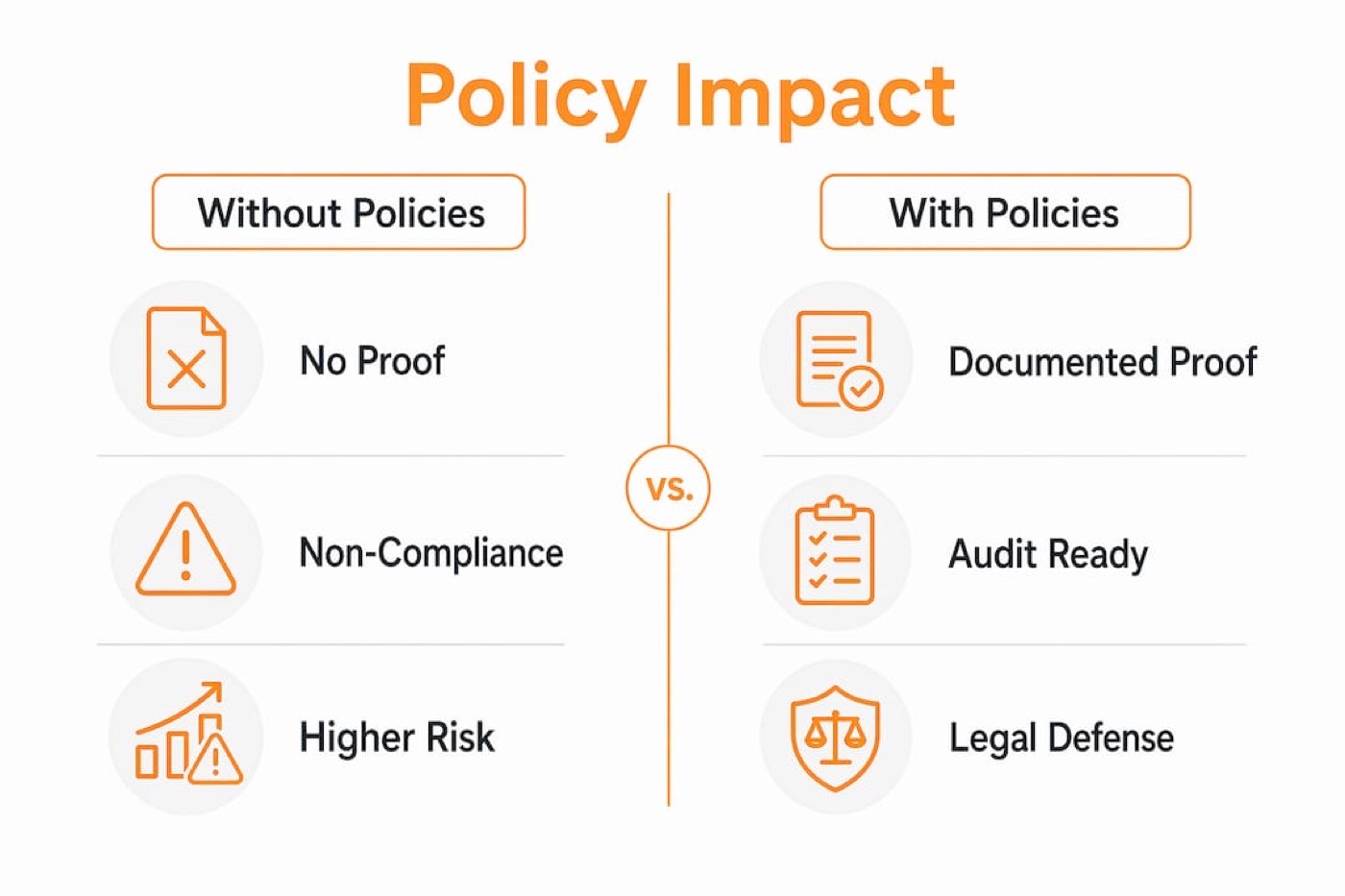
Audit readiness requires linking internal policies to actual practice. A policy binder on a shelf is not audit readiness. Audit readiness is when your manager can pull the training sign-off for every employee who touched that procedure in the last 12 months.
Manager training is where most operations break down. Policies written by ownership or outside counsel often never reach floor-level supervisors in a usable form. When a manager makes a decision that contradicts a written policy, that inconsistency becomes the plaintiff’s exhibit or the regulator’s finding. Enforcement consistency is not optional. It is the mechanism that makes the policy real.
Pro Tip: Run a quarterly internal audit against your own SOPs. Document what you find and what you corrected. That self-correction record is evidence of good faith during external reviews.
Why must cannabis internal policies be updated regularly?
The regulatory environment for cannabis changes faster than most industries. Policies written in 2023 may already be non-compliant in 2026. Three categories of change require immediate policy review:
- Federal reclassification. The DEA’s Schedule III reclassification in 2026 triggers enhanced public health considerations and new federal scrutiny. Operators who do not adapt their policies invite stricter future regulation and long-term business liability.
- State labor law updates. Minimum wage increases, paid sick leave expansions, and local cannabis ordinances change annually in most legal states. An employee handbook that does not reflect current state law is a wrongful termination claim waiting to happen.
- Track-and-trace system changes. METRC and BioTrack release system updates that affect required logging steps. Your SOPs must reflect current system requirements, not the version from your initial license application.
The risk of using generic or outdated templates is not theoretical. Compliance calendars with automated alerts at multiple intervals reduce compliance gaps and enforcement risks. A master calendar covering filings, renewals, tax deadlines, and regulatory responses is the operational backbone that keeps policies current.
Fragmented, ad hoc documents create a different kind of risk. When policies live in separate folders, owned by different people, with no central version control, you end up with contradictions. One SOP says cash is counted by two people. Another says one. A regulator finds both. That contradiction is a finding. Centralized compliance infrastructure is not a luxury for large operators. It is the minimum standard for any licensed cannabis business.
How does a strong internal policy framework create competitive advantages?
Investors and acquirers treat compliance infrastructure as a direct input to valuation. A cannabis business with documented, enforced, and current policies carries less regulatory risk. Less regulatory risk means a higher acquisition multiple and better access to institutional capital.
The competitive advantages of a mature internal policy framework include:
- Investor confidence. Institutional investors and private equity firms conduct compliance due diligence before closing. Gaps in policy documentation translate directly to price reductions or deal failures.
- Insurance terms. Insurance carriers prefer operators who demonstrate operational maturity through documented policies and staff training. Undeveloped compliance systems increase risk and costs exponentially.
- Staff turnover resilience. When procedures are written down and owned by roles rather than individuals, losing a key employee does not mean losing the knowledge of how the operation runs. This is especially critical in cannabis, where turnover rates are high.
- Financial statement reliability. Structured SOPs function as essential scaffolds for reliable financial reporting, improving audit outcomes and acquisition multiples.
- Operational consistency. Documented procedures reduce variance. Variance is where compliance failures hide.
The role of audits in cannabis operations is not just regulatory. Internal audits against your own policies generate the data that shows investors and lenders that your operation is predictable and defensible.
What practical steps help cannabis businesses develop effective internal policies?
Building a defensible internal policy framework is a project, not a one-time task. The steps below reflect what actually holds up under regulatory review:
- Build SOP templates with statute references. Every SOP must cite the specific state statute or regulation it implements. A procedure that says “follow state law” without citing the law is not defensible. Name the code section.
- Assign role-based ownership. Each policy section needs a named role responsible for execution and updates. Not a person’s name. A role. When the person leaves, the role stays.
- Implement training programs with sign-offs. Every employee who works under a policy must sign a training acknowledgment. Courts and regulators look for these records first. No sign-off means no evidence of training.
- Build a compliance calendar with automated alerts. A master calendar covering license renewals, tax filings, required reports, and regulatory deadlines should trigger alerts at 90, 30, and 7 days before each deadline. Manual tracking fails at scale.
- Run internal self-assessments quarterly. Compare actual practice against written policy. Document gaps. Document corrections. This self-assessment record demonstrates good faith and operational discipline during external reviews.
Pro Tip: When a regulator or auditor finds a gap, the question they ask next is whether you found it first. A documented self-assessment that identified and corrected the same issue is the strongest possible response.
Cannabis compliance technology supports all five steps above by centralizing documents, automating alerts, and maintaining version histories. The technology does not replace the policy work. It makes the policy work auditable.
The uncomfortable truth about internal policies in cannabis
Most operators I have seen get into trouble did not fail because of a bad regulation. They failed because their internal systems were not built to survive scrutiny. The policy existed. The training did not happen. The manager made a call that contradicted the written procedure. The regulator found the contradiction and treated it as willful non-compliance.
Generic templates are the most expensive shortcut in cannabis. A handbook downloaded from a non-cannabis HR platform does not address METRC logging requirements, state-specific cannabis labor protections, or the disciplinary structures that California’s DCC expects to see. When that handbook ends up in a wrongful termination proceeding, the gaps become the plaintiff’s argument.
The operators who attract institutional capital and survive multi-state expansion are not the ones with the best products. They are the ones with the most defensible operational infrastructure. Policies that are current, enforced, and documented are what separate a serious operator from one who is one audit away from a license suspension. That is not a soft observation. That is what the due diligence process reveals every time.
— JN
Cannabisbusinessminds resources for compliance-ready cannabis operations
Cannabisbusinessminds covers the financial and operational frameworks that cannabis businesses need to build audit-ready documentation and maintain compliance across state and federal requirements.

The platform’s cannabis bookkeeping tips for finance professionals connect internal controls directly to financial reporting accuracy, which is where auditors look first. For operators managing inventory procedures, the cannabis inventory costing guide covers the costing methods that SOPs must reference to produce defensible financial statements. If you are building or reviewing your compliance infrastructure in 2026, these resources give you the technical foundation to do it correctly.
FAQ
Why do cannabis businesses need internal policies?
Internal policies define compliance standards and operational procedures that protect the business during audits, regulatory inspections, and legal disputes. Compliance failures in cannabis stem primarily from internal inconsistencies, not external regulatory changes.
How often should cannabis internal policies be updated?
Cannabis employee handbooks and SOPs must be reviewed and updated at least annually. State record retention requirements range from 3 to 7 years, and federal changes like the 2026 DEA Schedule III reclassification require immediate policy review.
What happens if a cannabis business has no documented policies?
Regulators treat undocumented decisions as evidence of non-compliance. The cost to unwind compliance mistakes grows exponentially when caught late, and insurers may deny coverage or impose higher rates on operators without documented controls.
What is the role of SOPs in cannabis compliance?
Cannabis SOPs function as reusable, audit-defensible templates that must reference state statutes, integrate track-and-trace system requirements like METRC or BioTrack, and assign clear role-based ownership to survive regulatory review.
How do internal policies affect cannabis business valuation?
Investors and acquirers treat compliance infrastructure as a direct valuation input. Documented, enforced policies reduce regulatory risk, support better insurance terms, and improve acquisition multiples by demonstrating operational maturity.
Recommended
- Why Document Supply Chain Cannabis: Compliance and Profit – Cannabis Business Minds
- 7 Steps to an Effective Cannabis Business Checklist 2025 – Cannabis Business Minds
- The Role of External Audits in Cannabis Compliance – Cannabis Business Minds
- Why Create a Compliance Calendar for Cannabis Businesses – Cannabis Business Minds
This article is general education, not tax, legal or accounting advice. Cannabis rules change quickly; confirm how they apply to you with a qualified cannabis CPA or attorney.