How to Choose Cannabis Accountant for Compliance Success

2026 update: what rescheduling changed for 280E (reviewed October 2026)
Effective April 22, 2026, a DOJ/DEA final order moved marijuana covered by a qualifying state medical license (and FDA-approved marijuana drugs) to Schedule III. Section 280E only applies to Schedule I and II substances, so state-licensed medical cannabis activity is generally no longer subject to 280E going forward. Adult-use cannabis remains in Schedule I and fully subject to 280E. The DEA proceeding to reschedule all marijuana was temporarily stayed in October 2026, and Treasury/IRS guidance on transition years and mixed medical/adult-use businesses is still pending.
This article was written before the order took effect. Check where your business stands in about a minute.
More than 60 percent of American cannabis businesses face penalties each year due to accounting missteps. As regulations like Section 280E and IRC 471 complicate every transaction, even experienced operators struggle to keep their financial house in order. Choosing a compliant accountant can be the difference between lasting success and costly audits. This guide breaks down actionable steps to help you define your accounting needs and identify professionals equipped for the American cannabis industry’s toughest tax challenges.
Quick Summary
| Key Point | Explanation |
|---|---|
| 1. Define accounting requirements clearly | Establish a framework that meets state and federal regulations, focusing on tracking revenue and expenses precisely. |
| 2. Assess candidate experience thoroughly | Evaluate accountants for CPA credentials and cannabis-specific expertise, ensuring familiarity with tax laws like Section 280E. |
| 3. Verify tax law knowledge comprehensively | Ensure potential accountants understand federal and state tax regulations impacting cannabis businesses for effective financial management. |
| 4. Review communication practices meticulously | Select accountants who can provide clear, structured reporting and effective communication with regulatory agencies for compliance. |
| 5. Check compliance and references rigorously | Validate accountants’ past performance by contacting previous clients and reviewing their track record with regulatory compliance. |
Step 1: Define your cannabis accounting requirements
Successfully navigating cannabis financial compliance starts with crystal clear accounting requirements. Your goal is to establish a comprehensive framework that meets both state regulatory standards and complex federal tax regulations like Section 280E.
Begin by conducting a detailed internal assessment of your cannabis business operations. This means examining your specific business type whether you are a cultivator, dispensary, manufacturer, or integrated vertically across multiple segments. Each cannabis business model carries unique accounting complexities. Comprehensive cannabis accounting requirements demand precision in tracking revenue streams, cost of goods sold, and operational expenses.
Your accounting requirements should include meticulous documentation strategies that separate plant touching and non plant touching expenses. Track everything from inventory procurement to sales with granular detail. Develop robust systems for segregating expenses that qualify under IRC 471 guidelines and those restricted by Section 280E. This means creating separate accounting categories for direct cannabis production costs versus general administrative expenses.
Here’s a summary of cannabis accounting focus areas by business type:
| Business Type | Key Accounting Focus | Unique Complexity |
|---|---|---|
| Cultivator | Track production costs | Harvest inventory valuation |
| Dispensary | Revenue documentation | High cash transaction risk |
| Manufacturer | COGS allocation methods | Cost layering challenges |
| Vertically Integrated | Segment expense tracking | System integration needs |
Pro tip: Invest in specialized cannabis accounting software designed specifically for tracking complex regulatory compliance requirements across different operational segments.
Review these ways specialized cannabis accounting software impacts business compliance:
| Software Feature | Regulatory Challenge Addressed | Business Impact |
|---|---|---|
| Automated expense tracking | Complex IRC 471 and 280E rules | Reduces audit risk |
| Inventory integration | State compliance documentation | Prevents product loss reporting |
| Role-based access control | Segregation of duties requirements | Enhances data security |
Step 2: Evaluate candidate experience and credentials
Selecting the right cannabis accountant requires a strategic approach to assessing their professional qualifications and specialized industry expertise. Your goal is to find an accounting professional who understands the intricate financial landscape of cannabis businesses.
Comprehensive professional credential verification is crucial when evaluating potential cannabis accounting candidates. Look for Certified Public Accountant (CPA) credentials specifically demonstrating experience with cannabis sector tax regulations. Pay close attention to their understanding of Section 280E, IRC 471 compliance, and state specific cannabis financial reporting requirements. Ideal candidates should have proven experience navigating the complex tax restrictions unique to plant touching businesses.
Beyond formal credentials, examine their track record working with cannabis businesses. Request detailed case studies or references from similar cannabis operations in your specific segment such as cultivation, retail, or manufacturing. Verify their familiarity with specialized accounting software designed for tracking cannabis inventory, managing complex expense categorizations, and maintaining rigorous financial documentation required by state regulatory agencies.
Pro tip: Request a comprehensive portfolio demonstrating the candidate’s specific cannabis accounting expertise including past compliance documentation and tax strategy approaches.
Step 3: Assess knowledge of cannabis tax laws
Evaluating a cannabis accountant’s tax law expertise requires a strategic and comprehensive approach. Your goal is to ensure the candidate possesses deep understanding of the complex regulatory landscape specific to cannabis businesses.
During your assessment, probe their knowledge of critical federal and state tax regulations that uniquely impact cannabis operations. Cannabis business tax filing strategies demand intricate understanding of Section 280E, which prohibits standard business expense deductions for cannabis companies. A qualified accountant should demonstrate precise comprehension of how this federal tax code restricts financial reporting and tax strategies for plant touching businesses.
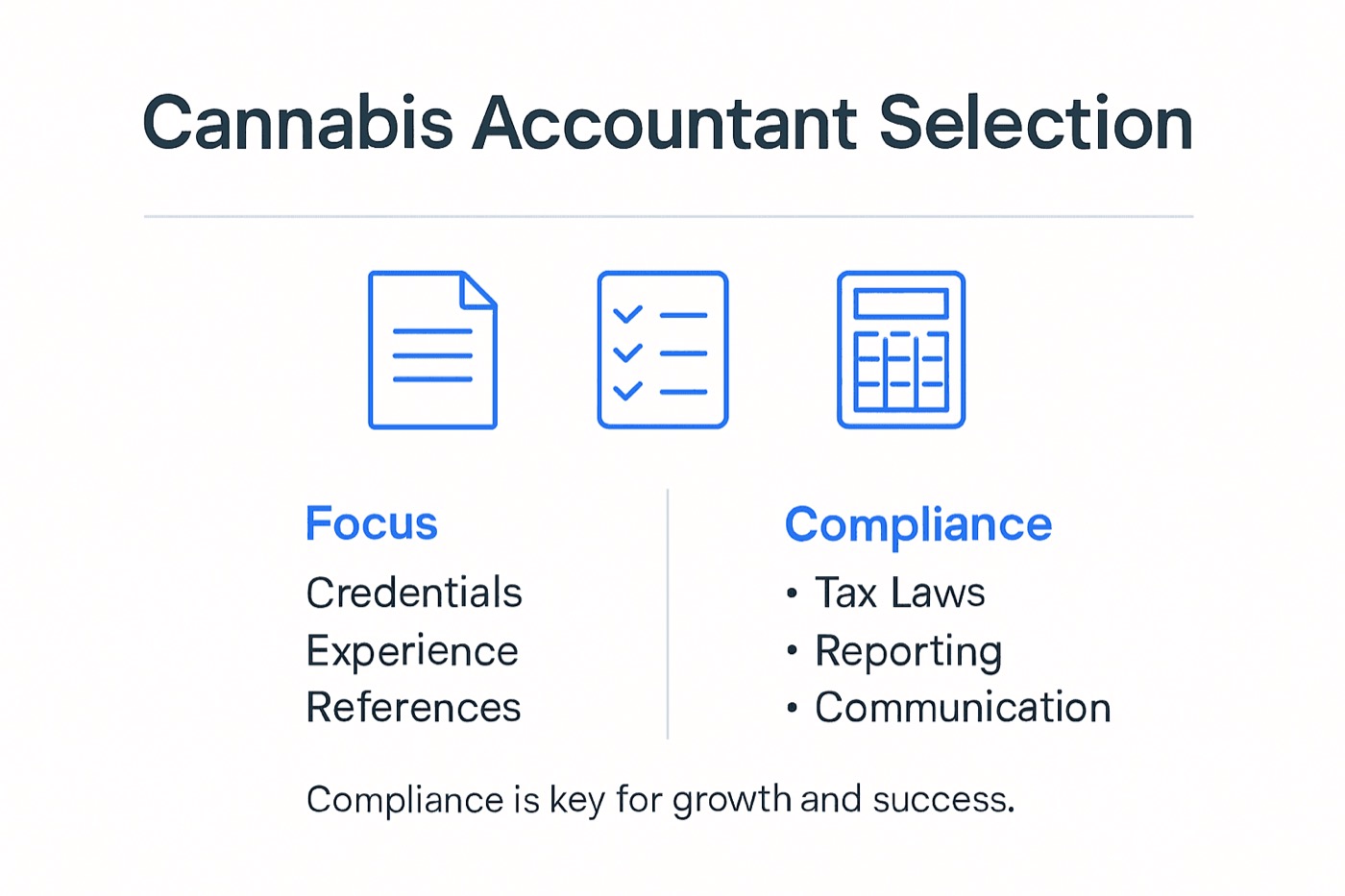
Conducting an in depth interview will help you gauge their practical experience. Ask specific questions about managing tax liabilities across different cannabis business models such as cultivation, manufacturing, and retail dispensaries. Inquire about their experience navigating state specific tax regulations, tracking inventory costs, and developing compliant accounting methodologies that minimize tax burdens while maintaining full regulatory adherence.
Pro tip: Request candidates provide detailed case studies demonstrating their successful tax strategy implementation for cannabis businesses operating in complex regulatory environments.
Step 4: Review communication and reporting practices
Selecting a cannabis accountant requires careful evaluation of their communication and reporting capabilities. Your goal is to ensure transparent and consistent information exchange that meets rigorous compliance standards.
Effective compliance reporting procedures are critical for cannabis businesses navigating complex regulatory environments. During your assessment, request sample reporting templates that demonstrate their ability to produce clear comprehensive documents. Examine their approach to communicating regulatory changes, financial risks, and detailed transaction documentation. A top tier cannabis accountant should provide structured reports that translate complex financial data into understandable insights for business leadership.
Inquire about their communication protocols with regulatory agencies. Skilled cannabis accountants must understand specific reporting requirements for different state jurisdictions. Ask how they track and communicate changes in tax regulations, maintain accurate inventory documentation, and ensure timely submissions to state cannabis control boards. Their reporting should showcase meticulous attention to detail and proactive compliance management across different operational segments of cannabis businesses.
Pro tip: Request a demonstration of their reporting workflow and communication strategy to verify their ability to maintain real time compliance documentation.
Step 5: Verify compliance and client references
Confirming an accountant’s regulatory compliance and professional track record is a critical step in selecting the right cannabis financial professional. Your goal is to validate their ability to navigate complex industry regulations and deliver consistent results.
Cannabis regulatory compliance verification requires a comprehensive approach to checking professional credentials and client references. Request a detailed list of cannabis businesses they have previously served, focusing on companies similar to your operational model. Contact these references directly to understand their experiences with the accountant’s compliance management, tax strategy implementation, and overall professional reliability. Pay special attention to how they handled challenging regulatory scenarios and maintained accurate financial documentation.
Dig deeper by examining their history of regulatory interactions. Ask for documentation demonstrating successful audits, clean compliance records, and proactive approaches to addressing potential financial reporting risks. Skilled cannabis accountants should be transparent about their professional history, willing to provide verifiable evidence of their expertise in navigating state and federal cannabis business regulations.
Pro tip: Request signed reference letters from previous cannabis business clients that specifically outline the accountant’s compliance performance and regulatory expertise.
Frequently Asked Questions
How do I define my cannabis accounting requirements?
Start by conducting an internal assessment of your cannabis business operations. Identify your specific business type—whether cultivator, dispensary, or manufacturer—and establish accounting frameworks to track revenue streams and expenses within 30 days.
What qualifications should I look for in a cannabis accountant?
Look for candidates with Certified Public Accountant (CPA) credentials and specific experience in cannabis sector tax regulations. Request their portfolio to verify past work with similar businesses and ensure their understanding of compliance requirements.
How can I assess a cannabis accountant’s knowledge of tax laws?
Evaluate their expertise by asking about federal and state tax regulations that affect cannabis businesses, especially Section 280E. Conduct in-depth interviews to discuss their practical experience managing tax liabilities across various cannabis models.
What should I consider regarding communication and reporting practices?
Ensure the accountant can provide clear and comprehensive documentation on compliance reporting. Request examples of report templates they use to communicate financial data and regulatory changes to verify they maintain transparency and detail.
How do I verify a cannabis accountant’s compliance track record?
Request a detailed list of previous cannabis clients and contact them for references. Look for evidence of successful audits and their ability to navigate regulatory challenges, ensuring the accountant has consistently met compliance standards.
Recommended
- Master the Cannabis Banking Workflow for Compliance Success – Cannabis Business Minds
- Cannabis Financial Reporting Guide for Full Compliance Success – Cannabis Business Minds
- Role of CPAs in U.S. Cannabis Compliance – Cannabis Business Minds
- Why Tax Compliance Matters: Complete Cannabis Guide – Cannabis Business Minds
This article is general education, not tax, legal or accounting advice. Cannabis rules change quickly; confirm how they apply to you with a qualified cannabis CPA or attorney.