How to Monitor Regulatory Changes in Cannabis: 2026
Monitoring regulatory changes in cannabis means continuously tracking specific agency subpages, applying AI-powered alerting tools, and triaging updates fast enough to implement compliant actions before deadlines hit. The industry’s compliance burden is not static. Minnesota’s 2026 Omnibus Cannabis Bill, DEA registration windows, and state-level emergency orders all demand a system that catches changes the moment they publish, not when a newsletter summarizes them a week later. Knowing how to monitor regulatory changes cannabis businesses face requires more than subscribing to a state register. It requires a layered, technical approach built around source mapping, automation, and a defensible audit trail.
How to monitor regulatory changes in cannabis: source mapping first
The first step is identifying every regulatory body with jurisdiction over your operation, then mapping the specific subpages that actually publish compliance-relevant content. Most regulatory changes affecting compliance happen on agency subpages, not in formal Federal Register entries. Guidance documents, enforcement action lists, FAQ updates, and emergency orders move faster than rulemaking and carry immediate operational weight.
Your source map should include:
- Federal bodies: DEA (registration and scheduling pages), FDA (hemp and cannabis product guidance), FinCEN (banking guidance updates)
- State licensing boards: Your state’s cannabis control board or department of revenue, specifically the enforcement, guidance, and FAQ subpages
- State administrative registers: For formal rulemaking, but treat these as secondary to agency subpages
- Local agencies: County health departments and municipal zoning boards in markets where local approval is required
Call this “regulatory dark matter.” Non-rule documents like agency FAQs, enforcement memos, and informal guidance letters affect your compliance posture the same day they publish. Waiting for formal rule codification means you are already behind.
Pro Tip: Build your source map as a living document in a shared spreadsheet. Assign each URL a criticality rating (high, medium, low) and a responsible owner. Review the map quarterly, because regulatory footprints expand as agencies add new subpages and enforcement portals.
What software tools best support cannabis regulation tracking?
Regulatory tracking software for cannabis compliance falls into three categories: general website change detection tools, AI-powered regulatory intelligence platforms, and seed-to-sale systems with built-in compliance modules. Each serves a different function and price point.

Visualping monitors specific URLs for content changes and sends alerts when a page updates. It works well for tracking state board enforcement pages and FAQ sections. Changeflow focuses on government website changes and is built specifically for regulatory monitoring workflows, including version comparison and alert routing. Specialized cannabis regulatory intelligence platforms automate risk scoring by synthesizing federal and state data, with automated risk scoring running at approximately $0.045 per tool call. That cost is negligible compared to a missed DEA deadline or a failed state audit.
| Tool | Best For | Alert Frequency | Audit Trail | Approx. Cost |
|---|---|---|---|---|
| Visualping | State board subpages, FAQ pages | Hourly to weekly | Basic change log | Free tier; paid from ~$10/mo |
| Changeflow | Government regulatory pages | Configurable | Version history | Paid plans available |
| Cannabis AI platforms | Federal + state risk scoring | Real-time | Full audit trail | Per-call pricing (~$0.045/call) |
| Seed-to-sale systems (e.g., Metrc integrations) | Inventory and license compliance | Event-driven | Integrated | Varies by state contract |
No single tool covers the full compliance monitoring stack. Visualping and Changeflow handle web-level change detection. AI platforms handle synthesis and risk classification. Seed-to-sale systems handle operational compliance at the transaction level. You need at least two layers running simultaneously.
Pro Tip: Never rely on a single tool’s alert as a final determination. Use automated flagging to surface changes, then assign a human reviewer to validate the operational impact before updating any SOP or filing.
How should you configure a monitoring schedule and triage system?
Alert frequency should match source criticality. Configuring monitoring cadences based on risk level prevents alert fatigue and keeps your team focused on what actually requires a response. A DEA registration page during an active rulemaking period warrants hourly checks. A low-traffic county zoning FAQ warrants weekly.
A practical cadence framework:
- Hourly: DEA scheduling pages, state cannabis board enforcement notices, active legislative session bill trackers
- Daily: State administrative registers, FDA cannabis guidance pages, FinCEN advisories
- Weekly: Local agency pages, industry association regulatory summaries, federal agency FAQ sections
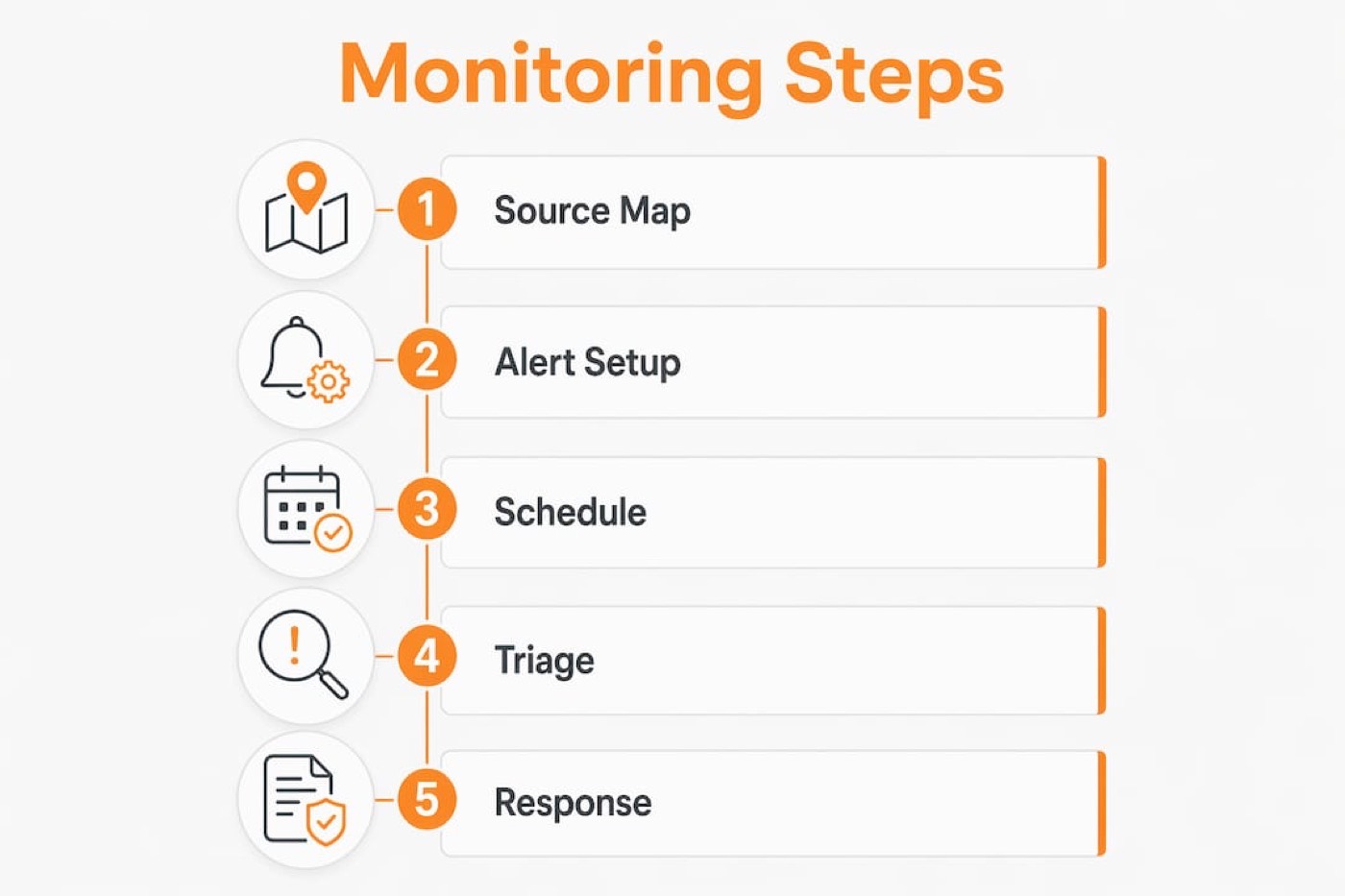
Once an alert fires, the triage system determines what happens next. A well-structured triage workflow rates each change by severity, assigns ownership, timestamps the detection, and documents the disposition decision. That documentation is your audit trail.
| Triage Step | Action | Owner | Timeframe |
|---|---|---|---|
| 1. Detect | Automated alert fires | System | Immediate |
| 2. Validate | Human reviewer confirms change is substantive | Compliance officer | Within 4 hours |
| 3. Rate severity | High / Medium / Low impact classification | Compliance officer | Same day |
| 4. Assign | Route to legal, operations, or finance | Compliance lead | Same day |
| 5. Document | Log change, rating, owner, and resolution | Compliance officer | Within 24 hours |
| 6. Archive | Add to 90-day audit trail | System + human | Ongoing |
Maintaining a 90-day audit trail is not optional if you face investor due diligence or an insurer inquiry. It demonstrates that your compliance function detected changes, assessed them, and acted. That paper trail is the difference between a defensible position and a liability exposure.
How to respond operationally once you identify a regulatory change
Detecting a change is step one. Implementing it is where most cannabis businesses fail. The operational response chain must connect your monitoring system directly to change control, SOP updates, staff training, and SKU-level decisions.
Here is a structured response sequence:
- Trigger a change control record. Every substantive regulatory change gets a formal change control entry in your compliance management system. No exceptions.
- Update affected SOPs within 72 hours. Identify which standard operating procedures reference the changed regulation and revise them before the change takes effect.
- Notify affected staff. Training is not optional when a rule changes how product is labeled, tested, or sold. Document the training date and attendees.
- Adjust SKU-level decisions. Product formulations, THC limits, and packaging requirements all tie to specific regulatory thresholds. A change in one state’s potency cap requires immediate review of your active product catalog for that market.
- Verify license and product approvals early. License approval bottlenecks cause operational paralysis when businesses wait until the deadline to confirm their filings were processed. Submit early and verify receipt.
- Monitor for state-federal interplay. States often create compliance bridges to maintain state-level compliance while federal rescheduling or registration changes work through the system. Track both layers simultaneously.
Minnesota’s 2026 Omnibus Cannabis Bill is a concrete example. The law mandates conversion of all medical cannabis combination businesses to a macrobusiness license by January 1, 2027. That deadline requires operational planning now: entity restructuring, license applications, and financial modeling for the new license tier. Businesses that detected this change in may 2026 have a workable runway. Those that catch it in november 2026 do not.
The DEA registration window for existing medical cannabis licensees is another example. The expedited registration deadline closed june 27, 2026, with approvals expected within six months. Missing that window meant waiting for a standard registration process with no guaranteed timeline.
Pro Tip: Build a compliance calendar that maps every known regulatory deadline for the next 12 months. Assign a 60-day and 30-day pre-deadline review task to each entry. Tie the calendar to your cannabis licensing workflow so operational milestones align with regulatory deadlines.
Why most cannabis compliance monitoring systems break down
The failure mode I see most often is not a technology gap. It is a source mapping gap. Teams set up Visualping on their state board’s homepage and call it done. The homepage almost never changes. The enforcement subpage, the FAQ section, and the emergency order portal change constantly. You are monitoring the wrong URL.
The second failure mode is treating automation as a final answer. AI-powered platforms are fast and useful for synthesizing compliance risk, but they do not know your specific license type, your product mix, or your operational constraints. A human reviewer who understands your business has to make the final call on every substantive change.
The third failure mode is ignoring subagency updates. State departments of agriculture, public health boards, and local tax authorities all publish guidance that affects cannabis operations. Most compliance teams track the cannabis control board and nothing else. That blind spot gets expensive.
The 90-day audit trail is the one thing I would not compromise on. When an investor asks whether you were compliant during a specific period, or when an insurer disputes a claim, your documented detection-to-resolution record is the only thing that answers the question. Build it from day one, not after the first inquiry.
The compliance baselines for 2026 have shifted materially from prior years. The businesses that stay ahead are the ones treating regulatory monitoring as a core operational function, not a quarterly checklist.
— JN
How Cannabisbusinessminds supports your compliance monitoring work
Cannabisbusinessminds covers the financial and operational side of cannabis compliance in depth, from licensing workflows to the cost accounting decisions that regulatory changes force on your business.

If a new state rule changes your product cost structure or triggers a license conversion, the financial modeling behind that decision matters as much as the legal response. Cannabisbusinessminds resources on compliance technology and vendor compliance review give you the operational framework to act on what your monitoring system detects. For the finance layer underneath every regulatory change, the cannabis accounting hub is where to start.
FAQ
What does monitoring regulatory changes in cannabis involve?
Monitoring regulatory changes in cannabis means tracking specific agency subpages, state administrative registers, and federal agency guidance pages using automated tools and manual validation. The goal is detecting changes before they take effect and implementing operational responses before deadlines hit.
Which tools are best for cannabis compliance monitoring?
Visualping and Changeflow handle web-level change detection for government and agency pages. AI-powered cannabis regulatory intelligence platforms add automated risk scoring at approximately $0.045 per tool call. Most operations need both layers running simultaneously.
How often should you check regulatory sources?
Alert frequency should match source criticality. High-risk pages like DEA scheduling and state enforcement portals warrant hourly monitoring. Daily checks cover state registers and FDA guidance. Weekly is sufficient for low-traffic local agency pages.
What is a compliance audit trail and why does it matter?
A compliance audit trail documents every regulatory change detected, its severity rating, the assigned owner, and the resolution. A 90-day trail is the standard for defending your compliance status during investor due diligence or insurer inquiries.
How do you respond to a cannabis regulatory change operationally?
Trigger a change control record, update affected SOPs within 72 hours, notify and train staff, and verify any license or product approvals early. Early license verification prevents the operational paralysis that hits businesses who wait until the deadline to confirm their filings were processed.
Recommended
- What Is Tax Compliance Monitoring for Cannabis Businesses – Cannabis Business Minds
- How to Review Vendor Compliance in Cannabis Operations – Cannabis Business Minds
- Cannabis compliance baselines: U.S. strategies for 2026 – Cannabis Business Minds
- What Is Cannabis Compliance: Impact on U.S. Businesses – Cannabis Business Minds
This article is general education, not tax, legal or accounting advice. Cannabis rules change quickly; confirm how they apply to you with a qualified cannabis CPA or attorney.