Role of CPAs in U.S. Cannabis Compliance

2026 update: what rescheduling changed for 280E (reviewed October 2026)
Effective April 22, 2026, a DOJ/DEA final order moved marijuana covered by a qualifying state medical license (and FDA-approved marijuana drugs) to Schedule III. Section 280E only applies to Schedule I and II substances, so state-licensed medical cannabis activity is generally no longer subject to 280E going forward. Adult-use cannabis remains in Schedule I and fully subject to 280E. The DEA proceeding to reschedule all marijuana was temporarily stayed in October 2026, and Treasury/IRS guidance on transition years and mixed medical/adult-use businesses is still pending.
This article was written before the order took effect. Check where your business stands in about a minute.
Most American cannabis businesses face tax rates up to 70 percent higher than other industries due to complex federal regulations like Section 280E. For accountants and financial advisors working in the cannabis sector, every decision carries extra scrutiny. This overview reveals the specialized role of Certified Public Accountants in cannabis, highlighting how expert guidance shapes compliance, risk management, and tax-saving strategies for dispensaries navigating the ever-shifting regulatory landscape.
Key Takeaways
| Point | Details |
|---|---|
| Role of Cannabis CPAs | Cannabis CPAs are vital in navigating complex regulations and ensuring compliance within the cannabis industry. They provide strategic guidance on tax liabilities and financial transparency. |
| Importance of IRC 280E | Understanding IRC 280E is crucial as it restricts the deduction of ordinary business expenses for cannabis companies, raising tax burdens significantly. |
| Skill Development | Cannabis CPAs need to cultivate a multifaceted skill set that includes legal, financial, and regulatory knowledge to effectively support cannabis businesses. |
| Risk Management | CPAs must employ robust documentation practices and audit strategies to mitigate regulatory risks and protect themselves and their clients in a complex legal environment. |
Defining the Role of CPAs in Cannabis
Cannabis-focused Certified Public Accountants (CPAs) play a critically strategic role in helping businesses navigate the complex regulatory landscape of the cannabis industry. These financial professionals serve as essential guides, translating complicated federal and state regulations into actionable compliance strategies. Specialized cannabis accounting practices demand an extraordinary level of expertise that goes far beyond traditional accounting methodologies.
The primary responsibilities of cannabis CPAs encompass several key dimensions. They must understand intricate tax codes like IRS Section 280E, which prohibits standard business deductions for cannabis enterprises. These professionals develop sophisticated accounting systems that meticulously document expenses, track financial transactions, and ensure precise reporting to minimize tax liabilities. Additionally, they provide strategic guidance on banking limitations, help clients maintain accurate records, and develop financial models that account for the unique challenges of operating in a federally restricted industry.
Moreover, cannabis CPAs serve as crucial risk management professionals. They assess potential legal and financial vulnerabilities, recommend compliance protocols, and help clients understand the nuanced regulatory environment. Their work involves continuous education about shifting legislative landscapes, proactively adapting financial strategies to meet evolving state and federal requirements. By maintaining rigorous documentation and implementing robust accounting practices, these professionals help cannabis businesses maintain financial transparency and legal legitimacy.
Pro tip: Develop a comprehensive understanding of IRC Section 280E and maintain meticulous, sector-specific accounting documentation to protect your cannabis business’s financial interests.
Core Skills Needed for Cannabis CPAs
Cannabis CPAs must develop a sophisticated and multifaceted skill set that goes beyond traditional accounting practices. Compliance specialists require comprehensive cross-disciplinary knowledge that encompasses intricate legal, financial, and regulatory domains. These professionals must be prepared to navigate the complex intersection of state and federal regulations while maintaining meticulous financial standards unique to the cannabis industry.
The core competencies for cannabis CPAs include advanced proficiency in several critical areas. Technical skills are paramount, with deep understanding of tax law, particularly IRS Section 280E, and expertise in developing robust financial reporting systems. Professionals must master complex compliance documentation, track intricate financial transactions, and create sophisticated accounting models that account for the industry’s unique regulatory challenges. Strong analytical capabilities help CPAs interpret nuanced legislative requirements and develop strategic financial approaches that minimize risk and maximize operational efficiency.
Beyond technical expertise, cannabis CPAs must cultivate exceptional interpersonal and communication skills. They serve as crucial intermediaries between cannabis businesses, regulatory agencies, and financial institutions. This requires the ability to translate complex regulatory language into actionable strategies, provide clear guidance to clients, and maintain exceptional attention to detail. Continuous professional education is also essential, as the cannabis regulatory landscape evolves rapidly, demanding ongoing learning and adaptability from these financial professionals.
Pro tip: Invest in specialized continuing education programs focused on cannabis regulations and develop a network of industry-specific legal and financial experts to stay ahead of emerging compliance requirements.
Understanding IRC 280E and IRC 471
IRC 280E represents a significant challenge for cannabis businesses, fundamentally restricting their ability to claim standard business deductions. This complex tax code prohibits businesses engaged in federally controlled substance trafficking from deducting ordinary business expenses, creating substantial tax burdens for cannabis enterprises. The regulation effectively treats cannabis businesses differently from other commercial operations, forcing them to pay taxes on gross income rather than net income after typical expense deductions.

The interaction between IRC 280E and IRC 471 provides a critical pathway for cannabis businesses to manage their tax liabilities. While 280E restricts most expense deductions, IRC 471 allows businesses to subtract the cost of goods sold (COGS) from their gross receipts. Inventory accounting becomes a sophisticated strategy where CPAs must meticulously document and allocate allowable expenses. Section 471© offers potential relief by permitting small cannabis businesses to use their existing financial statements for inventory accounting-and-sectio/), potentially mitigating some of the harsh tax consequences imposed by 280E.
Navigating these intricate tax regulations requires cannabis CPAs to develop advanced analytical skills and maintain exceptional documentation practices. They must understand the nuanced differences between expenses that can be included in COGS versus those explicitly disallowed under 280E. This involves careful tracking of direct production costs, such as materials and direct labor, while avoiding indirect expenses like marketing, distribution, and administrative overhead. CPAs must work closely with cannabis business owners to develop comprehensive accounting strategies that maximize allowable deductions while maintaining strict compliance with federal tax regulations.
Pro tip: Develop a comprehensive documentation system that clearly distinguishes between direct production costs and non-deductible expenses to optimize your cannabis business’s tax strategy under IRC 280E and 471.
Here’s a summary highlighting the differences between IRC Section 280E and IRC Section 471 for cannabis businesses:
| Tax Code | Main Function | Impact on Cannabis Businesses | Key CPA Strategy |
|---|---|---|---|
| IRC Section 280E | Disallows ordinary business deductions | Raises effective tax rate greatly | Develop tracking to separate non-deductible expenses |
| IRC Section 471 | Allows deduction of cost of goods sold (COGS) | Provides limited relief via inventory accounting | Optimize COGS allocation and documentation |
How CPAs Support Licensing and Formation
Cannabis entrepreneurs face a complex regulatory landscape that demands specialized expertise during business formation and licensing. CPAs play a critical role in guiding entrepreneurs through intricate state registration and entity structuring processes, helping them establish compliant and strategically sound business foundations. Their involvement goes far beyond traditional accounting, serving as strategic advisors who understand the nuanced regulatory environment unique to cannabis enterprises.
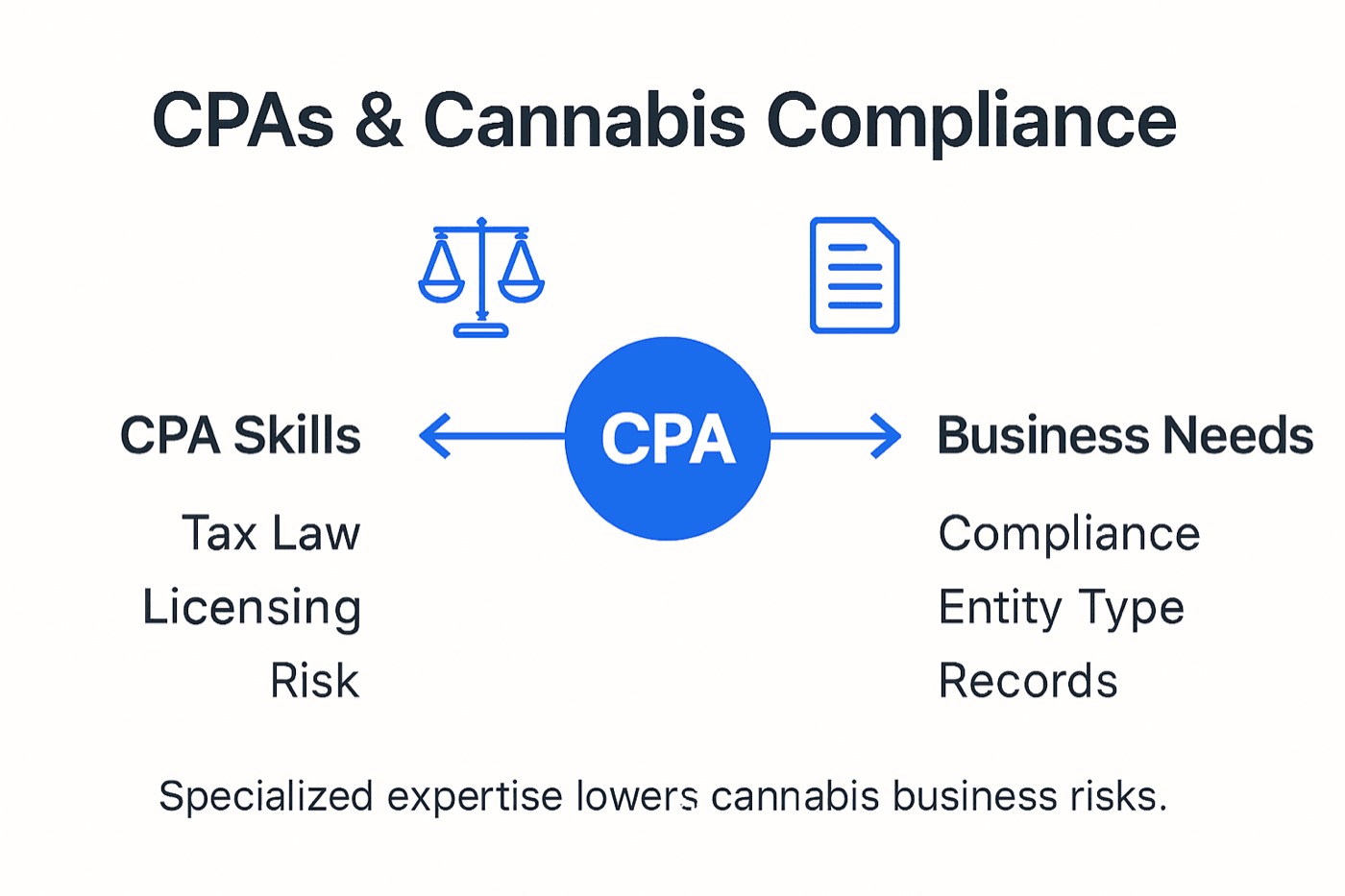
The licensing support provided by CPAs encompasses multiple critical dimensions. They assist clients in selecting appropriate business structures that minimize tax liability and maximize legal protection, such as recommending between LLC, corporation, or partnership formations based on specific state requirements. Business entity selection becomes a strategic decision involving careful analysis of tax implications, operational flexibility, and regulatory compliance. CPAs help clients navigate state-specific licensing requirements, prepare comprehensive documentation, and develop financial projections that demonstrate the business’s fiscal sustainability to regulatory authorities.
Moreover, CPAs serve as risk mitigation specialists during the cannabis business formation process. They help entrepreneurs anticipate potential compliance challenges by conducting thorough financial and regulatory assessments. This involves analyzing potential banking restrictions, understanding state-specific licensing limitations, and developing robust financial systems that can withstand intense regulatory scrutiny. Their expertise extends to creating comprehensive financial records, developing compliance protocols, and establishing accounting frameworks that align with both state and federal regulatory expectations.
Pro tip: Engage a cannabis-specialized CPA early in your business formation process to develop a comprehensive compliance strategy that addresses financial, regulatory, and licensing challenges.
This table compares common business entity types for cannabis companies from a CPA perspective:
| Entity Type | Tax Advantage | Regulatory Protection | CPA Consideration |
|---|---|---|---|
| LLC | Pass-through taxation, flexible structure | Moderate liability shield | Best for small, adaptive operations |
| Corporation (C-Corp) | Separate entity taxation, possible lower corporate tax | Strong liability protection | Suited for large or multi-state businesses |
| Partnership | Pass-through taxation, simple setup | Weak liability protection | Useful for joint ventures, careful CPA oversight needed |
Tax Strategy and Cost Accounting Challenges
Navigating complex tax structures and accounting regulations represents a critical challenge for cannabis CPAs, who must develop sophisticated strategies to manage the industry’s unique financial landscape. The federal prohibition of cannabis creates extraordinary accounting complexities that demand specialized expertise, particularly around tax reporting and expense allocation. Businesses in this sector face significantly higher tax burdens compared to traditional industries, making precise financial management essential for maintaining profitability.
The primary tax challenge stems from IRS Code Section 280E, which prohibits cannabis businesses from deducting most standard operating expenses. Cost of Goods Sold (COGS) becomes the primary mechanism for reducing taxable income, requiring CPAs to develop intricate accounting methodologies that meticulously document and allocate production-related expenses. This demands an unprecedented level of financial precision, where every expense must be carefully categorized to determine its potential deductibility. Cannabis CPAs must create comprehensive accounting systems that can withstand intense regulatory scrutiny while maximizing available tax strategies.
Furthermore, cannabis CPAs must continuously adapt to rapidly changing state and federal regulatory environments. Each state presents unique tax structures, licensing requirements, and reporting standards that necessitate a dynamic and flexible approach to financial management. This requires ongoing education, proactive compliance monitoring, and the ability to quickly adjust accounting practices in response to legislative changes. CPAs must develop robust tracking systems that can provide real-time financial insights while maintaining strict adherence to both state and federal regulations.
Pro tip: Implement a comprehensive expense tracking system that distinguishes between COGS and non-deductible expenses, and maintain meticulous documentation to support your tax strategy under Section 280E.
Risks, Liabilities, and Audit Preparation
CPAs operating in the cannabis industry face substantial professional risks that extend far beyond traditional accounting challenges. The complex legal environment created by conflicting state and federal cannabis regulations exposes accounting professionals to unprecedented liability risks. Unlike other industries, cannabis CPAs must navigate an extraordinarily nuanced landscape where federal prohibition intersects with state-level legalization, creating potential legal and professional vulnerabilities that require sophisticated risk management strategies.
The primary liability concerns for cannabis CPAs revolve around regulatory compliance and potential federal prosecution. Professional liability becomes a critical consideration, as accountants must develop robust documentation practices that can withstand intense regulatory scrutiny. This involves creating comprehensive audit trails, maintaining meticulous financial records, and implementing strict internal controls that demonstrate a commitment to compliance. CPAs must be prepared to defend their client’s financial practices while simultaneously protecting their own professional reputation and potential legal exposure.
Audit preparation in the cannabis industry demands an exceptional level of diligence and strategic planning. CPAs must develop comprehensive audit strategies that anticipate potential regulatory challenges, including detailed documentation of inventory tracking, expense allocation, and financial transactions. This requires developing sophisticated accounting systems that can provide transparent, verifiable financial information while navigating the unique restrictions imposed by IRS Section 280E. Successful audit preparation involves creating multiple layers of financial documentation, understanding the nuanced differences between allowable and non-allowable expenses, and maintaining a proactive approach to potential regulatory inquiries.
Pro tip: Create a comprehensive risk management protocol that includes detailed documentation, regular compliance reviews, and a clear understanding of both state and federal cannabis regulations.
Frequently Asked Questions
What is the role of CPAs in the cannabis industry?
CPAs in the cannabis industry help businesses navigate complex regulations, assist with tax compliance, and provide strategic financial guidance to ensure legal and operational integrity.
How does IRC Section 280E affect cannabis businesses?
IRC Section 280E prohibits cannabis businesses from deducting standard business expenses, significantly increasing their tax liabilities. CPAs help manage these challenges by optimizing allowable deductions through cost of goods sold (COGS) accounting.
What skills are essential for cannabis CPAs?
Cannabis CPAs need advanced knowledge of tax law, particularly regarding IRC Section 280E, strong analytical skills, and the ability to communicate complex regulatory information clearly to clients.
How can CPAs assist with cannabis licensing and business formation?
CPAs guide entrepreneurs through the licensing process, help select the appropriate business structure to minimize tax liability, and ensure compliance with state-specific regulations during business formation.
Recommended
- What Is Cannabis Compliance: Impact on U.S. Businesses – Cannabis Business Minds
- What Is Tax Compliance for Cannabis Businesses – Cannabis Business Minds
- Why Cannabis Tax Compliance Matters for U.S. Businesses – Cannabis Business Minds
- Why Tax Compliance Matters: Complete Cannabis Guide – Cannabis Business Minds
This article is general education, not tax, legal or accounting advice. Cannabis rules change quickly; confirm how they apply to you with a qualified cannabis CPA or attorney.