Cost Accounting Cannabis: Complete U.S. Industry Guide

2026 update: what rescheduling changed for 280E (reviewed October 2026)
Effective April 22, 2026, a DOJ/DEA final order moved marijuana covered by a qualifying state medical license (and FDA-approved marijuana drugs) to Schedule III. Section 280E only applies to Schedule I and II substances, so state-licensed medical cannabis activity is generally no longer subject to 280E going forward. Adult-use cannabis remains in Schedule I and fully subject to 280E. The DEA proceeding to reschedule all marijuana was temporarily stayed in October 2026, and Treasury/IRS guidance on transition years and mixed medical/adult-use businesses is still pending.
This article was written before the order took effect. Check where your business stands in about a minute.
Over 70 percent of cannabis businesses report facing major tax and accounting hurdles. These challenges often go beyond typical industries, as federal rules restrict which expenses can actually reduce taxable income. Accurate cost accounting is vital for cannabis operators who want to keep their doors open and stay compliant. Knowing which costs to track and how to align with strict tax laws can make the difference between long-term success and unexpected penalties.
Key Takeaways
| Point | Details |
|---|---|
| Cost Accounting Complexity | Cannabis businesses face unique accounting challenges due to federal regulations that limit expense deductions, necessitating meticulous tracking of COGS. |
| Key Accounting Methods | Employ absorption, standard, and direct costing methods to maximize deductions while ensuring compliance and accurate financial reporting. |
| Regulatory Awareness | A thorough understanding of Section 280E and IRC 471 is critical for managing costs and achieving tax optimization within legal frameworks. |
| Common Pitfalls | Avoid misclassifying expenses and failing to document costs effectively, as these mistakes can lead to significant financial risks and compliance issues. |
Defining Cost Accounting for Cannabis Businesses
Cost accounting for cannabis businesses represents a complex financial management strategy tailored specifically to the unique regulatory landscape of the cannabis industry. According to the IRS guidelines on Section 280E, these businesses face significant accounting challenges due to federal restrictions on deducting standard business expenses.
Cost accounting in this context focuses on meticulously tracking and calculating the Cost of Goods Sold (COGS), which remains the primary method for cannabis businesses to reduce their taxable income. This process involves carefully documenting all direct and indirect costs associated with producing and preparing cannabis products for sale, including:
- Cultivation expenses
- Direct labor costs
- Manufacturing overhead
- Packaging and processing materials
- Inventory management expenses
By implementing rigorous cost accounting practices, cannabis businesses can navigate the complex tax regulations affecting their industry. The goal is not just financial record-keeping, but strategic tax optimization within the strict federal guidelines that currently govern cannabis enterprise accounting.
Key Cost Accounting Methods in Cannabis
Cannabis businesses employ several specialized cost accounting methods to navigate the complex financial landscape created by federal tax restrictions. These methods focus on maximizing allowable deductions while maintaining precise financial documentation.
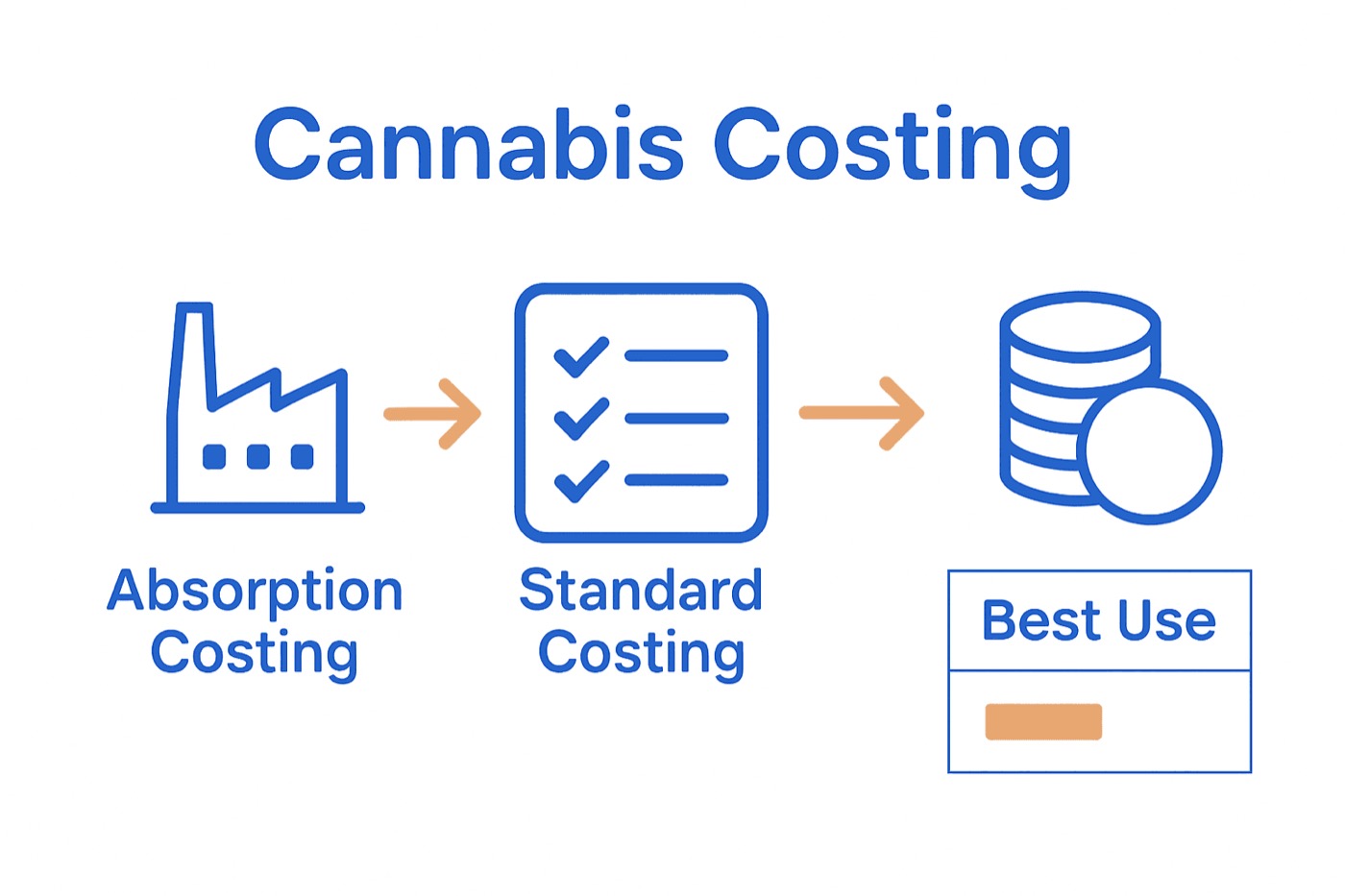
The primary cost accounting approaches include absorption costing, standard costing, and direct costing. Absorption costing provides the most comprehensive approach, capturing all production expenses including direct materials, direct labor, and both variable and fixed manufacturing overhead. This method becomes crucial in cannabis accounting because it helps businesses accurately calculate their Cost of Goods Sold (COGS) under IRC 471.
Standard costing allows businesses to establish predetermined cost benchmarks for production processes, helping cannabis companies:
- Identify cost variances
- Control manufacturing expenses
- Create more predictable financial forecasting
- Streamline inventory valuation
Finally, direct costing concentrates on variable expenses directly tied to product production, offering a streamlined approach for smaller cannabis operations seeking precise financial tracking. By carefully selecting and implementing these accounting methods, cannabis businesses can optimize their financial strategies while remaining compliant with complex regulatory requirements.
Here’s a comparison of key cost accounting methods used in cannabis businesses:
| Method | Main Focus | Key Benefits | Best For |
|---|---|---|---|
| Absorption Costing | All production costs | Accurate COGS Regulatory compliance |
Medium to large businesses |
| Standard Costing | Predetermined costs | Identifies variances Predictability |
Process improvement |
| Direct Costing | Variable direct costs only | Simplicity Precise tracking |
Small operations |
Section 280E, IRC 471, and Compliance Issues
Navigating the complex regulatory landscape of cannabis accounting requires a deep understanding of Section 280E and IRC 471, two critical federal tax provisions that dramatically impact financial operations for cannabis businesses. These regulations create unique compliance challenges that demand meticulous financial strategy and documentation.
Section 280E represents the most significant obstacle, explicitly prohibiting cannabis businesses from deducting standard operating expenses due to the federal classification of marijuana as a Schedule I controlled substance. This restriction means companies can only reduce their taxable income through carefully calculated Cost of Goods Sold (COGS), making precise accounting practices crucial for financial survival.
Under IRC 471, cannabis businesses must develop sophisticated inventory valuation methods that comply with strict federal guidelines. Key compliance requirements include:
- Detailed tracking of direct production costs
- Comprehensive documentation of manufacturing expenses
- Precise inventory management protocols
- Systematic allocation of overhead expenses
Successful navigation of these regulatory challenges demands a proactive approach, combining expert tax planning, rigorous record-keeping, and a deep understanding of the unique financial constraints facing the cannabis industry. Businesses that master these complex requirements can minimize tax liabilities while maintaining full legal compliance.
Tax Implications and Financial Management
Tax implications in the cannabis industry represent a minefield of complex regulatory challenges that demand sophisticated financial management strategies. According to legal analysis, cannabis businesses must navigate an intricate landscape where traditional accounting approaches fall short of federal requirements.
The most critical tax consideration stems from IRS consent requirements for accounting method changes. As highlighted by legal experts, businesses must secure explicit approval for any modifications to their financial reporting, which means maintaining meticulous documentation becomes paramount. Cannabis accounting practices must be designed with extreme precision to withstand potential IRS scrutiny.
Key financial management strategies for cannabis businesses include:
- Comprehensive documentation of all financial transactions
- Rigorous tracking of Cost of Goods Sold (COGS)
- Strategic allocation of allowable expenses
- Proactive tax planning to minimize potential liabilities
Successful financial management in the cannabis sector requires a proactive approach that anticipates regulatory challenges. Businesses must develop robust accounting systems that not only ensure compliance but also provide strategic insights into financial performance, transforming tax complexity into a competitive advantage.
Common Pitfalls in Cannabis Cost Accounting
Cannabis cost accounting presents a minefield of potential financial risks that can devastate unprepared businesses. The unique regulatory environment creates complex challenges that demand extraordinary attention to detail and sophisticated financial management strategies.
One of the most significant pitfalls involves misclassifying expenses. Cannabis businesses frequently struggle with properly allocating costs between Cost of Goods Sold (COGS) and non-deductible operational expenses. Dispensary accounting requires meticulous precision to navigate the strict IRS guidelines that govern financial reporting in this industry.
Key common pitfalls include:
- Inadequate documentation of inventory costs
- Failing to separate direct and indirect expenses
- Overlooking state-specific accounting regulations
- Inconsistent inventory valuation methods
- Incomplete tracking of production-related expenses
Successful cannabis cost accounting demands a proactive approach that anticipates regulatory scrutiny. Businesses must develop robust financial systems that not only ensure compliance but also provide strategic insights, transforming potential accounting challenges into opportunities for financial optimization and risk management.
Frequently Asked Questions
What is cost accounting in the cannabis industry?
Cost accounting in the cannabis industry refers to the financial management strategy that involves tracking and calculating the costs associated with producing and selling cannabis products. This includes direct and indirect costs like cultivation, labor, and overhead, focusing mainly on the Cost of Goods Sold (COGS) for tax optimization.
How does Section 280E impact cannabis businesses?
Section 280E prohibits cannabis businesses from deducting standard business expenses from their taxable income due to the federal classification of marijuana as a Schedule I controlled substance. This means that cannabis companies can only reduce their taxable income through COGS, necessitating precise accounting practices.
What are the primary cost accounting methods used in cannabis businesses?
The primary cost accounting methods used in cannabis businesses include absorption costing, standard costing, and direct costing. Absorption costing captures all production costs, while standard costing establishes cost benchmarks, and direct costing focuses on variable expenses, all crucial for compliance and financial strategy.
What common pitfalls should cannabis businesses avoid in cost accounting?
Common pitfalls in cannabis cost accounting include misclassifying expenses, inadequate documentation of inventory costs, failing to separate direct and indirect expenses, and inconsistent inventory valuation methods. Avoiding these pitfalls is essential for maintaining compliance and optimizing financial performance.
Recommended
This article is general education, not tax, legal or accounting advice. Cannabis rules change quickly; confirm how they apply to you with a qualified cannabis CPA or attorney.