Cannabis Due Diligence: Safeguarding Compliance and Value

2026 update: what rescheduling changed for 280E (reviewed October 2026)
Effective April 22, 2026, a DOJ/DEA final order moved marijuana covered by a qualifying state medical license (and FDA-approved marijuana drugs) to Schedule III. Section 280E only applies to Schedule I and II substances, so state-licensed medical cannabis activity is generally no longer subject to 280E going forward. Adult-use cannabis remains in Schedule I and fully subject to 280E. The DEA proceeding to reschedule all marijuana was temporarily stayed in October 2026, and Treasury/IRS guidance on transition years and mixed medical/adult-use businesses is still pending.
This article was written before the order took effect. Check where your business stands in about a minute.
Most American cannabis transactions face a level of scrutiny that far exceeds traditional business deals. For finance professionals and accountants, the ever-evolving mix of state and federal regulations demands deeper knowledge than in any other sector. With over 70 percent of cannabis businesses identifying regulatory compliance as their top risk, gaining authoritative insight into advanced due diligence practices can dramatically improve compliance, reduce tax exposure, and elevate the quality of risk assessment in this demanding industry.
Key Takeaways
| Point | Details |
|---|---|
| Cannabis Due Diligence is Essential | A specialized approach is required to assess risks and compliance in cannabis transactions amid complex regulations. |
| Types of Due Diligence are Critical | Legal, financial, operational, and market analyses are necessary to uncover potential risks and ensure robust evaluations. |
| Risk Management is Vital | Identifying red flags, such as inconsistent financial reporting, can prevent legal and financial troubles. |
| Best Practices Enhance Compliance | Establishing thorough internal frameworks and regular audits can help businesses navigate regulatory requirements effectively. |
Defining Cannabis Due Diligence and Its Importance
Cannabis due diligence represents a specialized investigative process designed to assess the unique risks and compliance requirements inherent in cannabis industry transactions. Unlike traditional business evaluations, cannabis due diligence demands a tailored approach that accounts for the complex regulatory landscape of state and federal cannabis regulations.
The core objective of cannabis due diligence is comprehensive risk assessment, focusing on factors specific to cannabis businesses. This includes analyzing regulatory compliance, verifying licensing status, examining operational practices, assessing financial documentation, and understanding potential legal vulnerabilities. Professionals conducting these investigations must navigate intricate legal frameworks that vary significantly across different jurisdictions, making deep specialized knowledge critical.
Key components of effective cannabis due diligence encompass multiple strategic dimensions. Financial review involves scrutinizing tax records, especially considering Section 280E implications. Regulatory compliance requires validating state-level licensing, understanding local cannabis operation restrictions, and ensuring all business practices align with current legal standards. Operational due diligence examines supply chain integrity, quality control processes, and potential risks associated with cultivation, processing, and distribution.
Pro tip: Engage cannabis-specialized legal and financial professionals who understand the nuanced regulatory environment and can conduct comprehensive, jurisdiction-specific due diligence assessments.
Types of Due Diligence in Cannabis Businesses
In the complex cannabis industry, due diligence encompasses several critical investigative domains that help businesses and investors thoroughly evaluate potential risks and opportunities. Cannabis store acquisitions require comprehensive due diligence across multiple strategic categories, ensuring a holistic understanding of the business’s operational landscape.
The primary types of due diligence in cannabis businesses include legal and regulatory compliance, financial assessment, operational review, and market analysis. Legal due diligence focuses on verifying licensing status, examining potential regulatory violations, and assessing compliance with state and federal cannabis regulations. Financial due diligence involves deep scrutiny of tax records, revenue streams, expense structures, and potential financial liabilities, with special attention to Section 280E tax implications unique to cannabis enterprises.
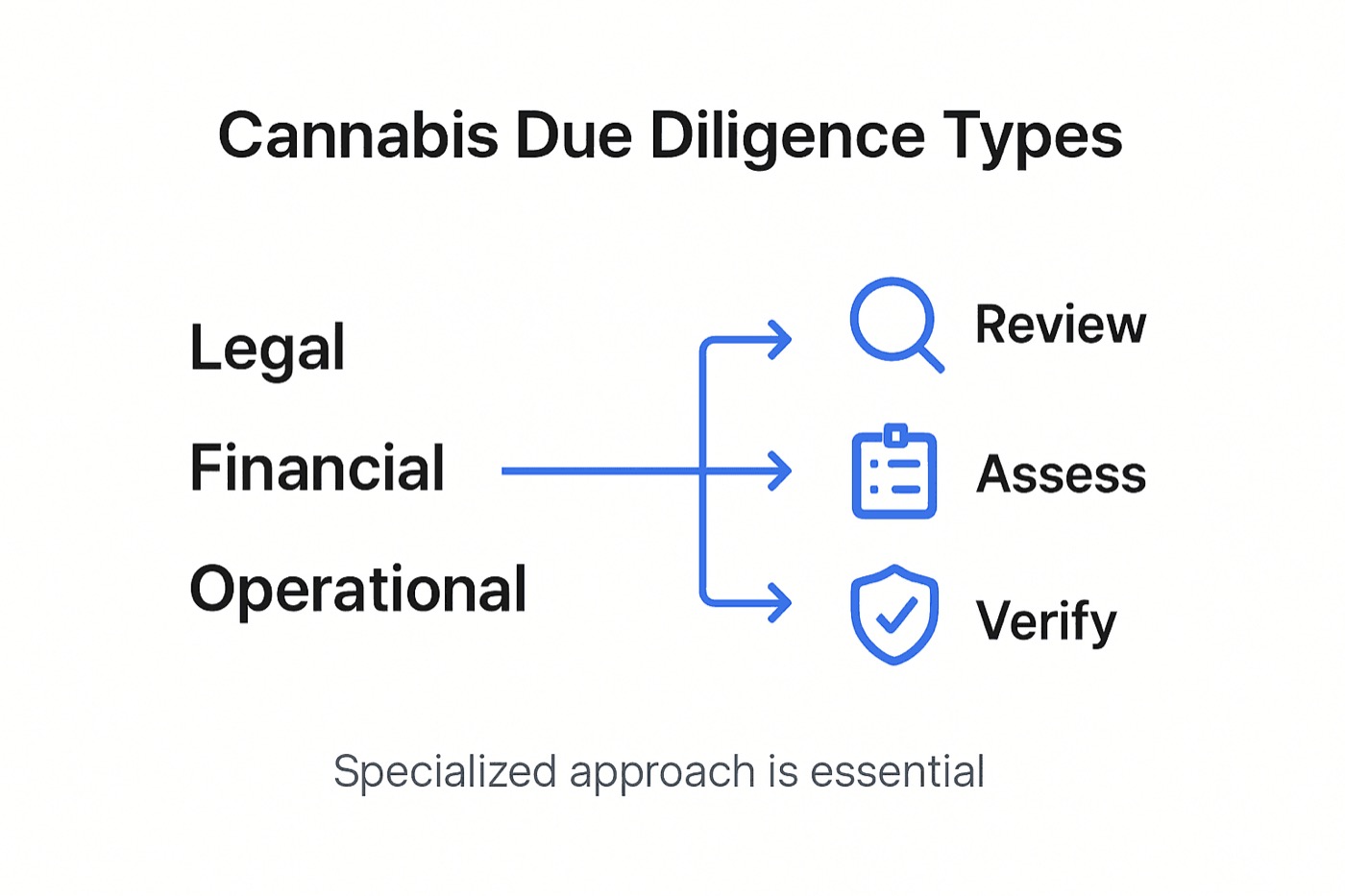
Operational due diligence evaluates the entire business ecosystem, including supply chain integrity, quality control processes, cultivation and distribution methodologies, and vendor relationship dynamics. This assessment helps identify potential operational risks, inefficiencies, and opportunities for optimization. Market analysis due diligence provides insights into competitive positioning, local market conditions, demographic trends, and potential growth trajectories, enabling investors and business leaders to make informed strategic decisions.
Pro tip: Develop a standardized, comprehensive due diligence checklist specific to cannabis businesses that covers regulatory, financial, operational, and market dimensions to ensure consistent and thorough evaluation.
Here’s how the main types of cannabis due diligence compare across their purpose and critical focus:
| Due Diligence Type | Primary Focus | Key Activities |
|---|---|---|
| Legal & Regulatory | License and law compliance | Verify licenses, spot violations |
| Financial | Financial health and taxation | Review tax records, assess cash flow |
| Operational | Supply chain and processes | Audit inventory, check procedures |
| Market Analysis | Market position and growth | Study trends, analyze competitors |
Critical Legal and Regulatory Frameworks
The complex legal landscape of cannabis regulation presents significant challenges for businesses operating in this emerging industry. The fundamental tension between federal and state cannabis laws creates a multifaceted regulatory environment that demands sophisticated legal understanding and strategic compliance planning.

Federal regulations remain the primary source of legal complexity, with cannabis classified as a Schedule I controlled substance under the Controlled Substances Act. This federal designation creates substantial operational barriers, despite progressive state-level legalization efforts. State regulations introduce additional layers of complexity, with each jurisdiction establishing unique licensing requirements, operational standards, and enforcement mechanisms that businesses must carefully navigate.
Key regulatory frameworks encompass multiple critical dimensions, including licensing protocols, product testing standards, tax reporting requirements, and operational restrictions. Businesses must develop comprehensive compliance strategies that address federal restrictions while simultaneously adhering to state and local regulatory mandates. The evolving legal landscape requires continuous monitoring of legislative developments, with particular attention to potential changes in federal enforcement policies, definitions of legal cannabis categories, and the scope of state-level reforms.
Pro tip: Maintain a dedicated legal compliance team or external counsel specializing in cannabis regulations to ensure ongoing adaptation to the dynamic legislative environment.
Financial, Tax, and Operational Assessment Steps
Financial and tax due diligence in cannabis businesses requires a comprehensive and specialized approach that addresses the unique challenges of this highly regulated industry. Cannabis enterprises must navigate complex financial landscapes characterized by federal restrictions and state-level variations in legal frameworks.
The core financial assessment process involves multiple critical components. First, businesses must conduct an exhaustive review of tax documentation, with particular emphasis on compliance with IRS Section 280E, which significantly restricts tax deductions for cannabis-related enterprises. This includes analyzing expense categorization, verifying accounting methodologies, and ensuring precise financial reporting that minimizes potential federal tax liabilities. Operational assessments should simultaneously examine cash management protocols, inventory tracking systems, and internal financial control mechanisms.
Tax compliance represents a particularly nuanced dimension of cannabis financial due diligence. Businesses must develop sophisticated strategies for documenting expenses, maintaining meticulous records, and demonstrating clear separation between different business activities. This requires engaging financial professionals with specialized expertise in cannabis accounting, who understand the intricate regulatory environment and can provide strategic guidance on minimizing tax exposure while maintaining full legal compliance.
Pro tip: Invest in a certified public accountant with specific cannabis industry experience to navigate the complex tax and financial reporting requirements unique to this sector.
Risks, Liabilities, and Common Red Flags
Cannabis industry due diligence requires comprehensive risk identification that goes far beyond traditional business assessments. The complex regulatory environment creates unique vulnerabilities that demand meticulous scrutiny and sophisticated risk management strategies.
Key risk categories include regulatory compliance, financial integrity, operational transparency, and legal exposure. Regulatory risks emerge from the significant discrepancies between federal and state cannabis laws, potentially exposing businesses to unexpected legal challenges. Financial risks involve complex tax implications, banking restrictions, and the potential for unexpected audits or regulatory interventions. Operational risks encompass licensing complications, supply chain disruptions, and potential violations of state-specific cannabis regulations.
Critical red flags that demand immediate investigation include inconsistent financial reporting, unexplained ownership changes, incomplete licensing documentation, suspicious cash flow patterns, and potential anti-money laundering (AML) compliance gaps. Investors and due diligence professionals must carefully examine ownership structures, verify all regulatory credentials, and conduct thorough background checks on key personnel to identify potential systemic risks that could compromise business viability.
This table summarizes frequent cannabis industry red flags and their potential business impact:
| Red Flag Indicator | Possible Consequence | Recommended Response |
|---|---|---|
| Inconsistent financial reports | Loss of investor trust | Immediate audit and review |
| Unexplained ownership changes | Regulatory investigation risk | Deep background checks |
| Incomplete licensing records | Fines and business disruption | Verify and update documentation |
| Suspicious cash flow patterns | Anti-money laundering scrutiny | Implement stricter controls |
Pro tip: Develop a comprehensive risk assessment matrix specifically tailored to cannabis businesses, incorporating federal, state, and local regulatory considerations to proactively identify and mitigate potential compliance vulnerabilities.
Best Practices for Ensuring Thorough Compliance
Cannabis compliance demands a structured and proactive approach to due diligence that goes beyond traditional regulatory oversight. Successful cannabis businesses must develop comprehensive strategies that anticipate and address potential regulatory challenges across multiple operational dimensions.
Key best practices involve establishing robust internal compliance frameworks that integrate continuous monitoring and adaptive risk management. This includes developing detailed standard operating procedures (SOPs) that explicitly address federal and state regulatory requirements, maintaining meticulous documentation of all business activities, and implementing ongoing staff training programs focused on regulatory compliance. Businesses should create comprehensive compliance checklists that cover licensing, reporting, product tracking, financial documentation, and operational standards.
Technological integration plays a critical role in ensuring thorough compliance. Advanced compliance management systems can help cannabis businesses track regulatory changes, monitor licensing requirements, manage documentation, and generate real-time compliance reports. These systems should provide capabilities for tracking inventory, managing financial transactions, documenting product sourcing, and maintaining audit trails that can withstand regulatory scrutiny.
Pro tip: Implement a quarterly compliance audit process that systematically reviews all operational, financial, and regulatory documentation to proactively identify and address potential compliance gaps before they become significant issues.
Frequently Asked Questions
What is cannabis due diligence?
Cannabis due diligence is a specialized investigative process that assesses the unique risks and compliance requirements within cannabis industry transactions, focusing on regulatory compliance, licensing status, operational practices, and financial documentation.
Why is cannabis due diligence essential for investors?
Cannabis due diligence is crucial for investors as it helps identify potential risks, ensures compliance with regulations, and facilitates informed decision-making by providing a comprehensive evaluation of a cannabis business’s operational landscape.
What are the primary types of due diligence in cannabis businesses?
The primary types of due diligence in cannabis businesses include legal and regulatory compliance, financial assessments, operational reviews, and market analysis. Each type addresses specific aspects such as licensing, financial health, operational efficiency, and market positioning.
How can businesses ensure thorough compliance in the cannabis industry?
Businesses can ensure thorough compliance by establishing robust internal frameworks, developing standard operating procedures, maintaining meticulous documentation, and utilizing technology for compliance management, along with conducting regular audits to identify potential gaps.
Recommended
- What Is Cannabis Compliance: Impact on U.S. Businesses – Cannabis Business Minds
- Master the Cannabis Banking Workflow for Compliance Success – Cannabis Business Minds
- Cannabis Audit Trail Explained: Compliance Essentials – Cannabis Business Minds
- 7 Essential Cannabis Dispensary Compliance Tips for Success – Cannabis Business Minds
This article is general education, not tax, legal or accounting advice. Cannabis rules change quickly; confirm how they apply to you with a qualified cannabis CPA or attorney.