The Role of External Audits in Cannabis Compliance
2026 update: what rescheduling changed for 280E (reviewed October 2026)
Effective April 22, 2026, a DOJ/DEA final order moved marijuana covered by a qualifying state medical license (and FDA-approved marijuana drugs) to Schedule III. Section 280E only applies to Schedule I and II substances, so state-licensed medical cannabis activity is generally no longer subject to 280E going forward. Adult-use cannabis remains in Schedule I and fully subject to 280E. The DEA proceeding to reschedule all marijuana was temporarily stayed in October 2026, and Treasury/IRS guidance on transition years and mixed medical/adult-use businesses is still pending.
Check where your business stands in about a minute.
Most cannabis operators treat audits as something that happens to them, not something they control. That framing is exactly the problem. The role of external audits in cannabis goes well beyond checking a regulatory box. Third-party audits are underused across the industry despite delivering compliance validation, investor credibility, and operational intelligence that internal reviews simply cannot replicate. Understanding the difference, and building toward audit readiness, is now a baseline expectation for any cannabis business that intends to scale, attract capital, or survive tightening federal scrutiny.
Table of Contents
- The role of external audits in cannabis: scope and standards
- Internal vs. external audits: distinct roles, not substitutes
- Key benefits beyond regulatory compliance
- How to prepare for and leverage external audits
- My take on where the industry is getting this wrong
- Strengthen your audit readiness with Cannabisbusinessminds
- FAQ
The role of external audits in cannabis: scope and standards
External audits are independent examinations conducted by qualified parties outside your organization. In cannabis, that means CPA firms, PCAOB-registered auditors, accredited laboratories, or specialized compliance consultants depending on what is being audited.
The scope breaks into four distinct types:
- Financial audits: CPA firms examine financial statements for material misstatements, assess internal controls, and issue opinions under GAAS or PCAOB standards. Public cannabis companies are required to engage PCAOB-registered auditors for their consolidated financial filings, and SEC scrutiny of cannabis issuers continues to increase.
- Compliance audits: State cannabis commissions examine licensee adherence to operating requirements, tracking mandates, employee documentation, and facility standards. These are not optional and failure carries license-level consequences.
- Potency and laboratory audits: States like Massachusetts require licensed cannabis operators to submit products for independent potency testing. Products outside the acceptable range get pulled from retail shelves, as the Massachusetts Cannabis Control Commission enforces a tolerance band of 75% to 125% of labeled THC content.
- IT and SOC 2 audits: SOC 2 engagements are independent CPA examinations of a cannabis operator’s internal controls evaluated against AICPA trust service criteria. Security is mandatory; availability, confidentiality, processing integrity, and privacy are scoped based on business needs.
Here is a quick reference of the audit types, the standard applied, and who conducts each:
| Audit type | Applicable standard | Conducted by |
|---|---|---|
| Financial statement audit | GAAS / PCAOB | Licensed CPA firm |
| State compliance audit | State cannabis commission rules | Regulatory agency or approved third party |
| Potency / laboratory audit | State testing program requirements | State-licensed independent lab |
| SOC 2 (IT controls) | AICPA SSAE 18 / Trust Service Criteria | CPA firm with SSAE competency |
The regulatory context is not uniform across states, but the directional trend is consistent. More states are mandating or incentivizing independent third-party review as cannabis markets mature and regulators face pressure to demonstrate consumer protection.
Internal vs. external audits: distinct roles, not substitutes
This is where most operators get it wrong. Internal audits and external audits serve different functions. Treating them as interchangeable creates real compliance exposure.
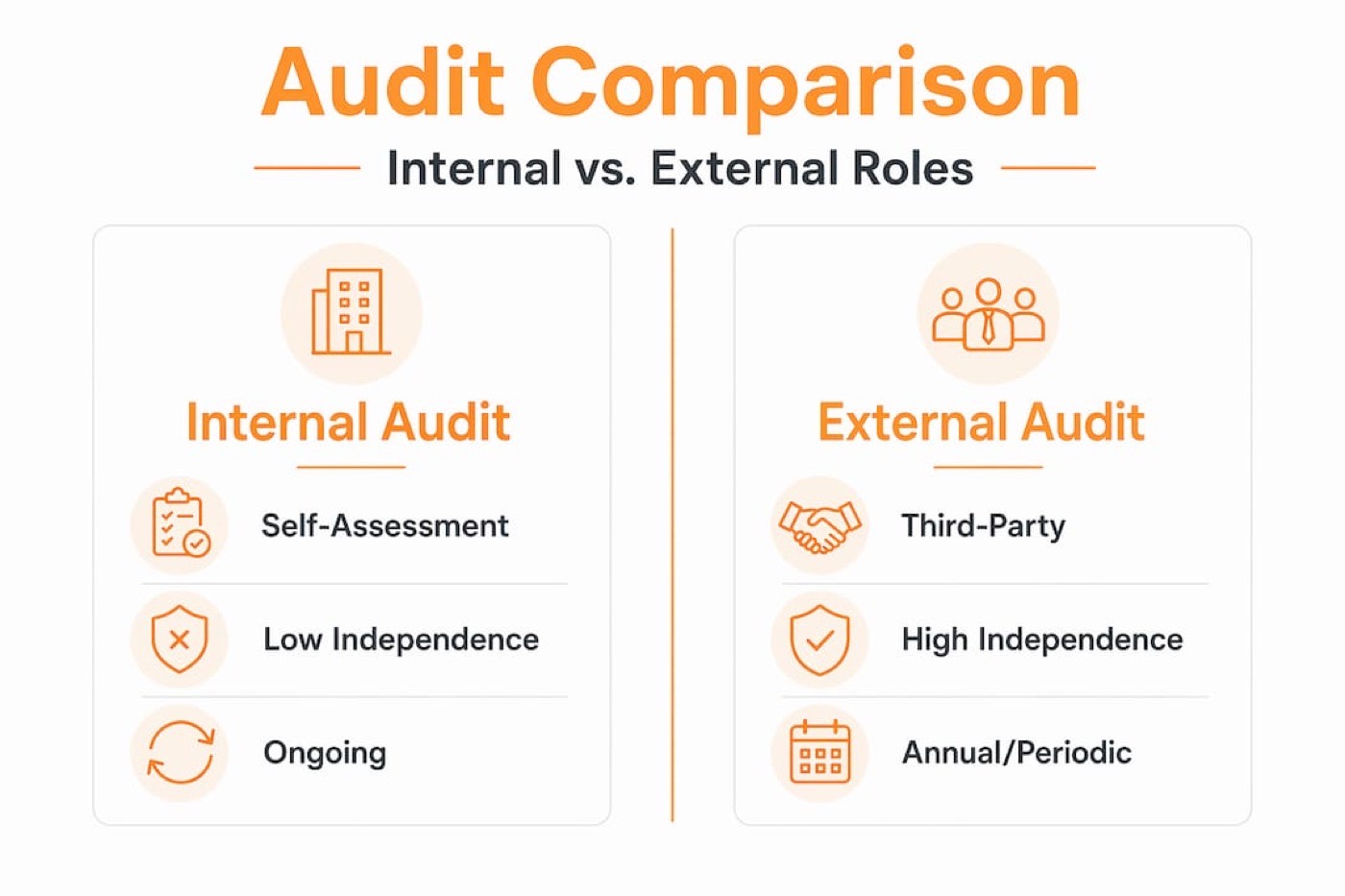
Internal audits are self-assessments. Your compliance team, internal controller, or operations staff run process checks against your own documented procedures. They are valuable for daily operational accountability: tracking log reconciliation, cash handling procedures, employee badging records. Done well, they catch drift before it becomes a pattern.
External audits bring something your internal team cannot provide. Objectivity. A qualified third party has no incentive to minimize findings, no familiarity bias, and typically has exposure to compliance patterns across dozens of cannabis businesses. Third-party auditors uncover issues early, enabling corrective action before regulators identify the same gaps through enforcement.

| Feature | Internal audit | External audit |
|---|---|---|
| Independence | Low (self-assessment) | High (third-party) |
| Regulatory credibility | Limited | Recognized by regulators and investors |
| Breadth of benchmarking | Limited to own operations | Cross-industry comparison |
| Depth of control testing | Operational focus | Controls, financials, IT, and compliance |
| Frequency | Ongoing / continuous | Periodic (annual or event-driven) |
| Cost | Lower | Higher, but offset by risk reduction |
The misconception operators carry is that a strong internal program eliminates the need for external review. It does not. Internal audits build the evidence base. External audits validate whether that evidence holds up to independent scrutiny.
Pro Tip: Before scheduling an external audit, run a gap analysis against the external auditor’s expected evidence requirements. The delta between what you have and what they will test is your remediation list.
Key benefits beyond regulatory compliance
The compliance angle is obvious. The non-obvious benefits are where most operators leave value on the table.
Investor and lender credibility is the first one worth naming directly. Institutional capital moving into cannabis expects audited financials. An unaudited financial statement from a cannabis company is not a baseline; it is a red flag. External audit opinions signal that financial controls are tested and that management representations have been independently challenged.
Early identification of compliance gaps is the benefit that directly reduces cost. Third-party audits provide unbiased evaluation with cross-industry benchmarking, and they surface control deficiencies before a regulator writes a notice of violation. The cost difference between self-remediation and regulator-mandated remediation is not marginal. It is often the difference between a corrective action plan and a license suspension hearing.
Product integrity and consumer trust are direct outputs of potency and quality audits. If your products consistently pass independent testing within the regulatory potency tolerance range, that is documentable evidence of quality control. That documentation matters during regulatory inspections and to dispensary buyers evaluating vendor reliability.
Federal rescheduling readiness is the forward-looking benefit. Cannabis businesses that have maintained continuous independent audit trails are better positioned when federal oversight frameworks change. Demonstrating historical compliance rigor is easier when that history is documented through audited records.
“The auditors don’t accept tool claims. Evidence means logs and boundary definitions, not vendor documentation.” This principle, drawn directly from SOC 2 cannabis IT audit standards, applies across all audit types. Evidence quality is what audits test, and self-reported controls are not evidence.
The role of audits in cannabis also extends to insurance positioning. Carriers writing cannabis policies increasingly require audit documentation as part of underwriting. A clean external audit record affects premiums and coverage terms.
How to prepare for and leverage external audits
Audit readiness is not a sprint you run before the auditor shows up. It is a continuous operational posture. Here is how to build it.
-
Establish reconciled evidence packages from day one. Auditable evidence packages must reconcile seed-to-sale data, operational records, and financial entries into a coherent picture. A cannabis business that executes compliantly but cannot produce reconciled documentation will fail an audit on evidence grounds alone.
-
Select the right CPA firm. Not every licensed CPA has cannabis-specific experience. You need a firm that understands METRC or your state’s seed-to-sale platform, has handled Section 280E positions, and knows the regulatory structure in your jurisdiction. For public companies, PCAOB registration is non-negotiable.
-
Run a pre-audit readiness assessment. Before engaging an external auditor formally, conduct an internal readiness check against the expected audit scope. For IT controls audits, identifying and remediating control deficiencies before the external review begins is the single most effective way to improve audit outcomes.
-
Build and maintain your control log infrastructure. For SOC 2 engagements, auditors require detailed control logs, access reviews, and boundary mappings specific to your technology stack. Generic vendor compliance reports are not audit evidence. Your own operational logs are.
-
Use audit findings to build corrective action plans. An audit finding is not a failure state. It is a documented gap with a documented remediation path. Cannabis operators who treat findings as operational intelligence rather than regulatory shame are the ones who improve year over year.
-
Leverage SOC 2 reports strategically. A completed SOC 2 Type II report is a market-facing document. It signals to investors, insurers, and regulators that your technology controls have been independently tested over time. In a capital-constrained sector, that signal carries weight.
Pro Tip: Your cannabis audit trail is only as strong as the weakest link in your system integrations. If your POS, METRC, and accounting software do not reconcile cleanly, fix that before scheduling any external review.
My take on where the industry is getting this wrong
I have worked through cannabis audits where the operator genuinely believed their internal compliance program was audit-proof. In most of those cases, the external auditor found material gaps within the first two days. Not because the team was incompetent. Because internal familiarity creates blind spots that an outside reviewer does not share.
What I have seen succeed consistently is the mindset shift from “passing an audit” to “being auditable.” Those are different things. Passing an audit is a point-in-time event. Being auditable is a continuous operational state where records are reconciled, controls are documented, and gaps are identified by the business before anyone external identifies them for you.
The expanding regulatory environment is not going to create less audit pressure. States are adding testing requirements. Federal rescheduling discussions are increasing the expectation of financial statement quality. Public cannabis companies are under SEC and PCAOB scrutiny in ways that private operators will eventually face too as the market consolidates.
The cannabis businesses I have seen struggle most with external audits are the ones that treated audit readiness as a finance department problem. It is not. It is an operational posture that finance coordinates but every department owns. Start there.
— JN
Strengthen your audit readiness with Cannabisbusinessminds

Cannabisbusinessminds has built a library of resources specifically for finance professionals who need to get audit-ready without starting from scratch. Whether you are building out your evidence infrastructure, working through cannabis inventory costing to ensure your records align with audit expectations, or trying to understand how cannabis accounting frameworks interact with external audit standards, the platform delivers guidance written by people who have been through these processes in real cannabis operations. If you are preparing for a state compliance review or a formal financial audit, the compliance baselines guide is a practical starting point. Cannabisbusinessminds also covers the cost accounting frameworks that external auditors scrutinize most closely. Get the technical depth your audit preparation actually requires.
FAQ
What is the role of external audits in cannabis?
External audits provide independent, third-party validation of a cannabis business’s financial statements, compliance controls, product quality, and IT systems. They identify gaps that internal reviews miss and carry regulatory and investor credibility that self-assessments cannot.
Why do cannabis businesses need both internal and external audits?
Internal audits build daily operational accountability, while external audits provide unbiased validation and cross-industry benchmarking. Third-party audits uncover compliance gaps that operators overlook due to familiarity bias, making both functions necessary for a complete compliance program.
What types of external audits apply to cannabis companies?
Cannabis businesses may face financial statement audits (CPA firms under GAAS or PCAOB), state compliance audits, independent potency testing audits, and SOC 2 IT controls examinations. The applicable types depend on whether the company is publicly traded, what state it operates in, and what technology infrastructure it uses.
How should a cannabis business prepare for an external audit?
Start with a gap analysis against the auditor’s expected evidence requirements, reconcile your seed-to-sale and financial records, and address control deficiencies before the formal engagement begins. Proactive remediation of control gaps before external review is the most effective way to improve audit outcomes.
Do cannabis audit results affect investor and regulatory relationships?
Yes. Clean external audit opinions improve credibility with institutional investors, insurance underwriters, and regulators. For public cannabis companies, PCAOB-audited financials are a legal requirement. For private operators, audited records signal operational maturity that increasingly affects capital access and licensing standing.
Recommended
- Role of Audits in Cannabis: Complete Industry Guide – Cannabis Business Minds
- Complete Guide to Why Cannabis Audits Matter – Cannabis Business Minds
- Why Audit Readiness Matters for Cannabis Businesses – Cannabis Business Minds
- Why Conduct Forensic Audits in Cannabis: 2026 Guide – Cannabis Business Minds
This article is general education, not tax, legal or accounting advice. Cannabis rules change quickly; confirm how they apply to you with a qualified cannabis CPA or attorney.