Understanding indirect tax on cannabis: a guide for U.S. operators
2026 update: what rescheduling changed for 280E (reviewed October 2026)
Effective April 22, 2026, a DOJ/DEA final order moved marijuana covered by a qualifying state medical license (and FDA-approved marijuana drugs) to Schedule III. Section 280E only applies to Schedule I and II substances, so state-licensed medical cannabis activity is generally no longer subject to 280E going forward. Adult-use cannabis remains in Schedule I and fully subject to 280E. The DEA proceeding to reschedule all marijuana was temporarily stayed in October 2026, and Treasury/IRS guidance on transition years and mixed medical/adult-use businesses is still pending.
Check where your business stands in about a minute.
Many cannabis operators walk into tax season believing their biggest exposure is federal income tax under Section 280E. That assumption is costly. Indirect taxes, including excise taxes, sales taxes, and use taxes, layer on top of your gross revenue before you ever reach your income tax calculation, and mismanaging them can trigger penalties, audits, and back payments that threaten your license and your bottom line. This guide cuts through the confusion and gives finance teams a concrete roadmap for understanding, tracking, and managing every indirect tax obligation your cannabis operation faces.
Table of Contents
- What is indirect tax in the cannabis industry?
- Types of indirect taxes applied to cannabis
- How indirect tax is determined: navigating state-by-state rules
- How federal tax law interacts with indirect cannabis taxes
- Practical compliance steps: how to approach indirect tax in your cannabis operation
- The uncomfortable truth most experts miss about indirect tax in cannabis
- Master cannabis tax and compliance with expert resources
- Frequently asked questions
Key Takeaways
| Point | Details |
|---|---|
| Indirect taxes stack up | Cannabis businesses often owe both general and cannabis-specific indirect taxes on each transaction. |
| State rules vary widely | Each state defines tax bases and responsibilities differently, requiring tailored compliance strategies. |
| Federal law is separate | IRC 280E affects income taxes but does not change indirect tax rules for cannabis businesses. |
| Preparation prevents penalties | Documenting and tracking indirect tax compliance helps avoid costly mistakes and audits. |
What is indirect tax in the cannabis industry?
At its core, an indirect tax is a tax collected by one party (usually a business) but ultimately paid by another (usually the consumer). Unlike a direct tax, which is assessed on a business’s income or profit, an indirect tax is applied to a transaction. For cannabis businesses, this distinction matters enormously because indirect taxes hit every sale you make, every product you distribute, and in some states, every gram you transfer between license types.
The most common indirect taxes affecting cannabis operators are:
- Sales tax: A general percentage applied to the retail price of goods sold to end consumers.
- Cannabis-specific excise tax: A dedicated levy imposed on cannabis products, calculated differently than standard sales tax.
- Use tax: Applied when a business purchases goods without paying sales tax and uses those goods within the state.
Here’s where many retailers and distributors get tripped up: they assume cannabis excise tax replaces sales tax. It doesn’t. As the California Cannabis Tax Law Guide confirms, cannabis-specific excise taxes apply in addition to sales and use taxes in many states. That stacking effect can push the effective tax rate on a single transaction well above 30% in high-tax jurisdictions.
“Operators who conflate excise tax with sales tax are effectively operating with an incomplete picture of their total tax liability. The two taxes serve different policy goals and are administered by different rules.”
Understanding the cannabis tax complexity of your state before you set pricing is not a best practice. It’s a survival requirement.
Types of indirect taxes applied to cannabis
Once you have the definition straight, the next step is understanding exactly which indirect taxes apply to your specific operation and how each one is calculated. Not every cannabis business faces the same tax mix. A retail dispensary has a different profile than a wholesale distributor or a cultivator.
Here’s a breakdown of the core indirect tax types:
- General sales tax: Applied at the point of retail sale. Calculated as a flat percentage of the selling price. The retailer collects it from the customer and remits it to the state.
- Cannabis excise tax: A state-level tax unique to cannabis products. As cannabis excise tax structures can vary by weight, potency, or price, the calculation method depends entirely on the state’s regulatory approach.
- Use tax: Often overlooked. If your business purchases supplies, packaging, or equipment from an out-of-state vendor without paying sales tax, use tax is owed on those items.
- Local taxes: Many municipalities layer a local cannabis tax on top of state taxes. These are also indirect and transaction-based.
The table below shows how these taxes differ in structure, which helps you understand your reporting obligations:
| Tax type | Calculation basis | Who pays it | Who remits it |
|---|---|---|---|
| General sales tax | Percentage of retail price | Consumer | Retailer |
| Cannabis excise tax | Price, weight, or potency | Consumer or licensee | Retailer or distributor |
| Use tax | Cost of untaxed purchases | Business | Business (self-reported) |
| Local cannabis tax | Flat rate or % of sales | Consumer | Retailer |
Knowing how to handle state cannabis taxes effectively starts with correctly classifying each tax your business owes. Misclassifying an excise tax as a sales tax, or missing use tax obligations entirely, are among the most common errors we see in cannabis finance operations.

How indirect tax is determined: navigating state-by-state rules
This is where cannabis finance gets genuinely complicated. Each state with a legal cannabis market has created its own framework for indirect taxation, and the differences are significant. The tax base (what counts as taxable income), who is legally responsible for collection, and the documentation required for compliance all vary from one jurisdiction to the next.
Per California Regulation 3802, edge-case compliance in cannabis indirect tax often turns on how the state defines the tax base and who is responsible for collecting and remitting the tax. In California, for example, the distributor historically collected the cannabis excise tax before the point of retail sale, which created unique documentation requirements that retailers and distributors both had to track.
Here’s a simplified look at how a few states differ:
| State | Excise tax basis | Who collects | Layered with sales tax? |
|---|---|---|---|
| California | 15% of gross receipts | Distributor/retailer | Yes |
| Colorado | 15% of retail price | Retailer | Yes |
| Illinois | 10-25% by THC content | Retailer | Yes |
| Washington | 37% of retail price | Retailer | Yes |
| Michigan | 10% of retail price | Retailer | Yes |
To stay compliant, follow this step-by-step approach when entering or auditing your tax obligations in any state:
- Identify every state where you hold a cannabis license or operate. Indirect tax compliance is jurisdiction-specific, and operating in multiple states multiplies your obligations.
- Determine the tax base for each state. Does the state tax at wholesale? At retail? Based on potency? Each answer changes your calculation method.
- Confirm who is legally responsible for remittance. If you’re a distributor, you may owe excise tax before any retail sale occurs.
- Review documentation requirements. Some states require specific invoice formats, transport manifests, or point-of-sale system reports to validate your tax filings.
- Update your systems when the law changes. State tax rules shift frequently. What was accurate in 2024 may already be outdated.
The California Cannabis Tax Return Guide reinforces that cannabis operators must build a transaction-level, state-by-state indirect tax engine to remain compliant. That’s not hyperbole. It’s a practical description of the work involved.
Pro Tip: Always verify your state’s documentation requirements before filing. Missing or incorrect documentation is one of the fastest ways to turn a minor discrepancy into a full audit. A proactive review of your tax compliance for cannabis systems every six months is money well spent.
You should also keep a running record of regulatory changes in each state where you operate. Subscribe to state revenue department newsletters, monitor your cannabis trade association’s updates, and review your cannabis tax filings guide at least quarterly to ensure your processes reflect current law.
How federal tax law interacts with indirect cannabis taxes
A critical source of confusion for cannabis finance professionals is the relationship between federal law and state indirect taxes. They are not the same system, and confusing them creates real compliance gaps.
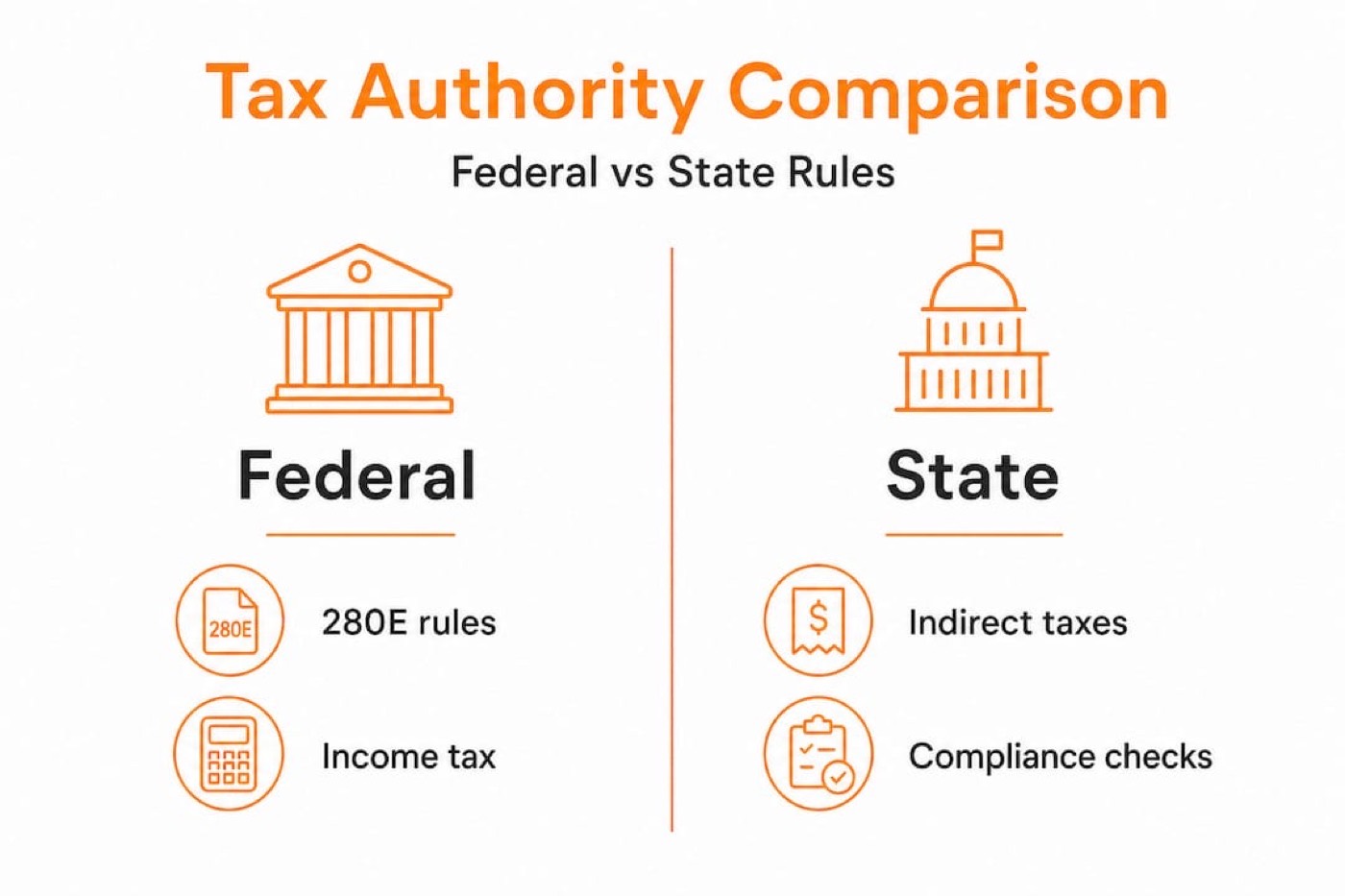
The most relevant federal provision is IRC Section 280E. According to the United States Code, IRC §280E disallows deductions and credits for amounts paid in connection with trafficking Schedule I controlled substances. This directly limits the federal income tax deductions available to cannabis businesses, which is a serious financial burden.
However, 280E does not touch indirect taxes. Here’s why that distinction matters:
- 280E affects your federal income tax return. It limits what you can deduct against gross income at the federal level.
- Sales tax and excise tax are state-level obligations. They are calculated, collected, and remitted separately from federal income tax.
- Indirect taxes are pass-through costs. You collect them from customers and remit them to the state. They never enter your federal taxable income calculation in the same way deductible expenses do.
The most dangerous mistake operators make is assuming that because 280E already limits their deductions, the state indirect tax obligations are somehow softened or offset. They aren’t. Your sales tax and excise tax liabilities exist completely independently of whatever federal income tax burden 280E creates.
Understanding the changes to 280E that may come through federal rescheduling is important, but it won’t change your state indirect tax obligations. Those are set by state legislatures, not federal drug scheduling.
Pro Tip: Maintain completely separate ledgers for federal income tax exposure and state indirect tax liabilities. Combining them in a single tracking sheet is a recipe for errors during filing season and makes it nearly impossible to audit your own numbers quickly. Your cannabis business tax filings will be cleaner and more defensible if these two categories are tracked in isolation.
Practical compliance steps: how to approach indirect tax in your cannabis operation
Knowing the rules is only half the battle. The other half is building the internal processes that keep your operation compliant as your business grows and the regulatory environment shifts. Here’s a practical framework you can implement today:
- Assess your current indirect tax exposure. Map every license, every state, and every transaction type. Identify which taxes apply, at what rate, and who is responsible for remittance.
- Implement point-of-sale and accounting system configurations. Your POS and accounting software should automatically calculate and separately track each indirect tax type on every transaction.
- Document everything at the transaction level. The California Cannabis Tax Return Guide is explicit that transaction-level tax tracking is necessary for accurate filings. Keep records of each sale, the taxes applied, and the remittance dates.
- Update your compliance systems regularly. Tax rates change. New local taxes are introduced. Federal rescheduling could shift the landscape. Build a quarterly review process into your finance calendar.
- Engage a cannabis-specialized tax professional. General CPAs often lack the specific knowledge to catch cannabis indirect tax errors before they become liabilities.
Your cannabis sales tax compliance process should include internal controls, meaning someone on your team other than the person who files is reviewing the calculations. Segregation of duties is a basic internal control principle that many small to mid-size cannabis operations skip, often to their detriment.
Also, build a formal process for reviewing your overall cannabis tax liability breakdown at least twice a year. This isn’t just about compliance. It’s about cash flow management. Indirect taxes represent real cash you are holding temporarily for the state. Mismanaging that cash can leave you unable to remit when deadlines arrive.
Pro Tip: Conduct a formal indirect tax audit at least once a year, separate from your annual financial audit. Bring in a cannabis tax specialist to review your state filings, documentation, and remittance history. The cost of that review is always less than the cost of a state audit finding.
The uncomfortable truth most experts miss about indirect tax in cannabis
Most articles on cannabis indirect tax coverage give you the rules and send you on your way. What they don’t tell you is why so many established cannabis businesses still get this wrong, even when they know the rules.
The problem is almost never ignorance. It’s organizational fragmentation. Finance teams track numbers. Operations teams track inventory. Legal teams track licensing. But indirect taxes live at the intersection of all three, and when those teams don’t communicate consistently, errors multiply. A new product line gets added without updating the POS tax configuration. A new municipality annexes your delivery zone without anyone updating the local tax rate. A distributor relationship changes, shifting who owes the excise tax, but the accounting system isn’t updated to reflect it.
The operators who consistently outperform on compliance are the ones who treat indirect tax as an operational discipline, not a finance department task. They hold cross-functional reviews. They assign clear ownership for each tax obligation. They build systems that flag anomalies automatically rather than waiting for a state notice to surface a problem.
There’s also a financial leadership dimension here. We’ve seen cannabis businesses that understood 280E deeply but had never mapped their state-by-state indirect tax exposure in a single document. The importance of tax compliance isn’t just regulatory. It’s competitive. Businesses with clean, proactive indirect tax systems spend less time responding to audits, carry less risk of license-threatening penalties, and are far more attractive to investors and acquirers.
Reactive compliance is expensive. Proactive compliance is a differentiator.
Master cannabis tax and compliance with expert resources
Getting your indirect tax obligations right requires more than reading a guide once. It requires the right tools, up-to-date knowledge, and resources built specifically for cannabis businesses.

Cannabis Business Minds offers a full library of resources designed for cannabis finance professionals who want to go beyond basic compliance. From detailed cannabis tax solutions covering state and federal obligations, to practical cannabis budgeting tools that help you account for indirect tax costs in your financial projections, to cannabis accounting resources that give your team the technical foundation to manage complex tax scenarios confidently, you’ll find everything built around the specific challenges cannabis operators face. Stop patching compliance gaps reactively and start building a tax-ready operation from the ground up.
Frequently asked questions
Do cannabis businesses pay both sales tax and cannabis excise tax?
Yes, in many states cannabis businesses must collect and remit both a general sales tax and a cannabis-specific excise tax on the same transactions, as excise taxes apply in addition to standard sales and use taxes.
How is the cannabis excise tax calculated?
It depends on the state, but excise tax structures can be based on the retail price, the THC potency of the product, or the physical weight of the cannabis being sold.
Who is responsible for collecting and remitting cannabis indirect taxes?
The responsibility can fall on retailers, distributors, or both, depending on state law. As state rules on remittance show, the supply chain position of the licensee often determines who owes what.
Does federal tax law 280E change how indirect taxes are handled?
No. IRC §280E affects federal income tax deductions only, and state-level indirect taxes like sales and excise tax operate on a completely separate track.
Recommended
- Indirect expenses in cannabis: Accounting and tax clarity – Cannabis Business Minds
- Why Cannabis Taxes Are High for U.S. Businesses – Cannabis Business Minds
- What Is Tax Liability for Cannabis? Complete Breakdown – Cannabis Business Minds
- Cannabis Entity Tax Status: Key U.S. Compliance Factors – Cannabis Business Minds
This article is general education, not tax, legal or accounting advice. Cannabis rules change quickly; confirm how they apply to you with a qualified cannabis CPA or attorney.