Why Cannabis Taxes Are High for U.S. Businesses

2026 update: what rescheduling changed for 280E (reviewed October 2026)
Effective April 22, 2026, a DOJ/DEA final order moved marijuana covered by a qualifying state medical license (and FDA-approved marijuana drugs) to Schedule III. Section 280E only applies to Schedule I and II substances, so state-licensed medical cannabis activity is generally no longer subject to 280E going forward. Adult-use cannabis remains in Schedule I and fully subject to 280E. The DEA proceeding to reschedule all marijuana was temporarily stayed in October 2026, and Treasury/IRS guidance on transition years and mixed medical/adult-use businesses is still pending.
This article was written before the order took effect. Check where your business stands in about a minute.
Most American cannabis businesses face tax rates that can exceed 70 percent, making profitability a persistent struggle. This staggering burden does not just stem from complex state rules but also from the harsh federal tax restrictions imposed by Section 280E. For accountants and finance professionals, understanding these regulations is non-negotiable. Unlocking viable tax optimization strategies is key to protecting cash flow, meeting compliance requirements, and sustaining growth in a rapidly evolving industry.
Key Takeaways
| Point | Details |
|---|---|
| Complex Tax Landscape | Cannabis taxation in the U.S. is complicated by state-level regulations and federal prohibition, necessitating specialized financial management strategies. |
| Impact of Section 280E | Section 280E prohibits standard business deductions for cannabis businesses, leading to effective tax rates that can reach 70-80%, straining financial sustainability. |
| State Tax Models | Each state employs different cannabis tax models, such as ad valorem, weight-based, and potency-based taxes, demanding adaptability in financial planning. |
| Strategic Tax Optimization | Businesses should focus on detailed Cost of Goods Sold allocation and consider corporate structuring to optimize tax liabilities while ensuring compliance. |
Defining Cannabis Taxation in the U.S.
Cannabis taxation in the United States represents a complex and unique financial landscape driven by conflicting federal and state regulations. Cannabis tax structures currently create significant financial challenges for businesses operating within this emerging industry, particularly due to the intricate interplay between state legalization efforts and federal prohibition.
At the core of cannabis taxation complexity are two primary factors: state-level cannabis tax frameworks and the controversial Section 280E of the Internal Revenue Code. Each state with legal cannabis markets has developed its own taxation approach, ranging from excise taxes to cultivation and retail sales taxes. These state-level taxes frequently operate independently from federal tax guidelines, creating a multilayered regulatory environment that demands sophisticated financial management.
The federal government’s current stance significantly complicates cannabis business taxation. Despite growing state-level legalization, cannabis remains a Schedule I controlled substance under federal law. This classification prevents cannabis businesses from claiming standard business deductions, forcing them to pay taxes on gross income rather than net income. The result is an effective tax rate that can exceed 70% for many cannabis enterprises, making financial sustainability extraordinarily challenging.
Pro Tip for Cannabis Financial Management: Develop a comprehensive tax strategy with a cannabis-specialized accountant who understands both state and federal tax implications, ensuring your business can navigate the complex regulatory landscape while maintaining financial compliance.
Key Taxation Characteristics:
- State-level tax rates ranging from 10% to 37%
- Prohibition of standard business expense deductions
- Complex compliance requirements across different jurisdictions
- Mandatory tracking of all financial transactions
Understanding these nuanced taxation dynamics requires continuous education and strategic financial planning for cannabis business professionals.
Federal Laws Driving High Cannabis Taxes
The intricate landscape of federal cannabis taxation is fundamentally shaped by a series of restrictive legal provisions that create substantial financial burdens for cannabis businesses. Economic opportunities for cannabis businesses remain constrained by complex federal regulations that disproportionately impact the industry’s financial sustainability.
At the epicenter of these taxation challenges is Section 280E of the Internal Revenue Code, a provision originally designed to prevent drug traffickers from claiming business expense deductions. This federal statute prevents cannabis businesses from deducting standard operational expenses like payroll, rent, and marketing costs, effectively forcing companies to pay taxes on their gross income rather than net income. The result is an exceptionally punitive tax structure that can consume up to 70% of a cannabis enterprise’s revenue, creating significant financial strain.
The federal government’s classification of cannabis as a Schedule I controlled substance further exacerbates these taxation challenges. Unlike businesses in other industries, cannabis enterprises cannot leverage typical tax strategies or business expense deductions. This unique legal status means that even state-legal cannabis businesses must navigate a complex financial landscape where standard accounting practices are severely restricted. The tax implications extend beyond simple revenue calculations, fundamentally affecting business models, investment strategies, and long-term financial planning.
Key Federal Tax Constraints:
- Prohibition of standard business expense deductions
- Taxation based on gross income rather than net income
- Restrictions stemming from Schedule I controlled substance status
- Complex compliance requirements across federal and state jurisdictions
Pro Tip for Cannabis Financial Strategy: Develop a specialized tax strategy with an accountant experienced in cannabis regulations, focusing on maximizing allowable deductions and maintaining meticulous financial documentation to minimize potential federal tax penalties.
Section 280E and Its Operational Impact
Section 280E represents a profound regulatory challenge that fundamentally disrupts standard business operations for cannabis enterprises. Implications of 280E on the regulated cannabis industry reveal the extraordinary financial pressures created by this unique tax provision, which essentially treats cannabis businesses as though they were illegal drug trafficking operations.
The operational consequences of Section 280E are particularly devastating. This Internal Revenue Code provision prohibits cannabis businesses from deducting typical expenses such as payroll, rent, utilities, marketing, and insurance that would normally be considered standard business costs. Gross receipts taxation becomes the default mechanism, meaning companies must pay federal taxes on total revenue instead of net income after legitimate business expenses. This creates an effective tax rate that can consume up to 80% of a company’s gross revenue, transforming what would be profitable enterprises into financially unsustainable ventures.
Navigating these complex tax restrictions requires sophisticated financial strategies. Cannabis businesses must carefully segregate their operations, distinguishing between plant-touching activities (which cannot claim deductions) and ancillary services that might qualify for standard business expense treatments. Cost of Goods Sold (COGS) represents the primary avenue for potential tax relief, requiring meticulous accounting practices and a nuanced understanding of what expenses can be legitimately incorporated into direct product costs.
To clarify how Section 280E shapes cannabis business operations, here’s a summary table:
| Business Factor | Under Section 280E | Typical U.S. Business |
|---|---|---|
| Expense Deductions | Only COGS allowed | Most operating expenses deductible |
| Taxable Income Basis | Gross income | Net income after expenses |
| Potential Effective Tax | Often 70-80% of gross revenue | Usually 21-35% of net income |
| Financial Management | Specialized strategies required | Standard practices sufficient |
Key Operational Challenges Under 280E:
- Inability to deduct standard business expenses
- Taxation based on gross receipts
- Complex cost accounting requirements
- Limited financial planning flexibility
Pro Tip for Financial Compliance: Develop a comprehensive accounting system that precisely tracks and allocates expenses, focusing on maximizing permissible Cost of Goods Sold deductions while maintaining immaculate financial documentation to withstand potential IRS scrutiny.
State-Level Cannabis Tax Models Explained
State-level cannabis tax structures represent a complex patchwork of regulatory approaches that dramatically impact cannabis business financial strategies. Each state has developed unique taxation models that reflect local economic priorities, creating a challenging landscape for cannabis entrepreneurs navigating diverse and often unpredictable fiscal environments.
The primary state-level tax models fall into three fundamental categories: ad valorem taxes, weight-based taxes, and potency-based taxes. Ad valorem taxes calculate cannabis tax liability as a percentage of the product’s retail price, typically ranging from 10% to 37%. Weight-based taxes assess a fixed dollar amount per ounce or gram of cannabis, providing a more predictable revenue stream for states. Potency-based taxation, an emerging model, calculates taxes according to the product’s tetrahydrocannabinol (THC) content, incentivizing lower-potency products and creating more nuanced pricing structures.
The implementation of these tax models varies significantly across jurisdictions. Some states combine multiple taxation approaches, creating intricate fiscal frameworks that require sophisticated financial management. California, for instance, imposes both cultivation and retail excise taxes, while Colorado uses a hybrid model that includes both percentage-based and weight-based calculations. These complex tax structures not only generate substantial state revenues but also introduce significant compliance challenges for cannabis businesses operating across multiple jurisdictions.
Here’s a comparison of the three major state-level cannabis tax models:
| Tax Model | Basis of Taxation | Common Business Impact |
|---|---|---|
| Ad Valorem | Percentage of retail price | Increases costs as prices rise |
| Weight-Based | Amount per ounce/gram | Predictable payments, less profit shift |
| Potency-Based | THC content in product | Incentivizes lower-potency products |
State Cannabis Taxation Characteristics:
- Variable tax rates from 10% to 37%
- Multiple taxation models (ad valorem, weight-based, potency-based)
- Significant variance in state-level approaches
- Complex compliance requirements
Pro Tip for Tax Navigation: Develop a state-specific tax tracking system that monitors unique local tax requirements, enabling precise financial planning and minimizing the risk of unexpected tax liabilities across different jurisdictions.
Financial Burdens and Compliance Requirements
Financial challenges for cannabis businesses extend far beyond typical operational expenses, creating a uniquely demanding regulatory environment that threatens the fundamental financial viability of cannabis enterprises. The complex interplay between federal prohibition and state-level legalization generates extraordinary compliance requirements that consume significant financial and administrative resources.
The compliance burden for cannabis businesses involves multiple sophisticated layers of financial reporting and documentation. Federal regulations demand meticulous record-keeping that goes well beyond standard business accounting practices. Companies must develop intricate systems to track every financial transaction, segregate plant-touching and ancillary business activities, and maintain immaculate documentation to withstand potential IRS audits. These requirements necessitate specialized accounting expertise, often requiring businesses to invest heavily in professional services that can navigate the complex regulatory landscape.
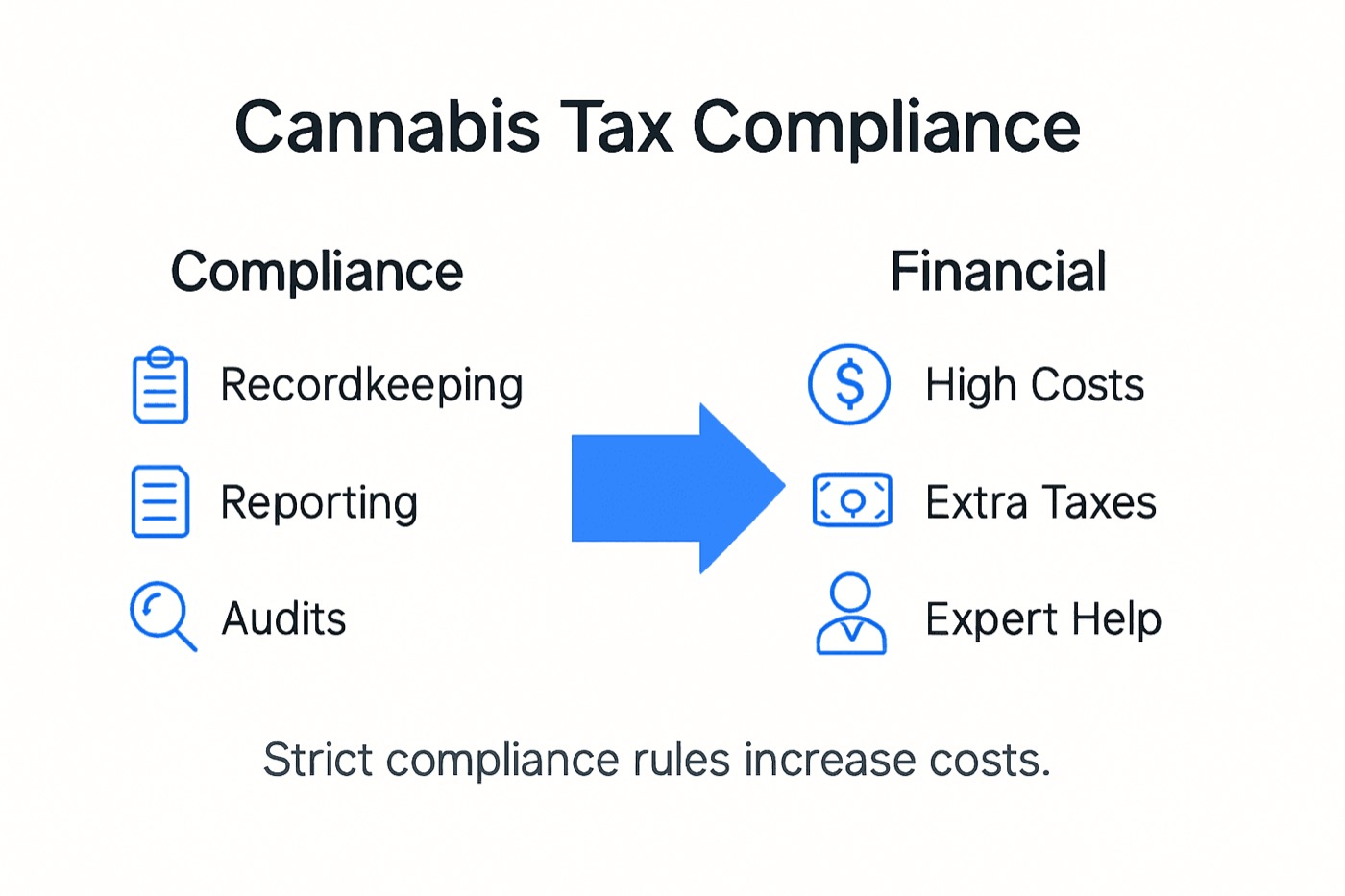
The financial strain is particularly acute when considering the restricted deduction capabilities imposed by Section 280E. Cannabis businesses are effectively prohibited from claiming standard business expenses, forcing them to pay taxes on gross revenue rather than net income. This regulatory constraint can result in effective tax rates exceeding 70%, transforming what would typically be profitable enterprises into financially precarious operations. The cumulative impact creates significant barriers to entry and sustainable growth for cannabis businesses, disproportionately affecting smaller operators with limited financial resources.
Key Compliance Challenges:
- Restricted business expense deductions
- Complex multi-jurisdictional reporting requirements
- Extensive documentation and record-keeping mandates
- Heightened risk of financial scrutiny
Pro Tip for Regulatory Navigation: Invest in specialized cannabis-focused accounting software and professional tax advisory services to create robust compliance systems that minimize financial risk and optimize available tax strategies.
Tax Optimization Strategies for Cannabis Firms
Economic opportunities for cannabis businesses require sophisticated tax optimization strategies that navigate the complex regulatory landscape. Cannabis firms must develop innovative approaches to minimize tax liabilities while maintaining strict compliance with federal and state regulations.
The most critical tax optimization strategy centers on Cost of Goods Sold (COGS) allocation. Businesses can strategically categorize expenses directly related to product production, including cultivation costs, direct labor, and supplies. By meticulously documenting and allocating these expenses, cannabis firms can legitimately reduce their taxable income under Section 280E. This approach requires creating separate legal entities for plant-touching and ancillary services, allowing for more nuanced expense management and potential tax deduction opportunities.
Another key optimization strategy involves careful corporate structuring and vertical integration. Cannabis businesses can create multiple legal entities that perform different functions, such as separating cultivation, manufacturing, and retail operations. This approach allows for more flexible expense allocation and potential tax mitigation. Some firms successfully implement strategies like leasing equipment to separate entities, creating additional avenues for expense deduction and reducing overall tax burden. Sophisticated cannabis enterprises often work with specialized tax professionals who understand the intricate regulatory landscape and can help develop complex but legal tax optimization frameworks.
Key Tax Optimization Approaches:
- Detailed COGS expense allocation
- Strategic corporate entity structuring
- Vertical integration of business operations
- Precise documentation and expense tracking
- Separation of plant-touching and ancillary services
Pro Tip for Tax Management: Engage a cannabis-specialized tax advisor who understands the nuanced regulatory environment, ensuring your business develops a comprehensive tax strategy that maximizes legal optimization while maintaining strict compliance with federal and state regulations.
Frequently Asked Questions
Why are cannabis taxes so high for businesses?
Cannabis taxes are high due to a combination of state-level tax frameworks and federal regulations, particularly Section 280E, which prohibits standard business deductions and requires taxation on gross income instead of net income, leading to effective tax rates that can exceed 70%.
What is Section 280E and how does it affect cannabis businesses?
Section 280E of the Internal Revenue Code disallows cannabis businesses from deducting common operational expenses, effectively treating them like illegal enterprises. This results in significantly higher tax burdens since they must pay taxes based on gross revenue instead of net income.
How do state-level tax models impact cannabis business operations?
State-level tax models introduce complexity as each state has its own tax rates and structures, such as ad valorem, weight-based, and potency-based taxes. This patchwork of regulations can lead to unpredictable financial outcomes and compliance challenges for cannabis businesses operating across different jurisdictions.
What strategies can cannabis businesses use to optimize taxes?
Cannabis businesses can optimize taxes by strategically allocating costs under Cost of Goods Sold (COGS), carefully structuring corporate entities, and maintaining meticulous documentation to separate plant-touching activities from ancillary services, which may allow for different tax treatment.
Recommended
- Tax Exposure Cannabis – Impact on US Businesses – Cannabis Business Minds
- Why Cannabis Tax Compliance Matters for U.S. Businesses – Cannabis Business Minds
- What Is Tax Liability for Cannabis? Complete Breakdown – Cannabis Business Minds
- Cannabis Entity Tax Status: Key U.S. Compliance Factors – Cannabis Business Minds
This article is general education, not tax, legal or accounting advice. Cannabis rules change quickly; confirm how they apply to you with a qualified cannabis CPA or attorney.