Step by Step 1099 Reporting for Cannabis Businesses

2026 update: what rescheduling changed for 280E (reviewed October 2026)
Effective April 22, 2026, a DOJ/DEA final order moved marijuana covered by a qualifying state medical license (and FDA-approved marijuana drugs) to Schedule III. Section 280E only applies to Schedule I and II substances, so state-licensed medical cannabis activity is generally no longer subject to 280E going forward. Adult-use cannabis remains in Schedule I and fully subject to 280E. The DEA proceeding to reschedule all marijuana was temporarily stayed in October 2026, and Treasury/IRS guidance on transition years and mixed medical/adult-use businesses is still pending.
Check where your business stands in about a minute.
Step by step 1099 reporting for cannabis businesses requires precise compliance with IRS Form 1099-NEC, updated 2026 thresholds, and worker classification rules that carry real financial consequences under Section 280E. The standard industry term for this process is nonemployee compensation reporting, and getting it wrong costs more in cannabis than in most industries because every misclassified dollar touches your deductibility position. For tax year 2026, the reporting threshold rose to $2,000, up from $600 in 2025. That change alone will affect how you categorize and track contractor payments throughout the year. This guide covers prerequisites, the filing walkthrough, common errors, reconciliation, and audit exposure specific to cannabis operators.
What are the prerequisites for step by step 1099 reporting in cannabis?
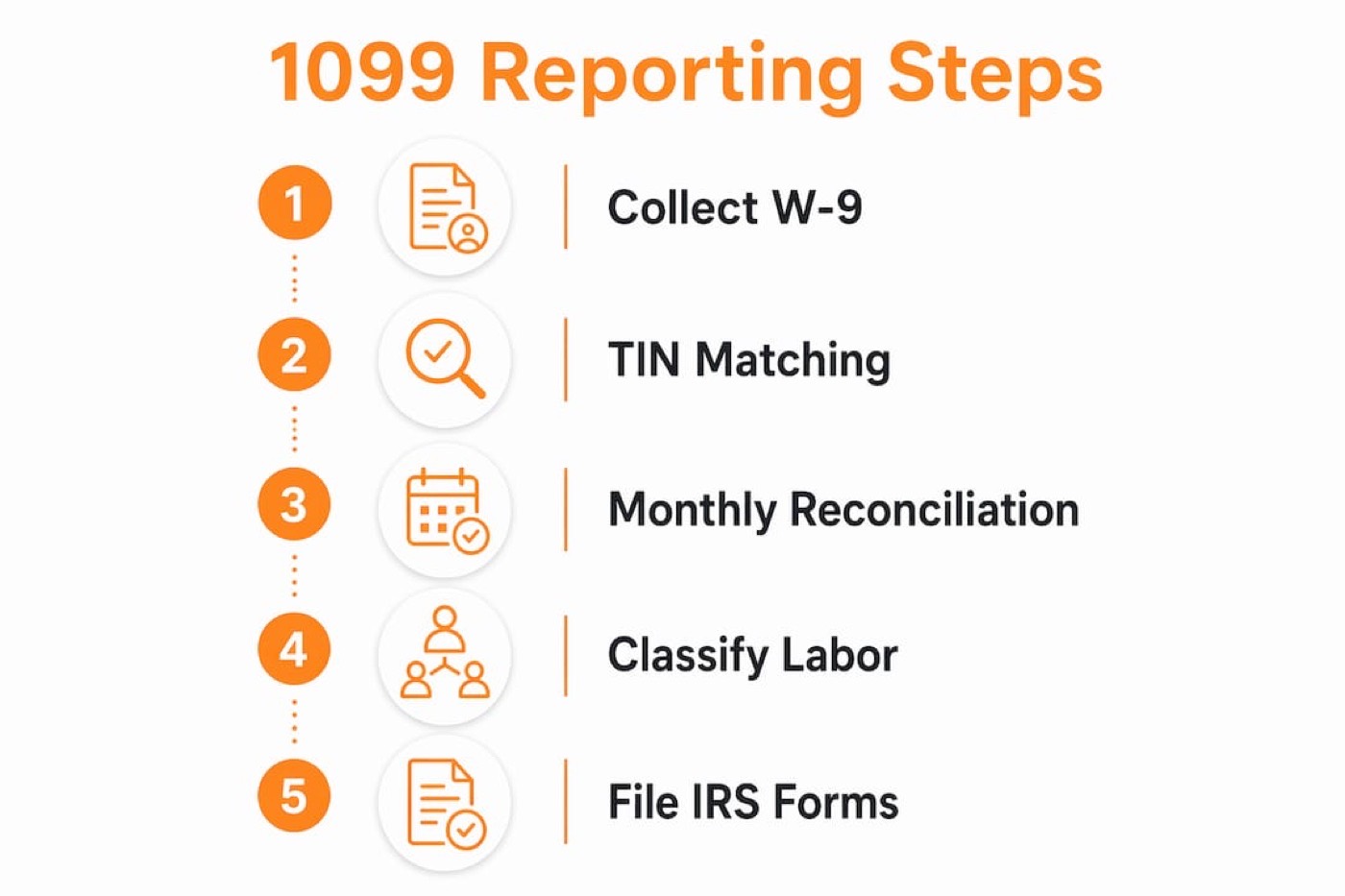
Accurate 1099 reporting starts months before january 31, not in the last two weeks of january. The foundation is a complete W-9 on file for every contractor before the first payment clears. No W-9 means you are legally required to apply backup withholding of 24% immediately. That withholding must then appear on the 1099 filing itself, creating a paper trail that signals to the IRS you had a compliance gap.
TIN matching is the next layer. The IRS TIN Matching Program lets you verify a contractor’s Taxpayer Identification Number against IRS records before filing. A mismatch triggers a CP2100 notice and potential penalties. Cannabis businesses face heightened exposure here because contractor relationships are often informal, and vendors sometimes operate under multiple entity structures.

Worker classification is where most cannabis operators get into trouble. The IRS applies a behavioral control, financial control, and type of relationship test to determine whether a worker is an employee or an independent contractor. Budtenders classified as contractors almost always fail this test. They work set hours, follow store protocols, and operate under direct supervision. That is an employee relationship, and filing a 1099-NEC for a budtender instead of a W-2 is a misclassification that invites both IRS and state labor audits.
The prerequisites checklist before you file:
- Collect a signed W-9 from every contractor before payment
- Run TIN matching through the IRS e-Services portal
- Confirm worker classification using the IRS common law test, not just job title
- Track all contractor payments in real time through your general ledger, not just vendor reports
- Reconcile your payroll compliance records against contractor accounts monthly
Pro Tip: Set a W-9 collection trigger in your accounts payable workflow. No W-9 on file means the payment does not process. That single rule eliminates most backup withholding exposure before it starts.
How to file Form 1099-NEC for cannabis contractors step by step
The 1099-NEC is the correct form for reporting nonemployee compensation paid to contractors. The 1099-MISC is not the right form for contractor payments and has not been since 2020. Using the wrong form is a filing error the IRS will flag.
Follow these steps in order:
- Confirm payment totals. Pull contractor payment totals from your general ledger contractor accounts, not just vendor reports. Vendor reports alone miss payments and produce incomplete filings.
- Apply the $2,000 threshold. For tax year 2026, only contractors paid $2,000 or more require a 1099-NEC. Payments below that threshold do not require filing, but you should still retain records.
- Enter payer information. Box fields require your legal business name, EIN, and address exactly as registered with the IRS. Discrepancies between your EIN registration and the payer name cause processing delays.
- Enter payee information. Use the name and TIN exactly as they appear on the contractor’s W-9. Do not abbreviate or alter the name.
- Report nonemployee compensation in Box 1. This is the total amount paid to the contractor during the calendar year, before any backup withholding.
- Report direct sales in Box 2 if applicable. If a contractor sold you consumer products for resale totaling more than $5,000, check Box 2. This applies to some cannabis product vendors.
- File electronically if you have 10 or more forms. The IRS requires electronic filing via the FIRE system for 10 or more information returns. Fewer than 10 can be filed on paper, but electronic filing reduces error rates.
- Distribute recipient copies. Contractors must receive their copy by january 31, 2027. Mailing on january 31 is not sufficient if it arrives late.
- File with the IRS by january 31, 2027. The 1099-NEC deadline is January 31 with no automatic extension available.
| Filing method | Forms threshold | IRS system | Deadline |
|---|---|---|---|
| Electronic | 10 or more | FIRE system | January 31 |
| Paper | Fewer than 10 | Mail to IRS | January 31 |
| Recipient copy | All forms | Direct to contractor | January 31 |
Pro Tip: File electronically even if you have fewer than 10 forms. The FIRE system provides confirmation of receipt, which paper filing does not. That confirmation is your proof of timely filing if the IRS ever questions it.
What are common mistakes and audit risks in cannabis 1099 reporting?
The most expensive mistake is misclassifying employees as contractors. Under Section 280E, cannabis businesses cannot deduct most operating expenses. Labor costs allocated to cost of goods sold are deductible; operating labor is not. Some operators misclassify workers as contractors to shift labor costs off the books entirely. Misclassification under 280E invites IRS scrutiny that goes well beyond the 1099 filing itself. The IRS treats it as a deliberate evasion strategy, not a paperwork error.
The second common error is ignoring the updated $2,000 threshold. Operators who built their 1099 workflows around the old $600 threshold will either over-file or under-file in 2026. Over-filing is not a penalty risk, but under-filing is. Review your payment tracking system now and confirm the threshold is updated.
The third error is failing to apply backup withholding when W-9s are missing. Many cannabis businesses pay contractors informally and collect W-9s at year end. That approach fails because backup withholding is required from the moment a valid W-9 is absent, not retroactively.
Reconstructing contractor records after the fact is the single fastest way to lose an IRS audit. Examiners treat retrospective documentation as fabricated. Build your records in real time or accept that they will not hold up under examination.
Additional audit red flags specific to cannabis:
- 1099 totals that do not reconcile with Seed-to-Sale records or the general ledger
- Contractor payments to individuals who also appear on the payroll register
- Missing or inconsistent TINs across multiple filing years
- Tip income reported inconsistently for budtenders who are not formally recognized as tipped employees by the IRS
Late or incorrect filings carry penalties of $60 to $330 per form depending on how late the filing is. For a cannabis business with 50 contractors, that is a $3,000 to $16,500 exposure before any underlying tax adjustments.
How to reconcile cannabis payroll and contractor payments for 1099 accuracy
Monthly reconciliation is the operational discipline that makes january 31 filing manageable. Without it, year-end 1099 prep becomes a forensic exercise. The goal is a clean match between your payroll register, your contractor payment ledger, and your departmental labor allocations every month.
The reconciliation process has three components. First, compare your payroll register against your general ledger payroll accounts. Any variance signals either a posting error or a classification problem. Second, compare your contractor payment ledger against your accounts payable vendor records. General ledger contractor accounts capture payments that vendor reports miss. Third, tie both sets of records to your Seed-to-Sale system. Integrating payroll with Seed-to-Sale data strengthens labor cost allocation and gives you a defensible audit trail.
| Reconciliation task | Frequency | Purpose |
|---|---|---|
| Payroll register vs. general ledger | Monthly | Catch posting errors and classification gaps |
| Contractor ledger vs. vendor reports | Monthly | Identify missed payments before year end |
| Labor allocations vs. Seed-to-Sale | Monthly | Support COGS vs. operating expense split |
| W-9 status review | Quarterly | Flag missing TINs before backup withholding triggers |
| Full 1099 pre-filing review | December | Confirm all thresholds, TINs, and amounts |
Written labor cost classification policies are not optional. The IRS expects to see documented policies that explain how your business allocates labor between COGS and operating expenses under 280E. Verbal policies do not survive examination. Your cannabis expense classification methodology needs to be in writing, dated, and applied consistently.
Record retention for cannabis businesses should cover at minimum six years for federal tax records. State requirements vary. Some states with their own cannabis tax regimes require longer retention periods. Cannabis recordkeeping requirements at the federal level align with the general IRS statute of limitations, but cannabis-specific state audits can extend that window.
Pro Tip: Run your 1099 pre-filing reconciliation in december, not january. December gives you time to chase missing W-9s, correct ledger errors, and resolve TIN mismatches before the filing deadline creates pressure.
The part of 1099 reporting that most cannabis operators underestimate
The operational complexity of 1099 reporting in cannabis is not the form itself. The form is straightforward. The complexity lives in the classification decisions made 12 months before the filing deadline, and in the documentation discipline required to defend those decisions under audit.
I have seen cannabis businesses with clean books get tripped up because their labor allocation methodology was not written down. The IRS examiner asked for the policy. There was none. The entire COGS labor deduction was at risk. That is a 280E exposure that no amount of correct 1099 filing can fix after the fact.
The other thing operators consistently underestimate is state divergence. Some states have decoupled from federal 280E, meaning they allow deductions that the IRS does not. Maintaining dual record sets for federal and state returns is becoming standard practice for multi-state operators. Your 1099 filings feed both sets of records, and discrepancies between them create reconciliation problems that compound over time.
The cannabis tax reporting process is not a year-end exercise. It is a year-round operational discipline. Operators who treat it as paperwork will keep paying penalties. Operators who build it into their monthly close process will have defensible records when the IRS comes asking.
— JN
Cannabis finance resources for 1099 compliance in 2026
Accurate 1099 filing is one piece of a larger compliance picture for cannabis finance professionals. The classification decisions, reconciliation workflows, and documentation standards that support your filings require ongoing attention, not just a january sprint.

Cannabisbusinessminds covers the full range of cannabis bookkeeping and tax compliance topics built specifically for finance professionals working in this industry. The 2026 bookkeeping guidance covers updated IRS requirements, labor classification frameworks, and documentation best practices that directly support your 1099 process. For operators managing complex cost structures, the cannabis tax liability breakdown explains how 280E interacts with your filing obligations at every level. These resources are built for professionals who already know the basics and need the cannabis-specific layer.
FAQ
What is the 1099-NEC threshold for cannabis businesses in 2026?
The threshold for filing Form 1099-NEC in 2026 is $2,000 per contractor, up from $600 in 2025. Payments below $2,000 do not require a 1099-NEC, but you should retain payment records regardless.
Can cannabis businesses file 1099s for budtenders?
Budtenders generally do not qualify as independent contractors under IRS classification rules. They meet the criteria for employee status, which requires a W-2, not a 1099-NEC. Filing a 1099-NEC for a budtender is a misclassification that triggers audit risk and back tax liability.
What happens if a cannabis contractor does not provide a W-9?
Backup withholding of 24% applies immediately when a contractor fails to provide a valid W-9. That withholding must be reported on the 1099 filing and remitted to the IRS separately.
When is the 1099-NEC filing deadline for tax year 2026?
The deadline to file Form 1099-NEC with the IRS and furnish copies to recipients is january 31, 2027. No automatic extension is available for 1099-NEC, unlike some other information returns.
How does 280E affect 1099 reporting decisions in cannabis?
Section 280E disallows deductions for operating expenses in cannabis businesses. Correct worker classification determines whether labor costs fall into deductible COGS or non-deductible operating expenses. Misclassifying employees as contractors to manipulate that split is one of the IRS’s primary audit targets in cannabis.
Recommended
- 7 Essential Cannabis Tax Forms Every Business Needs – Cannabis Business Minds
- Cannabis Financial Reporting Guide for Full Compliance Success – Cannabis Business Minds
- 7 Steps to an Effective Cannabis Business Checklist 2025 – Cannabis Business Minds
- 7 Steps to a Cannabis Financial Reporting Checklist Success – Cannabis Business Minds
This article is general education, not tax, legal or accounting advice. Cannabis rules change quickly; confirm how they apply to you with a qualified cannabis CPA or attorney.