Indirect expenses in cannabis: Accounting and tax clarity
2026 update: what rescheduling changed for 280E (reviewed October 2026)
Effective April 22, 2026, a DOJ/DEA final order moved marijuana covered by a qualifying state medical license (and FDA-approved marijuana drugs) to Schedule III. Section 280E only applies to Schedule I and II substances, so state-licensed medical cannabis activity is generally no longer subject to 280E going forward. Adult-use cannabis remains in Schedule I and fully subject to 280E. The DEA proceeding to reschedule all marijuana was temporarily stayed in October 2026, and Treasury/IRS guidance on transition years and mixed medical/adult-use businesses is still pending.
Check where your business stands in about a minute.
Cannabis businesses operate under a tax code that punishes them for the same overhead costs that every other industry writes off without a second thought. Rent, utilities, administrative salaries — for a hardware store, these are straightforward deductions. For a licensed dispensary or cultivator, each one represents a potential tax trap. IRC 280E prohibits deductions for many day-to-day and overhead expenses, making the treatment of indirect expenses one of the most consequential accounting decisions you will make. This guide breaks down what qualifies as an indirect expense, how federal regulations determine their fate, and what you can do to protect your bottom line.
Table of Contents
- What are indirect expenses in cannabis operations?
- IRS regulations: IRC 280E, IRC 471, and the fate of indirect expenses
- How to allocate and document indirect expenses: Practical guidance
- Common pitfalls and strategic structuring: Staying audit-ready
- Perspective: Why indirect expense strategy is the secret sauce for surviving 280E
- Discover more ways to optimize your cannabis business finances
- Frequently asked questions
Key Takeaways
| Point | Details |
|---|---|
| 280E limits most deductions | Indirect expenses are generally non-deductible for federal tax purposes unless properly capitalized. |
| COGS allocation is crucial | Including qualifying indirect expenses in COGS can reduce a cannabis business’s tax burden. |
| Document everything | Thorough records and justifiable allocation methods are essential for both compliance and audit defense. |
| Audit risk is high | Careless treatment of indirect expenses triggers IRS scrutiny, making strategy and recordkeeping essential. |
What are indirect expenses in cannabis operations?
Indirect expenses are costs that support your business operations but cannot be traced to a single unit of product. They are the background hum of your business — always present, often significant, and in cannabis, far more complicated than anywhere else.
For a cannabis cultivator, indirect expenses include facility rent, electricity for climate control systems, water bills, depreciation on grow equipment, and supervisory wages for a head grower who oversees multiple cultivation rooms. For a dispensary, indirect expenses show up as retail space rent, point-of-sale system costs, manager salaries, and insurance premiums. None of these tie directly to a single gram of flower or a single edible on the shelf.

Here is a clear breakdown of how direct and indirect costs differ in a cannabis context:
Direct costs:
- Seeds, clones, and plant material
- Direct cultivation labor (trimmers, budtenders during budtender-specific tasks)
- Packaging materials applied per unit
- Raw material inputs for extraction (solvent costs, for example)
Indirect costs:
- Facility rent and lease costs
- Utilities (electricity, water, HVAC)
- Administrative and supervisory salaries
- Security systems and monitoring contracts
- Equipment depreciation
- Compliance and licensing fees
- General liability insurance
For multi-site cannabis operators, indirect expenses commonly represent 20 to 40 percent of total operating costs. That is not just overhead — that is a massive block of spending that determines whether your accounting methodology saves or costs you hundreds of thousands of dollars per year.
According to federal treasury regulations, all costs beyond direct materials and direct labor or acquisition costs qualify as indirect inventory costs for cannabis producers. That broad definition pulls a surprising range of expenses into a regulatory gray zone where the wrong classification can mean the difference between a manageable tax bill and an effective rate that exceeds your actual profit margin.
Understanding the full scope of cannabis expense categories is the foundation for every tax strategy that follows. You cannot allocate what you have not identified, and you cannot defend what you have not documented.
The financial stakes are especially high in cannabis because the industry’s normal pricing pressures from competition, compliance costs, and market volatility leave thin margins. When indirect expenses are not properly accounted for, those margins disappear. The operational cost types that seem minor in isolation can compound into a significant tax liability across a full fiscal year.
IRS regulations: IRC 280E, IRC 471, and the fate of indirect expenses
Now that we see what counts as an indirect expense, the key question is: how does federal law decide if you gain any tax benefit from it?
IRC 280E is the rule that most cannabis professionals know and dread. It states that no deduction or credit is allowed for any amount paid in carrying on a trade or business that consists of trafficking in a controlled substance. Cannabis, federally classified as Schedule I, falls squarely under this prohibition. What that means practically is that the normal business deductions every other company takes — rent, wages, marketing — are off-limits for the portion of your business engaged in cannabis trafficking.
IRC 471 is the lifeline. This section governs inventory accounting and defines what costs can be capitalized into the cost of goods sold (COGS). Only COGS under IRC 471 can reduce taxable income for cannabis businesses — indirect expenses are blocked as operating deductions but may be includable in COGS if properly allocated to inventory. That distinction is everything.
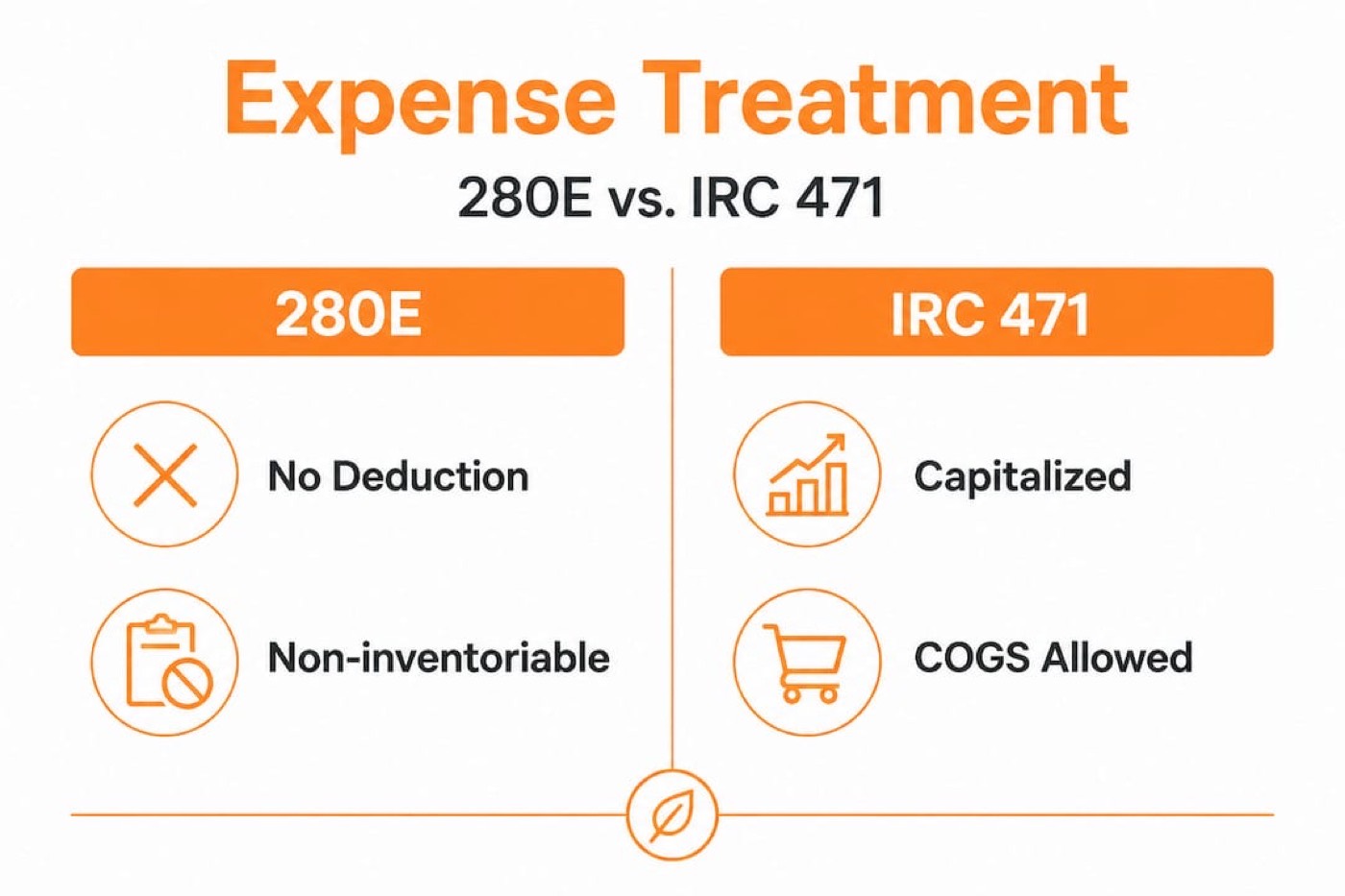
Here is a direct comparison to clarify the regulatory landscape:
| Expense type | Treatment under 280E | Treatment under IRC 471 (COGS) |
|---|---|---|
| Direct cultivation labor | Not deductible as expense | Includable in COGS |
| Facility rent (production) | Not deductible as expense | Potentially allocable to COGS |
| Administrative salaries | Not deductible as expense | Partially allocable if tied to production |
| Equipment depreciation (production) | Not deductible as expense | Includable in COGS if tied to production |
| Marketing and advertising | Not deductible | Not includable in COGS |
| Retail staff wages | Not deductible | Generally not includable in COGS |
| Utilities (production only) | Not deductible as expense | Potentially allocable to COGS |
The strategic goal is to move as many legitimate indirect costs as possible into your COGS calculation using IRC 471 methodology. Every dollar that properly lands in COGS reduces your taxable income by a dollar — legally and defensibly.
Here are the steps cannabis businesses should take to evaluate where each indirect expense lands:
- Categorize every indirect expense by whether it relates to production, dispensary operations, or general administration.
- Apply a reasonable allocation methodology such as square footage, direct labor hours, or machine hours for costs that span multiple functions.
- Distinguish production-related from non-production costs. Only production-adjacent indirect costs have a path into COGS.
- Review IRS guidance and Treasury regulations specific to cannabis inventory accounting to confirm eligibility.
- Document the method and rationale for each allocation decision in writing before the tax year closes.
Working through this process with a specialist in cost accounting for cannabis is not optional at scale. The regulations are complex enough that a DIY approach frequently leaves money on the table or creates audit exposure. Understanding your cannabis COGS calculation with precision is what separates businesses that survive 280E from those that do not.
How to allocate and document indirect expenses: Practical guidance
Understanding the tax logic is only half the battle — putting the right processes in place is what actually moves the needle for your bottom line.
The IRS applies significant scrutiny to cannabis businesses, and indirect expense allocation is one of the first places examiners look. Vague or inconsistent allocation logic is an immediate red flag. The good news is that a disciplined allocation process is not complicated to build — it just requires consistency and documentation.
Depreciation of production assets is a strong example. A cultivator who uses extraction equipment exclusively for cannabis production can allocate a portion of that equipment’s annual depreciation directly to inventory. That depreciation becomes part of COGS, reducing taxable income in a way that a standard operating expense deduction never could under 280E. The key is that the depreciation must be tied to production activity, documented with asset records and usage logs.
Here is a practical step-by-step allocation process for cannabis indirect costs:
- Create an expense register that logs every indirect cost by category, amount, and department at the time it is incurred, not at year-end.
- Define your allocation basis for each cost type. Rent often uses square footage. Supervisory salaries may use percentage of time spent in production versus retail. Utilities may use metered consumption per space.
- Apply the allocation consistently every period. Changing your method mid-year is a red flag and can be challenged in an audit.
- Reconcile to financial statements quarterly so that your COGS figure builds accurately throughout the year.
- Create and retain written documentation explaining your methodology, including any supporting calculations or third-party appraisals used for depreciation.
- Archive supporting records including lease agreements, utility bills, payroll records, and equipment purchase invoices that substantiate every number.
Pro Tip: Schedule a quarterly review of your expense allocations with a cannabis-specialized accountant. Tax positions can shift as your business changes — new equipment, expanded space, or added headcount can all affect which costs qualify for inventory capitalization. Catching those changes early is far less expensive than correcting them after an IRS examination.
The discipline of documenting expenses thoroughly serves two purposes: it maximizes your defensible COGS, and it positions your business to withstand an audit without disruption. A well-organized expense file is also significantly faster and less expensive to defend than a disorganized one.
Take time to review which items appear on your eligible business expenses list against what you are currently capturing in COGS. Many cannabis businesses discover that legitimate allocable costs have been sitting in operating expense accounts, completely inaccessible as tax relief, simply because no one built the allocation framework at the start.
Common pitfalls and strategic structuring: Staying audit-ready
Even with perfect knowledge and systems, cannabis companies face tripwires — here is how to avoid the most expensive mistakes.
The single most common error in cannabis indirect expense accounting is failing to document the allocation logic in writing. Finance teams often apply a reasonable methodology in their heads or in a spreadsheet that gets deleted, but when an examiner asks “why did you allocate 60 percent of facility rent to COGS?” the answer needs to be documented, not reconstructed from memory.
A second widespread mistake is assuming that state and federal tax treatment is identical. Many states do not apply 280E, which means some indirect expenses that are blocked federally may be fully deductible on your state return. Managing two parallel calculations is operationally demanding but financially essential. Conflating the two frameworks causes errors in both directions.
Misclassifying costs is another persistent problem. A supervisory salary for a manager who splits time between production and retail cannot be fully allocated to COGS — only the production-related portion qualifies. Failing to split it correctly either understates your COGS (costing you money) or overstates it (creating audit risk). Segregation of business activities and expense allocation are among the most frequently examined issues in IRS audits of cannabis businesses.
Entity structuring deserves its own discussion. Some operators create separate legal entities for cannabis-touching and non-cannabis-touching activities. A management company that provides administrative services to the cannabis entity may be able to deduct those overhead costs at the management company level, where 280E does not apply. This is a legitimate strategy, but it requires clean separation in practice and proper intercompany agreements. A structure that looks good on paper but shares books, employees, and accounts in practice will not hold up under examination.
Pro Tip: Maintain completely separate books and bank accounts for cannabis and ancillary operations if you use a multi-entity structure. Comingled records are the fastest way to lose the tax benefit you built the structure to capture.
Here are the top four audit red flags related to indirect expenses in cannabis businesses:
- Inconsistent allocation methods applied across different tax years without documented justification
- Large, unsupported COGS increases from one year to the next without corresponding production growth
- Misclassified costs that appear in both COGS and operating expense lines simultaneously
- No written allocation policy on file at the time of examination
Addressing these issues proactively through structured tax planning for dispensaries and a clear understanding of cannabis tax liability explained will reduce both your effective tax rate and your audit risk in the same move.
Perspective: Why indirect expense strategy is the secret sauce for surviving 280E
With the nuts and bolts covered, here is the deeper lesson from the trenches of cannabis tax planning.
Most cannabis operators spend considerable energy focused on legislative reform — hoping that federal rescheduling or 280E repeal will solve their tax problem. That hope may eventually pay off. But right now, the businesses winning the tax game are not waiting for Washington. They are building back-office systems that squeeze every legitimate dollar out of the regulations that already exist.
The reality is that indirect costs become valuable under federal tax law only through their treatment as inventoriable costs, not ordinary deductions. That is a narrow path, but it is the path. And it rewards operators who treat accounting with the same rigor they give to cultivation protocols or dispensary operations.
What most people miss is that this is not primarily a legal strategy — it is an accounting strategy. The competitive advantage is not in finding an obscure loophole or aggressive filing position. It is in having cleaner records, a more defensible methodology, and a more complete understanding of your own cost structure than the competitor across the street. A solid grasp of cannabis GAAP overview principles provides the foundation for building that advantage systematically.
The uncomfortable truth is that many cannabis businesses overpay their taxes not because the rules are impossible, but because their accounting infrastructure has not kept pace with their operational complexity. Every dollar of indirect expense that sits in an operating account instead of properly allocated inventory cost is a dollar of unnecessary tax burden. That is not a legal failure. It is an accounting one — and it is entirely fixable.
Discover more ways to optimize your cannabis business finances
Cannabis tax compliance is not a one-time project. Regulations evolve, your cost structure changes, and the IRS continues to scrutinize the industry at elevated levels. Staying current requires ongoing education and access to professionals who understand the intersection of cannabis operations and complex tax law.

At Cannabis Business Minds, we build resources specifically for cannabis finance professionals navigating exactly these challenges. Whether you are refining your approach to inventory cost accounting through our Cannabis cost accounting guide, planning your financials with confidence through our cannabis budgeting guidance, or looking for deeper support through our accounting solutions for cannabis, we have structured tools and guidance to help you work more efficiently and stay fully compliant. Your next step toward a stronger financial foundation starts here.
Frequently asked questions
Can cannabis businesses deduct indirect expenses from taxable income?
Generally, indirect expenses are not deductible under IRC 280E unless they are properly included in COGS using IRC 471 inventory accounting rules. Only costs capitalized into inventory can reduce taxable income.
What are typical indirect expenses for a cannabis cultivator?
Common examples include rent, utilities, facility depreciation, supervisory salaries, insurance premiums, and administrative overhead that can be allocated to production activities under Treasury regulations.
How can I maximize my allowable COGS with indirect expenses?
Accurately allocate production-related indirect costs to inventory using a documented methodology, and confirm that each cost is incident to and necessary for production before including it in your COGS calculation.
Are state and federal rules the same for indirect expense deductions in cannabis?
No. Many states have decoupled from 280E entirely, so indirect expenses that are blocked at the federal level may be fully deductible on your state return, creating a separate set of calculations that must be managed independently.
Recommended
- Cost Accounting Cannabis: Complete U.S. Industry Guide – Cannabis Business Minds
- Cannabis Expense Categories Explained: Tax and Compliance – Cannabis Business Minds
- 7 Key Eligible Business Expenses for Cannabis Companies – Cannabis Business Minds
- 7 Key Types of Operational Costs in Cannabis Explained – Cannabis Business Minds
- SEO for Cannabis Accountants & CPAs | Dope SEO – Cannabiz Marketing Solutions
This article is general education, not tax, legal or accounting advice. Cannabis rules change quickly; confirm how they apply to you with a qualified cannabis CPA or attorney.