Cannabis Tax Audit Response Workflow: 2026 Guide

2026 update: what rescheduling changed for 280E (reviewed October 2026)
Effective April 22, 2026, a DOJ/DEA final order moved marijuana covered by a qualifying state medical license (and FDA-approved marijuana drugs) to Schedule III. Section 280E only applies to Schedule I and II substances, so state-licensed medical cannabis activity is generally no longer subject to 280E going forward. Adult-use cannabis remains in Schedule I and fully subject to 280E. The DEA proceeding to reschedule all marijuana was temporarily stayed in October 2026, and Treasury/IRS guidance on transition years and mixed medical/adult-use businesses is still pending.
Check where your business stands in about a minute.
A tax audit response workflow for cannabis businesses is defined as the structured, sequential process a cannabis operator follows from the moment it receives an IRS or state tax notice through final resolution, including documentation assembly, professional representation, and formal appeals. This process is not optional or improvised. Cannabis businesses face audit exposure that standard businesses do not, specifically because of IRC Section 280E, seed-to-sale reconciliation requirements, and cash-intensive operations that trigger IRS Form 8300 scrutiny. Building a defensible tax audit response workflow for cannabis requires integrating Metrc data, accrual-based accounting records, and 280E cost allocation documentation before the first notice arrives, not after.
What does a cannabis tax audit response workflow require?
The prerequisites for an effective audit response are accounting infrastructure decisions made months or years before any notice lands. Audit-ready bookkeeping is the primary defense. Without it, the workflow collapses at the first document request.
The core documentation systems you need in place before audit onset include:
- Seed-to-sale integration with financial accounting. Metrc tracks weight and regulatory compliance. It does not track labor allocation, overhead absorption, or COGS in the way an IRS examiner expects. Your accounting system must bridge that gap with a separate, documented costing layer.
- POS reconciliation to tax filings. Examiners are trained to cross-reference POS data, Metrc records, and filed returns. Gaps between these three sources are the most common trigger for proposed adjustments.
- Accrual-based general ledger. Cash-basis accounting does not survive a 280E audit. Accrual accounting and intercompany policies must be established before audit onset, not retrofitted after.
- IRS Form 8300 filing logs. Cannabis retailers handling cash transactions above $10,000 must maintain complete Form 8300 records. Missing filings are a separate penalty exposure on top of income tax adjustments.
- 280E expense allocation schedules. Every deduction claimed must tie to a documented COGS or inventory cost. Schedules showing the allocation methodology between plant-touching and non-plant-touching activities are non-negotiable.
Pro Tip: Run quarterly mock audits by pulling random prior-period documents and testing whether your team can retrieve and reconcile them within 48 hours. This drill exposes gaps in your filing system before an examiner does.
How do you execute a cannabis audit response step by step?

The IRS audit timeline for cannabis businesses follows a predictable structure. Understanding each phase prevents missed deadlines and reactive decisions.
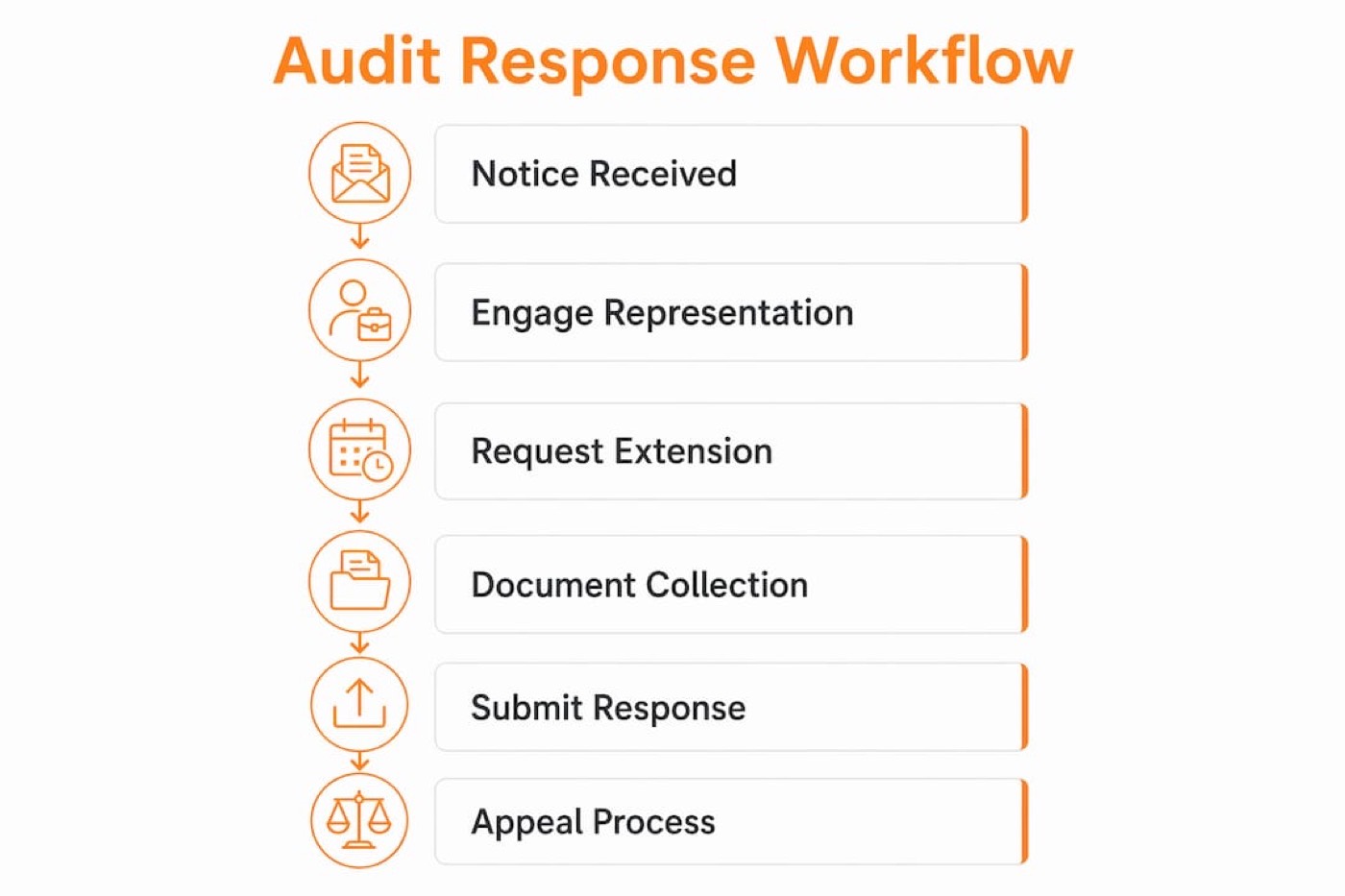
Critical response steps in order:
- Day 1: Receive notice and engage representation. Do not respond directly to the IRS or state authority without a tax attorney or CPA experienced in cannabis. Early professional engagement reduces penalty exposure and improves the accuracy of your initial response.
- Days 1–14: Respond to the Information Document Request (IDR). The IDR lists every record the examiner wants. Request an extension if needed. Submitting incomplete records is worse than requesting more time.
- Weeks 2–8: Records review phase. Organize documents into a structured data room. Group by tax year, entity, and category. Retrofitting documents at this stage is less credible than a pre-organized system.
- Weeks 8–12: Proposed adjustments. The examiner issues proposed changes. Review each line item against your allocation schedules and challenge unsupported adjustments in writing.
- Months 4–12+: Appeals. If adjustments are disputed, the IRS Office of Appeals or state equivalent handles the case. This phase can extend well beyond 12 months for complex cannabis audits.
| Audit Phase | Timeline | Key Action |
|---|---|---|
| Initial notice and IDR | Day 1 | Engage representation, request extension |
| Records review | Weeks 2–8 | Deliver organized data room |
| Proposed adjustments | Weeks 8–12 | Challenge unsupported line items |
| Appeals | Months 4–12+ | Submit formal protest with documentation |
Pro Tip: Request a 30-day extension on the initial IDR response. Examiners routinely grant it. Use that time to organize your data room properly rather than submitting a partial response under pressure.
How do cannabis-specific rules change the audit workflow?
280E compliance is where most cannabis audits are won or lost. The IRS aggressively reviews cost allocations in entities that operate both medical and adult-use lines, particularly as federal rescheduling creates new allocation questions. Your workflow must address these cannabis-specific layers directly.
The most common cannabis-specific audit challenges and how to handle them:
- 280E expense classification. Only COGS and inventory costs survive 280E. Every other deduction requires a documented, defensible rationale tied to a second trade or business. Allocation schedules must show the methodology, not just the numbers.
- Seed-to-sale versus financial accounting disconnect. Metrc and similar systems track regulatory compliance, not financial costing. Labor and overhead must be integrated separately. Most cannabis COGS calculations fail audits precisely because this integration was never built.
- Medical versus adult-use cost allocation. Rescheduling offers potential 280E relief for medical cannabis operations, but the IRS expects rigorous documentation of which costs belong to which line. Mixed-entity structures without clear operational separation are a primary audit target.
- Single trade or business pitfalls. The IRS disallows expense allocations when it determines that medical and adult-use operations constitute a single trade or business. Operational and legal segregation must be documented at the facility, contract, and entity level, not just in accounting entries.
| Compliance Area | What Auditors Check | What You Need |
|---|---|---|
| 280E COGS | Allocation methodology and support | Documented cost schedules by activity |
| Seed-to-sale reconciliation | Consistency with financial records | Integrated costing layer in accounting system |
| Medical vs. adult-use split | Operational separation evidence | Separate facilities, contracts, and legal entities |
| Intercompany transactions | Arm’s-length documentation | Formal intercompany agreements and transfer pricing |
For a deeper look at how cannabis inventory costing affects audit outcomes, the accounting structure you choose at entity formation shapes every allocation decision an examiner will scrutinize.
What are the most common mistakes in cannabis audit responses?
The errors that increase cannabis audit liabilities are predictable. Most of them come from treating the audit as a documentation project rather than a test of pre-existing controls.
- Retrofitting records after notice. Examiners detect inconsistencies between POS data, Metrc, and tax filings. Documents assembled after the fact rarely align cleanly with filed returns. The credibility gap costs more than the original adjustment.
- Ignoring deadlines. Missing an IDR deadline or failing to file a timely protest converts a manageable adjustment into an assessed liability. California imposes a 10% late-filing penalty plus a 10% late-payment penalty. Colorado can impose up to 25%, with annual interest above 8%. These stack fast.
- Responding without representation. Panic responses to audit notices consistently increase final liabilities. An unrepresented operator concedes positions a qualified tax professional would challenge.
- Poor intercompany loan documentation. Cannabis operators frequently move cash between entities without formal loan agreements or market-rate interest. Examiners treat undocumented intercompany transfers as distributions or income, triggering additional adjustments.
- Cash protocol lapses. Unreported cash transactions and missing Form 8300 filings create a separate audit track on top of income tax issues. These are not minor procedural errors. They carry independent civil and criminal penalty exposure.
Responding to a cannabis audit is less a legal battle and more a test of documentation and data integrity. The operator with organized, consistent records across Metrc, POS, and the general ledger wins before the examiner asks a second question.
Practical troubleshooting: if you receive an IDR and your records are incomplete, prioritize reconstructing COGS documentation first. That is where the largest proposed adjustments originate. Engage a cannabis-specialized CPA or tax attorney before submitting anything. Request every available extension. Do not volunteer information beyond what the IDR specifically requests.
Why audit readiness is a business discipline, not a project
The operators I see survive IRS scrutiny without material adjustments share one characteristic: they treat cannabis tax compliance as a standing operational function, not a fire drill. Their Metrc data reconciles to their general ledger every month. Their 280E allocation schedules are updated quarterly. Their intercompany agreements are signed and dated before any cash moves.
The operators who struggle built their documentation after the notice arrived. Retrofitted records look exactly like what they are. Examiners have seen every version of this, and they are not impressed by a well-organized binder assembled in three weeks.
Brian Whalen’s position at Green Bean CFO is correct: audit defense is embedded in regular business discipline, not activated by a notice. Accrual accounting, clear intercompany rules, and quarterly mock audits are the controls that make a workflow functional when it matters.
The rescheduling question adds a new layer of complexity in 2026. If your entity has both medical and adult-use revenue, the allocation methodology you document now will be the one you defend under oath later. The IRS has signaled it will challenge mixed-entity structures aggressively. Operational separation is not an accounting entry. It requires separate facilities, separate licenses, and separate legal entities with documented arm’s-length relationships.
Audit readiness is a competitive advantage. Operators who can respond to an IDR in two weeks with a complete, consistent data room spend less on professional fees, accept fewer proposed adjustments, and close audits faster. That is a measurable financial outcome, not a compliance checkbox.
— JN
Build a stronger audit foundation with Cannabisbusinessminds
Cannabis audit exposure starts long before any IRS notice. The financial controls, costing methodologies, and documentation systems you build now determine how your audit response performs under pressure.

Cannabisbusinessminds provides specialized resources built for cannabis finance professionals who need more than generic tax guidance. The cannabis inventory costing guide covers the costing methodologies that directly affect COGS defensibility in an audit. For operators managing cost accounting across multiple license types, the cost accounting cannabis guide provides the framework auditors expect to see. These are not introductory overviews. They are built for the finance professionals who get questioned on the details.
FAQ
What is a cannabis tax audit response workflow?
A cannabis tax audit response workflow is the structured process a cannabis business follows from receiving an IRS or state tax notice through document production, examiner communication, and final resolution or appeals. It integrates seed-to-sale data, 280E allocation schedules, and accrual accounting records into a defensible submission.
How long does a cannabis tax audit typically take?
The IRS audit timeline runs from initial IDR on Day 1 through proposed adjustments at weeks 8–12, with appeals extending 4–12 months or longer for complex cannabis cases.
What documents are most critical in a cannabis financial audit?
Examiners prioritize consistency between POS records, Metrc seed-to-sale data, and filed tax returns. Supporting 280E expense allocation schedules, IRS Form 8300 filings, and intercompany loan agreements are the next tier of required documentation.
How does section 280e affect the audit response process?
280E limits deductions to COGS and inventory costs, so every expense claimed outside that category requires documented support tied to a separate trade or business. Allocation methodology must be established before audit onset to survive examiner scrutiny.
What penalties apply if a cannabis business fails a state tax audit?
California assesses a 10% late-filing penalty plus a 10% late-payment penalty. Colorado penalties reach 25% with annual interest above 8%, and these penalties compound on top of any income tax adjustments from the audit.
Recommended
- Cannabis Tax Exemption Eligibility Workflow: 2026 Guide – Cannabis Business Minds
- Master Cannabis Taxation Workflow 2025: Step-by-Step Guide – Cannabis Business Minds
- Cannabis Tax Compliance Guide: Achieve Full Legal Readiness – Cannabis Business Minds
- Cannabis Audit Preparation Workflow for Dispensaries – Cannabis Business Minds
This article is general education, not tax, legal or accounting advice. Cannabis rules change quickly; confirm how they apply to you with a qualified cannabis CPA or attorney.