How to Handle Cannabis Sales Tax for Compliance

Most American cannabis dispensaries in California face the reality of ever-changing sales tax rules that can strain both compliance efforts and profit margins. With California’s multi-tiered cannabis tax structure ranking among the most complicated in the country, owners and financial officers must contend with a maze of state and local regulations. This guide offers practical steps to help you secure accurate tax rates, maintain meticulous records, and safeguard your cannabis business from costly compliance mistakes.
Quick Summary
| Key Point | Explanation |
|---|---|
| 1. Assess Tax Rates Regularly | Compile accurate cannabis tax rates specific to your jurisdiction to ensure financial compliance and reporting accuracy. |
| 2. Identify Product Tax Status | Understand which cannabis products are taxable and any possible exemptions to maintain precise financial records. |
| 3. Register for Proper Permits | Obtain all necessary sales tax permits and licenses to legally operate your cannabis business within your state and local jurisdictions. |
| 4. Implement Tracking Systems | Use a reliable seed-to-sale tracking system to meticulously document every sales transaction and meet regulatory requirements. |
| 5. File Taxes Timely | Submit accurate sales tax returns and payments within deadlines to avoid penalties and ensure compliance with state regulations. |
Step 1: Assess state and local cannabis sales tax rates
Assessing state and local cannabis sales tax rates requires a systematic approach that helps dispensary owners understand their exact tax obligations. Your goal is to compile accurate tax rate information specific to your jurisdiction to ensure precise financial reporting and compliance.
Start by utilizing the detailed state cannabis tax collection data from the U.S. Census Bureau. This resource provides quarterly tax collection statistics that reveal current tax rates across different states. Pay special attention to both excise taxes and general sales taxes, as cannabis businesses often face unique multi-tiered tax structures. States like California, Washington, and Colorado have particularly complex cannabis tax frameworks that combine multiple tax categories.
Each state calculates cannabis taxes differently. Some apply a percentage of the retail price, while others use weight-based calculations or hybrid models. For instance, some states impose an additional local tax on top of state rates, which means dispensary owners must track municipal tax regulations carefully. You will need to review current tax rates annually, as cannabis tax policies frequently change with new legislation.
Pro tip: Create a dedicated spreadsheet tracking tax rates for each jurisdiction where you operate, updating it quarterly to maintain precise compliance records.
Here’s how major states differ in cannabis sales tax structures:
| State | Tax Structure | Notable Features |
|---|---|---|
| California | Multi-tiered, % rate | State and local excise taxes |
| Washington | Fixed % rate | No additional local taxes |
| Colorado | Hybrid: % + weight | Separate medical and recreational |
| Oregon | Flat % excise | No local option tax |
Step 2: Identify taxable products and exemptions
Identifying taxable cannabis products and their potential exemptions is a critical step in maintaining accurate financial records and ensuring tax compliance. Your objective is to comprehensively understand which products are subject to sales tax and which might qualify for special tax treatment.
Start by examining your product inventory through the lens of cannabis tax exposure for different product categories. Cannabis businesses face unique tax challenges where medical and recreational products may be taxed differently. Flower, concentrates, edibles, and topical products often have distinct tax classifications. Medical cannabis products typically receive more lenient tax treatment compared to recreational items, with some states offering partial or full exemptions for patients with valid medical cannabis cards.
Carefully document each product category and its corresponding tax status. Some jurisdictions impose additional taxes on high THC content products or specific delivery methods. For instance, edibles might be taxed at a different rate than dried flower, and concentrates could trigger higher tax brackets. Pay close attention to state specific regulations, as tax rules can vary significantly between jurisdictions.
Pro tip: Create a detailed product tax classification spreadsheet that maps each cannabis product to its precise tax category, updating it quarterly to reflect any regulatory changes.
Summary of key cannabis product tax classifications:
| Product Type | Typical Tax Status | Common Exemptions |
|---|---|---|
| Flower | Fully taxable | Medical use in some states |
| Edibles | Often higher rate | Variable by THC content |
| Concentrates | May trigger higher taxes | Medical products sometimes exempt |
| Topicals | Sometimes exempt | Medical use may qualify |
Step 3: Register for required sales tax permits
Registering for sales tax permits is a critical step in establishing legal cannabis business operations. Your primary objective is to obtain all necessary documentation that allows you to collect and remit sales tax within your specific jurisdiction.
Understand the comprehensive business license requirements for cannabis businesses, which extend beyond simple sales tax permits. Each state has unique regulatory frameworks that demand specific documentation. You will typically need to register with your state’s department of revenue, obtain a federal tax identification number, and secure local municipal business licenses. Some jurisdictions require separate permits for medical and recreational cannabis sales, which means you might need multiple registrations depending on your product lines.
Prepare a comprehensive documentation package before beginning the registration process. This should include your business formation documents, employer identification number (EIN), proof of state cannabis business licensing, and detailed information about your physical business location. Each permit application will require specific supporting documentation, so carefully review the requirements for your particular state and local jurisdictions. Some states may mandate additional background checks or financial disclosures for cannabis business permit applications.
Pro tip: Maintain digital and physical copies of all permit applications and correspondence in a secure, organized filing system to track your registration progress and maintain compliance.
Step 4: Implement accurate sales tracking systems
Implementing accurate sales tracking systems is crucial for maintaining financial compliance and operational transparency in your cannabis business. Your primary goal is to develop a robust system that meticulously records every sales transaction while meeting strict regulatory requirements.
Choose a comprehensive seed-to-sale tracking system that integrates seamlessly with state regulatory platforms. These advanced software solutions provide real-time inventory monitoring and automated reporting capabilities. Every transaction must be recorded with extreme precision tracking details like product type, quantity, price, customer information, and tax calculations. Most state regulatory frameworks require granular documentation that proves the legitimate origin and sale of each cannabis product.
Ensure your tracking system generates detailed reports that can be easily submitted to state authorities. The system should capture not just sales data but also inventory movements, product transfers, and tax calculations. Some jurisdictions mandate specific tracking requirements that differ for medical and recreational cannabis sales. Consider consulting with a cannabis compliance expert to verify that your chosen system meets all local and state regulatory standards.
Pro tip: Select a tracking system with built-in compliance alerts that automatically flag potential reporting discrepancies or regulatory violations before they become serious issues.
Step 5: File and remit cannabis sales tax timely
Filing and remitting cannabis sales tax requires precision and strict adherence to state specific deadlines. Your primary objective is to submit accurate tax returns and payments within the prescribed timeframes to maintain regulatory compliance and avoid potential penalties.
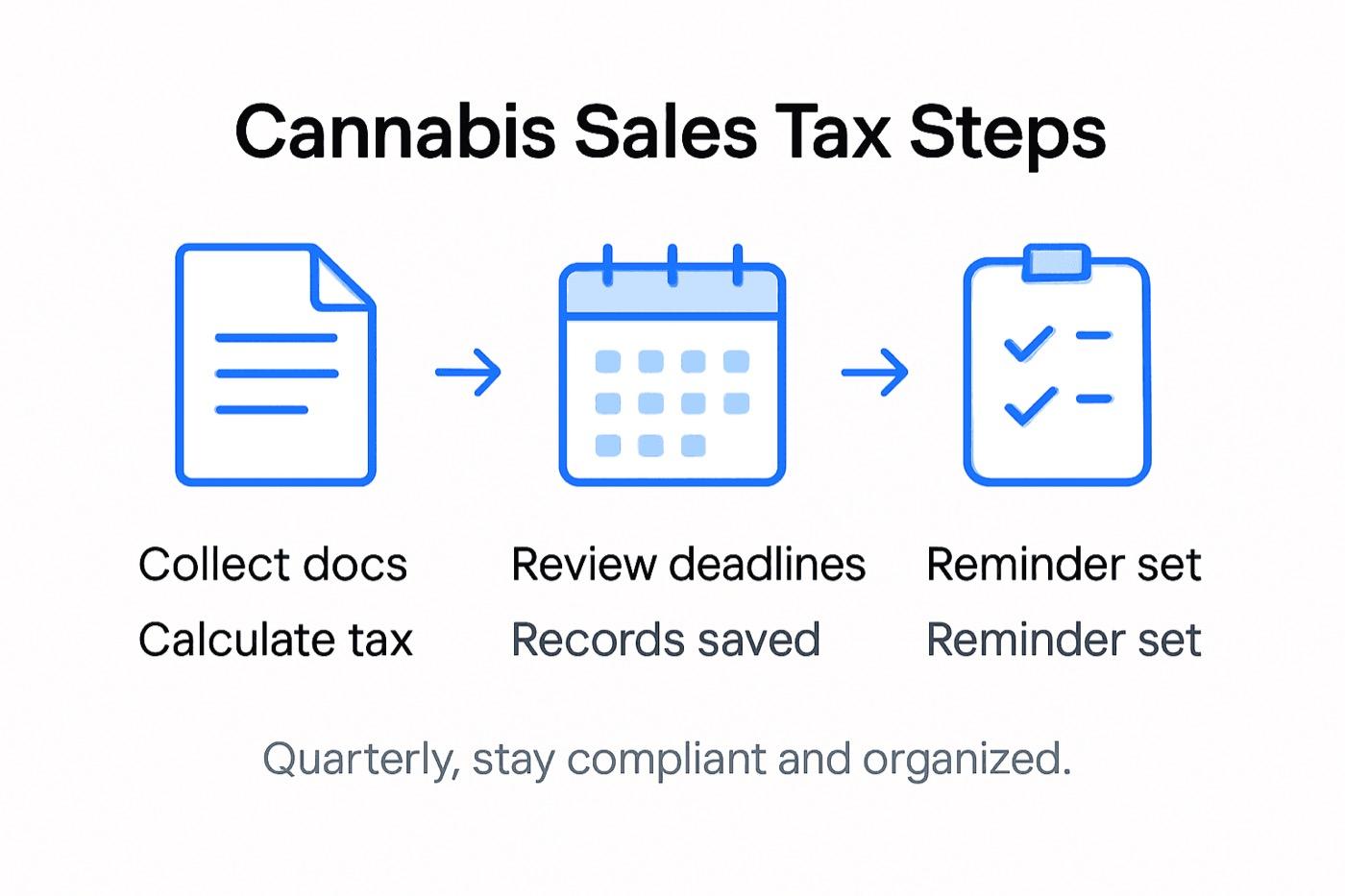
Understand the specific sales tax filing requirements that govern your jurisdiction. Most states mandate monthly or quarterly tax return submissions, with returns due regardless of whether taxable sales occurred. Cannabis businesses typically must file by the 20th day following the reporting period. Electronic filing has become the standard method, allowing businesses to schedule payments and submit documentation efficiently. Pay close attention to the specific filing frequency determined by your business volume and state regulations.
Prepare comprehensive documentation for each tax filing. Your records should include detailed sales summaries, total collected tax amounts, product category breakdowns, and precise transaction records. Some jurisdictions require separate reporting for medical and recreational cannabis sales. Always double check your calculations and ensure all required supporting documentation accompanies your tax submission. Late or incorrect filings can result in substantial financial penalties and potentially jeopardize your cannabis business license.
Pro tip: Set up automated calendar reminders at least one week before tax filing deadlines to ensure you have sufficient time to compile accurate documentation and submit timely returns.
Step 6: Verify compliance and maintain tax records
Verifying compliance and maintaining comprehensive tax records protects your cannabis business from potential regulatory challenges and financial audits. Your primary goal is to establish a systematic approach to documenting every financial transaction and ensuring alignment with state regulatory requirements.
Implement state-approved seed-to-sale tracking systems that provide comprehensive documentation throughout your cannabis supply chain. These systems create an auditable trail tracking each product from initial cultivation through final sale. Your records must include detailed transaction logs, tax collection documentation, product transfer information, and precise sales reports. Pay special attention to capturing granular details like product type, quantity, pricing, tax rates applied, and customer verification information.
Develop a robust record retention strategy that exceeds minimum state requirements. Most jurisdictions mandate keeping tax and sales records for at least four to seven years. Store both digital and physical copies of all financial documents in secure locations with multiple backup systems. Create standardized templates for record keeping that ensure consistency and completeness across all documentation. Regular internal audits can help identify potential compliance gaps before external regulatory inspections occur.
Pro tip: Conduct quarterly internal compliance reviews to proactively identify and resolve any potential recordkeeping discrepancies before they become significant regulatory issues.
Frequently Asked Questions
How can I assess cannabis sales tax rates for my dispensary?
To assess cannabis sales tax rates, compile information from local and state resources to understand your specific tax obligations. Create a dedicated spreadsheet to track tax rates for each jurisdiction quarterly, ensuring you remain compliant with changes in tax laws.
What products are taxable under cannabis sales tax regulations?
Cannabis sales tax regulations typically classify products such as flower, edibles, concentrates, and topicals differently. Review your inventory and document each product’s tax status, noting any exemptions, especially for medical cannabis users.
How do I register for sales tax permits for my cannabis business?
To register for sales tax permits, gather business formation documents, identification numbers, and local licenses. Submit these documents to your state’s department of revenue to obtain the necessary permits for collecting and remitting sales tax.
What steps should I take to implement an accurate sales tracking system?
To implement an accurate sales tracking system, choose a comprehensive seed-to-sale tracking solution that records every transaction meticulously. Ensure the system includes features for monitoring inventory, integrating tax calculations, and generating compliance reports for regulatory submission.
When do I need to file and remit cannabis sales tax payments?
You must file and remit cannabis sales tax according to your state’s specific deadlines, which are often monthly or quarterly. Set calendar reminders at least one week before filing deadlines to ensure timely submissions and avoid penalties.
How can I verify compliance and maintain accurate tax records?
To verify compliance, implement state-approved seed-to-sale tracking systems that document every transaction thoroughly. Maintain both digital and physical copies of financial documents for at least four years, and conduct quarterly internal reviews to identify any potential compliance gaps.
Recommended
- How to Handle State Cannabis Taxes for Compliance – Cannabis Business Minds
- Why Tax Compliance Matters: Complete Cannabis Guide – Cannabis Business Minds
- What Is Tax Compliance for Cannabis Businesses – Cannabis Business Minds
- Why Cannabis Tax Compliance Matters for U.S. Businesses – Cannabis Business Minds
This article is general education, not tax, legal or accounting advice. Cannabis rules change quickly; confirm how they apply to you with a qualified cannabis CPA or attorney.