Schedule 3 Cannabis Taxes: 2026 IRS Compliance Guide

2026 update: what rescheduling changed for 280E (reviewed October 2026)
Effective April 22, 2026, a DOJ/DEA final order moved marijuana covered by a qualifying state medical license (and FDA-approved marijuana drugs) to Schedule III. Section 280E only applies to Schedule I and II substances, so state-licensed medical cannabis activity is generally no longer subject to 280E going forward. Adult-use cannabis remains in Schedule I and fully subject to 280E. The DEA proceeding to reschedule all marijuana was temporarily stayed in October 2026, and Treasury/IRS guidance on transition years and mixed medical/adult-use businesses is still pending.
Check where your business stands in about a minute.
Schedule 3 cannabis taxes refer to the changed federal tax treatment resulting from the DOJ’s reclassification of FDA-approved and state-licensed medical marijuana products from Schedule I to Schedule III, effective april 22, 2026. That reclassification removes the IRC Section 280E disallowance for qualifying medical cannabis activities, a shift that directly cuts taxable income for compliant medical operators. Recreational cannabis remains Schedule I and stays fully subject to 280E. The Department of Justice, Drug Enforcement Administration, Treasury, and IRS are all active players in this regulatory shift, and each has distinct authority over how your business responds. Getting the distinction between medical and recreational treatment right is not optional. It is the foundation of every cannabis tax filing you make in 2026.
How do Schedule 3 cannabis taxes change 280E treatment?
Section 280E is the IRS code provision that blocks ordinary business deductions for businesses trafficking in Schedule I or Schedule II controlled substances. Before rescheduling, every cannabis operator, medical or recreational, faced 280E. That meant paying federal income tax on gross profit with no deduction for rent, payroll, marketing, or most operating expenses. Only cost of goods sold was deductible under IRC 471.
The DOJ reclassified medical cannabis to Schedule III effective april 22, 2026. Treasury and the IRS issued transition guidance granting full-year 280E relief for qualifying medical cannabis activities for the entire 2026 taxable year. That means a state-licensed medical dispensary can now deduct ordinary business expenses against its medical cannabis revenue. The effective tax rate drop for a well-run medical operator can be substantial.

The relief is not universal. Recreational cannabis remains Schedule I, fully subject to 280E restrictions. Adult-use operations get no deduction relief. That split creates a two-tier tax environment within the same industry.
Key facts about the 280E change:
- Medical cannabis activities under qualifying state licenses are now exempt from 280E disallowance.
- The IRS transition rule applies the relief for the full 2026 tax year, not just from april 22 forward.
- Recreational operations remain under the original 280E framework with no deduction access beyond COGS.
- Dual-license operators must segregate expenses between Schedule I and Schedule III activities.
- No retroactive relief for prior tax years has been confirmed by the IRS.
Pro Tip: Do not assume the full-year transition rule applies automatically. Your medical cannabis activities must qualify under your state license structure. Confirm with your tax counsel before filing.
What compliance requirements apply to Schedule 3 cannabis businesses?
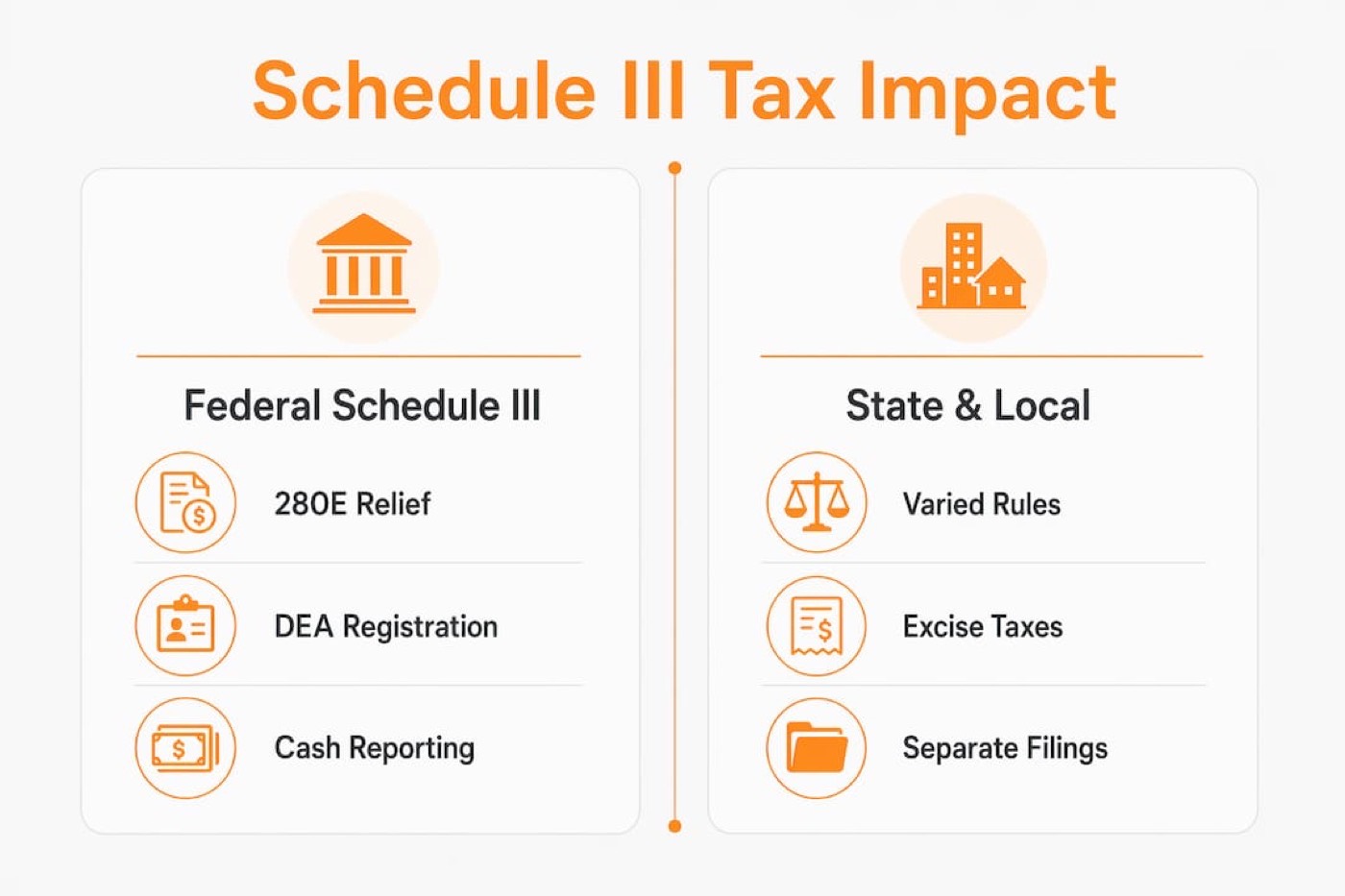
Schedule III classification changes your 280E exposure. It does not change your federal employment tax obligations. Cannabis employers must still withhold federal income tax, pay employer Social Security at 6.2%, and pay Medicare at 1.45% on all wages. Federal tax deposits must be made on time regardless of your cannabis license type. That has not changed.
Cash transaction reporting is mandatory. You must file Form 8300 for any cash payment exceeding $10,000. Cannabis businesses operate heavily in cash, which makes this a high-frequency filing obligation. Missing a Form 8300 filing draws IRS attention fast.
The IRS audit risk for cannabis businesses is five times higher than for comparable businesses in other industries. That elevated scrutiny does not decrease with Schedule III status. If anything, the complexity of dual-license expense allocation gives auditors more to examine.
Compliance steps for Schedule III operators:
- Register with the DEA. DEA registration is mandatory for all plant-touching cannabis businesses operating under Schedule III. Floor plans, labor reports, and operational documentation must be retained for a minimum of seven years.
- File Form 8300 on every qualifying cash transaction. Document the payer, amount, and date. Keep copies for audit defense.
- Maintain payroll records at the federal standard. Employer tax deposits, W-2s, and 941 filings must be current and accurate.
- Document all expense allocations. Every deduction claimed under the new Schedule III relief needs a paper trail connecting it to a qualifying medical cannabis activity.
- Do not amend prior-year returns yet. The IRS has not committed to retroactive 280E relief for years before 2026. Filing amended returns or refund claims now risks rejection and increased audit exposure.
Pro Tip: Build your DEA registration file before your first 2026 tax filing. Auditors will ask for it. Having it ready signals operational seriousness and reduces examination time.
How should dual-license operators handle expense allocation?
Dual-license operators face the hardest accounting problem in cannabis right now. You have one entity running both a Schedule III medical operation and a Schedule I recreational operation. The IRS has not issued formal guidance on how to allocate shared expenses between the two activity types. That gap is where audit risk lives.
Improper expense allocation between Schedule I recreational and Schedule III medical activities can result in denial of deductions on both sides. That is not a theoretical risk. It is the outcome auditors pursue when they find commingled records. You lose the Schedule III deduction benefit and face 280E disallowance on the recreational side simultaneously.
The practical approach is operational separation. Build separate cost centers for medical and recreational activities. Assign direct costs to each activity at the transaction level. For shared overhead, document a defensible allocation methodology and apply it consistently. Consistency matters as much as the methodology itself.
Key considerations for dual operators:
- Separate point-of-sale systems for medical and recreational sales produce the cleanest revenue records.
- Labor costs should be tracked by employee function, not just by location, to support activity-based allocation.
- Shared facility costs require a documented allocation basis, such as square footage or revenue percentage, applied uniformly across all periods.
- Separate accounting systems for Schedule I and Schedule III activities are the most defensible structure under IRS scrutiny.
- The DEA administrative hearing scheduled for june 29, 2026, may expand rescheduling to include recreational cannabis. That would change the 280E picture for adult-use operators, but no business should restructure its accounting based on an anticipated outcome.
The current absence of IRS guidance is not permission to guess. It is a signal to document your methodology thoroughly and be prepared to defend it.
How do state and local taxes interact with Schedule 3 classification?
Federal Schedule III relief does not automatically reduce your state tax burden. State tax regimes vary widely, and many states have not conformed their tax codes to federal 280E treatment. Some states already allowed ordinary business deductions for cannabis operators regardless of federal 280E restrictions. Others still disallow those deductions at the state level even after federal rescheduling.
Illinois is a useful case study. The Illinois Cannabis Regulation and Tax Act imposes excise taxes based on THC concentration, which means product formulation directly affects tax liability. Higher-potency products carry higher tax rates. That structure is independent of federal Schedule III status and requires separate compliance tracking.
| Tax Type | Federal (Schedule III Medical) | State (Varies by Jurisdiction) |
|---|---|---|
| 280E disallowance | Removed for qualifying medical | Depends on state conformity |
| Ordinary deductions | Now available for medical ops | Some states allow, some do not |
| Excise tax | Not applicable federally | Common; rates vary by state |
| THC-based tax rates | Not applicable federally | Applied in states like Illinois |
| Employment taxes | Unchanged; fully applicable | State payroll taxes apply |
Multi-state operators face the most complex picture. A dispensary group operating in California, Illinois, and Colorado encounters three distinct excise tax structures, varying conformity to federal 280E rules, and different documentation requirements. Federal Schedule III relief is one variable in a multi-variable equation.
Pro Tip: Map your state tax positions separately from your federal position. A state that decouples from federal 280E changes may still require you to add back deductions that are now federally allowed. Missing that adjustment creates a state underpayment.
What the 2026 rescheduling actually means for your tax position
The rescheduling is a genuine win for medical cannabis operators. But the professionals I have seen get into trouble are the ones who treated it as a blanket fix rather than a conditional one. The conditions matter more than the headline.
DEA registration is not a formality. It is the threshold requirement for Schedule III status. An operator without active DEA registration cannot claim the 280E exemption, regardless of state license status. I have seen businesses assume their state license is sufficient. It is not. The federal and state frameworks are parallel, not interchangeable.
The IRS audit environment will not soften because of rescheduling. IRS enforcement intensity will remain high, particularly for dual-license businesses where expense allocation is complex. The 280E exemption creates a new deduction category that auditors will examine closely. Every dollar of newly claimed deduction needs documentation that connects it to a qualifying medical activity.
The retroactive relief question is the one I watch most carefully. Assuming retroactive 280E relief without IRS confirmation risks rejected claims and increased audit exposure. The IRS has been explicit that prior-year relief is not confirmed. Filing amended returns now is a calculated risk, not a safe move.
The june 29, 2026, DEA hearing on recreational cannabis rescheduling is worth monitoring. If recreational cannabis moves to Schedule III, the entire 280E framework shifts again. Build your accounting systems to be adaptable, not locked into the current structure.
— JN
Cannabisbusinessminds resources for cannabis tax compliance
Cannabis tax compliance in 2026 requires more than knowing the rules. It requires systems that produce defensible records at the transaction level, every day.

Cannabisbusinessminds publishes specialized guides built for cannabis finance professionals managing exactly these challenges. The cannabis bookkeeping guide for 2026 covers the recordkeeping frameworks that support Schedule III deduction claims and dual-license expense allocation. For operators managing inventory cost accounting under IRC 471, the inventory costing guide provides the technical depth your CPA needs. If you are working through your overall cannabis tax liability, Cannabisbusinessminds has a structured breakdown that covers both federal and state obligations in one place.
FAQ
What is Schedule 3 cannabis tax treatment?
Schedule 3 cannabis tax treatment refers to the removal of the IRC Section 280E disallowance for state-licensed medical cannabis activities following the DOJ’s reclassification of those products from Schedule I to Schedule III, effective april 22, 2026. Recreational cannabis remains Schedule I and stays fully subject to 280E.
Does Schedule III rescheduling apply to recreational cannabis?
No. Recreational cannabis remains Schedule I and is fully subject to Section 280E tax restrictions. Only state-licensed medical cannabis activities under qualifying licenses receive the 280E exemption.
Can cannabis businesses file amended returns for prior years?
The IRS has not committed to retroactive 280E relief for years before 2026. Filing amended returns or refund claims before formal IRS guidance is issued carries meaningful audit risk and rejection exposure.
What documentation does a Schedule III cannabis operator need?
DEA registration is mandatory, along with floor plans, labor reports, and full operational records retained for a minimum of seven years. Expense allocation records connecting deductions to qualifying medical activities are required for audit defense.
How do dual-license operators separate Schedule I and Schedule III expenses?
Dual operators should build separate cost centers and accounting systems for medical and recreational activities. Shared overhead requires a documented, consistently applied allocation methodology, such as revenue percentage or square footage, to withstand IRS scrutiny.
Recommended
- 7 Essential Cannabis Tax Forms Every Business Needs – Cannabis Business Minds
- Cannabis Tax Exemption Eligibility Workflow: 2026 Guide – Cannabis Business Minds
- The Role of Tax Credits in Cannabis: 2026 Guide – Cannabis Business Minds
- Cannabis Tax Basis: What Every Finance Pro Must Know – Cannabis Business Minds
This article is general education, not tax, legal or accounting advice. Cannabis rules change quickly; confirm how they apply to you with a qualified cannabis CPA or attorney.