Cannabis Expense Categories Explained: Tax and Compliance

2026 update: what rescheduling changed for 280E (reviewed October 2026)
Effective April 22, 2026, a DOJ/DEA final order moved marijuana covered by a qualifying state medical license (and FDA-approved marijuana drugs) to Schedule III. Section 280E only applies to Schedule I and II substances, so state-licensed medical cannabis activity is generally no longer subject to 280E going forward. Adult-use cannabis remains in Schedule I and fully subject to 280E. The DEA proceeding to reschedule all marijuana was temporarily stayed in October 2026, and Treasury/IRS guidance on transition years and mixed medical/adult-use businesses is still pending.
This article was written before the order took effect. Check where your business stands in about a minute.
Did you know that some cannabis businesses face effective tax rates of up to 90 percent due to strict federal regulations? Misunderstandings about expense categories and what is truly deductible can lead to costly mistakes. With complex tax laws like Section 280E and the need for precise financial documentation, cannabis entrepreneurs must clearly separate their costs and stay vigilant. Getting this right helps protect profits and keeps operations compliant.
Key Takeaways
| Point | Details |
|---|---|
| Understanding 280E | Cannabis businesses can only deduct Cost of Goods Sold (COGS), leading to higher effective tax rates due to the restrictive nature of Section 280E. |
| Expense Categorization | Precise tracking of cultivation and operational costs is crucial for cannabis businesses to ensure compliance and maximize allowable deductions. |
| Documentation Importance | Comprehensive recordkeeping practices are essential to support expense classifications and withstand IRS scrutiny during audits. |
| Strategic Financial Planning | Developing sophisticated accounting strategies that distinguish between COGS and non-deductible expenses is vital for financial sustainability in the cannabis sector. |
Defining Cannabis Expense Categories and Myths
Navigating expense categories in the cannabis industry requires understanding complex regulatory landscapes that differ dramatically from traditional business accounting practices. Cannabis businesses face unique financial challenges due to federal tax restrictions, particularly the notorious Section 280E, which dramatically limits tax deductions for businesses trafficking controlled substances.
Expense categories in cannabis enterprises essentially break down into two primary classifications: Cost of Goods Sold (COGS) and Non-COGS Expenses. COGS represent direct production costs like cultivation materials, direct labor, and packaging expenses. Non-COGS expenses, however, face severe limitations under federal tax code, including marketing, administrative overhead, and general operational costs. Most cannabis businesses mistakenly believe they can deduct expenses similarly to other industries – but this is a critical misconception.
Common myths surrounding cannabis expense categories often revolve around tax deductibility. Many entrepreneurs incorrectly assume all business expenses are deductible, but federal regulations sharply restrict these options. Understanding the 280E Deductible COGS Factsheet can provide deeper insights into these complex rules. Successful cannabis financial management requires meticulous record-keeping, strategic expense tracking, and a nuanced understanding of IRC Section 280E’s intricate requirements.
Key expense categories cannabis businesses must track include:
- Direct cultivation expenses
- Raw material costs
- Production labor
- Packaging materials
- Inventory tracking
- Compliance-related documentation
By understanding these categories and federal restrictions, cannabis business owners can optimize their financial strategies and maintain rigorous compliance with existing tax regulations.
Common Expense Types in Cannabis Businesses
Cannabis businesses encounter a unique financial landscape with specialized expense categories that require meticulous tracking and strategic management. Unlike traditional industries, these enterprises must navigate complex regulatory requirements that significantly impact their financial operations and potential tax deductions.
The primary expense types in cannabis businesses can be strategically categorized into several critical areas: cultivation expenses, operational costs, compliance and licensing expenses, and inventory management. Cultivation expenses include direct production costs such as seeds, growing equipment, nutrients, labor for plant maintenance, and facility infrastructure. Operational costs encompass utilities, employee salaries, insurance, rent, and technology systems specific to cannabis business management.
Cannabis Accounting resources emphasize the critical nature of precise expense categorization. Compliance and licensing expenses represent another substantial financial category, involving costs related to regulatory permits, legal consultations, state and local licensing fees, security requirements, and ongoing regulatory documentation. These expenses are particularly complex due to the stringent requirements imposed by both state and federal regulatory frameworks.
Key expense types cannabis businesses must carefully track include:
- Direct cultivation materials
- Growing facility maintenance
- Security infrastructure
- Compliance documentation
- Employee training and wages
- Legal and consulting fees
- Insurance and risk management
- Technology and tracking systems
Successful cannabis financial management requires a comprehensive understanding of these expense categories, ensuring precise tracking, strategic budgeting, and maintaining rigorous compliance with evolving regulatory standards.
Section 280E and IRS Deductibility Rules
Section 280E of the Internal Revenue Code represents a significant challenge for cannabis businesses, creating a complex and restrictive tax environment that dramatically limits potential deductions. Originally designed to prevent drug traffickers from claiming tax benefits, this provision specifically targets businesses dealing with federally controlled substances, effectively creating substantial financial obstacles for legal cannabis enterprises.
Under Section 280E, cannabis businesses can only deduct Cost of Goods Sold (COGS), which means most standard business expenses like marketing, administrative salaries, and operational overhead are non-deductible. This federal restriction creates a unique tax burden where cannabis businesses can face effective tax rates significantly higher than traditional industries – sometimes approaching 70-90% of gross income instead of typical corporate tax rates.
Cannabis Tax resources highlight the critical nuances of navigating these complex regulations. The IRS strictly interprets these rules, meaning businesses must maintain meticulous documentation to prove which expenses qualify under COGS. Strategies like separating plant-touching and ancillary operations, maintaining rigorous accounting practices, and understanding precise regulatory definitions become essential for financial survival.
Key implications of Section 280E include:
- Limited tax deduction opportunities
- Higher effective tax rates
- Complex accounting requirements
- Increased financial reporting burdens
- Potential significant tax liabilities
Successful cannabis businesses must develop sophisticated financial strategies that optimize available deductions while maintaining strict compliance with these challenging federal tax regulations.
Cost of Goods Sold Versus Non-Deductible Expenses
Understanding the critical distinction between Cost of Goods Sold (COGS) and non-deductible expenses is fundamental for cannabis businesses navigating the complex tax landscape created by Section 280E. This differentiation represents the primary mechanism through which the IRS restricts tax deductions for cannabis enterprises, creating a uniquely challenging financial environment.
Cost of Goods Sold (COGS) encompasses direct production expenses that can be legitimately deducted, including materials directly related to creating a product. For cannabis businesses, this typically includes expenses like seeds, cultivation supplies, direct labor for plant production, and packaging materials. In contrast, non-deductible expenses cover virtually all other standard business operations – marketing, administrative salaries, rent, most employee wages, and general operational costs that would normally be tax-deductible in other industries.
Cannabis Accounting professionals emphasize the nuanced approach required to maximize allowable deductions. The IRS applies an exceptionally narrow interpretation of COGS, meaning businesses must meticulously document and categorize expenses. Successful cannabis enterprises develop sophisticated accounting strategies that carefully allocate expenses between COGS and non-deductible categories, potentially creating separate legal entities to optimize tax treatment.
Key differences between COGS and non-deductible expenses include:
Here’s a comparison of Cost of Goods Sold (COGS) and Non-Deductible Expenses for cannabis businesses:
| Category | COGS (Deductible) | Non-Deductible Expenses |
|---|---|---|
| Typical Costs | Cultivation supplies Packaging Direct production labor |
Marketing Admin salaries Rent Insurance |
| IRS Deductibility | Fully deductible under 280E | Not deductible under 280E |
| Tax Impact | Lowers taxable income | No effect on taxable income |
| Documentation Focus | Production tracking Inventory logs |
General operational records |
| Compliance Risk | High if misclassified | High for improper deductions |
- COGS covers direct production expenses
- Non-deductible expenses include most operational costs
- COGS can reduce taxable income
- Non-deductible expenses create additional tax burden
- Precise documentation is critical for both categories
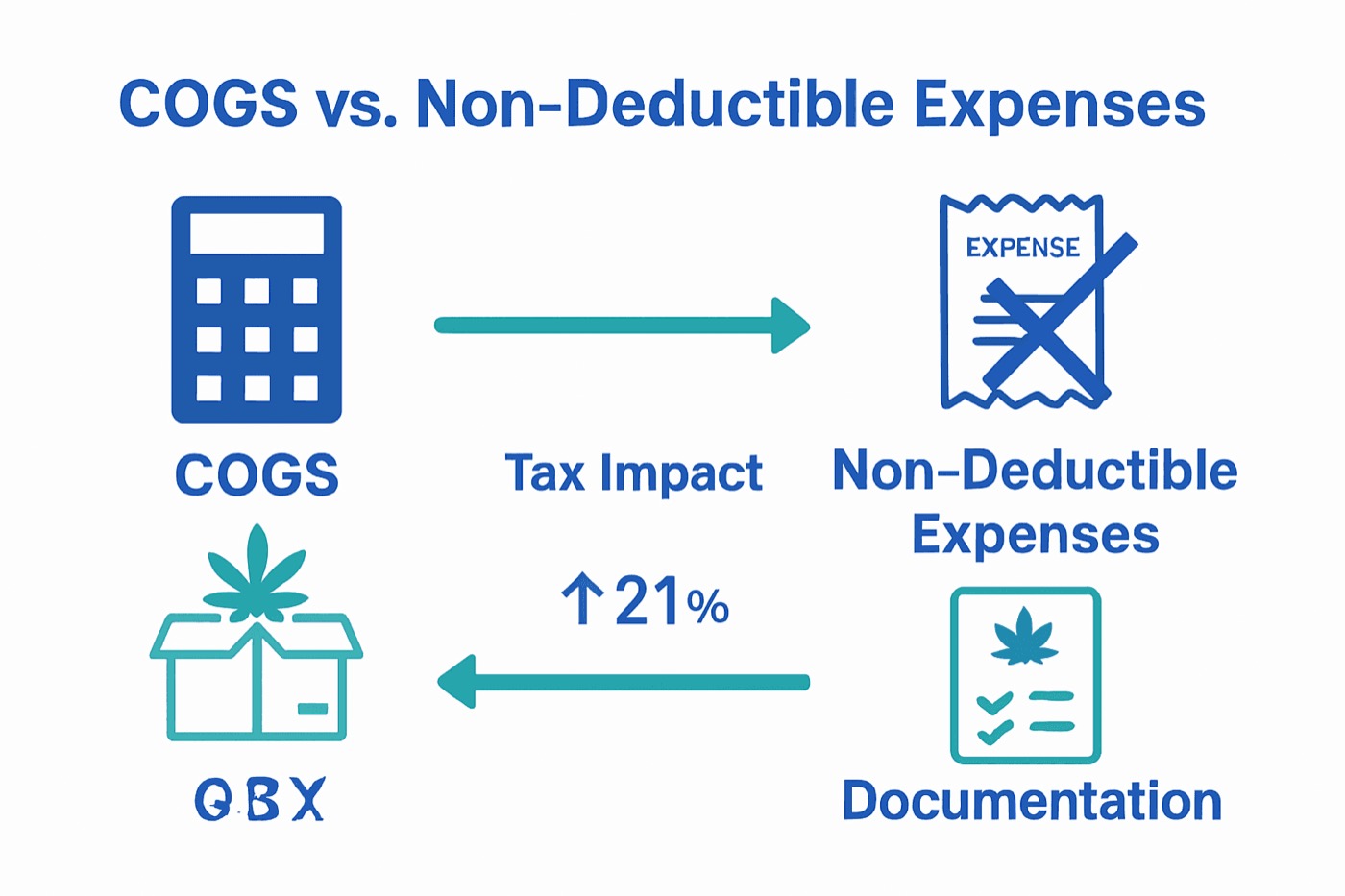
Navigating these complex regulations requires cannabis businesses to develop robust financial strategies that maximize available deductions while maintaining strict compliance with federal tax guidelines.
Recordkeeping and Documentation Requirements
In the cannabis industry, recordkeeping is not just a best practice – it’s a critical survival strategy that can make or break a business’s financial sustainability. The extraordinary complexity of tax regulations and IRS scrutiny demands an unprecedented level of documentation precision that far exceeds standard business accounting practices.
Comprehensive documentation for cannabis businesses must cover every aspect of operational expenses, with particular emphasis on distinguishing between Cost of Goods Sold (COGS) and non-deductible expenses. This means maintaining exhaustive records including detailed cultivation logs, precise inventory tracking, exact labor allocation percentages, equipment purchase documentation, and meticulously categorized expense records. Each financial transaction requires supporting documentation that can withstand potential IRS audit scrutiny.
Cannabis Tax experts recommend developing a robust documentation system that includes:
- Digital and physical receipt preservation
- Time-stamped production records
- Detailed inventory management logs
- Precise employee time tracking
- Segregated expense categorization
- Continuous reconciliation processes
- Secure backup and archive systems
Key documentation requirements include maintaining records for at least seven years, implementing cloud-based and physical backup systems, utilizing specialized cannabis accounting software, and creating clear audit trails that demonstrate the legitimate business purpose of each expense. Successful cannabis businesses treat documentation as a strategic financial defense mechanism, recognizing that meticulous record-keeping is not just about compliance – it’s about protecting the financial integrity of the entire enterprise.
Frequently Asked Questions
What are Cost of Goods Sold (COGS) in the cannabis industry?
Cost of Goods Sold (COGS) refers to direct production expenses that cannabis businesses can deduct under federal tax law. This includes costs related to seeds, cultivation supplies, direct labor for plant production, and packaging materials.
Why is Section 280E significant for cannabis businesses?
Section 280E restricts cannabis businesses from deducting most operational expenses. It limits deductions primarily to COGS, leading to significantly higher effective tax rates compared to traditional industries, making tax compliance a critical concern for these businesses.
How can cannabis businesses effectively manage their expenses?
Cannabis businesses should implement meticulous record-keeping for all expense categories, separating COGS from non-deductible expenses, and utilize specialized accounting tools to track and document every financial transaction accurately.
What documentation is required for cannabis businesses?
Cannabis businesses need to maintain comprehensive documentation, including detailed cultivation logs, inventory management records, time-stamped production records, and segregated expense records, to ensure compliance with IRS guidelines and prepare for potential audits.
Recommended
This article is general education, not tax, legal or accounting advice. Cannabis rules change quickly; confirm how they apply to you with a qualified cannabis CPA or attorney.