Role of Tax Strategy in Cannabis Profitability

2026 update: what rescheduling changed for 280E (reviewed October 2026)
Effective April 22, 2026, a DOJ/DEA final order moved marijuana covered by a qualifying state medical license (and FDA-approved marijuana drugs) to Schedule III. Section 280E only applies to Schedule I and II substances, so state-licensed medical cannabis activity is generally no longer subject to 280E going forward. Adult-use cannabis remains in Schedule I and fully subject to 280E. The DEA proceeding to reschedule all marijuana was temporarily stayed in October 2026, and Treasury/IRS guidance on transition years and mixed medical/adult-use businesses is still pending.
This article was written before the order took effect. Check where your business stands in about a minute.
Most American cannabis businesses face tax rates that can be nearly twice as high as other industries. The unique clash between federal and state regulations creates financial headaches for any company trying to stay compliant. Understanding how tax strategy works in this evolving space means you can protect profits, meet compliance rules, and avoid costly mistakes that threaten your business’s future.
Key Takeaways
| Point | Details |
|---|---|
| Tax Strategy Importance | Effective tax strategies in the cannabis industry are crucial for minimizing liabilities while ensuring compliance with complex regulations. |
| Section 280E Challenges | Cannabis businesses must navigate Section 280E, which limits deductible expenses, necessitating detailed expense tracking and accounting. |
| Cost Accounting Necessities | Robust cost accounting techniques are essential for maximizing deductions and maintaining profitability under stringent tax regulations. |
| Compliance and Risks | Failure to implement strong tax strategies can lead to significant financial risks, including excessive liabilities and potential legal exposure. |
Defining Tax Strategy in Cannabis Industry
A tax strategy in the cannabis industry represents a comprehensive financial approach designed to manage and minimize tax liabilities while ensuring full regulatory compliance. Unlike traditional business tax planning, cannabis enterprises face unique challenges due to complex federal and state regulations. Tax structures in cannabis require meticulous planning to navigate the intricate legal landscape effectively.
Cannabis businesses encounter extraordinary tax complexities that distinguish their financial management from other industries. The primary challenge stems from Section 280E of the Internal Revenue Code, which prohibits cannabis businesses from deducting standard operating expenses. This restriction means companies must develop sophisticated strategies to optimize their financial positioning and protect profitability. Successful tax strategies involve detailed record-keeping, strategic expense allocation, and proactive compliance management.
Effective tax strategies for cannabis enterprises typically encompass several key components:
- Precise Expense Classification: Carefully documenting and categorizing expenses to maximize allowable deductions
- Cost Accounting Techniques: Implementing robust accounting methods that align with IRS guidelines
- Entity Structure Optimization: Selecting business structures that provide maximum tax efficiency
- State-Level Compliance: Understanding and adapting to varying state tax regulations
Professional tax advisors specializing in cannabis businesses play a critical role in developing these nuanced strategies. Their expertise helps organizations navigate the complex regulatory environment, minimize tax burdens, and maintain financial sustainability in an industry characterized by significant legal and financial uncertainty.
Navigating Section 280E and IRC 471
Section 280E and IRC 471 represent two critical tax provisions that dramatically impact cannabis business financial strategies. Key enforcement guidelines from the IRS highlight the significant challenges these regulations pose for cannabis enterprises seeking to maintain profitability while ensuring strict regulatory compliance.
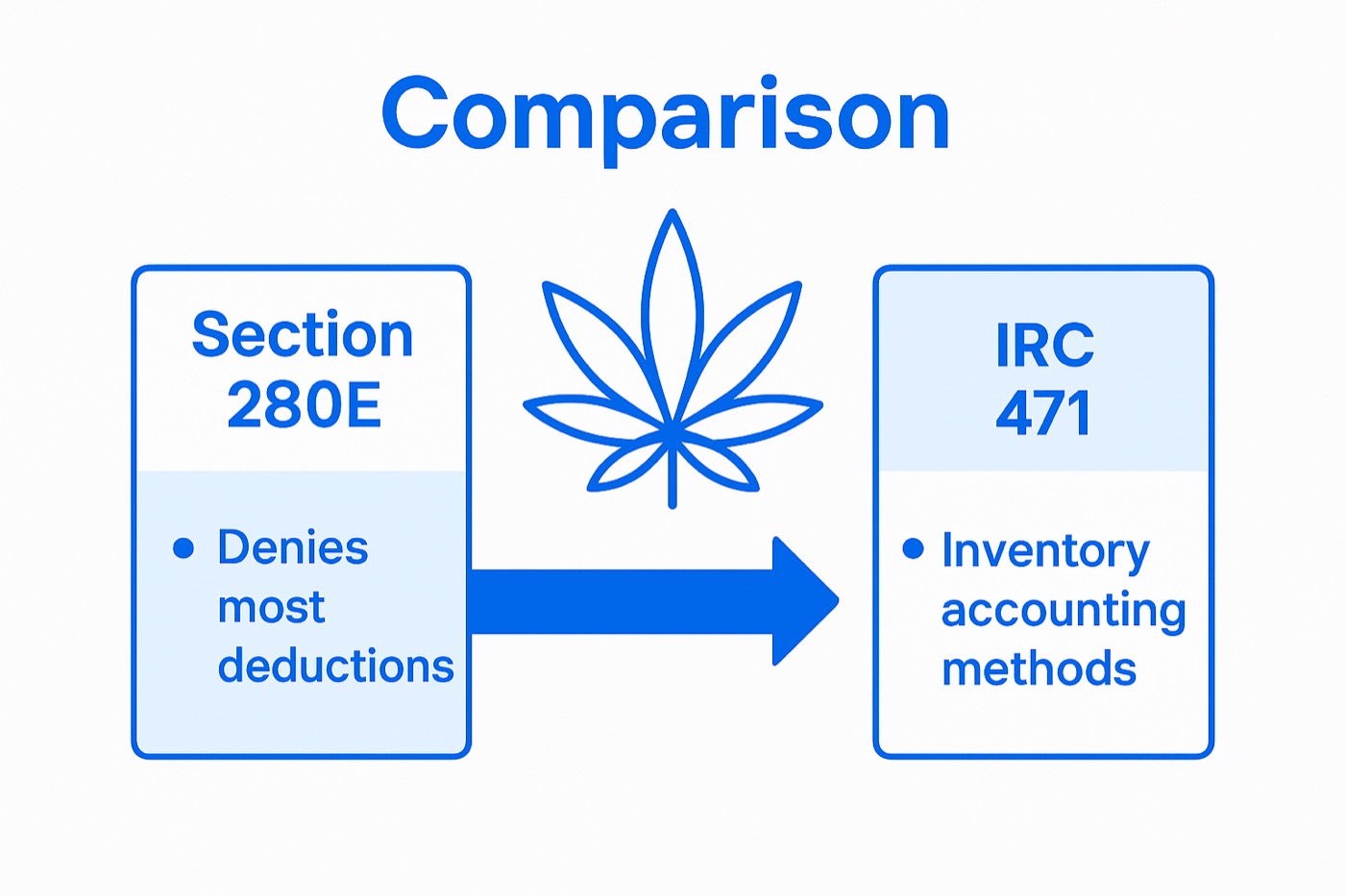
Under Section 280E, cannabis businesses are prohibited from deducting typical operating expenses, creating a unique tax burden that substantially increases their effective tax rate. This restriction means companies can only deduct expenses directly related to the cost of goods sold (COGS), forcing businesses to develop sophisticated accounting strategies. Cost accounting becomes paramount, with companies required to meticulously track and allocate expenses to maximize their allowable deductions.
IRC 471© provides some potential relief by allowing small cannabis businesses to use simplified inventory accounting methods. This provision enables smaller enterprises to:
- Reduce complex accounting requirements
- Potentially minimize tax liabilities
- Simplify financial reporting processes
- Adapt accounting methods to their specific operational scale
Professional tax advisors specializing in cannabis regulations play a crucial role in helping businesses navigate these complex provisions. Recent legal updates demonstrate the ongoing challenges in interpreting and applying these tax regulations, underscoring the importance of staying informed and proactively managing tax strategies in this evolving legal landscape.
Effective Tax Planning Methods for Cannabis
Developing a comprehensive tax strategy is crucial for cannabis businesses seeking to optimize their financial performance and minimize tax liabilities. Tax planning for dispensaries requires a multifaceted approach that goes beyond traditional business accounting practices, considering the unique regulatory challenges specific to the cannabis industry.

Successful tax planning involves several strategic components. Cost of Goods Sold (COGS) becomes a critical focus, as businesses must carefully document and allocate expenses to maximize allowable deductions under Section 280E. This requires meticulous record-keeping and a deep understanding of what expenses can be legitimately included in COGS calculations. Cannabis enterprises must develop sophisticated accounting systems that can withstand potential IRS scrutiny while optimizing their tax positioning.
Key tax planning methods for cannabis businesses include:
- Entity Structuring: Strategically organizing business entities to minimize tax exposure
- Detailed Expense Tracking: Implementing robust accounting systems that precisely document allowable expenses
- State-Level Tax Optimization: Understanding and leveraging variations in state tax regulations
- Vertical Integration Strategies: Exploring business models that can maximize tax efficiency
- Proactive Compliance Management: Maintaining up-to-date knowledge of changing tax regulations
Professional tax advisors specializing in cannabis businesses play a crucial role in developing these nuanced strategies. Their expertise helps organizations navigate complex regulatory environments, ultimately protecting financial sustainability and maximizing potential profitability in an industry characterized by significant legal and financial challenges.
Compliance Requirements for Cannabis Businesses
Compliance in the cannabis industry represents a complex and multifaceted challenge that demands meticulous attention to legal and regulatory details. Key enforcement guidelines from the IRS highlight the intricate compliance landscape that cannabis businesses must navigate to remain operational and financially viable.
Regulatory Compliance encompasses multiple critical areas for cannabis enterprises. Businesses must maintain rigorous documentation, implement robust accounting systems, and develop comprehensive tracking mechanisms for all financial transactions. This includes precise inventory management, detailed expense reporting, and strict adherence to state and federal regulations that govern cannabis operations.
Critical compliance requirements for cannabis businesses include:
- Licensing Verification: Maintaining current and valid business licenses
- Inventory Tracking: Implementing comprehensive seed-to-sale tracking systems
- Financial Record Maintenance: Documenting all financial transactions with exceptional detail
- Tax Reporting: Submitting accurate and timely tax documentation
- Product Testing Compliance: Ensuring all products meet state-mandated safety standards
Recent legal updates demonstrate the evolving nature of compliance challenges in the cannabis industry. Professional legal and tax advisors specializing in cannabis regulations play a crucial role in helping businesses interpret and implement these complex requirements, ultimately protecting organizations from potential legal and financial risks.
Financial Risks of Poor Tax Strategy
Poor tax strategy in the cannabis industry can create catastrophic financial consequences that extend far beyond simple monetary losses. Understanding potential tax exposure becomes critical for cannabis businesses seeking to maintain financial stability and regulatory compliance.
Financial Vulnerability emerges through multiple complex channels when cannabis businesses neglect comprehensive tax planning. Inadequate tax strategies can result in substantial unexpected tax assessments, significant penalties, potential business seizures, and even criminal investigations. The unique regulatory environment surrounding cannabis enterprises means that tax mistakes are often magnified, with potential consequences that can quickly escalate beyond standard business risks.
Key financial risks associated with poor tax strategy include:
- Excessive Tax Liabilities: Unexpected tax assessments that can consume business profits
- Penalty Accumulation: Compounding financial penalties for incorrect reporting
- Operational Disruption: Potential business license revocation or temporary shutdown
- Legal Exposure: Increased risk of audits and potential legal proceedings
- Credit and Funding Limitations: Reduced access to financial resources and investment
Comprehensive tax liability analysis reveals that cannabis businesses operating without strategic tax planning face substantially higher financial risks. Professional tax advisors specializing in cannabis regulations can help organizations develop proactive strategies that mitigate these potential financial vulnerabilities, ultimately protecting the business’s long-term sustainability and profitability.
Frequently Asked Questions
What is a tax strategy in the cannabis industry?
A tax strategy in the cannabis industry refers to a comprehensive approach aimed at managing and minimizing tax liabilities while ensuring compliance with regulatory requirements unique to cannabis businesses.
How does Section 280E affect cannabis businesses?
Section 280E prohibits cannabis businesses from deducting standard operating expenses, significantly increasing their effective tax rate and necessitating sophisticated tax strategies to optimize financial positioning.
What are some effective tax planning methods for cannabis enterprises?
Effective tax planning methods include careful expense tracking, entity structuring for tax efficiency, understanding state-level tax regulations, and implementing cost accounting techniques to maximize deductions under Section 280E.
Why is compliance important for cannabis businesses?
Compliance is crucial for cannabis businesses to maintain legal operation, avoid penalties, and protect financial viability, requiring rigorous documentation, accurate tax reporting, and adherence to regulatory standards.
Recommended
- Tax Exposure Cannabis – Impact on US Businesses – Cannabis Business Minds
- Cannabis Tax Professionals: Complete Role Breakdown – Cannabis Business Minds
- Cannabis Financial Planning Explained: Key U.S. Requirements – Cannabis Business Minds
- What Is Tax Liability for Cannabis? Complete Breakdown – Cannabis Business Minds
- Corporate Tax Planning Explained: UK Business Essentials
This article is general education, not tax, legal or accounting advice. Cannabis rules change quickly; confirm how they apply to you with a qualified cannabis CPA or attorney.