Explaining non-deductible cannabis expenses: A U.S. guide

2026 update: what rescheduling changed for 280E (reviewed October 2026)
Effective April 22, 2026, a DOJ/DEA final order moved marijuana covered by a qualifying state medical license (and FDA-approved marijuana drugs) to Schedule III. Section 280E only applies to Schedule I and II substances, so state-licensed medical cannabis activity is generally no longer subject to 280E going forward. Adult-use cannabis remains in Schedule I and fully subject to 280E. The DEA proceeding to reschedule all marijuana was temporarily stayed in October 2026, and Treasury/IRS guidance on transition years and mixed medical/adult-use businesses is still pending.
Check where your business stands in about a minute.
Running a cannabis business while federally legal or state-legal is a tax trap unlike anything else in American commerce. Explaining non-deductible cannabis expenses is not just an accounting exercise. It is survival planning. Under Internal Revenue Code Section 280E, cannabis businesses classified as Schedule I traffickers cannot deduct ordinary business expenses the way every other industry can, meaning your rent, payroll, utilities, and marketing costs do not reduce your federal taxable income. Effective federal tax rates for cannabis businesses have reached as high as 80%, turning profitable dispensaries into tax-insolvent operations. This guide cuts through that confusion with precise, actionable clarity.
Table of Contents
- How section 280E creates non-deductible cannabis expenses
- Clarifying cost of goods sold under IRC section 471 for cannabis businesses
- Distinguishing deductible expenses from permanently non-deductible costs
- Impact of medical marijuana rescheduling on deductible expenses
- Practical strategies for managing non-deductible expenses and tax exposure
- Why 280E’s rigid tax treatment demands strategic clarity, not compromise
- Explore expert cannabis accounting and tax services
- Frequently asked questions
How section 280E creates non-deductible cannabis expenses
Section 280E of the Internal Revenue Code was originally enacted in 1982 to block drug dealers from deducting business expenses after a court allowed a cocaine dealer to write off his scale and telephone. Congress made the rule permanent, and it now applies directly to any business that traffics in Schedule I or Schedule II controlled substances, which includes cannabis under federal law regardless of state legality.
The practical result is severe. Under 280E, cannabis businesses cannot deduct the same expenses every other business takes for granted. Understanding why cannabis taxes are so disproportionate begins with this list of permanently non-deductible operating expenses:
- Retail rent and lease payments
- Payroll for budtenders, managers, and administrative staff
- Utility costs for retail and administrative spaces
- Marketing, advertising, and promotional costs
- Insurance premiums for business operations
- Professional fees for legal, accounting, and consulting services outside production
The only mechanism available to reduce taxable income is Cost of Goods Sold (COGS). COGS is not a deduction under Section 162. It is an offset to gross receipts under IRC Section 61, meaning it reduces what counts as gross income before the deduction rules even apply. That distinction is critical.
“If your cannabis business generates $2 million in revenue and spends $1.5 million operating it, your federal taxable income is not $500,000. It could easily be $1.4 million or more depending on how well you’ve allocated costs into COGS. That is the 280E trap.”
The resulting tax exposure for cannabis businesses is staggering. Dispensaries routinely face effective federal tax rates exceeding 70%, and those who do not structure their accounting correctly can find themselves paying taxes on income they never actually kept.
Clarifying cost of goods sold under IRC section 471 for cannabis businesses
With the strict limits of 280E clarified, we now examine the legal accounting methods that cannabis businesses can use to minimize taxable income by maximizing COGS. This is where IRC Section 471 becomes your most valuable tool.
IRC Section 471 governs how businesses value inventory. For cannabis companies, using it correctly means capturing more costs inside COGS rather than leaving them exposed as non-deductible operating expenses. Cannabis businesses qualifying as small business taxpayers can use IRC Section 471© to allocate more expenditures into COGS, reducing federal taxable income. The $32 million gross receipts threshold for small business taxpayer status makes this election available to most single-state or regional operators.

Here is how costs break down under IRC 471:
Direct costs (always includable in COGS):
- Seeds, clones, and raw plant material
- Labor directly tied to cultivation, trimming, extraction, and packaging for production
- Production-related packaging materials
- Direct materials used in manufacturing cannabis products
Indirect costs (allocable to COGS with proper documentation):
- Portion of facility rent attributable to cultivation or production space
- Utilities serving production areas, allocated by metered usage or engineering estimate
- Depreciation on equipment used in production
- Supervisory labor for production staff, allocated by time studies
The allocation is the key. You cannot simply claim 100% of your rent as a COGS cost. You must demonstrate, with documentation, what percentage of your facility is used for production versus retail or administrative purposes.
| Cost category | Includable in COGS | Documentation required |
|---|---|---|
| Cultivation labor | Yes | Time sheets, job descriptions |
| Retail budtender wages | No | N/A |
| Production facility rent | Partial | Floor plan, square footage analysis |
| Administrative office rent | No | N/A |
| Production equipment depreciation | Yes | Asset schedule, usage logs |
| Marketing expenses | No | N/A |
| Utilities (production area) | Partial | Sub-meters or engineering estimate |
For a deeper breakdown of how this accounting works in practice, the cannabis COGS guide covers the mechanics of what qualifies and how to document it.
Pro Tip: Proper cost segregation and detailed indirect cost allocation studies typically return 5x to 18x their cost in federal tax savings. A $15,000 cost segregation study that shifts $300,000 in overhead into COGS pays for itself many times over, and it gives you a defensible, auditable record.
Steps to maximize COGS under IRC 471:
- Commission a formal floor plan analysis distinguishing production, retail, and administrative square footage
- Implement time-tracking for all employees to separate production hours from non-production hours
- Install utility sub-meters or obtain engineering estimates for production area energy use
- Document all indirect costs with clear allocation methodology before filing
- Review your small business taxpayer eligibility annually for the simplified 471© election
A specialized cost accounting framework can make this process repeatable and audit-ready.
Distinguishing deductible expenses from permanently non-deductible costs
Understanding which expenses can and cannot be included in COGS leads us to the complex reality of navigating medical versus recreational cannabis accounting after recent regulatory changes.
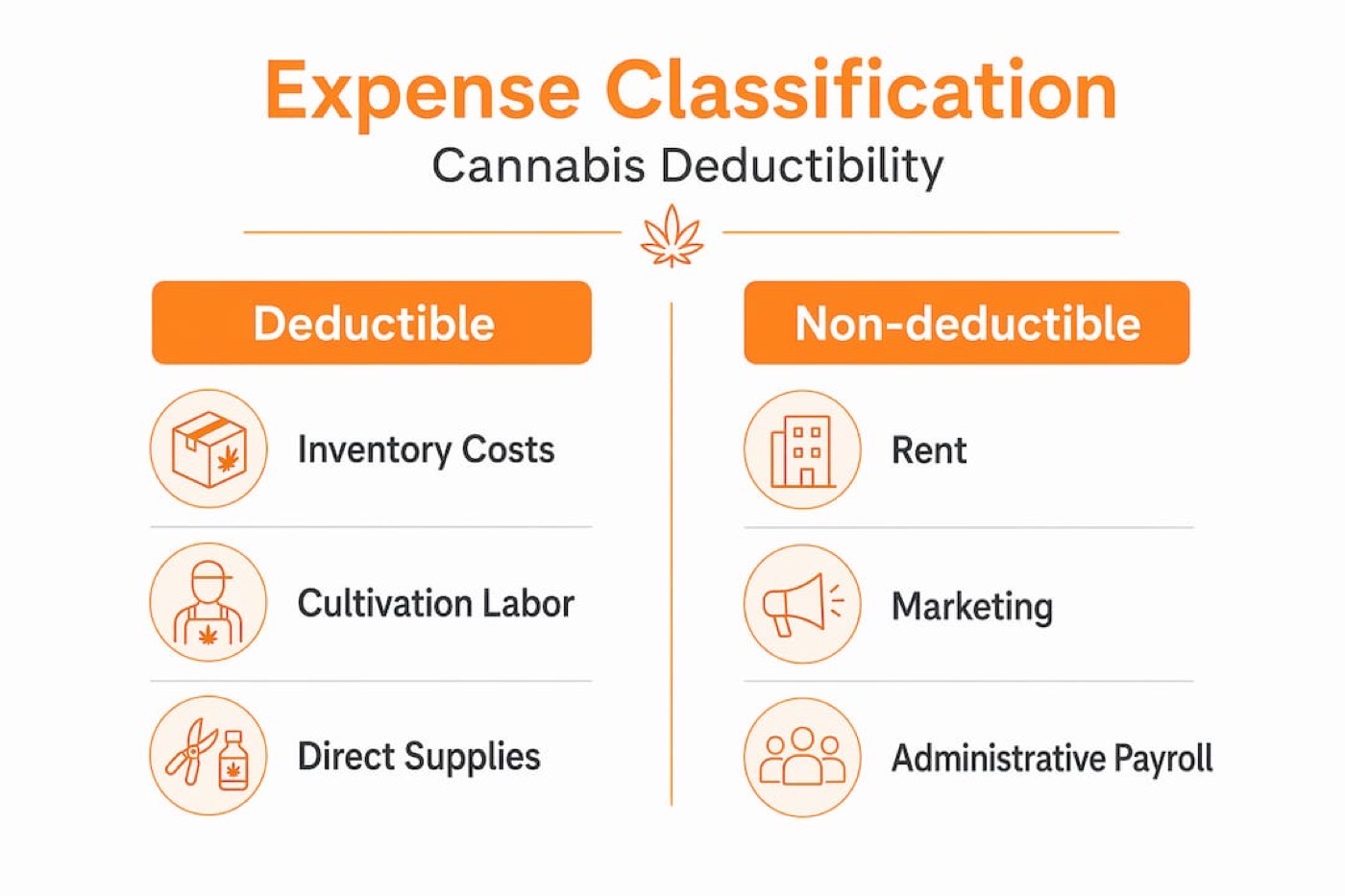
Not every gray area is worth pursuing. Some cannabis expenses are permanently off the table, and treating them as COGS allocations under any rationale invites audit risk. Tax professionals warn that failing to properly allocate overhead between medical and recreational cannabis streams leads to audit risks and tax distortion.
Here is a clear breakdown of what falls where:
| Expense type | Treatment | Common misclassification |
|---|---|---|
| Cultivation labor | COGS (direct) | Misclassified as operating payroll |
| Retail staff wages | Non-deductible | Incorrectly split into COGS |
| Production facility rent | COGS (partial) | Full amount claimed in COGS |
| Retail space rent | Non-deductible | Partial COGS claimed without support |
| Marketing | Non-deductible | No COGS path exists |
| Administrative salaries | Non-deductible | Occasionally misallocated as management |
| Extraction equipment depreciation | COGS | Often omitted entirely |
| Business insurance | Non-deductible | Sometimes incorrectly allocated |
Understanding indirect expenses in cannabis accounting requires recognizing that the line between production and retail is the most litigated distinction in cannabis tax law.
Pro Tip: When building your allocation methodology, assume the IRS will ask you to justify every dollar. Document your reasoning before you file, not after.
Recreational cannabis operations remain fully non-deductible under 280E as of 2026. Medical cannabis, as explained below, now operates under different federal rules following the April 2026 DOJ rescheduling.
Impact of medical marijuana rescheduling on deductible expenses
With this regulatory shift in mind, the final critical piece is how to practically apply these accounting nuances to manage tax exposure effectively.
In April 2026, the Department of Justice completed the rescheduling of state-licensed medical marijuana from Schedule I to Schedule III of the Controlled Substances Act. This is the most significant change to cannabis federal tax treatment since 280E was applied to the industry. Medical marijuana rescheduled to Schedule III permits deductions if obtained by prescription, while recreational remains non-deductible.
What this means in practice:
- Medical cannabis businesses no longer fall under 280E for their medical operations, provided the product is legally procured via prescription
- Standard business expense deductions, including rent, payroll, and utilities, become available for medical cannabis activities
- Taxpayers may now claim medical expense deductions on Schedule A when cannabis is prescribed by a physician
- Recreational cannabis remains Schedule I and continues to carry the full 280E non-deduction burden
The compliance challenge is real. If your dispensary sells both medical and recreational products, you now operate under two entirely different federal tax regimes simultaneously.
Steps to separate your medical and recreational operations for tax compliance:
- Create separate cost centers or legal entities for medical and recreational product lines
- Track all revenue, labor, rent, and overhead by product category
- Allocate shared costs, like a mixed-use facility, by documented usage percentage
- Maintain inventory records that distinguish medical from recreational product at every stage
- Work with legal counsel to confirm your state’s medical program qualifies under the 2026 federal rescheduling guidelines
Key compliance fact: Businesses that commingle medical and recreational expenses risk having the IRS treat all activity as Schedule I, eliminating the deduction benefit entirely and triggering back taxes with penalties.
For an in-depth look at how Schedule III rescheduling changes 280E obligations, the analysis covers both the opportunity and the compliance risk.
Practical strategies for managing non-deductible expenses and tax exposure
Bringing these strategies together clarifies how to navigate non-deductible expense challenges while meeting federal compliance requirements.
Cannabis businesses cannot deduct their way out of 280E. But they can account their way into a significantly lower tax burden through disciplined, documented cost management. Here is a practical framework:
-
Maximize COGS through production overhead segmentation. Every dollar of production-related indirect cost captured in COGS is a dollar removed from taxable gross profit. Start with rent allocation by square footage and labor allocation by time study.
-
Consider a management company structure. A separate management company that provides services to your cannabis entity can legitimately receive payments for services. Those payments may be deductible at the management company level since that entity does not traffic in cannabis. This structure requires careful legal setup and must reflect actual services rendered.
-
Build defensible documentation systems. Floor plans, time-tracking records, utility sub-metering, and written allocation methodologies are not optional. They are the difference between a clean audit and a large disallowance.
-
Prepare for elevated audit scrutiny. Cannabis businesses are a known IRS enforcement priority. Your records must be audit-ready from day one.
-
Understand the collection risk. The IRS disregards 280E-disallowed expenses in collection potential calculations, often pushing tax liabilities beyond actual cash flow and creating insolvency risk. This is not just a tax planning issue. It is a solvency issue.
Pro Tip: Advanced cost segregation studies on cultivation and production facilities routinely yield multi-fold tax savings. Do not treat them as optional expenses. Treat them as required infrastructure for any cannabis business with more than $1 million in annual revenue.
Managing tax strategy for cannabis profitability means accepting that federal law is not going to give you the deductions other businesses take for granted and building your entire financial model around that constraint. The businesses that survive 280E are the ones that master cannabis accounting at the cost-allocation level, not just the bookkeeping level.
Why 280E’s rigid tax treatment demands strategic clarity, not compromise
Here is the uncomfortable truth that most cannabis tax articles dance around: Section 280E is not a tough tax rule with creative workarounds. It is a structural financial barrier with no true equivalent in any other legal industry in America. There is no other sector where a fully licensed, state-regulated business paying employees, rent, and taxes on a physical storefront cannot deduct those costs from federal income.
Conventional deduction logic fails completely here. The businesses that get into serious trouble are the ones that treat 280E like a gray area to be negotiated, finding soft allocation rationales, claiming administrative employees as production workers, or stretching COGS definitions beyond what the documentation supports. The IRS audits cannabis businesses at a disproportionate rate, and they arrive prepared.
What makes this particularly punishing is what 280E creates in terms of taxable income: a fictional taxable income model forcing operators into chronic tax arrearages and insolvency despite actual cash flow realities. You can be generating real cash and still owe more in taxes than you earned after expenses. That is not hyperbole. That is the documented outcome for underprepared cannabis operators.
The only rational response is hard-nosed cost accounting. Accept the constraint. Build your entity structure, your documentation systems, and your COGS methodology as if the IRS will audit every return. Pursue management company structures only with proper legal review. Separate medical and recreational operations cleanly now that the 2026 rescheduling makes the distinction legally meaningful.
This is not about tax exposure cannabis businesses can minimize with clever strategy. It is about making every allocable dollar count, defending it with documentation, and treating anything without paper support as a liability, not an asset.
Explore expert cannabis accounting and tax services
Navigating 280E and IRC 471 is not something you figure out once and move on from. The rules are changing with the 2026 rescheduling, IRS enforcement is active, and the cost of getting this wrong is existential for most cannabis businesses.

Cannabis Business Minds provides specialized guides, tools, and cannabis accounting resources built specifically for the legal and financial realities of the U.S. cannabis industry. Whether you need to build a rigorous cost accounting framework for COGS optimization under IRC 471 or want a cannabis budgeting approach that accounts for your non-deductible expense reality, the resources here are designed for finance professionals who need precision, not generalities. The earlier you build these systems, the lower your audit risk and your effective tax rate.
Frequently asked questions
What expenses can cannabis businesses deduct under IRC Section 280E?
Cannabis businesses cannot deduct ordinary business expenses like rent or payroll under 280E, but can reduce gross receipts by cost of goods sold, which includes direct production costs and some allocated indirect expenses per IRC 471 rules. 280E disallows ordinary business expense deductions except for COGS, which is an offset to gross receipts, not a standard deduction.
How does the DOJ 2026 rescheduling affect cannabis expense deductibility?
The DOJ’s April 2026 rescheduling moved state-licensed medical marijuana to Schedule III, meaning taxpayers who obtain medical marijuana via prescription can now deduct related business expenses, but recreational remains Schedule I and is non-deductible under federal tax law.
What records are required to support indirect costs allocated to COGS?
Cannabis businesses must maintain detailed documentation such as floor plans showing production versus administrative space, time studies for labor allocation, and utility sub-metering or engineering estimates. Proper cost allocation requires these records to support any indirect cost inclusion in COGS.
Can cannabis businesses negotiate tax payments using actual cash flow if expenses are non-deductible?
No. IRS policy upheld by Tax Court requires disregarding 280E non-deductible expenses when calculating reasonable collection potential, forcing businesses to negotiate tax liabilities based on a fictional income model rather than actual cash flow, which regularly creates insolvency risk.
Recommended
- Cannabis Expense Categories Explained: Tax and Compliance – Cannabis Business Minds
- Understanding indirect tax on cannabis: a guide for U.S. operators – Cannabis Business Minds
- 7 Key Eligible Business Expenses for Cannabis Companies – Cannabis Business Minds
- Indirect expenses in cannabis: Accounting and tax clarity – Cannabis Business Minds
This article is general education, not tax, legal or accounting advice. Cannabis rules change quickly; confirm how they apply to you with a qualified cannabis CPA or attorney.