Cannabis COGS explained: your essential compliance guide
2026 update: what rescheduling changed for 280E (reviewed October 2026)
Effective April 22, 2026, a DOJ/DEA final order moved marijuana covered by a qualifying state medical license (and FDA-approved marijuana drugs) to Schedule III. Section 280E only applies to Schedule I and II substances, so state-licensed medical cannabis activity is generally no longer subject to 280E going forward. Adult-use cannabis remains in Schedule I and fully subject to 280E. The DEA proceeding to reschedule all marijuana was temporarily stayed in October 2026, and Treasury/IRS guidance on transition years and mixed medical/adult-use businesses is still pending.
Check where your business stands in about a minute.
For cannabis business owners, cost of goods sold is not just an accounting line item. It is the single most important number on your financial statement, because under IRC Section 280E, COGS is essentially the only major deductible offset available to federally illegal cannabis businesses. Get it wrong, and you face audit exposure, inflated tax bills, and potential penalties that can cripple an otherwise profitable operation. This guide walks you through exactly what COGS includes, how to calculate it correctly, which regulatory frameworks apply, and what changes on the horizon could reshape your strategy.
Table of Contents
- What is cost of goods sold (COGS) in cannabis?
- Core components: what counts as cannabis COGS?
- COGS calculation in practice: methods and compliance differences
- Regulatory nuances: federal, state, and GAAP requirements
- Recent changes and what’s next for cannabis COGS
- Perspective: why COGS compliance is make-or-break and what most miss
- Get expert help for cannabis COGS and compliance
- Frequently asked questions
Key Takeaways
| Point | Details |
|---|---|
| COGS defines profitability | Calculating COGS accurately is essential for minimizing cannabis tax and maximizing legal profit. |
| Direct costs only | Only direct production costs are includable in cannabis COGS, not general business expenses. |
| Compliant methods matter | Method and documentation choices in COGS calculation can make the difference in surviving a tax audit. |
| Rules are changing | New regulations could alter who qualifies for COGS deductions—planning ahead is required for compliance. |
| Expert help recommended | Specialist cannabis accountants and tax advisors help avoid pitfalls that can trigger costly audits or penalties. |
What is cost of goods sold (COGS) in cannabis?
COGS represents the direct costs tied to producing or acquiring the products your cannabis business sells during a given period. For a dispensary, that means the wholesale cost of flower, edibles, or concentrates you purchased and then sold. For a cultivator or manufacturer, it means the full cost of growing, processing, and packaging your products.
In most industries, businesses can deduct a wide range of operating expenses: salaries, rent, advertising, professional fees. Cannabis businesses operating under federal law cannot. Because cannabis remains a Schedule I controlled substance under federal law (as of 2026), Section 280E disallows deductions for most ordinary business expenses. The one carve-out? COGS, the primary deductible offset under 280E.
This is why calculating cannabis COGS correctly is not an optional accounting exercise. It is a survival strategy. A business that overclaims COGS without documentation invites IRS scrutiny. A business that underclaims COGS by miscategorizing direct costs as operating expenses leaves real money on the table and pays taxes on income it should not owe.
“In cannabis, COGS isn’t just about tracking product costs. It is the boundary between what you owe and what you keep.”
Common costs eligible for inclusion:
- Raw materials purchased for production
- Direct labor tied to growing, trimming, and packaging
- Rent and utilities for production facilities
- Equipment depreciation for production-specific assets
- Quality control and testing tied directly to production
Common costs that do NOT belong in COGS:
- General administrative (G&A) salaries and overhead
- Marketing and advertising spend
- Legal fees unrelated to production
- Corporate office rent and utilities
The CPA’s role in compliance becomes especially clear when you realize that the line between “direct production cost” and “operating expense” is not always obvious and the IRS scrutinizes it closely.
Core components: what counts as cannabis COGS?
Once you understand why COGS matters, you need a precise inventory of what belongs inside it. The IRS and cannabis-specific accounting guidance give us a framework, but the details require careful attention.
Direct costs includable in COGS for cannabis operations include raw materials such as seeds, nutrients, growing media, and soil. Direct labor covers everyone on the production floor: cultivators, trimmers, extraction technicians, and packaging staff. Facility costs like rent and utilities are included only for the space and square footage directly used in production. Equipment depreciation and maintenance for production-specific machinery also qualify.

What gets operators in trouble most often is the gray area. Consider a facility manager who splits time between the grow room and administrative tasks. Only the portion of their salary tied to direct production qualifies for COGS. The rest is an operating expense that 280E disallows. Similarly, certain edge cases to exclude include G&A overhead, marketing costs, and accelerated depreciation methods that inflate COGS beyond what the IRS accepts.
Vertically integrated operators face an additional challenge. If your business cultivates, manufactures, and retails cannabis under one roof, you must run segment-specific COGS for each business unit. The cultivation segment tracks production costs. The retail segment tracks wholesale acquisition costs. Blending these together is one of the most common and costly misclassifications in the industry.
Pro Tip: Use a time-tracking system for all employees who work across production and administrative functions. Time logs become your documentation when the IRS asks why you allocated 70% of a manager’s salary to COGS.
“Cost allocation decisions that seem minor in year one become major audit liabilities in year three if you cannot document the basis for each classification.”
For a detailed framework on separating direct from indirect costs, the cost allocation for compliance guide breaks down allocation methodologies that hold up to scrutiny.
COGS calculation in practice: methods and compliance differences
The standard formula for cannabis COGS looks straightforward: Beginning Inventory plus Purchases or Production Costs minus Ending Inventory equals COGS for the period. But the method you use to value that inventory changes everything.
Here is a step-by-step view of the calculation process:
- Record your beginning inventory value at the start of the accounting period.
- Add all direct production costs or wholesale purchases made during the period.
- Conduct a physical or perpetual inventory count at period end.
- Value your ending inventory using a consistent costing method.
- Subtract ending inventory from the sum in step two to arrive at COGS.
The costing method you select determines how you assign value to each unit of inventory. The most common inventory costing methods used by cannabis operators include FIFO (first in, first out), LIFO (last in, first out), weighted average, standard costing, and activity-based costing. Each method produces a different COGS figure from the same set of transactions, which directly impacts taxable income.
| Costing method | How it works | Best for | Key risk |
|---|---|---|---|
| FIFO | Oldest inventory sold first | Dispensaries with rotating stock | Higher COGS in deflationary markets |
| LIFO | Newest inventory sold first | Rising-cost environments | IRS scrutiny; not GAAP-compliant |
| Weighted average | Average cost across all units | Cultivators with homogenous product | Smooths out cost spikes |
| Standard costing | Predetermined cost per unit | Manufacturers with stable processes | Variances require explanation |
| Activity-based costing | Allocates overhead by activity driver | Large, complex operations | High administrative burden |
The IRS requires consistency. Switching costing methods from year to year without formal justification and disclosure is a red flag. It signals manipulation rather than legitimate accounting, and auditors know exactly what to look for.
GAAP rules for cannabis inventory add another layer. Under generally accepted accounting principles, your financial statements must reflect inventory at the lower of cost or net realizable value. This is not optional for businesses seeking financing, working with institutional investors, or preparing for acquisition.
Statistical context matters here. Dispensary gross margins typically run 45 to 55%, meaning COGS represents roughly 45 to 55% of revenue. Manufacturers, by contrast, can capture 60 to 75% of facility costs within COGS, giving them a larger deductible base under 280E. Knowing your segment’s typical COGS-to-revenue ratio helps you benchmark your calculations and flag unusual variances before an auditor does.
Pro Tip: Run a COGS reconciliation monthly, not just at year-end. Monthly reconciliation catches data entry errors, inventory shrinkage, and misclassifications while they are still correctable, not after the IRS has asked for three years of records.
Regulatory nuances: federal, state, and GAAP requirements
COGS compliance in cannabis is not a single-rulebook problem. You are navigating federal tax law, GAAP accounting standards, and state-specific reporting requirements simultaneously, and they do not always agree with each other.
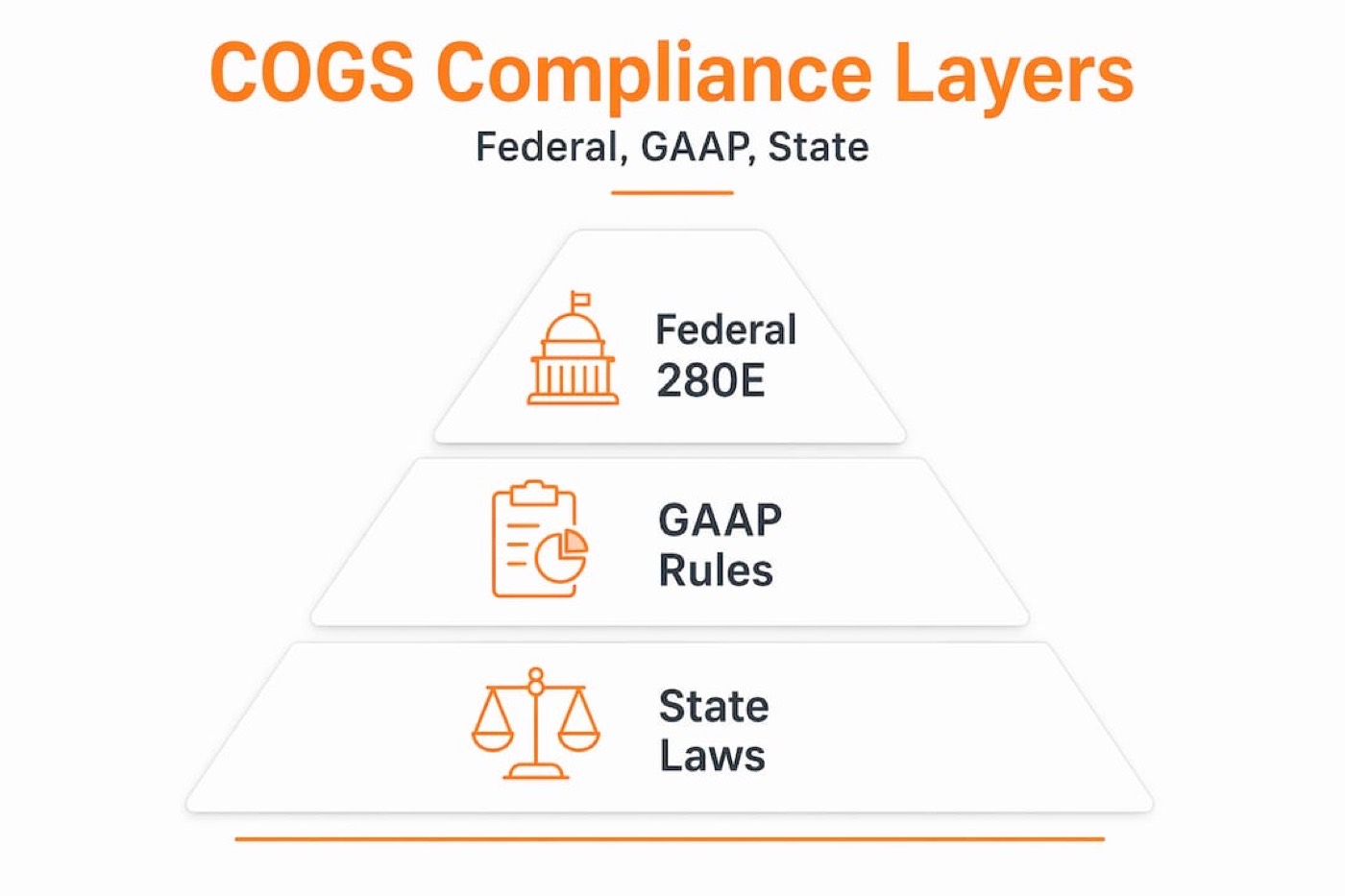
Federal level: Section 280E. The IRS applies 280E to all businesses trafficking in Schedule I or Schedule II controlled substances. For cannabis, that means ordinary business expenses are not deductible. Only COGS and certain cost-of-goods items survive the 280E filter. Misunderstanding this leads businesses to deduct salaries or rent as operating expenses, then face reclassification and substantial underpayment penalties during an audit.
GAAP requirements. Under ASC 330 for cannabis inventory, businesses must value inventory at the lower of cost or net realizable value, commonly called the LCNRV rule. Cultivation operations must capitalize their growing costs as work in progress (WIP) until the crop is harvested. Once harvested, those costs transfer to finished goods inventory. Biological assets, meaning living plants in active cultivation, require specific tracking and disclosure. This is a layer of complexity most non-cannabis accountants are not prepared for.
State-level decoupling. Many states have decoupled their tax codes from federal law, meaning some states allow cannabis businesses to deduct ordinary business expenses even though the IRS does not. California, Colorado, and several other major cannabis markets have implemented some form of decoupling. This means your state taxable income can differ significantly from your federal taxable income, requiring separate tracking and reporting.
| Regulatory layer | Key rule | Impact on COGS |
|---|---|---|
| Federal (280E) | No ordinary deductions | COGS is the primary tax shield |
| GAAP (ASC 330) | LCNRV; WIP capitalization | Affects book vs. tax inventory values |
| State (varies) | Decoupling may allow more deductions | Creates two separate income calculations |
Documentation best practices for audit defense include maintaining detailed cost allocation worksheets, employee time logs, production records, and consistent depreciation schedules. Every dollar in COGS needs a paper trail that connects it to a direct production activity. The GAAP compliance guide and cannabis tax compliance issues resources provide specific templates and frameworks for building that trail.
Recent changes and what’s next for cannabis COGS
The regulatory landscape for cannabis taxation is shifting, and the direction matters for how you plan your COGS strategy today.
The most significant potential change is federal rescheduling. Post-2026 rescheduling of cannabis to Schedule III for medical cannabis could eliminate 280E for qualifying medical operators, allowing them to deduct ordinary business expenses just like any other company. That would be a massive shift, reducing effective tax rates dramatically for medical businesses. Recreational cannabis businesses would likely remain under 280E restrictions even after rescheduling, because recreational sales would not qualify under Schedule III medical use provisions.
Key action items for operators planning ahead:
- Identify which portion of your revenue comes from medical versus recreational sales.
- Begin apportionment planning now to separate qualifying medical COGS from recreational COGS.
- Commission a cost study if you have not done one recently. A cost study documents your allocation methodology in a form that survives regulatory transition.
- Review your entity structure. Rescheduling may make it advantageous to separate medical and recreational operations.
For large operators with average gross receipts exceeding $31 million, there is an additional wrinkle. If 280E no longer applies after rescheduling, Section 263A, known as the UNICAP rules, may kick in. UNICAP requires large businesses to capitalize certain indirect costs into inventory rather than expensing them. This actually produces a result similar to current 280E treatment for some operators, meaning the tax benefit of rescheduling could be partially offset for large businesses by UNICAP capitalization requirements.
Pro Tip: Do not wait for rescheduling to become final before restructuring your cost accounting. Operators who build compliant, well-documented COGS systems now will transition far more smoothly than those scrambling to retrofit their records after the rules change.
For a broader view of how these changes connect to tax strategy for profitability, the interplay between 280E, UNICAP, and state decoupling creates both risks and real opportunities for operators who plan proactively.
Perspective: why COGS compliance is make-or-break and what most miss
Here is an uncomfortable truth: most cannabis operators treat COGS as a bookkeeping task, not a strategic function. They hand receipts to their accountant, get a number back, and move on. That approach is not just sloppy. In this industry, it is genuinely dangerous.
The operators who thrive are the ones who understand that every dollar of defensible COGS is a dollar that reduces taxable income in an environment where ordinary deductions are illegal. They invest in cost studies. They use time-tracking systems. They hire expert cannabis CPAs who build defensible allocations rather than general accountants who apply standard-industry logic to a non-standard-industry problem. Common errors that CPAs in this space flag consistently include undercapitalizing production overhead, misclassifying facility costs, and using GAAP methods that conflict with IRS tax treatment.
Here is what we see repeatedly: a cannabis business runs profitably for two or three years, relies on a general CPA, then faces an IRS audit that reclassifies $400,000 of COGS as non-deductible operating expenses. The resulting tax bill, penalties, and interest wipes out multiple years of profit. The tragedy is that the underlying business was strong. The COGS methodology was just indefensible.
Specialized advisors for the role of tax professionals in cannabis is not a luxury. It is a structural requirement. The gap between a generic accountant and a cannabis-specialized CPA is the gap between an educated guess and a documented, audit-proof position. In an industry where your primary tax tool is COGS and the IRS knows it, that difference is everything.
Get expert help for cannabis COGS and compliance
Understanding COGS theory is one thing. Applying it correctly across your cultivation, manufacturing, or dispensary operation while keeping pace with regulatory changes is another challenge entirely.

Cannabis Business Minds provides specialized guides, tools, and frameworks built specifically for cannabis finance professionals and business owners who need more than generic accounting advice. Whether you are building out your cost accounting cannabis guide from scratch, tightening your cannabis budgeting resources to reflect accurate COGS projections, or looking for cannabis accounting solutions that integrate compliance with financial planning, the platform gives you the targeted knowledge to protect your deductions, pass audits, and run your business with financial confidence. Stop leaving money on the table. Start building COGS positions that hold up.
Frequently asked questions
What is the simple formula for calculating cannabis COGS?
COGS equals beginning inventory plus production or purchase costs for the period minus ending inventory. This formula applies across cultivation, manufacturing, and retail cannabis operations.
Can dispensaries include rent and utilities in COGS?
Yes, but only the portion directly tied to production space and activities qualifies. Rent for a general office or administrative area does not belong in COGS.
What happens if you misclassify costs in cannabis COGS?
Misclassifying costs harms the defensibility of your tax position, can trigger IRS audits, and may result in penalties on reclassified amounts that 280E then disallows entirely.
Will federal cannabis law changes affect COGS rules?
If rescheduling to Schedule III proceeds, medical cannabis operators could gain access to ordinary business deductions, but recreational businesses are expected to remain under 280E restrictions.
Are inventory valuation rules for cannabis different from other industries?
Cannabis must follow GAAP’s LCNRV rule and track biological assets such as living plants as part of inventory, adding complexity that standard retail or manufacturing accounting does not require.
Recommended
- How to Calculate Cannabis COGS for Compliance Success – Cannabis Business Minds
- Cannabis cost allocation: Guide for compliance and profit – Cannabis Business Minds
- Understanding the 280E Deductible COGS Factsheet: Key Insights for Cannabis Businesses
- 7 Key Eligible Business Expenses for Cannabis Companies – Cannabis Business Minds
This article is general education, not tax, legal or accounting advice. Cannabis rules change quickly; confirm how they apply to you with a qualified cannabis CPA or attorney.