Why Track Deferred Taxes in Cannabis: 2026 Guide
2026 update: what rescheduling changed for 280E (reviewed October 2026)
Effective April 22, 2026, a DOJ/DEA final order moved marijuana covered by a qualifying state medical license (and FDA-approved marijuana drugs) to Schedule III. Section 280E only applies to Schedule I and II substances, so state-licensed medical cannabis activity is generally no longer subject to 280E going forward. Adult-use cannabis remains in Schedule I and fully subject to 280E. The DEA proceeding to reschedule all marijuana was temporarily stayed in October 2026, and Treasury/IRS guidance on transition years and mixed medical/adult-use businesses is still pending.
Check where your business stands in about a minute.
Deferred tax tracking in cannabis is defined as the systematic recognition and measurement of temporary differences between GAAP book income and taxable income under ASC 740, a requirement that becomes uniquely complex when IRC §280E is in play. Cannabis businesses carry book-tax differences that most industries never encounter, and those differences produce deferred tax assets and liabilities that directly affect your financial statements, audit exposure, and investor disclosures. The 2026 DEA rescheduling to Schedule III changes the calculation again, making this the wrong year to treat deferred taxes as a year-end cleanup item. Understanding why track deferred taxes cannabis operations require this discipline starts with knowing what ASC 740 actually demands of you.
Why track deferred taxes in cannabis under ASC 740
ASC 740 requires cannabis companies to recognize deferred tax assets and liabilities that reflect the unusual book-tax differences created by §280E. This is not optional. Every cannabis operator preparing GAAP-compliant financial statements must run a tax provision that captures both current and deferred components, regardless of whether they are profitable.
The standard requires you to measure uncertain tax positions, assess valuation allowances on deferred tax assets, and disclose effective tax rates. For a cannabis dispensary or multi-state operator, those uncertain tax positions often include the scope of §280E disallowances, cost of goods sold allocations, and state conformity questions. Each of those positions feeds directly into your deferred tax schedule.

ASC 740 compliance becomes especially visible during mergers, capital raises, and regulatory audits. Acquirers and institutional investors run their own tax provision analyses. If your deferred tax schedules are absent or inconsistent with your returns, that gap creates audit risk and can derail transactions. Cannabis-specific tax software that integrates with your accounting system reduces manual error and frees your finance team for higher-level analysis rather than spreadsheet reconciliation.
Key areas where ASC 740 creates tracking obligations for cannabis operators:
- §280E disallowances that create permanent and temporary differences between book and taxable income
- Net operating loss carryforwards that generate deferred tax assets requiring realizability assessment
- Inventory capitalization differences between GAAP (ASC 330) and tax (IRC §471 and §263A)
- State tax conformity variations where some states decouple from federal §280E treatment
- Uncertain tax positions that require probability-weighted measurement under ASC 740-10
Pro Tip: Run your ASC 740 provision quarterly, not just at year-end. Cannabis regulatory changes in 2026 are moving fast enough that a year-end-only approach will leave you restating numbers you already reported to investors.
How does 2026 rescheduling change deferred tax measurement?
The 2026 rescheduling of cannabis to Schedule III triggers an ASC 740 reassessment event, not just a change in your tax return. Removing §280E exposure requires cannabis operators to reassess deferred tax assets and liabilities, valuation allowances, and effective tax rates across the board. That is a financial reporting obligation, separate from whatever you file with the IRS.
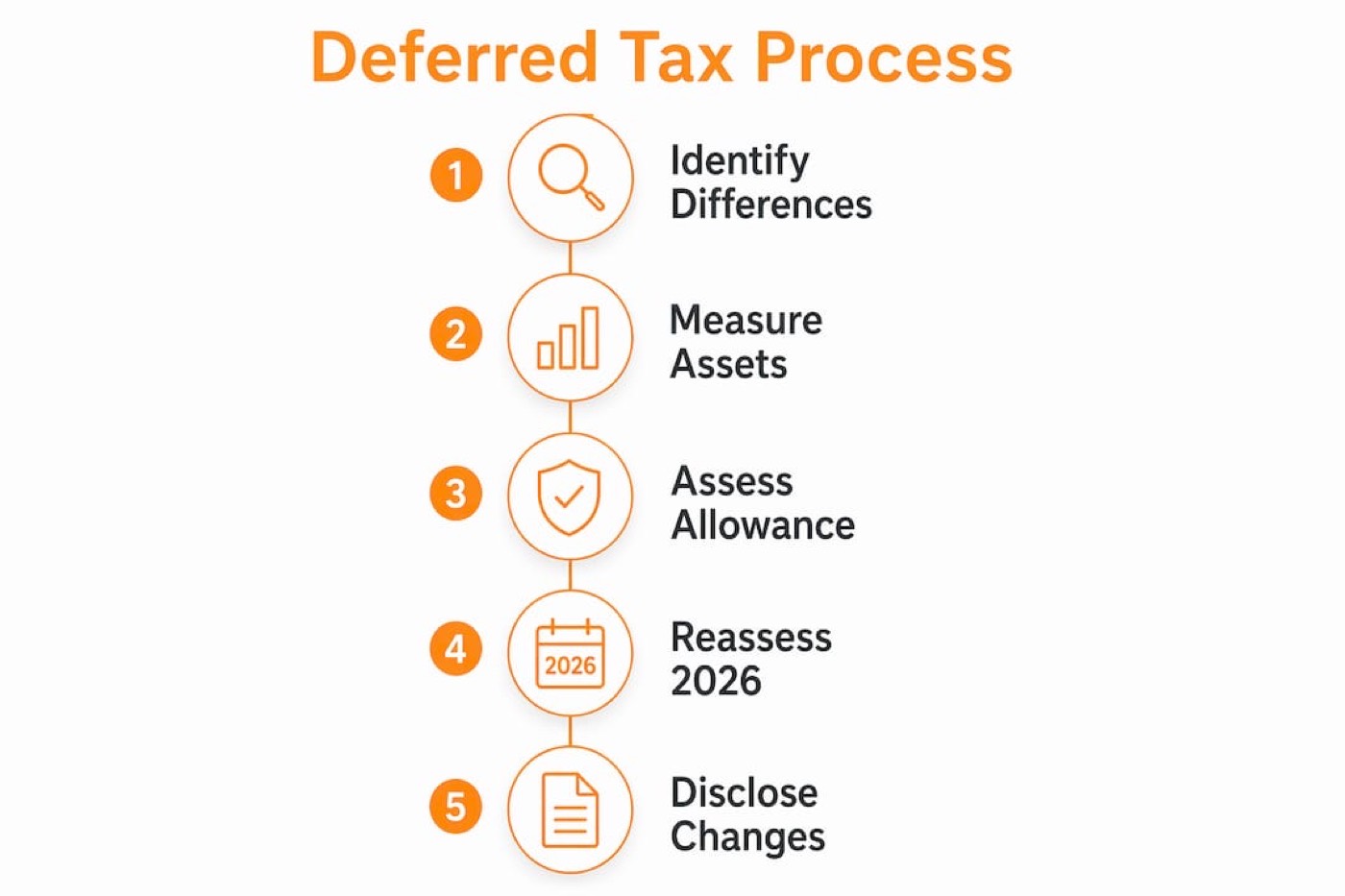
Treasury and IRS guidance signals that the §280E repeal applies to the full taxable year that includes the rescheduling effective date. That means operators must factor rescheduling into 2026 filings and re-run deferred tax schedules for the entire year, not just the period after the effective date. Timing reversals shift accordingly, which changes both your current tax expense and your deferred tax balance sheet positions.
Here is the sequence of steps a cannabis finance team needs to work through after rescheduling:
- Re-run the full deferred tax schedule for the 2026 taxable year using the assumption that §280E no longer applies.
- Reassess valuation allowances on existing deferred tax assets, particularly NOL carryforwards that were previously considered unrealizable due to §280E-inflated taxable income.
- Recalculate effective tax rates for interim financial reporting periods already filed, and determine whether restatement or disclosure is required.
- Review inventory and COGS allocations under §263A, since the prior strategy of maximizing COGS under §280E may now produce suboptimal tax outcomes.
- Evaluate protective claims and amended returns for prior years where §280E disallowances may be recoverable, and assess whether those claims create new deferred tax positions.
The Schedule III rescheduling changes to §280E are not a simple line-item update. They require a full reassessment of every deferred tax position on your balance sheet.
Pro Tip: If your effective tax rate drops materially in 2026 due to rescheduling, that change must be disclosed in your financial statement footnotes. Investors and auditors will ask about it. Have the deferred tax reconciliation ready before the question arrives.
How do NOL deferred tax assets affect cannabis company valuation?
NOL-related deferred tax assets represent real enterprise value for cannabis companies, but that value is scenario-based, not static. A 2026 Forbes report estimated approximately $320 million in deferred tax value from NOL carryforwards for top cannabis operators during 2023 through 2025. That number only materializes if the underlying NOLs are realizable, which requires a forward-looking taxable income analysis.
Realizability depends on two variables that cannabis finance teams frequently underestimate. First, annual taxable income projections must support utilization of the NOL within the carryforward period. Second, ownership changes under IRC §382 can impose annual utilization limits that dramatically reduce the asset’s present value. A cannabis company that has gone through multiple capital raises or a merger may have §382 limitations that make a large NOL balance worth far less than its face value.
| Factor | Impact on NOL deferred tax asset |
|---|---|
| Positive taxable income projections | Increases realizability, reduces valuation allowance |
| IRC §382 ownership change | Imposes annual utilization cap, reduces asset value |
| §280E repeal in 2026 | Lowers taxable income base, may improve NOL absorption |
| State conformity to federal NOL rules | Varies by state; some states cap or disallow NOL carryforwards |
| Valuation allowance reversal | Recognized as income in the period of reversal |
Investor transparency on deferred tax schedules is not a courtesy. It is a disclosure requirement under ASC 740. Finance teams must present clear deferred tax rollforward schedules, valuation allowance movements, and NOL expiration tables. Investors modeling cannabis company valuations will use those schedules directly. Vague or incomplete disclosures signal weak internal controls, which affects cost of capital.
- Track NOL carryforward amounts by vintage year and jurisdiction
- Model §382 annual limitation scenarios before presenting deferred tax assets to investors
- Document the assumptions behind every valuation allowance conclusion in your tax provision workpapers
What drives deferred tax amounts from inventory and cost allocation?
GAAP inventory valuation under ASC 330 and tax inventory treatment under IRC §471 and §263A produce different cost bases, and those differences flow directly into your deferred tax accounts. GAAP and tax cost allocation differences in cannabis create book-tax timing differences that are among the largest drivers of deferred tax balance fluctuations for operators. This is where the mechanical complexity of cannabis tax accounting is most visible.
Under §280E, cannabis operators historically maximized COGS allocations to reduce taxable income, since only cost of goods sold was deductible. That strategy created specific cost flow elections and overhead allocation methodologies that may now be suboptimal post-rescheduling. When §280E no longer applies, the incentive to push costs into COGS disappears, and the prior allocation approach may actually create unfavorable timing differences.
| Cost item | GAAP treatment (ASC 330) | Tax treatment (§471/§263A) | Deferred tax impact |
|---|---|---|---|
| Direct production labor | Capitalized to inventory | Capitalized to inventory | Minimal difference |
| Indirect overhead | Allocated per systematic method | §263A uniform capitalization rules | Timing difference possible |
| Selling expenses | Expensed as incurred | Non-deductible under §280E (pre-2026) | Permanent difference pre-2026 |
| Depreciation on production assets | GAAP depreciation schedule | MACRS or bonus depreciation | Timing difference, deferred tax liability |
| Pre-opening costs | Expensed under GAAP | Amortized over 15 years (§195) | Deferred tax asset created |
Accurate cost allocation for overheads and production expenses is not just a GAAP compliance issue. Errors in cost allocation propagate into deferred tax accounts and misrepresent both tax expense and balance sheet positions. An auditor who finds a cost allocation error will trace it through to the deferred tax schedule. If those two do not reconcile, you have a material weakness conversation on your hands.
Understanding your cannabis tax basis for inventory and production assets is the starting point for getting the deferred tax calculation right. The deferred tax account is not an independent number. It is the output of every other accounting decision you make about cost flow, depreciation, and expense recognition.
Pro Tip: Document your cost allocation methodology in writing before your audit begins. If your GAAP allocation and tax allocation use different overhead rates or different cost pools, that difference needs to appear explicitly in your deferred tax workpapers, not as a plug figure.
My read on where cannabis finance teams get this wrong
The most common failure I see is treating deferred tax tracking as a tax return exercise rather than a financial reporting obligation. Finance teams reconcile their returns, confirm the current tax payable, and stop there. The deferred tax schedule gets built backward from whatever number makes the provision tie out, rather than forward from a rigorous analysis of temporary differences. That approach works until an auditor or acquirer pulls the workpapers.
The second failure is underestimating how much the 2026 rescheduling changes the valuation allowance analysis. Operators who carried full valuation allowances against their NOL deferred tax assets because §280E made those NOLs effectively unusable now need to reassess whether those allowances should be partially or fully reversed. A valuation allowance reversal flows through income. If you do not catch it in the right period, you are restating financials.
The third failure is technology. Most general-purpose accounting platforms do not handle cannabis-specific tax compliance issues without significant customization. Finance teams that rely on manual spreadsheets for their ASC 740 provision are one personnel change away from a material error. Cannabis-specific tax software that integrates deductible and non-deductible expense tracking with the provision calculation is not a luxury at this point. It is the baseline for a defensible process.
Deferred tax accounting under ASC 740 is not an optional task for cannabis businesses. It is fundamental for transparent tax provision reporting to investors and auditors. The operators who treat it that way will be better positioned for the regulatory and capital market scrutiny that comes with federal normalization.
— JN
How Cannabisbusinessminds supports your deferred tax compliance
Cannabis finance teams dealing with ASC 740 complexity, §280E transitions, and 2026 rescheduling adjustments need resources built specifically for this industry.

Cannabisbusinessminds covers the full range of cannabis tax accounting topics, from inventory costing methods that drive your deferred tax balances to cost accounting frameworks that hold up under audit. The cannabis inventory costing guide is a direct resource for finance professionals working through the GAAP-to-tax reconciliation that sits at the center of every deferred tax calculation. For operators building out their full accounting infrastructure, the cost accounting guide covers the allocation methodologies that determine whether your deferred tax numbers are defensible. If you are dealing with IRS exposure from prior §280E positions, Omni Tax Help provides specialized resolution support for cannabis business tax debt.
FAQ
What is a deferred tax asset in cannabis accounting?
A deferred tax asset in cannabis accounting is a balance sheet item representing future tax benefits from temporary differences between GAAP income and taxable income, most commonly from NOL carryforwards and timing differences in cost allocation. Under ASC 740, cannabis operators must assess whether these assets are realizable and record a valuation allowance if they are not.
Why does §280E create deferred tax complexity?
§280E disallows deductions for ordinary business expenses in cannabis, creating permanent and temporary differences between book and taxable income that must be tracked under ASC 740. These differences produce deferred tax balances that do not exist in most other industries and require specialized provision workpapers to document correctly.
How does 2026 rescheduling affect existing deferred tax balances?
The 2026 rescheduling to Schedule III triggers a full ASC 740 reassessment, requiring cannabis operators to reassess deferred tax positions including valuation allowances and effective tax rates for the full taxable year. Operators cannot simply adjust their tax return. The financial reporting impact must be captured in the period the change occurs.
What is a valuation allowance and when is it required?
A valuation allowance reduces a deferred tax asset to the amount more likely than not to be realized, based on projected taxable income and utilization constraints. Cannabis operators with large NOL carryforwards and a history of §280E-inflated tax losses frequently carry full or partial valuation allowances that must be reassessed as the tax environment changes.
How do inventory costing methods affect deferred tax balances?
Differences between GAAP inventory costing under ASC 330 and tax inventory rules under IRC §471 and §263A create book-tax timing differences that flow directly into deferred tax accounts. An operator using a different overhead allocation rate for GAAP versus tax purposes will carry a deferred tax balance that must reconcile to those allocation differences in every reporting period.
Recommended
- 7 Key Cannabis Accounting Trends for 2025 – Cannabis Business Minds
- Cannabis Business Tax Filings Explained: U.S. Compliance Guide – Cannabis Business Minds
- What Is Effective Tax Rate in Cannabis Operations – Cannabis Business Minds
- What Is Tax Liability for Cannabis? Complete Breakdown – Cannabis Business Minds
This article is general education, not tax, legal or accounting advice. Cannabis rules change quickly; confirm how they apply to you with a qualified cannabis CPA or attorney.