Cannabis Inventory Costing: What Finance Pros Must Know
2026 update: what rescheduling changed for 280E (reviewed October 2026)
Effective April 22, 2026, a DOJ/DEA final order moved marijuana covered by a qualifying state medical license (and FDA-approved marijuana drugs) to Schedule III. Section 280E only applies to Schedule I and II substances, so state-licensed medical cannabis activity is generally no longer subject to 280E going forward. Adult-use cannabis remains in Schedule I and fully subject to 280E. The DEA proceeding to reschedule all marijuana was temporarily stayed in October 2026, and Treasury/IRS guidance on transition years and mixed medical/adult-use businesses is still pending.
Check where your business stands in about a minute.
Understanding what is inventory costing cannabis is not a bookkeeping formality. It is the single most consequential accounting decision a cannabis operator makes, because under Section 280E, only COGS is deductible at the federal level. Every dollar you fail to capitalize into inventory is a dollar taxed at the full federal rate. Most operators either underestimate this or misapply it entirely, and the IRS has noticed.
Table of Contents
- What is inventory costing in cannabis operations
- Valuation methods and cost flow in cannabis
- Inventory counts, reconciliation, and audit readiness
- Common pitfalls that increase tax exposure
- My take on the inventory costing gap in cannabis
- Get deeper on cannabis cost accounting
- FAQ
What is inventory costing in cannabis operations
Cannabis inventory costing is the process of determining the total cost to be capitalized into inventory for each unit of product, from live plant through finished goods. It governs what enters cost of goods sold (COGS), when it enters, and what stays on the balance sheet until the point of sale.
The regulatory foundation is IRC §471-11, which requires cannabis producers to capitalize direct and allowable indirect production costs into inventory. Direct costs include direct labor and raw materials. Indirect costs include facility rent, utilities, equipment depreciation, and supervision. None of these are deductible when incurred. They become deductible only when the product is sold, at which point they move from inventory to COGS.
Under GAAP, ASC 330 requires that cannabis inventory be valued at lower of cost or net realizable value (LCNRV). Write-downs under LCNRV are permanent. You cannot reverse them in a later period when market conditions improve, which makes initial cost accuracy critical.
Here is what qualifies for capitalization under IRC §471-11:
- Direct production labor (trimmers, growers, extraction technicians)
- Raw materials and supplies consumed in production
- Facility costs allocated to production (rent, utilities, property taxes)
- Depreciation on production equipment
- Quality control and compliance costs directly tied to production
- Indirect labor for production supervisors and maintenance staff
Selling expenses, general and administrative overhead, and marketing costs are excluded from capitalization. The IRS draws a clear line at the production boundary. For non-deductible cannabis expenses, the distinction between production and non-production costs is where most audits start.
Pro Tip: Document your cost allocation methodology in writing before the tax year begins. An undocumented method is indefensible under audit, even if the math is technically correct.
Section 280E compounds everything. Because 280E restricts deductions to COGS only for Schedule I traffickers, proper inventory capitalization is not just compliance. It is the primary tax shield available to cannabis businesses. The larger and more accurately built your COGS, the lower your effective federal tax rate.
Valuation methods and cost flow in cannabis
Choosing how to value cannabis inventory requires you to account for biological assets, conversion losses, and multi-stage production. No other industry requires this combination simultaneously.
Tracking live plants as WIP
Live plants in active growth cycles are work-in-process (WIP) assets. Percentage of completion accounting applied at the batch or grow-room level is the recognized best practice for capturing costs as they accumulate during the growth cycle. You assign costs to each batch proportionally based on elapsed growth time or growth stage, not all at once at harvest.

Incorrect WIP tracking leads to understated inventory values and distorted financial statements, which then flows into understated COGS on sale. This is a direct 280E exposure.
Costing method comparison
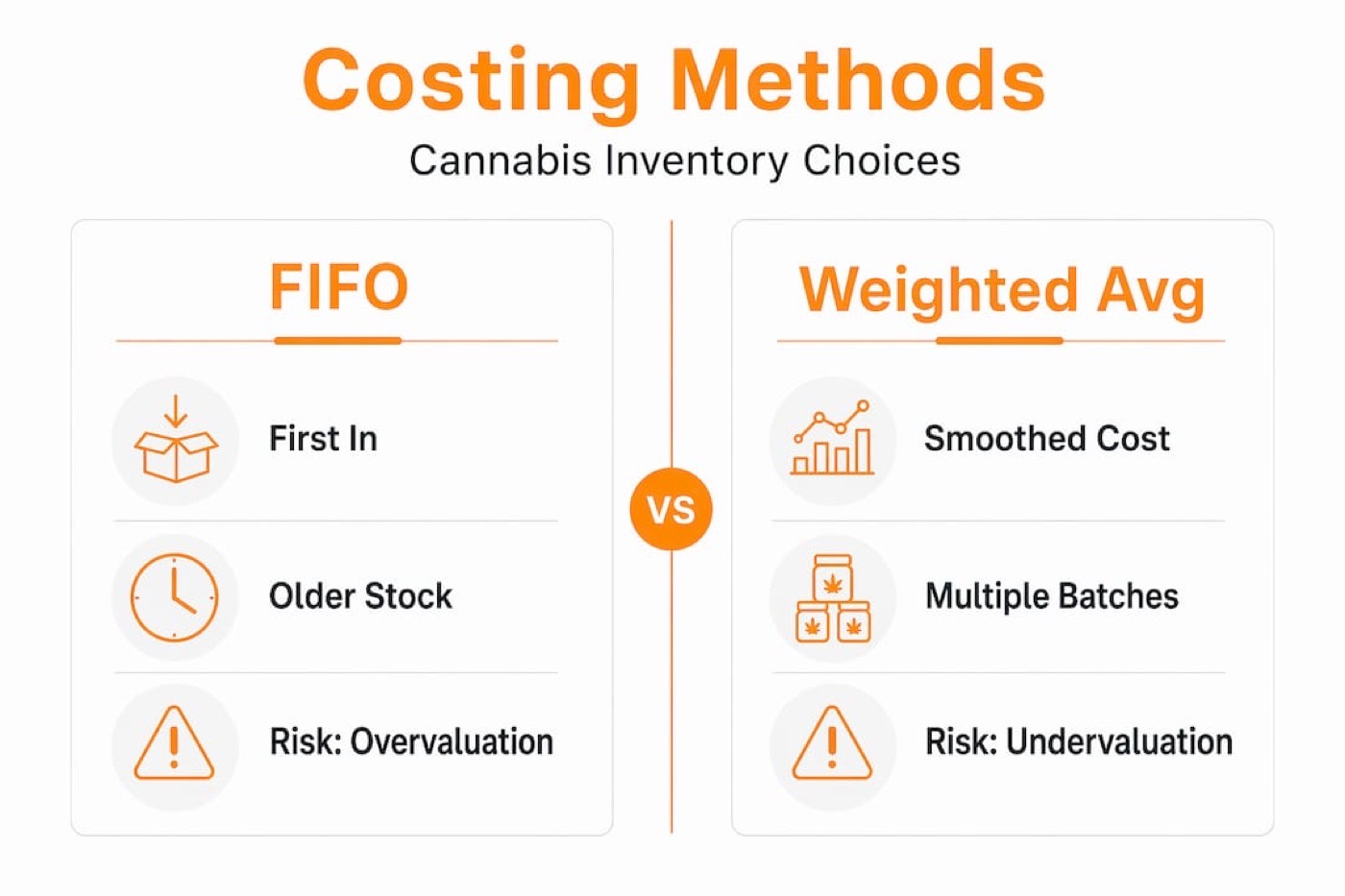
The method you choose for cost flow affects how inventory is valued period to period. Here is how the primary methods compare for cannabis operations:
| Method | How it works | Cannabis suitability | Key risk |
|---|---|---|---|
| FIFO | First units in are first units out; oldest costs hit COGS first | Good for perishable products; aligns physical flow | Rising production costs increase ending inventory value |
| Weighted average | Blends all period costs into a single per-unit rate | Practical for homogenous products like bulk flower | Obscures batch-level cost variances |
| Standard cost | Pre-set cost per unit; variances tracked separately | Strong for manufacturing and extraction operations | Requires disciplined variance analysis to avoid distortion |
| Specific identification | Tracks actual cost per individual lot | Best for high-value, serialized products | Not scalable for high-volume operations |
Pro Tip: Weighted average cost tends to work well for cultivators running multiple overlapping grow cycles because it smooths out the cost spikes between harvests. Standard cost works better for extractors and manufacturers where the production process is more controlled.
Conversion factors and yield reconciliation
This is where most cultivators lose the plot. Failing to apply conversion factors from wet to dry weight results in overstated inventory and understated COGS. When you harvest 1,000 pounds wet and end up with 200 pounds dry, the cost assigned to inventory must reflect the 200 pounds, not the 1,000. Errors here can compound into hundreds of thousands of dollars in overstated inventory on the balance sheet.
Overhead allocation is equally specific. Defensible methods include square footage allocation for facility costs, direct labor hours for labor-driven overhead, and machine hours for equipment-intensive processes. The method must match the cost driver. Using square footage to allocate labor costs will not survive IRS scrutiny.
Inventory counts, reconciliation, and audit readiness
Cannabis inventory does not exist in isolation. Every gram must reconcile to a state-mandated track-and-trace system. In most states, that system is Metrc.
The operational requirements for maintaining defensible inventory records break down into four non-negotiable practices:
-
Conduct blind cycle counts on a defined schedule. Blind cycle counts where counters do not see expected quantities before counting, eliminate unconscious bias and reduce fraud risk. This is not a suggestion. It is an audit expectation.
-
Reconcile physical counts to Metrc after every count. Physical inventory counts integrated with track-and-trace systems must happen at minimum monthly. A count that does not reconcile to Metrc is not just an accounting problem. It is a compliance violation.
-
Document and escalate discrepancies above threshold. Most state regulations require a discrepancy over 3% to be reported within 24 hours. Any variance you cannot explain through shrinkage, evaporation, or documented destruction becomes a liability in an IRS exam.
-
Maintain a written adjustment log with supporting rationale. Consistent reconciliation and documentation explains period-to-period inventory changes in a way that supports both state compliance and federal tax positions. Undocumented adjustments are the fastest way to lose an audit.
For a practical framework covering legal obligations and reconciliation workflows, Cannabisbusinessminds has a detailed resource on cannabis inventory compliance that covers state-level requirements in depth.
Pro Tip: Assign cycle count responsibilities to staff who do not have custody over the inventory they are counting. This separation of duties is a basic internal control, and its absence is a red flag in any financial review.
Common pitfalls that increase tax exposure
Most cannabis operators who face unexpectedly high federal tax bills share a common set of accounting failures. These are not edge cases. They are the norm for operators without a cannabis-specialized accounting function.
The biggest exposure points:
-
Premature expensing of production costs. Capitalizing eligible costs builds a COGS shield. Expensing them in the period incurred destroys it. When operators treat cultivation labor or facility overhead as a period expense rather than a product cost, they inflate taxable income in every year they do it.
-
Ignoring allowable indirect costs. Operators frequently under-allocate indirect costs such as facility overhead and utilities, missing $500,000 or more in annual tax deductions for mid-size operations. Every allocable production cost left off the inventory schedule is money paid to the IRS unnecessarily.
-
Poor WIP tracking. Many cannabis operators fail to properly capitalize WIP plant costs using percentage of completion. The result is understated inventory mid-cycle and distorted COGS at harvest. Over multiple grow cycles, these errors accumulate.
-
Yield reconciliation failures. Not adjusting for wet-to-dry conversion, trim loss, and extraction yield rates creates systematic overstatement of inventory and understatement of COGS across every harvest.
-
Inconsistent costing methods. Switching methods between periods without proper disclosure and authorization invites IRS scrutiny and creates comparability problems across financial statements.
Each of these errors individually increases taxable income. Combined, they can create an effective federal tax rate that makes profitable operations appear near-insolvent on a cash flow basis. Understanding cannabis operational costs is a precondition to getting the capitalization policy right.
My take on the inventory costing gap in cannabis
I have reviewed the books of dozens of cannabis operators, and the pattern is consistent. The operators paying the most in federal taxes are not the least profitable. They are the ones with the least disciplined inventory accounting.
The misconception I see most often is treating cannabis like a retail business. In retail, you buy goods at a known cost and sell them. Inventory accounting is straightforward. In cannabis cultivation, you are manufacturing a product from a biological asset through multiple transformation stages, each of which generates costs that must be capitalized. Treating those costs as operating expenses is not just wrong. It is expensive.
What I find frustrating is that the rules are not ambiguous. IRC §471-11 and ASC 330 are well-established. The failure is almost always operational, not conceptual. Operators do not have systems built to capture costs at the batch level, so the accountant ends up allocating everything at year-end using a rough methodology that will not hold up under examination.
The operators with the cleanest tax positions run inventory cost accounting monthly, reconcile to Metrc weekly, and have their indirect cost allocation documented in a written policy. That combination does not eliminate 280E. Nothing does. But it minimizes exposure and builds a defensible record. That is the actual job.
— JN
Get deeper on cannabis cost accounting
Inventory costing is one piece of a larger financial architecture. If your current system does not capture WIP costs by batch, allocate overhead to production, or reconcile to Metrc on a fixed schedule, the exposure compounds every reporting period.

Cannabisbusinessminds publishes in-depth technical resources built specifically for cannabis finance professionals. The cannabis cost accounting guide covers IRC §471, COGS structuring, and allocation methods with the specificity this industry requires. For broader financial management, the cannabis accounting section covers compliance, audit readiness, and tax positioning across business types. Start there if you are building or rebuilding your inventory costing framework.
FAQ
What is inventory costing in cannabis?
Inventory costing in cannabis is the process of determining which production costs must be capitalized into inventory rather than expensed immediately, governed primarily by IRC §471-11. Under 280E, only COGS is deductible at the federal level, making accurate capitalization the primary mechanism for reducing taxable income.
What costing methods can cannabis operators use?
Cannabis operators can use FIFO, weighted average cost, standard cost, or specific identification. The method must be applied consistently across periods and documented in a written accounting policy to withstand IRS scrutiny.
What is inventory capitalization in cannabis?
Inventory capitalization is the accounting practice of adding production costs, including direct labor, materials, and qualifying indirect costs like facility overhead, to the inventory asset on the balance sheet rather than recording them as period expenses. These costs are deductible only when the related product is sold.
What is inventory cycle counting in cannabis?
Inventory cycle counting in cannabis is a recurring process of physically counting portions of inventory on a scheduled basis and reconciling those counts to the track-and-trace system such as Metrc. State regulations often require discrepancies above 3% to be reported within 24 hours.
How does 280E affect cannabis inventory valuation?
Section 280E disallows all deductions except COGS for cannabis businesses at the federal level. This makes cannabis inventory valuation a direct tax issue. Every dollar of production cost properly capitalized and matched to sold product reduces the amount of income taxed at the full federal rate.
Recommended
- Effective Cannabis Inventory: Complete Guide for U.S. Operators – Cannabis Business Minds
- 7 Key Types of Operational Costs in Cannabis Explained – Cannabis Business Minds
- How to Calculate Cannabis COGS for Compliance Success – Cannabis Business Minds
- Cost Accounting Cannabis: Complete U.S. Industry Guide – Cannabis Business Minds
This article is general education, not tax, legal or accounting advice. Cannabis rules change quickly; confirm how they apply to you with a qualified cannabis CPA or attorney.