What Is Effective Tax Rate in Cannabis Operations
2026 update: what rescheduling changed for 280E (reviewed October 2026)
Effective April 22, 2026, a DOJ/DEA final order moved marijuana covered by a qualifying state medical license (and FDA-approved marijuana drugs) to Schedule III. Section 280E only applies to Schedule I and II substances, so state-licensed medical cannabis activity is generally no longer subject to 280E going forward. Adult-use cannabis remains in Schedule I and fully subject to 280E. The DEA proceeding to reschedule all marijuana was temporarily stayed in October 2026, and Treasury/IRS guidance on transition years and mixed medical/adult-use businesses is still pending.
Check where your business stands in about a minute.
Understanding what is effective tax rate cannabis actually means for your operations is not a simple calculation. Most business owners and finance professionals assume the effective rate is a fixed number derived from the corporate tax schedule. For cannabis, it isn’t. Federal law under IRC Section 280E, combined with the April 22, 2026, rescheduling of medical marijuana to Schedule III, plus wildly varying state excise taxes, means your effective rate could sit anywhere between 21% and 80% depending on license type, state, and how well your cost accounting holds up under scrutiny.
Table of Contents
- What is effective tax rate for cannabis businesses
- The 2026 rescheduling and its impact on federal effective rates
- State and local tax structures
- Strategies and compliance implications
- My take on where cannabis tax planning actually stands in 2026
- Tax resources built for cannabis finance professionals
- FAQ
What is effective tax rate for cannabis businesses
The effective tax rate is the percentage of your actual taxable income paid in total taxes, not just the statutory rate. For most industries, that calculation moves from gross revenue to net income through a series of deductions, and the corporate rate of 21% applies to what remains. Cannabis does not work that way.
IRC Section 280E prohibits deductions for businesses that “traffic in controlled substances” under Schedule I or II of the Controlled Substances Act. That disallowance means cannabis operators cannot deduct most ordinary business expenses, including rent, payroll, marketing, or professional services. You pay tax on something much closer to gross profit than net income. The result is a cannabis effective tax overview that looks nothing like a standard corporate return.
The only relief under 280E has always been the cost of goods sold (COGS). COGS is not a deduction in the traditional sense; it is an offset to gross receipts that reduces the income subject to tax before 280E applies. That narrow opening is where all the leverage sits.
Here is what the math typically looks like in practice:
- A dispensary with $2 million in gross revenue and $800,000 in COGS has $1.2 million in gross profit
- Under 280E, no SG&A is deductible, so taxable income is $1.2 million
- At a 21% corporate rate applied to that $1.2 million, the actual tax is $252,000
- As a percentage of true net income (say, $400,000 after all expenses), that is a 63% effective rate
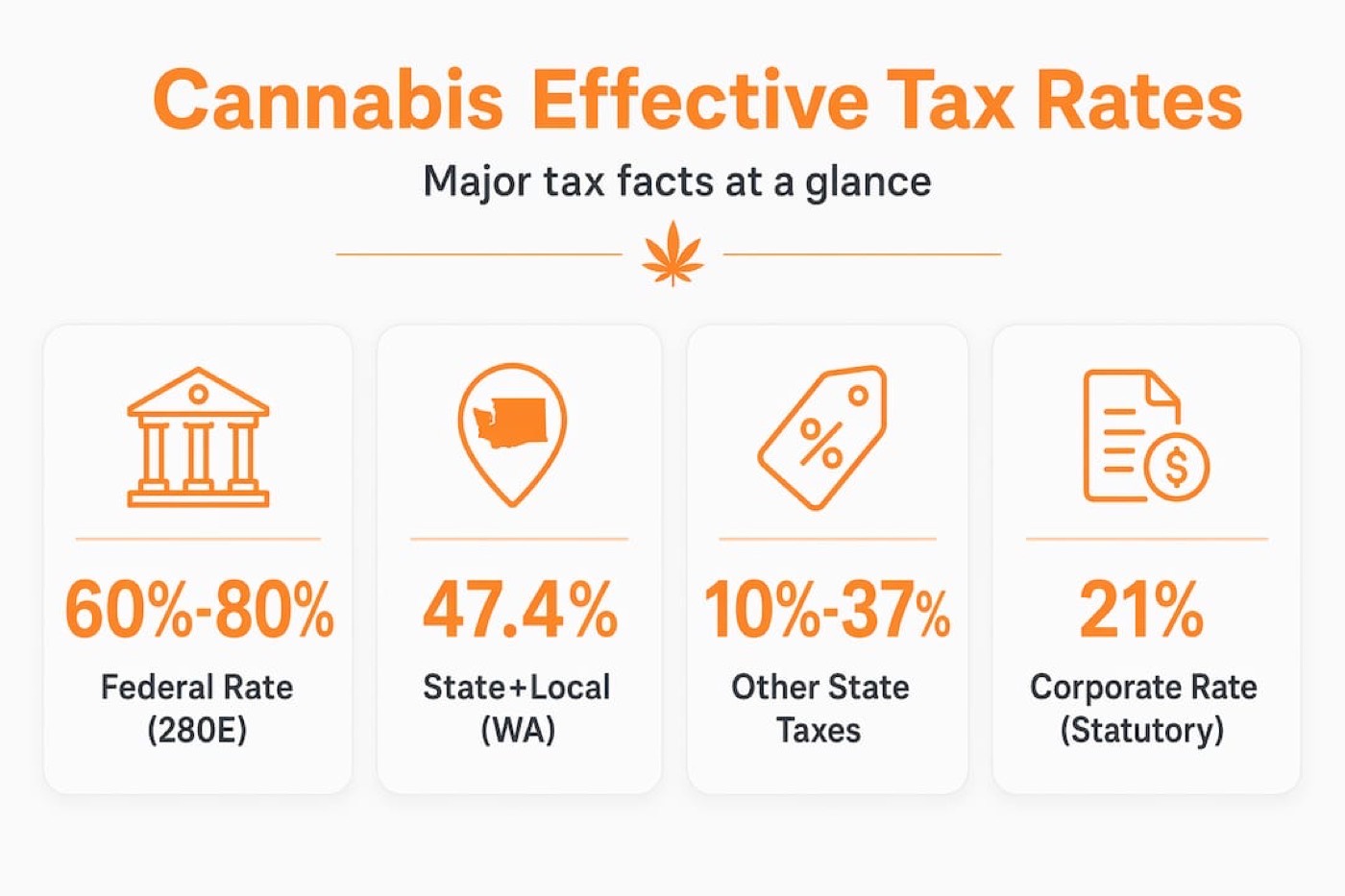
That is precisely why cannabis businesses under 280E face effective federal tax rates often ranging from 60% to 80% of gross profit. Standard corporations pay 21% to 28% on net income. The difference is structural, not incidental.
Pro Tip: Never confuse the statutory 21% corporate rate with your effective rate. If you are a single-license dispensary still under 280E, your effective federal rate is a multiple of that. Build your cash flow models from the actual tax obligation, not the statutory rate.

The 2026 rescheduling and its impact on federal effective rates
On April 22, 2026, the DEA issued a final order rescheduling state-licensed medical marijuana from Schedule I to Schedule III. This is the most consequential federal tax development in cannabis history, and it requires precision to apply correctly.
For qualifying medical cannabis operators, the removal from Schedule I eliminates the 280E disallowance. That means ordinary and necessary business expenses are now deductible for federal purposes. Effective federal tax rates drop to normalized corporate levels, roughly 21% to 30%, depending on the operator’s specific cost structure. The estimated industry-wide tax savings are approximately $2.3 billion annually once fully implemented.
Qualifying for that relief is not automatic. The following requirements apply:
- The operator must hold a state license specifically for medical cannabis. Adult-use or recreational operations are explicitly excluded because they remain on Schedule I.
- The operator must register with the DEA under Schedule III within the prescribed deadline. No registration, no relief.
- The rescheduling is prospective only. No amendments to prior-year returns are permitted. Prior 280E tax years remain closed.
- The full 2026 tax year is covered, not just the period after April 22.
- Dual-license operators running both medical and adult-use programs must maintain separate accounting records for each activity stream.
- Allocation of shared costs between medical and adult-use operations must be documented with specificity, not estimated broadly.
Pro Tip: If you run dual licenses, the burden of proof to segregate expenses falls on you. The IRS will not accept a rough allocation. Set up separate cost centers, separate payroll coding, and separate inventory tracking for each program before your next period close.
The rescheduling relief is real, but it is also precise in its application. Adult-use operators continue to face 280E in full until recreational cannabis is rescheduled separately, which has not occurred.
State and local tax structures
Federal effective rates are only part of the picture. The impact of cannabis taxation at the state and local level adds another layer that, in some jurisdictions, exceeds the federal burden on its own.
State excise tax models fall into three broad categories. Some states tax at a flat percentage of the retail sales price. Others apply the tax at the wholesale level, which functions similarly to a gross receipts tax. A growing number of states use THC content-based formulas that tie the tax rate directly to potency rather than price.
| State | Primary Tax Model | Rate | Combined Effective Tax (with state and local sales tax) |
|---|---|---|---|
| Washington | Retail excise | 37% | Up to 47.4% |
| California | Retail excise + cultivation | 15% + weight-based | 35% to 45% depending on city |
| Colorado | Retail excise | 15% | 25% to 30% |
| Arizona | Retail excise | 16% | 22% to 24% |
| Alaska | Weight-based per gram | Varies by type | 20% to 25% |
State cannabis retail taxes reach as high as 47.4% in Washington, while Arizona’s combined effective cannabis tax ranges from 22.1% to 24.1% depending on city. That spread represents a real strategic variable when multi-state operators choose where to deploy capital.
Local taxes add further complexity. Many municipalities layer privilege taxes, local sales taxes, or special cannabis district fees on top of state excise taxes. These range from 1% to 15% depending on the jurisdiction. The cumulative effect when stacked with federal effective rates is a total tax burden that, for adult-use operators in high-tax states still subject to 280E, can exceed 70% of true economic profit.
Strategies and compliance implications
Managing your effective tax rate in cannabis is not about finding aggressive positions. It is about precision in classification, documentation, and forward modeling. There are clear paths to reducing effective rates within the law, and equally clear ways to expose yourself to IRS challenge.
The single highest-leverage tool for any operator still under 280E remains COGS classification. Accurate cost allocation is the primary method to reduce effective tax rates under 280E. The more costs that legitimately qualify as part of inventory production or acquisition, the lower your taxable gross profit. Misclassification in the wrong direction cuts the other way fast. Misclassified costs push effective rates upward to 70% to 80%; correct classification can bring rates down to 40% to 55%. That 15 to 25 percentage point swing is not theoretical. It shows up in cash.
A few areas where operators routinely get COGS classification wrong include:
- Packaging directly associated with the product (COGS eligible) versus branded retail packaging for upsell (SG&A)
- Cultivation labor directly tied to plant production (COGS eligible) versus administrative staff who also touch cultivation facilities (SG&A)
- Delivery costs that are part of the production distribution chain (COGS eligible) versus customer-facing delivery fees (SG&A)
For post-rescheduling medical operators, the compliance stakes shift but do not diminish. Dual-license compliance costs will offset a portion of the tax savings generated by rescheduling relief. Operators who attempt to claim medical 280E relief without airtight activity segregation are inviting an audit that could claw back those savings entirely.
Proactive tax rate modeling matters here more than in most industries. Because the effective rate can swing dramatically based on cost allocation choices, license type, and state, modeling three or four scenarios before the fiscal year closes gives you the ability to make capital deployment and staffing decisions with accurate after-tax numbers. Reactive compliance, where you find out in March what your effective rate was the prior year, eliminates that flexibility entirely. For more on structuring your financial workflows to support this, the cannabis business tax filings resource at Cannabisbusinessminds walks through the compliance mechanics in detail.
Pro Tip: Build a tax rate model that runs both 280E and normalized scenarios if you hold dual licenses. You need to know the actual effective rate under each treatment, not just the best-case number. Plan cash reserves based on the higher of the two until your DEA registration is confirmed and documentation is complete.
The role of internal controls in this environment cannot be understated. The IRS treats cannabis operators as high-risk for a reason. Your tax compliance practices need to support the position you take on your return, not simply reflect it after the fact.
My take on where cannabis tax planning actually stands in 2026
I’ve watched operators treat 280E as an immovable wall for years. Most did not fight it because they thought the fight was in the courts, not in the accounting. That was a missed opportunity. The cost accounting lever was always there.
What 2026 changes is the ceiling, not the floor. Medical operators who qualify for Schedule III relief face a real reduction in effective federal rates. But I’ve seen the same operators underestimate how much work it takes to actually capture that savings. DEA registration deadlines, separate ledgers for medical and adult-use, defensible allocation methodologies across shared facilities and staff. That is not a quarterly adjustment. That is a structural change to how your books work.
My concern is the assumption that rescheduling closes the tax chapter for cannabis. It doesn’t. Adult-use operations still face the full 280E burden. Multi-state operators with a mix of license types face uneven effective rates across their portfolio. And state excise taxes in high-burden states like Washington are not going anywhere regardless of what the DEA does.
What I’d emphasize to any finance professional in this space right now: the effective rate calculation is a dynamic number, not a lookup table. It changes with your license type, your cost allocation decisions, your state mix, and your documentation quality. Operators who treat it as static will overpay. Operators who model it actively and build the accounting infrastructure to support aggressive-but-defensible COGS positions will see the difference in cash, not just in footnotes.
The rescheduling is good news. It just isn’t a substitute for doing the work.
— JN
Tax resources built for cannabis finance professionals

If your current accounting workflow isn’t built to support 280E defense, post-rescheduling expense segregation, or multi-state effective rate modeling, you’re flying without instruments. Cannabisbusinessminds provides the resources to change that.
The cost accounting guide for cannabis walks through COGS classification methodology, inventory costing approaches, and the documentation practices that hold up under IRS review. The cannabis budgeting framework helps operators project after-tax cash positions across different effective rate scenarios, including the shift from 280E to normalized treatment for qualifying medical operations. For operators building out their overall financial infrastructure, the cannabis accounting resource hub covers the full compliance stack. These aren’t overview articles. They’re working references built for the professionals actually doing this work.
FAQ
What is the effective tax rate for cannabis under 280E?
Cannabis businesses subject to IRC Section 280E typically face effective federal tax rates ranging from 60% to 80% of gross profit because ordinary business expenses are not deductible, forcing taxes on gross rather than net income.
Does the 2026 rescheduling eliminate 280E for all cannabis operators?
No. The April 22, 2026, final order removes 280E restrictions only for state-licensed medical marijuana operators who register with the DEA under Schedule III. Adult-use and recreational operations remain fully subject to 280E.
How do state taxes affect the overall effective cannabis tax rate?
State excise taxes range from roughly 10% to 37%, with combined state and local burdens reaching up to 47.4% in Washington. Layered with federal effective rates, total tax burden can exceed 70% of true economic profit for adult-use operators in high-tax states.
What is the most effective way to reduce effective tax rates under 280E?
Correctly classifying costs as COGS rather than SG&A is the primary tool. Proper cost allocation can reduce effective federal tax rates from the 70% to 80% range down to 40% to 55%.
Can dual-license cannabis operators claim 280E relief for both operations after 2026?
No. Dual-license operators must maintain separate books for medical and adult-use activities. Only the medical stream qualifies for Schedule III relief, and compliance costs for segregation will partially offset the tax savings generated.
Recommended
- Why Cannabis Taxes Are High for U.S. Businesses – Cannabis Business Minds
- Tax Exposure Cannabis – Impact on US Businesses – Cannabis Business Minds
- What Is Tax Liability for Cannabis? Complete Breakdown – Cannabis Business Minds
- Cannabis Entity Tax Status: Key U.S. Compliance Factors – Cannabis Business Minds
This article is general education, not tax, legal or accounting advice. Cannabis rules change quickly; confirm how they apply to you with a qualified cannabis CPA or attorney.