Cannabis Tax Basis: What Every Finance Pro Must Know
2026 update: what rescheduling changed for 280E (reviewed October 2026)
Effective April 22, 2026, a DOJ/DEA final order moved marijuana covered by a qualifying state medical license (and FDA-approved marijuana drugs) to Schedule III. Section 280E only applies to Schedule I and II substances, so state-licensed medical cannabis activity is generally no longer subject to 280E going forward. Adult-use cannabis remains in Schedule I and fully subject to 280E. The DEA proceeding to reschedule all marijuana was temporarily stayed in October 2026, and Treasury/IRS guidance on transition years and mixed medical/adult-use businesses is still pending.
Check where your business stands in about a minute.
Most cannabis accountants get the fundamentals right and still end up in trouble. They treat tax basis as a simple inventory costing question, record their numbers, and move on. What is cannabis tax basis, really? It is the IRS-defensible cost assigned to inventory, capital assets, and sold goods that directly determines your federal taxable income. It is not just an accounting entry. Under IRC §280E and the emerging framework following the 2026 Schedule III reclassification, getting cannabis tax basis wrong creates cascading consequences: misstated COGS, disallowed deductions, audit exposure, and retroactive tax liability at effective rates that can exceed 70%.
Table of Contents
- What is cannabis tax basis under U.S. tax code
- How IRC §280E and Schedule III reclassification affect your deductions
- Practical methods for determining cannabis tax basis
- State-level cannabis tax bases and how they interact with federal basis
- Audit triggers and compliance risks you need to understand
- My perspective on where this is heading
- What Cannabisbusinessminds offers for cannabis finance professionals
- FAQ
What is cannabis tax basis under U.S. tax code
Tax basis in any business is the cost amount assigned to an asset or sold inventory that reduces taxable income when that asset is sold or consumed. In cannabis, that definition collides with a tax code that was never designed for a legal industry operating under federal Schedule I restrictions.
Under standard federal tax rules, businesses reduce taxable income through two primary channels: cost of goods sold and ordinary business expense deductions under IRC §162. Cannabis businesses, historically, only had access to the first channel. IRC §280E prohibited deductions for all ordinary and necessary expenses related to a Schedule I or II controlled substance trafficking business. That meant rent, payroll for non-production staff, marketing, and banking fees were all non-deductible.
COGS, however, survived. The IRS has confirmed cannabis businesses calculate COGS under Section 471, which governs inventory costing. This means the cannabis tax basis for sold inventory is the cornerstone of federal tax reduction for most operators. Getting it right matters more here than in almost any other industry.
The core components of a defensible cannabis tax basis for inventory include:
- Direct production costs: Seeds, clones, nutrients, growing media, direct cultivation labor, and packaging materials
- Indirect production costs: Facility depreciation allocated to production space, utilities attributable to cultivation and processing, and quality control labor
- Capitalized overhead: Indirect costs systematically allocated to inventory under IRC §471 and Treasury Regulation §1.471-11
- Capital asset basis: The adjusted cost of machinery, build-outs, and equipment used in production, reduced by depreciation
- Inventory valuation method: Whether FIFO, LIFO, or weighted average, the methodology must be consistent year over year
Accurate basis records are not optional. The IRS scrutinizes cannabis basis documentation more aggressively than almost any other industry segment because the deduction stakes are higher and the history of noncompliance is well-documented.
How IRC §280E and Schedule III reclassification affect your deductions

IRC §280E was born in 1982, written specifically in response to a drug dealer who tried to deduct his “cost of doing business” on Schedule C. Congress blocked it. The rule landed on the entire controlled substance trafficking category, and legal cannabis operators have been caught in it ever since.
The practical effect: a dispensary earning $5M in gross revenue with $2M in COGS paid taxes on $3M rather than its actual net income. Operating expenses like salaries for front-of-house staff, advertising, and lease payments added to the effective rate. Pre-tax income projections show potential 57% increases for multi-state operators following the 2026 reclassification shift.
The 2026 reclassification of medical marijuana to Schedule III changes the deduction framework materially. Businesses operating under Schedule III are no longer “trafficking” a Schedule I or II substance, which removes the §280E bar on §162 ordinary deductions. That unlocks rent, management salaries, professional fees, and other previously blocked expenses.
Here is the current federal deduction framework by stage:
- Pre-2026 (Schedule I/II): Only COGS deductible; all §162 expenses disallowed under §280E for trafficking businesses
- 2026 transition (Schedule III medical): §280E bar lifted for medical cannabis; ordinary §162 deductions become available; adult-use operators face ambiguity pending further guidance
- Post-reclassification compliance shift: Businesses must now track and substantiate both COGS and ordinary expenses; the scrutiny shifts from “did you deduct too much COGS?” to “are those §162 deductions legitimate?”
- Ongoing audit risk: Rescheduling increases compliance demands as IRS transitions its enforcement focus from §280E challenges to §162 expense scrutiny
Pro Tip: Do not assume Schedule III relief applies automatically to adult-use operations. As of mid-2026, federal guidance specifically addresses medical cannabis. If your client operates both medical and recreational licenses, maintain separate cost center tracking and consult current IRS notices before claiming §162 deductions on the recreational side.
The transition also creates a documentation trap. Businesses that previously had thin recordkeeping because they were only defending COGS now face the standard §162 substantiation burden. Receipts, business purpose documentation, and allocation methodologies become mandatory. The bar just moved.
Practical methods for determining cannabis tax basis
The IRS is skeptical of aggressive COGS allocation without a standard accounting basis. That skepticism is earned. The most defensible approach is a formal 280E cost study built on facility activity mapping.
A valid cost study requires three things: a complete inventory of all facility activities segregated by production versus non-production, a labor tracking methodology that allocates time to specific cost centers, and a systematic indirect cost allocation methodology under §1.471-11. Cost studies typically identify $400,000 to $800,000 in indirect costs allocable to COGS for midsize operations, producing material tax savings.
Common inventory basis errors that collapse under audit:
- Weight conversion mistakes: Tracking 1,000 pounds as 5,000 pounds drops your cost-per-pound by 80% and immediately triggers an audit flag
- Internal transfer pricing gaps: Moving product between licensed entities below fair market value distorts COGS and creates phantom income at the receiving entity
- Batch-level tracking failures: Without lot-level cost tracking through cultivation, processing, and sale, you cannot reconstruct basis per unit
- Misclassified overhead: Allocating corporate management overhead into COGS when it belongs in §162 is the type of error the IRS specifically looks for in cannabis
Pro Tip: Monthly reconciliation of physical inventory against expected yields from planted weight and extraction ratios is standard practice for defensible basis documentation. Operators who do it quarterly or annually almost always have unexplained variances that become audit issues.
| Cost type | COGS-includable | Non-deductible (pre-2026) |
|---|---|---|
| Direct cultivation labor | Yes | No |
| Production facility depreciation | Yes (allocated portion) | No |
| Front-of-house retail staff | No | Yes |
| Nutrients and growing media | Yes | No |
| Corporate marketing expenses | No | Yes |
| Quality control lab testing | Yes | No |
| Legal and professional fees | No | Yes |
| Allocated production utilities | Yes | No |
For cannabis inventory costing that holds under IRS review, the methodology must be documented before the tax year begins, not reconstructed after a notice of examination arrives.
State-level cannabis tax bases and how they interact with federal basis
Federal basis calculation and state excise tax bases are separate frameworks that can create compounding liability if mismanaged. Cannabis businesses face layered taxes: federal income tax on taxable income, state income or franchise tax, state cannabis excise tax, local excise tax, and standard sales tax applied at point of sale.
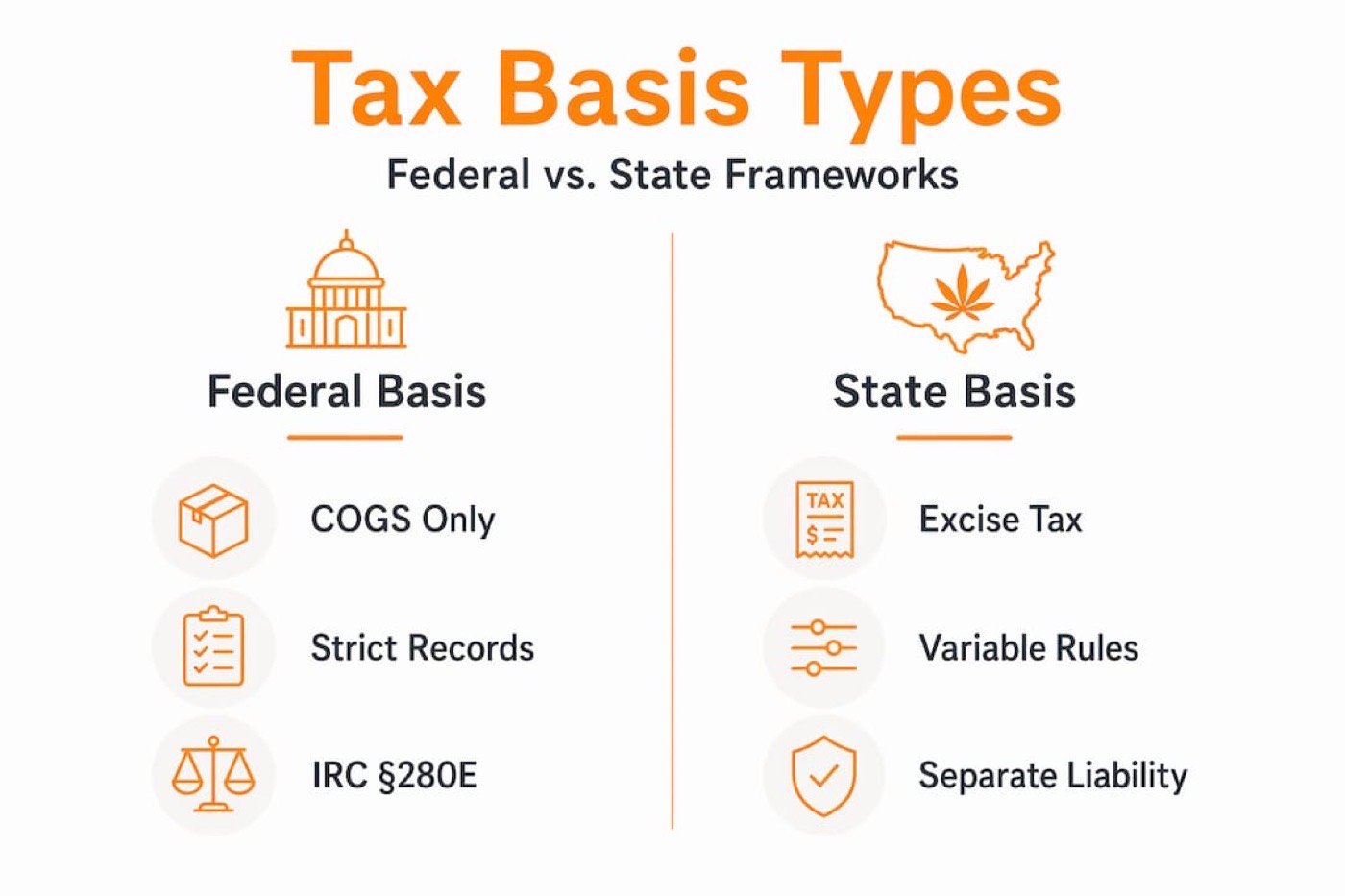
The state excise tax base is where the technical complexity multiplies. States use different calculation bases:
| State | Excise tax base | Notes |
|---|---|---|
| California | 15% of retail selling price | CDTFA enforces arm’s-length pricing on transfers |
| New York | Potency-based (THC content) | Separate rate per milligram of total THC |
| Alabama | Net worth tax applied differently | Uses its own business tax base structure |
| Illinois | Graduated retail price percentage | Higher rate for high-potency products |
The interaction between state excise tax and federal COGS basis is a live issue. California’s CDTFA, for example, requires arm’s-length market pricing on all internal transfers between affiliated entities. If a licensed cultivator transfers product to a licensed retailer at below-market cost, the CDTFA calculates excise tax on the actual market value, not the transfer price. That creates a state excise tax liability based on phantom revenue the business never received.
Using below-market internal pricing also contaminates the federal COGS calculation. The receiving entity records a lower cost basis for inventory, which ultimately understates its COGS deduction and overstates taxable income. Both sides of that equation work against the operator.
Audit triggers and compliance risks you need to understand
The IRS enforcement picture in cannabis is no longer theoretical. In May 2026, the DOJ ordered repayment of an $8.4M tax refund plus interest from a cannabis multistate operator due to §280E violations. That enforcement action is a preview of the post-reclassification environment, not a relic of it.
Key audit triggers the IRS and state agencies focus on in cannabis basis examinations:
- Gross margin percentages materially inconsistent with industry benchmarks for the operator’s license type
- COGS claims that include clearly non-production overhead without allocation methodology documentation
- Year-over-year COGS percentage spikes without corresponding changes in production costs or inventory methodology
- Internal transfer pricing between affiliated entities that deviates from fair market value
- Operators without granular data and defensible cost studies face retroactive liabilities that compound with interest and penalties
“Tax basis in cannabis is primarily about defensible COGS classification. The IRS is skeptical of aggressive or custom COGS allocation without a standard accounting basis. Operators who cannot reconstruct their cost methodology under examination face not just disallowance but accuracy-related penalties.”
The consequences of indefensible basis go beyond the current tax year. IRS adjustments to COGS methodology can be applied retroactively across open statute years, meaning a single examination can generate three to six years of tax deficiencies simultaneously. Add cannabis tax exposure from state audits running concurrently, and the liability picture becomes severe quickly.
My perspective on where this is heading
I’ve reviewed cost studies built by operations teams who genuinely believed their COGS allocation was aggressive but defensible. Most of them were wrong. The defensibility gap usually comes down to one thing: documentation created after the fact to support a number someone already decided on, rather than a methodology established prospectively.
The transition to Schedule III is going to expose exactly that problem. Pre-reclassification, cannabis finance teams focused almost exclusively on maximizing COGS because it was the only game in town. Post-reclassification, the IRS will have new angles to examine. The §162 deductions that operators are now claiming will face the same skepticism that inflated COGS claims faced for years. The difference is that most businesses are not structurally ready for that level of §162 documentation.
What I’ve consistently seen in well-run operations is a proactive stance. They conduct cost studies before filing, not in response to an IRS notice. They maintain batch-level inventory tracking throughout the year. They document the business purpose of every significant expense claimed under §162 now that it is available. They do not assume that reclassification means the IRS has stopped paying attention to cannabis.
The operators who will struggle post-2026 are those treating Schedule III as a green light to claim every expense they previously couldn’t, without the documentation to back it. That approach invites exactly the enforcement scrutiny they were trying to escape.
What Cannabisbusinessminds offers for cannabis finance professionals
If your practice is managing cannabis COGS calculations, cost allocations, or preparing for post-reclassification filing positions, Cannabisbusinessminds has resources built specifically for that work.

The cannabis cost accounting guide covers the full cost allocation framework from facility mapping through indirect cost attribution, with the detail level needed to build a defensible 280E cost study. For basis documentation at the inventory level, the cannabis inventory costing resource walks through IRC §471 methodology, batch tracking requirements, and the common errors that collapse under IRS examination. The Schedule III rescheduling analysis covers the current state of §280E relief and what it actually means for your 2026 filing position. These are not surface-level overviews. They are written for finance professionals who need technical precision, not introductions.
FAQ
What is cannabis tax basis in simple terms?
Cannabis tax basis is the IRS-defensible cost assigned to inventory or capital assets that reduces your federal taxable income. It is primarily established through COGS calculated under IRC §471 and must be documented with a consistent, defensible methodology.
How does IRC §280E affect cannabis tax basis?
Section 280E historically disallowed all ordinary business deductions for cannabis operators, limiting tax basis reduction to COGS only. The 2026 Schedule III reclassification for medical marijuana removes this restriction, allowing §162 ordinary deductions for qualifying businesses.
What costs can be included in cannabis COGS for tax purposes?
Direct production costs such as cultivation labor, nutrients, and direct materials, plus allocated indirect costs like production facility depreciation and utilities, are includable. Front-of-house retail staff, marketing, and corporate overhead generally cannot be allocated to COGS.
What triggers an IRS audit of cannabis tax basis?
Gross margin percentages inconsistent with industry norms, year-over-year COGS spikes without methodology documentation, and internal transfer pricing below fair market value are the most common triggers, along with the absence of a formal cost study to support the allocation.
How do state cannabis excise taxes interact with federal tax basis?
State excise taxes use separate calculation bases, such as retail price, weight, or potency, and are generally not reducible by federal COGS deductions. Below-market internal transfer pricing can create a state excise tax liability based on phantom market value, simultaneously understating federal COGS.
Recommended
- Cannabis Inventory Costing: What Finance Pros Must Know – Cannabis Business Minds
- What Is Tax Liability for Cannabis? Complete Breakdown – Cannabis Business Minds
- Cannabis Tax Professionals: Complete Role Breakdown – Cannabis Business Minds
- Why Cannabis Taxes Are High for U.S. Businesses – Cannabis Business Minds
This article is general education, not tax, legal or accounting advice. Cannabis rules change quickly; confirm how they apply to you with a qualified cannabis CPA or attorney.