Why Reconcile Cash for Cannabis: A Finance Guide

2026 update: what rescheduling changed for 280E (reviewed October 2026)
Effective April 22, 2026, a DOJ/DEA final order moved marijuana covered by a qualifying state medical license (and FDA-approved marijuana drugs) to Schedule III. Section 280E only applies to Schedule I and II substances, so state-licensed medical cannabis activity is generally no longer subject to 280E going forward. Adult-use cannabis remains in Schedule I and fully subject to 280E. The DEA proceeding to reschedule all marijuana was temporarily stayed in October 2026, and Treasury/IRS guidance on transition years and mixed medical/adult-use businesses is still pending.
Check where your business stands in about a minute.
Cannabis businesses sit in a financial position unlike any other industry. Because federal banking restrictions force most dispensaries and operators to run heavily cash-dependent, understanding why you must reconcile cash for cannabis operations is not academic. It is the difference between surviving a state audit and losing your license. Operators who treat reconciliation as an end-of-month housekeeping task are compounding losses and building documentation deficits that no accountant can fix retroactively.
Table of Contents
- Why reconciling cash daily is the foundation of cannabis internal controls
- Documentation and retention standards for cannabis cash records
- Common causes of cash discrepancies in cannabis operations
- Technology and procedures that strengthen cash reconciliation
- Consequences of poor cash reconciliation in cannabis
- My take on where most operators get this wrong
- How Cannabisbusinessminds supports your cash management
- FAQ
Why reconciling cash daily is the foundation of cannabis internal controls
Daily cash reconciliation is the single most important internal control for cannabis operations. Not weekly. Not monthly. Daily. When you wait even 48 hours, a discrepancy that started as a $40 variance from a missed sale can multiply across shifts before anyone notices. By the time a monthly reconciliation catches it, the source is unrecoverable, the audit trail is cold, and your explanation to a regulator is “we’re not sure.”
The correct framework is a three-way match run at the end of every shift. Your POS total, physical cash count, and bank deposit slip must all align before the till closes for the day. If they do not align, you document the variance immediately. That documentation triggers your investigation protocol, not your curiosity.
Here is what daily reconciliation catches that weekly cycles routinely miss:
- Register shortages from incorrect change caught before the next shift inherits them
- Unreported cash sales or voids that track-and-trace systems like METRC will flag later
- Counterfeit bills that entered the drawer during peak hours
- Missing safe drops where a budtender processed a drop without logging it
- Drawer manipulation that presents as random rounding errors across shifts
Pro Tip: Set a non-negotiable variance threshold of $10 per drawer per shift. Anything above that threshold requires a written variance memo, supervisor signature, and a 24-hour investigation window before the shift report is filed.
The reason monthly reconciliation fails cannabis operations specifically is the volume of cash transactions. A dispensary processing 200 to 400 transactions per day accumulates thousands of entry points for error every week. Monthly attempts to control shrinkage invariably fail because the signal-to-noise ratio is too high and transaction-level investigation becomes practically impossible.
Documentation and retention standards for cannabis cash records
Reconciliation without documentation is not reconciliation. It is a verbal agreement with yourself that will not survive an IRS examination or a state regulatory review. IRS standards require 7-year retention of all cash records, including signed reconciliation sheets with dual counter signatures, deposit slips, variance logs, and incident reports.
Your document chain for every single business day must include:
- Opening drawer count sheet signed by the assigned budtender and a supervisor
- Mid-shift cash drop log with dollar amounts and timestamps
- Closing drawer count sheet with physical count verified by two individuals independently
- POS daily summary report pulled directly from your point-of-sale system
- Bank deposit slip matching the net cash after the starting drawer is returned to the safe
- Variance report completed when the three-way match does not balance, regardless of variance size
The dual counter requirement is non-negotiable. Most dispensaries that fail regulatory audits do so not because their cash was short, but because their variance logs lack signatures, their count sheets are unsigned, or a supervisor’s verification is missing. A regulator reviewing your records does not assume clean intent from clean totals. They verify the control process that produced those totals.
A clean bank deposit without linkage to signed daily reconciliation sheets and POS reports is insufficient for audits. The cash itself is rarely the audit issue. The paper trail determines compliance outcomes.
For cannabis businesses actively maintaining or pursuing banking relationships, understand that banks scrutinize cash management systems more closely than revenue figures. A bank reviewing your account will pull your reconciliation documentation. Gaps trigger account closures. Period.
For a detailed breakdown of what specific records must be retained and for how long, the cannabis recordkeeping requirements resource from Cannabisbusinessminds covers IRS and state-level standards in full.
Common causes of cash discrepancies in cannabis operations
Not every variance is a crisis. Understanding the source distribution matters enormously when you are allocating investigation resources and building your variance log narrative.
Research shows that 85% of POS to METRC discrepancies are data entry errors. A budtender enters a product quantity incorrectly, a void is applied to the wrong transaction, or a transfer receipt gets logged against the wrong inventory batch. These are correctable with immediate documentation and targeted staff training. The fix is procedural.
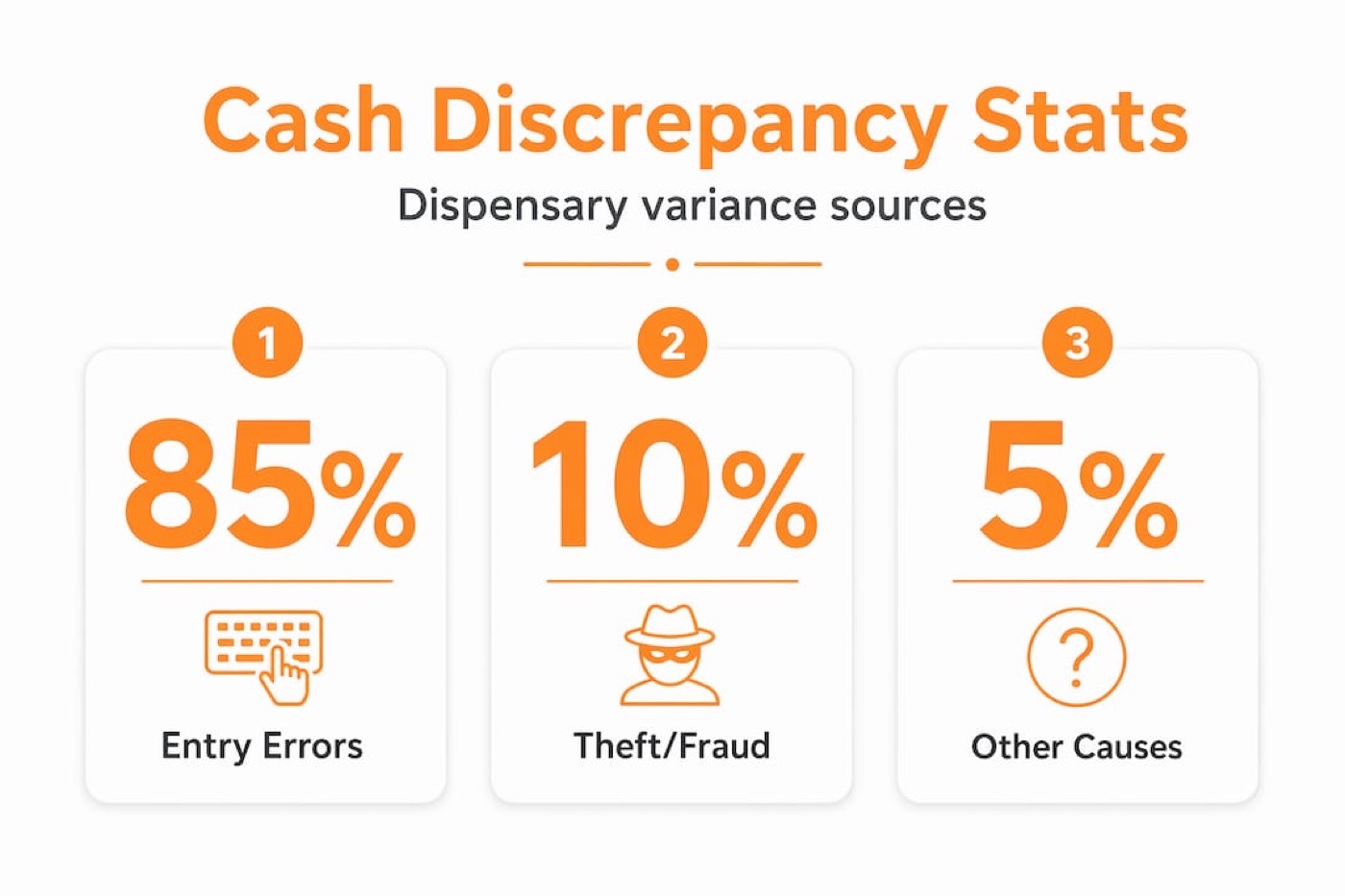
The remaining 15% of discrepancies represent incidents requiring formal investigation. These include product diversion, unreported sales, falsified deposit logs, or drawer manipulation. Operators who treat these incidents the same as data entry errors are making a serious compliance error. A 15% category incident left uninvestigated and undocumented signals to an auditor that your control environment is indifferent to serious losses.
Your investigation protocol for variances above threshold should follow this sequence:
- Step 1: Pull surveillance footage from the relevant shift and transaction time window
- Step 2: Run a transaction-level POS audit against the physical count sheet for that drawer
- Step 3: Review METRC transfer and sale records to identify any inventory that moved without a corresponding cash entry
- Step 4: Conduct employee interviews with documentation of what was asked and what was answered
- Step 5: File a formal incident report regardless of whether the investigation resolves the variance or not
Pro Tip: Keep a running variance log in a shared spreadsheet accessible only to your finance team and compliance officer. Log every variance, the investigation outcome, and the corrective action taken. Auditors interpret a maintained variance log as evidence of a functioning control environment, not a list of problems.
The role of audits in cannabis is specifically to test whether these controls exist and function. A variance log with 30 entries and documented resolutions reads far better than a clean ledger with no variance history at all.
Technology and procedures that strengthen cash reconciliation
Standardized procedures eliminate ambiguity at the shift level. Starting cash drawer amounts must be fixed and consistent across all registers. When a drawer opens at $200 every morning, any deviation in the opening count is an immediate red flag before the first transaction processes.

Mid-shift cash drops are a critical security and reconciliation control. When drawers accumulate more than $300 to $500 depending on transaction volume, a logged drop to the safe reduces theft opportunity and simplifies end-of-shift counts. Every drop must be logged with a timestamp, two signatures, and a drop receipt.
Manual versus automated cash counting
| Method | Accuracy | Audit Trail | Counterfeit Detection | Speed |
|---|---|---|---|---|
| Manual hand count | Moderate | Requires manual documentation | None | Slow |
| Basic bill counter | High | Printed count receipt | UV detection only | Fast |
| Multi-sensor bill counter | Very high | Printed count receipt with denominations | UV, magnetic, IR | Fast |
| Integrated POS cash drawer | High | Auto-logged in POS system | None by default | Automatic |
Multi-sensor bill counters with counterfeit detection are not optional hardware for a cannabis operation. They are basic infrastructure. Running both a register-level and a back-office counterfeit screen before funds hit your safe means a counterfeit bill caught at the counter does not require unwinding a bank deposit after the fact.
Bill counters that print denomination-level count receipts create a document directly linkable to your reconciliation sheet. That receipt becomes part of your daily document chain. Without it, your count is a verbal number backed by handwriting, which auditors treat with skepticism.
Pro Tip: Integrate your POS system with your track-and-trace platform so that inventory movement and cash transactions reconcile automatically at end of day. Manual cross-checks are still required, but automated matching flags discrepancies before your team begins the physical count.
Dual-custody protocols mean no single employee handles cash from drawer to safe without a second person present and signing off. This is the single most effective theft prevention measure available. Operators undervalue dual custody to their consistent detriment.
Consequences of poor cash reconciliation in cannabis
The financial and regulatory consequences of weak reconciliation controls compound in ways specific to cannabis that do not apply in other industries.
- IRC Section 280E exposure: Cannabis operators already operate under restrictive federal tax rules that intensify the need for airtight documentation. Documentation gaps in cash records translate directly to disallowed deductions and larger tax liabilities.
- Audit triggers and regulatory fines: State regulators in licensed cannabis markets actively review cash handling procedures. Poor controls invite costly audits that can escalate to license conditions or full revocation.
- Banking relationship loss: Poor documentation risks account closures even if cash totals match. Banks exit accounts when the documentation infrastructure does not meet their compliance standards.
- Employee theft exposure: Poor cash controls result in median $100,000 losses from employee theft in cash-heavy businesses. Without daily reconciliation, theft schemes run undetected for months.
- Compounding shrinkage: Without daily detection, shrinkage accumulates beyond what internal investigation can trace. By month-end, the loss is documented only as a number, not a recoverable event.
The operators who treat cash reconciliation as administrative overhead tend to be the same operators who face the costliest audits. Clean cash management for cannabis is not a best practice. It is the baseline for staying in business.
My take on where most operators get this wrong
I have reviewed reconciliation packages from dispensaries across multiple states, and the pattern is consistent. Operators spend real money on POS systems, compliant track-and-trace software, and compliance consultants. Then they run weekly reconciliations because the daily process feels operationally heavy.
That tradeoff is backwards. A daily reconciliation takes 20 to 30 minutes with a trained team and a standardized sheet. A regulatory audit triggered by documentation gaps takes months and costs far more than any efficiency gain from skipping daily counts.
The other thing I have seen repeatedly: operators who show clean deposits but cannot produce the reconciliation chain. A deposit matches your bank statement. Fine. But if you cannot link that deposit to a signed closing count, a POS summary, and a variance log entry for that date, the deposit means nothing to an examiner. They are not auditing your totals. They are auditing your process.
Dual custody gets skipped because it feels like bureaucratic friction. It is not friction. It is evidence. Every dual-custody signature is a data point that your control environment functions. Every missing signature is a gap that looks like negligence or intent, depending on the auditor’s read.
Build the daily discipline first. The documentation follows naturally. Monthly reconciliation is not a lower-effort version of daily reconciliation. It is a different thing entirely, and it is the thing that gets cannabis operators in trouble.
— JN
How Cannabisbusinessminds supports your cash management

Strong cash reconciliation does not exist in isolation from the rest of your financial operation. At Cannabisbusinessminds, the cannabis accounting resources cover the full financial control stack, from documentation standards to the tax code provisions that make those standards non-negotiable. If you are building or auditing your reconciliation process, the cost accounting guide for cannabis connects cash handling controls directly to your cost of goods accounting and IRS compliance posture. For operators working to improve budgeting around cash flow, the budgeting framework provides structure for planning around cash-intensive operations. Cannabisbusinessminds exists to give cannabis finance professionals the technical depth to build controls that actually hold up.
FAQ
Why must cannabis businesses reconcile cash daily?
Daily reconciliation detects discrepancies within 24 hours before they compound. Weekly or monthly cycles allow shrinkage to accumulate beyond traceable investigation.
What documents are required for cannabis cash reconciliation?
IRS standards require signed opening and closing count sheets, POS daily summaries, bank deposit slips, variance logs, and dual-counter signatures retained for 7 years minimum.
What is the three-way match in cannabis cash reconciliation?
The three-way match requires your POS total, physical cash count, and deposit slip to reconcile against each other at end of shift every day before funds are deposited.
How does poor reconciliation affect cannabis banking?
Banks review cash management documentation, not just cash totals. Insufficient reconciliation records directly trigger account closure risk regardless of whether the numbers balance.
What causes most cash discrepancies in cannabis dispensaries?
85% of discrepancies trace to data entry errors correctable through training. The remaining 15% indicate potential theft or diversion and require formal documented investigation.
Recommended
- What is financial consolidation in cannabis: a complete guide – Cannabis Business Minds
- How to Handle Cannabis Petty Cash for 280E Compliance – Cannabis Business Minds
- 7 Steps to a Cannabis Financial Reporting Checklist Success – Cannabis Business Minds
- Why Reconcile Cannabis Inventory: Essential Guide – Cannabis Business Minds
This article is general education, not tax, legal or accounting advice. Cannabis rules change quickly; confirm how they apply to you with a qualified cannabis CPA or attorney.