Cash Collections for a Cannabis Business: 2026 Guide

Cash collections for a cannabis business are a specialized process combining strict compliance, dual-custody cash handling, and structured accounts receivable management to secure and maximize cash flow. The industry’s predominantly cash nature, driven by federal banking restrictions, means that weak collection controls translate directly into audit exposure, liquidity gaps, and lost revenue. Standard operating procedures (SOPs), dual-custody counting, and proactive aging management are not optional add-ons. They are the operational foundation every cannabis operator needs to stay solvent and bank-ready.
What are the best practices for cash collections in cannabis retail?
High-traffic dispensaries process $20,000 to $50,000+ in cash daily, with 50–70% of transactions completed in cash. That volume creates real exposure at every shift change, drawer count, and deposit run. The controls you put in place at the point-of-sale level determine whether your books are defensible or a liability.
Standardize starting drawer amounts
Retail dispensaries should standardize starting drawer amounts between $200 and $500, calibrated to transaction volume. A consistent starting balance gives your reconciliation a clean baseline. Without it, variance analysis becomes guesswork, and your POS system data loses its audit value.
Dual-custody counting at every handoff
Dual-custody cash counting requires two employees to physically count and sign for every cash transfer event. This applies at shift start, shift end, and every cash room drop. A 3-minute start-of-shift count creates an audit trail that banking partners and state regulators both demand.

The signed verification form is the key artifact. Register totals without matching documentation lead to costly audit findings, not cash shortages themselves. The shortage is the symptom. The missing paper trail is the actual problem.
Variance reporting and POS integration
Document every count, every variance, and every corrective action. Integrate your cash count workflow directly with your POS system so that end-of-day reconciliation is automatic, not manual. Variance thresholds should be defined in your SOPs, typically $5–$10 per drawer, with anything above triggering a documented review.
| Control Element | Recommended Standard | Purpose |
|---|---|---|
| Starting drawer amount | $200–$500 | Clean reconciliation baseline |
| Cash count frequency | Start and end of every shift | Continuous audit trail |
| Dual-custody requirement | Two employees, signed form | Fraud prevention and bank readiness |
| Variance threshold | $5–$10 per drawer | Triggers documented review |
| Deposit schedule | Daily, documented | Aligns with sales reporting |
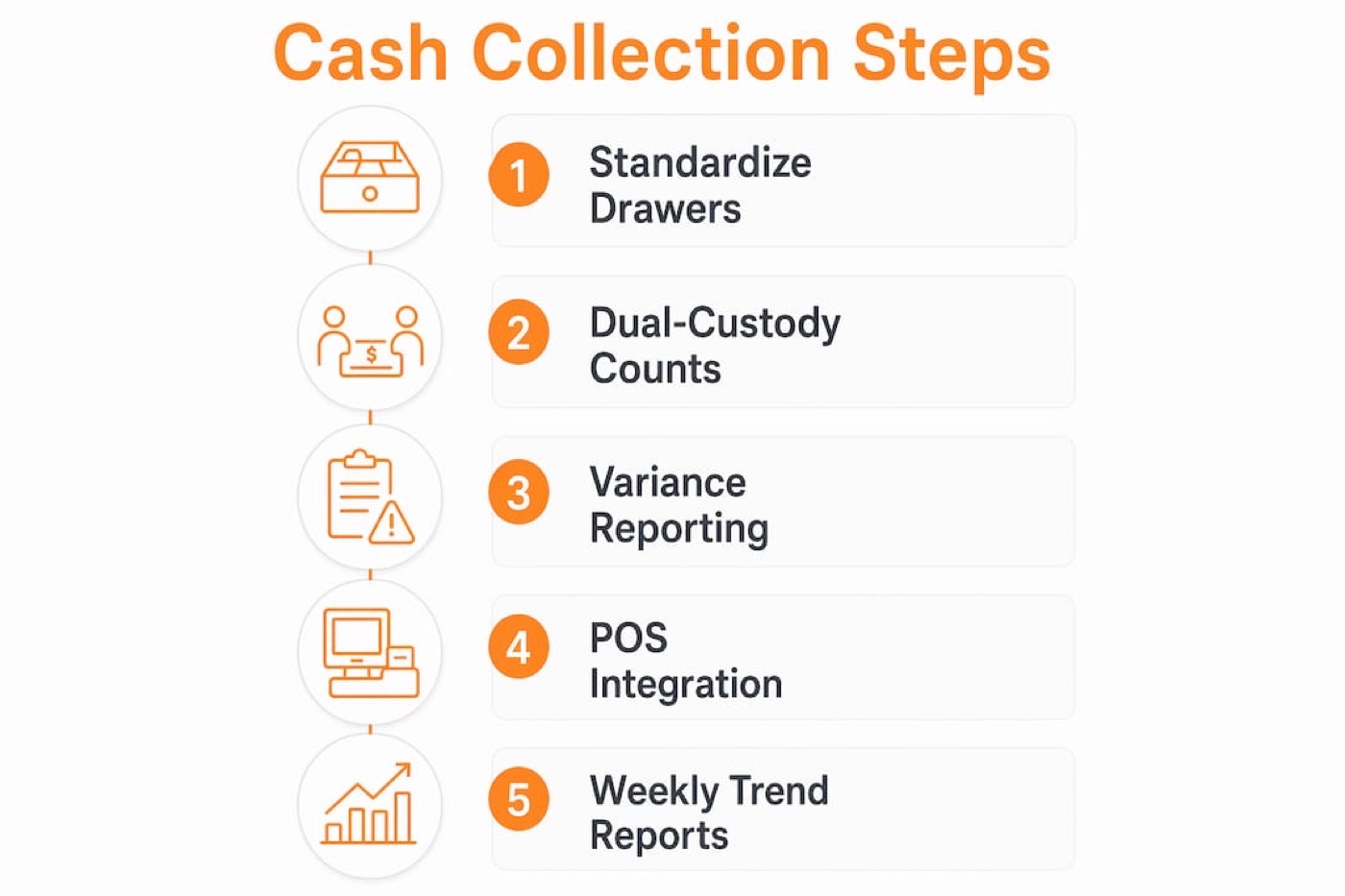
Pro Tip: Run a weekly variance trend report across all drawers. A single drawer with recurring small variances is a stronger fraud signal than one large discrepancy.
How can cannabis wholesalers manage accounts receivable to reduce DSO?
Wholesale cannabis operators face a different collection problem. Revenue shows up on the P&L, but cash does not arrive for weeks. Disentangling channel-specific payment cycles is the most effective way to avoid liquidity pitfalls despite appearing profitable on paper. A structured AR cadence is the fix.
A proactive four-pillar AR collection system works as follows:
- Pre-due date reminder. Send a written reminder 3–5 days before the invoice due date. This eliminates the “I forgot” response and sets a professional tone for the relationship.
- Call within 3 days of due date. If payment has not arrived by the due date, a direct phone call from your AR team goes out within 72 hours. Email alone does not create urgency.
- Senior escalation by day 7. If the account remains unpaid at 7 days past due, a senior finance manager or owner contacts the buyer directly. This signals that the relationship has moved beyond routine collections.
- Order hold for overdue accounts. No new orders ship to accounts with outstanding balances beyond your defined threshold. This is the single most effective lever in wholesale cannabis collections.
Implementing a proactive AR cadence with reminders and escalation can reduce AR from $400,000 to $120,000 and increase available cash by $255,000 in 90 days.
That result is not exceptional. It is what happens when you replace passive invoicing with a documented collection workflow. The operators who achieve it are not doing anything exotic. They are simply executing a process consistently.
For accounts exceeding 40 days past due, recovery probability declines sharply. At that point, specialized cannabis debt collection agencies become necessary. General commercial collectors often lack the regulatory knowledge to operate in licensed cannabis markets. Agencies experienced in cannabis navigate those restrictions effectively and are worth the fee on accounts that would otherwise be written off.
Your dispensary financial best practices should include a defined aging bucket policy: 0–30 days standard terms, 31–60 days on watch, 61–90 days escalated, and 90+ days referred to collections or written off with documentation.
How should cannabis businesses structure cash flow forecasting?
The biggest misconception in cannabis revenue management is equating revenue with actual cash available due to lags in payment processing and banking restrictions. A P&L that shows profitability can mask a cash crisis that surfaces two weeks later. The fix is a properly structured cash flow model.
The 13-week rolling cash flow model, updated weekly with license-level detail, is the standard for cannabis operators managing multiple revenue channels. It forces you to model cash receipts separately from revenue recognition dates.
Separate your cash flow channels
Cash flow forecasts must segregate retail, wholesale, and delivery payment lag channels separately. Retail collections typically lag 7–10 days. Wholesale collections lag 14–21 days. Blending these into a single cash flow line distorts your liquidity picture and can trigger a cash crisis that your income statement never predicted.
| Revenue Channel | Typical Collection Lag | Forecast Treatment |
|---|---|---|
| Retail (in-store) | 7–10 days | Model by deposit date, not sale date |
| Wholesale | 14–21 days | Model by invoice due date plus DSO |
| Delivery | 7–14 days | Separate line, payment method dependent |
Build in downside scenarios
Every cannabis cash flow model needs a downside scenario. Model a 15–20% revenue reduction and a 10-day extension on wholesale collections simultaneously. If that scenario breaks your liquidity, you have a structural problem that needs to be addressed before it becomes a crisis.
Cash flow forecasting must account for tax accruals at the license level, with cash outflows modeled on actual state excise tax due dates. Missing a state excise tax payment because it was not modeled as a cash outflow is an avoidable error that operators make repeatedly.
Pro Tip: Never blend revenue recognition dates with cash receipt dates in the same forecast line. That single error is responsible for more cannabis liquidity crises than any other forecasting mistake.
What regulatory and audit compliance requirements affect cannabis cash collections?
Banks require documented SOPs, segregation of duties, and consistent deposit schedules aligned with daily sales reporting before approving accounts or extending credit. Banking partners prioritize documented operational discipline over raw revenue. Operators lacking compliant documentation face investigative monitoring by their banking partners. That monitoring can escalate to account termination.
The core compliance requirements for cannabis cash collections are:
- Seven-year document retention. Cannabis businesses must retain all cash count sheets, deposit slips, and variance logs for a minimum of seven years to comply with IRS audits. Many operators discard working papers after fiscal year close, which creates direct audit exposure.
- Segregation of duties. The employee who counts cash cannot be the same employee who records the count or makes the deposit. This is a non-negotiable internal control for any cannabis operation with banking relationships.
- Documented deposit schedules. Deposits must occur on a regular, documented schedule that aligns with your daily sales reporting. Irregular deposits that do not match reported sales are a red flag in both state regulatory reviews and IRS examinations.
- Signed verification forms. Every cash count, every transfer, and every deposit requires a signed form from two employees. These forms are the primary evidence in any audit or investigation.
Your legal compliance framework for cash collections should treat documentation as a product, not a byproduct. The paper trail you build today is your defense in an audit two years from now.
Where most cannabis operators get cash collections wrong
The dual-custody count is the control that operators cut first when they are short-staffed. That is the wrong trade-off. A 3-minute count with two employees is not a labor cost. It is insurance against a six-figure audit finding or an internal theft that goes undetected for months. I have seen operators lose more in a single undocumented cash room incident than they would have spent on dual-custody compliance for an entire year.
The AR aging problem in wholesale cannabis is consistently underestimated. Operators see a large receivables balance and treat it as a timing issue. By the time they escalate, the account is 60 days past due and recovery is genuinely uncertain. The four-pillar cadence works because it creates urgency before the relationship deteriorates. Waiting until day 30 to make the first call is already too late.
On cash flow forecasting, the error I see most often is a single blended cash line that mixes retail deposits, wholesale receivables, and delivery collections. When a liquidity gap appears, no one can identify which channel caused it. Separate lines by channel from the start. It takes 20 minutes to set up and saves hours of forensic work later.
Documentation discipline is what keeps banking relationships intact. Your bank does not care that you processed $2 million in sales last quarter. They care that your deposit records match your sales reports and that two people signed every count sheet. Build that discipline into your SOPs before you need a new banking relationship, not after you lose one.
— IN
How Cannabisbusinessminds supports your cannabis finance operations
Cannabisbusinessminds covers the full range of cannabis finance controls, from cash handling protocols to bookkeeping compliance and cost accounting.

The cannabis bookkeeping tips for 2026 resource covers documentation standards, reconciliation workflows, and the controls that keep dispensaries audit-ready. For operators managing inventory alongside cash collections, the cannabis inventory costing guide addresses cost accounting principles that directly affect your gross margin and cash flow modeling. Both resources are built for finance professionals who need technical depth, not introductory overviews. Cannabisbusinessminds publishes at the level your operation actually requires.
FAQ
What is the recommended starting drawer amount for a cannabis dispensary?
Retail dispensaries should standardize starting drawer amounts between $200 and $500, depending on transaction volume. This creates a consistent reconciliation baseline and supports accurate variance reporting.
How long must cannabis businesses retain cash count records?
Cannabis businesses must retain all cash count sheets, deposit slips, and variance logs for a minimum of seven years to comply with IRS audit requirements.
What is a dual-custody cash count?
Dual-custody cash counting requires two employees to physically count and sign for every cash transfer event. It prevents internal theft and creates the audit trail that banking partners require.
How does a 13-week rolling cash flow model help cannabis operators?
A 13-week rolling cash flow model, updated weekly with separate lines for retail, wholesale, and delivery channels, prevents liquidity crises caused by blending revenue recognition dates with actual cash receipt dates.
When should a cannabis wholesaler use a debt collection agency?
For wholesale AR exceeding 40 days past due, recovery probability declines sharply. Specialized cannabis debt collection agencies with regulatory experience become the appropriate next step at that threshold.
Recommended
- Cannabis Bookkeeping Tips for Finance Pros in 2026 – Cannabis Business Minds
- Cannabis Accounting – Cannabis Business Minds
- How to Optimize Cannabis Cash Flow for Lasting Growth – Cannabis Business Minds
- 7 Essential Dispensary Financial Best Practices Explained – Cannabis Business Minds
This article is general education, not tax, legal or accounting advice. Cannabis rules change quickly; confirm how they apply to you with a qualified cannabis CPA or attorney.