How to Improve Cash Flow in a Cannabis Business

2026 update: what rescheduling changed for 280E (reviewed October 2026)
Effective April 22, 2026, a DOJ/DEA final order moved marijuana covered by a qualifying state medical license (and FDA-approved marijuana drugs) to Schedule III. Section 280E only applies to Schedule I and II substances, so state-licensed medical cannabis activity is generally no longer subject to 280E going forward. Adult-use cannabis remains in Schedule I and fully subject to 280E. The DEA proceeding to reschedule all marijuana was temporarily stayed in October 2026, and Treasury/IRS guidance on transition years and mixed medical/adult-use businesses is still pending.
Check where your business stands in about a minute.
Cash flow management in a cannabis business is defined as the active control of cash receipt timing, accounts receivable aging, inventory capital, and revenue channel mix to maintain liquidity under federal tax constraints. Profitability on paper means nothing if your bank account runs dry before payroll. Cannabis operators face a compounding problem: Section 280E limits deductible expenses, banking access remains restricted, and customers in wholesale channels routinely pay late. The operators who stay liquid are not the most profitable on paper. They are the most disciplined about when cash actually arrives and how much is frozen in inventory or owed by slow-paying accounts.
How can accurate cash flow forecasting improve cash flow in a cannabis business?
The single most common forecasting error in cannabis finance is using invoice dates instead of cash receipt dates. Invoice date forecasting causes liquidity surprises because it records revenue when earned, not when collected. A wholesale account with net-30 terms that consistently pays on day 45 will blow a hole in your weekly cash position if your model assumes day 30.
The fix is a rolling 13-week cash flow model updated every week with actual cash receipt dates. That model must be reconciled weekly, not monthly. Stale data produces stale decisions, and in cannabis, a two-week-old forecast is already wrong.
Blending retail, wholesale, and delivery cash flows into one line is the second major error. Each channel has a different collection lag. Retail is cash or debit at point of sale. Wholesale may be net-15 to net-45 with variable payment behavior. Delivery sits somewhere in between. Mixing them masks where your liquidity risk actually lives.
- Separate cash flows by channel: Retail, wholesale, and delivery each need their own collection lag assumptions.
- Use actual payment history: Replace assumed terms with the average days-to-pay for each account.
- Run scenario models: Stress test for a 20% revenue drop or a spike in bad debt write-offs.
- Reconcile weekly: Compare forecast to actuals every Monday and document the variance.
Pro Tip: Build a “worst case” tab in your 13-week model that assumes your three slowest-paying wholesale accounts miss their next payment entirely. If that scenario breaks your cash position, your credit terms are too loose.
What are best practices for aggressive accounts receivable management in cannabis?
Aggressive AR management cut average AR aging from 65 to just over 20 days and reduced bad debt losses by 80% in documented cannabis operations. That is not a marginal improvement. It is the difference between a business that funds its own growth and one that borrows to cover payroll.
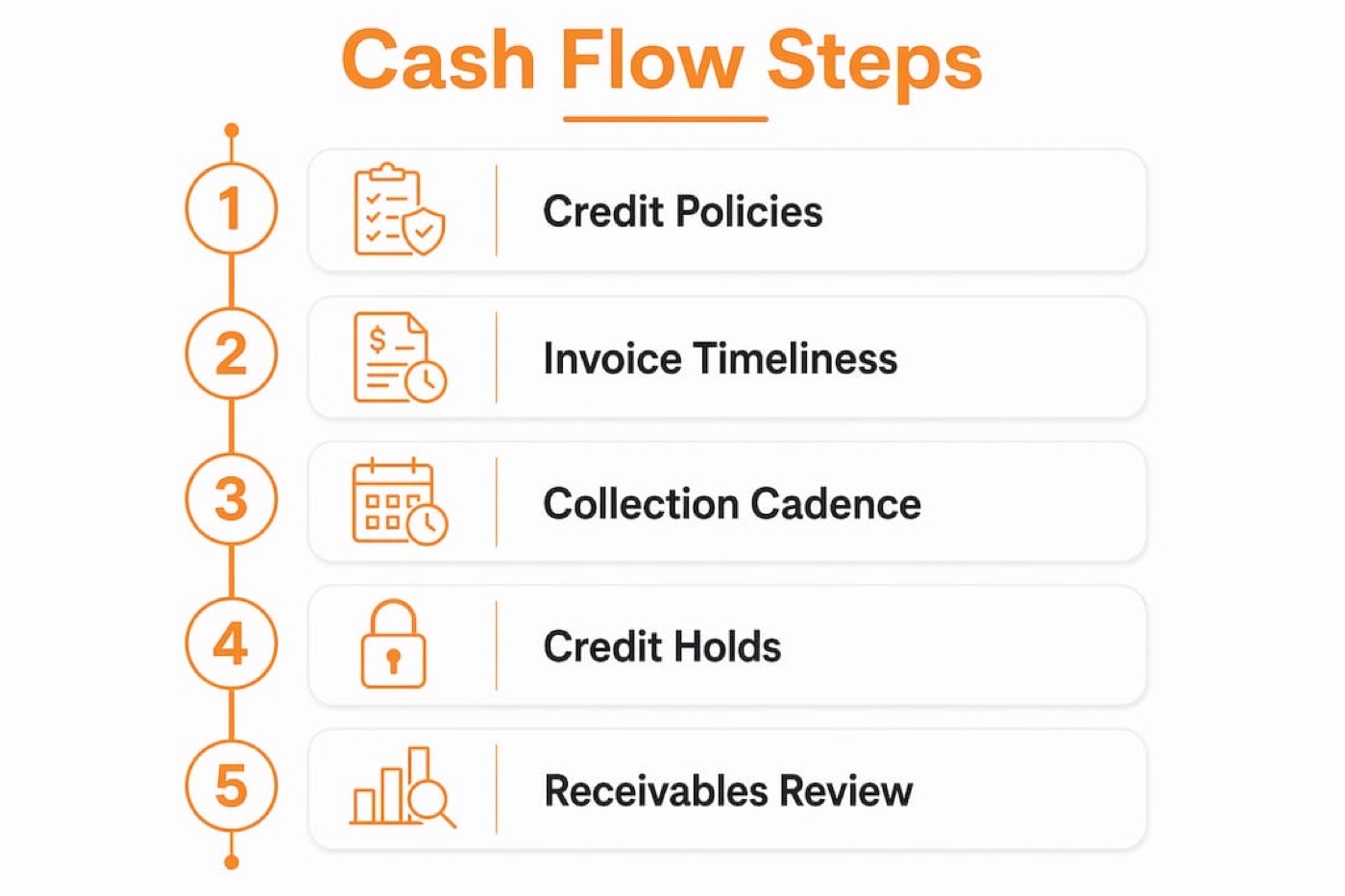
The collection cadence that produces those results follows a specific sequence:
- Confirm delivery immediately. Send a written delivery confirmation the same day product ships. This starts the clock and removes the “I never received it” dispute.
- Send a reminder 5 days before the due date. Email works here. The goal is to surface disputes before the invoice is overdue, not after.
- Call 3 days after the due date. Not email. Phone. Email is easy to ignore. A phone call signals that you track this and you expect payment.
- Issue a credit hold at 30 days past due. No new orders until the balance is cleared. This policy must be applied consistently or it loses all deterrent value.
- Resolve disputes within 72 hours. Speed in dispute resolution matters more than winning the argument. A $500 pricing dispute that drags for three weeks costs more in collection time than the $500 is worth.
- Assign ownership. One person owns AR. Not the sales rep who wants to protect the relationship. A dedicated collector or an outsourced AR service with no conflicting incentives.
Pro Tip: Your sales team will push back on credit holds. Hold the line. A customer who owes you $15,000 and keeps ordering is not a good customer. They are a financing arrangement you did not agree to.
The credit hold policy is where most operators fail. Applying it selectively destroys its effectiveness. Accounts past 30 days due should trigger an automatic no-new-orders flag in your system, not a conversation about whether this account is “too important” to hold.
How does inventory management directly impact cash flow in cannabis?
Inventory is cash frozen on shelves. Every dollar sitting in slow-moving SKUs is a dollar that cannot fund payroll, pay a vendor, or cover a tax installment. Inventory mismanagement traps capital and constrains operational agility in ways that show up slowly and then all at once.
The target is 30 days’ supply on hand. More than that and you are financing your supplier’s production cycle. Less than that and you risk stockouts that push customers to competitors. The 30-day inventory target is not a soft guideline. It is a financial discipline that requires weekly sell-through tracking by SKU.
- Audit SKUs quarterly. Cut any SKU with less than 10% sell-through in 60 days. Shelf space and capital are finite.
- Negotiate vendor payment terms. Push for net-30 or net-45 on inventory purchases. Align payment outflows with your own cash inflows.
- Track sell-through by SKU weekly. Aggregate inventory reports hide the slow movers. You need line-level visibility.
- Never finance operations with sales tax collections. Sales tax collected belongs to the state. Spending it creates a liability that compounds with penalties.
| Inventory Position | Cash Impact | Risk Level |
|---|---|---|
| Under 15 days’ supply | Stockout risk, lost revenue | High |
| 15–30 days’ supply | Healthy capital efficiency | Low |
| 31–60 days’ supply | Capital tied up, reduced agility | Medium |
| Over 60 days’ supply | Cash frozen, write-down risk | High |
For cannabis inventory control, the compliance layer adds another dimension. Seed-to-sale tracking systems like Metrc create a paper trail that must match your financial records. Discrepancies between your POS system and your inventory ledger are both a compliance problem and a cash flow problem.

Which payment and sales strategies can boost cannabis revenue and stabilize cash flow?
Top-performing dispensaries generate 50%+ of revenue online. That concentration in a single channel is not a risk. It is a signal that operators who build strong online ordering infrastructure capture more revenue per customer and reduce the friction that kills impulse purchases.
Modern payment options matter more than most operators realize. Adding debit, ACH, or cashless ATM options increases completed online orders by 30%+. Cash-only operations lose a measurable percentage of sales at checkout. That lost revenue is a cash flow problem disguised as a payment preference.
- Build a loyalty program. Loyalty members drive over 56% of revenue and shop 10.8% more frequently than non-members. Predictable repeat purchase behavior is the closest thing cannabis retail has to recurring revenue.
- Use SMS marketing. SMS messaging generates up to $2.44 in revenue per message over 60 days. That is a measurable return on a low-cost channel.
- Personalize campaigns. Personalized marketing increases revenue per recipient by 21%. Generic blast emails do not produce the same result.
- Offer early payment discounts to wholesale accounts. A 1% discount for payment within 10 days (net-30 terms) costs less than the carrying cost of a 30-day receivable.
For operators looking to expand their cannabis revenue streams, the combination of online ordering infrastructure, loyalty programs, and modern payment methods produces compounding cash flow benefits. Each element reinforces the others.
How does 280E tax law influence cash flow management in cannabis?
Section 280E of the Internal Revenue Code prohibits cannabis businesses from deducting ordinary business expenses because cannabis remains a Schedule I controlled substance federally. The only path to reducing taxable income is maximizing cost of goods sold (COGS). Every dollar correctly classified as COGS reduces taxable income dollar for dollar. Every dollar misclassified as a non-deductible operating expense is taxed at full rates.
Documented, defensible cost studies are the mechanism. A cost study allocates direct and indirect costs, including labor, utilities, and facility expenses, to COGS based on a supportable methodology. The IRS will challenge allocations that lack documentation. “We estimated it” is not a defense.
- Allocate labor costs to COGS. Budtenders, trimmers, and production staff who touch the product have allocable labor costs. Document their time.
- Include facility and utility costs. Square footage used for production or storage is allocable. Square footage used for retail or administration is not.
- Price management fees at arm’s length. Inflated management fees between related entities trigger IRS audits. The fee must reflect what an unrelated party would charge.
- Maintain separate tax accrual schedules. Excise tax and sales tax liabilities need their own ledger lines, not a combined “tax payable” account.
- Set aside tax funds immediately. Do not wait until the quarterly estimate is due. Fund the tax reserve weekly from gross receipts.
“The cannabis operators who get surprised by tax bills are the ones who treated their tax accrual as a line item to revisit later. By the time ‘later’ arrives, the cash is already spent.”
For a full breakdown of how 280E affects your tax liability, the classification decisions made at the chart-of-accounts level determine your effective tax rate. That work happens in accounting, not at tax time.
What I have seen operators get wrong about cannabis cash flow
The gap between paper profit and actual cash availability is where most cannabis businesses quietly fail. I have reviewed financials for operators showing strong net income on their P&L while their checking account could not cover two weeks of payroll. The problem is almost always the same: no rolling forecast, AR aging past 60 days, and inventory sitting at 90 days’ supply.
The operators who build lasting banking relationships are not the ones with the highest revenue. Banks evaluate documented cash handling and daily reconciliations, not gross sales. An operator running $2 million a year with clean books and a weekly cash reconciliation process will keep their bank account. An operator running $5 million with sloppy cash controls will lose it.
The 280E compliance piece is where I see the most expensive mistakes. Operators who skip the cost study and take a rough COGS estimate are leaving real money on the table and creating audit exposure simultaneously. The cost study is not optional. It is the foundation of your tax position.
Static forecasting is the other recurring failure. A forecast built in january and reviewed in december is not a forecast. It is a historical document. The cannabis financial forecasting discipline that actually works requires weekly updates, variance analysis, and scenario planning built into the operating rhythm of the finance team.
— JN
Cannabisbusinessminds resources for cannabis cash flow management
Cannabisbusinessminds covers the financial and regulatory frameworks that cannabis operators need to manage cash flow with precision.

The cannabis bookkeeping guide covers the chart-of-accounts structure and reconciliation practices that underpin accurate cash reporting. The inventory costing resource details COGS allocation methods that directly affect both your 280E tax position and your working capital. For operators building out their financial planning process, the budgeting guide provides step-by-step frameworks for cannabis-specific cash planning. Each resource is written for finance professionals who already know the basics and need the cannabis-specific layer.
FAQ
What is the fastest way to improve cannabis business cash flow?
Aggressive AR management produces the fastest results. Structured collection cadences cut average AR aging from 65 to just over 20 days and reduce bad debt losses by 80%, based on documented cannabis operations.
How does a rolling 13-week cash flow model work for cannabis?
A rolling 13-week model tracks expected cash receipts and disbursements by week, updated every week with actual payment data. It separates retail, wholesale, and delivery collection lags to give an accurate picture of liquidity 90 days out.
Why does 280E matter for cannabis cash flow?
Section 280E disallows most business expense deductions for cannabis companies. Maximizing defensible COGS allocations through documented cost studies reduces taxable income and preserves cash that would otherwise go to federal taxes.
What inventory level is right for a cannabis dispensary?
A 30-day supply target balances stockout risk against capital efficiency. Holding more than 60 days of inventory freezes cash and creates write-down risk if products expire or lose market value.
How do loyalty programs affect cash flow stability?
Loyalty program members drive over 56% of dispensary revenue and shop 10.8% more frequently than non-members. That purchase frequency creates predictable cash inflows that make weekly forecasting more reliable.
Recommended
- How to Optimize Cannabis Cash Flow for Lasting Growth – Cannabis Business Minds
- Why Implement Cash Controls in Your Cannabis Business – Cannabis Business Minds
- 7 Essential Dispensary Financial Best Practices Explained – Cannabis Business Minds
- Why Reconcile Cash for Cannabis: A Finance Guide – Cannabis Business Minds
This article is general education, not tax, legal or accounting advice. Cannabis rules change quickly; confirm how they apply to you with a qualified cannabis CPA or attorney.