How to Handle Cannabis Petty Cash for 280E Compliance

2026 update: what rescheduling changed for 280E (reviewed October 2026)
Effective April 22, 2026, a DOJ/DEA final order moved marijuana covered by a qualifying state medical license (and FDA-approved marijuana drugs) to Schedule III. Section 280E only applies to Schedule I and II substances, so state-licensed medical cannabis activity is generally no longer subject to 280E going forward. Adult-use cannabis remains in Schedule I and fully subject to 280E. The DEA proceeding to reschedule all marijuana was temporarily stayed in October 2026, and Treasury/IRS guidance on transition years and mixed medical/adult-use businesses is still pending.
Check where your business stands in about a minute.
A failed IRS audit in a cannabis business rarely starts with a million-dollar accounting scandal. More often, it begins with an unmarked envelope of cash, a missing receipt, or a petty cash payout labeled “miscellaneous.” Because cash-intensive cannabis operations already face elevated IRS scrutiny under Section 280E, even small documentation gaps in petty cash management can trigger costly penalties, disallowed deductions, or full-scale examinations. This guide walks you through the exact steps to build a petty cash system that holds up under audit pressure and keeps your cannabis business compliant with IRC 471 and 280E.
Table of Contents
- Understand how tax law shapes petty cash management
- What you need before opening a petty cash fund
- Step-by-step: How to control petty cash for audit defense
- Avoiding common pitfalls: COGS eligibility and recordkeeping mistakes
- Review and reporting: Proving compliance under audit
- Our perspective: Why cautious petty cash handling is non-negotiable in cannabis
- How we can help you raise your cannabis accounting game
- Frequently asked questions
Key Takeaways
| Point | Details |
|---|---|
| 280E limits deductions | Cannabis businesses cannot deduct most operating expenses, so petty cash must be managed with extra care. |
| Document every transaction | Maintain receipts, approval logs, and tie all petty cash to the general ledger to protect against IRS audit risk. |
| COGS eligibility needs support | Only certain expenses tied to inventory are COGS-eligible—require documentation to prove all claims. |
| Segregate duties and reconcile | Assign key roles, separate authorization, and perform regular reviews to ensure compliance and control. |
Understand how tax law shapes petty cash management
Before you build any system, you need to understand why petty cash is a uniquely loaded issue for cannabis businesses. It goes deeper than just keeping receipts.
IRC Section 280E disallows all deductions and credits for businesses trafficking in Schedule I or II controlled substances under federal law. Cannabis remains Schedule I, which means your dispensary or cultivation operation cannot deduct ordinary business expenses the way a regular company can. Payroll, rent, marketing, and yes, petty cash payouts for supplies all fall into this trap unless they can be classified as Cost of Goods Sold, known as COGS.
“No deduction or credit shall be allowed for any amount paid or incurred during the taxable year in carrying on any trade or business if such trade or business (or the activities which comprise such trade or business) consists of trafficking in controlled substances…” — IRC Section 280E
That one rule changes everything about how you manage every dollar that moves through your operation, including the small amounts flowing through petty cash. Understanding the importance of cannabis audits helps you appreciate why every cash movement matters.
What makes this especially tricky is the cash-intensive reality most cannabis operators live with daily. Because federal banking restrictions limit access to standard financial services, many businesses handle an outsized proportion of transactions in physical cash. That reality creates what tax examiners call a “high-risk environment” for cash-on-hand accuracy. IRS Internal Revenue Manual 4.10.3 explicitly directs examiners to evaluate internal controls and accounting systems, paying particular attention to cash-on-hand balancing. Every cannabis cash challenge you navigate improperly becomes a potential red flag.
| Requirement | Why it matters for petty cash |
|---|---|
| IRC 280E | Disallows most operating expense deductions; petty cash must map to COGS or be carefully documented |
| IRC 471 | Governs inventory accounting methods; affects what qualifies as COGS |
| IRM 4.10.3 | IRS exam guidance reviews cash-on-hand and internal controls directly |
| Substantiation rules | All cash disbursements need receipts, dates, amounts, and business purpose |
| General ledger linkage | Petty cash fund must reconcile to your books; unexplained variances trigger flags |
Understanding these layers is the foundation of solid cannabis business bookkeeping. Without it, no process you build will stick under pressure.
What you need before opening a petty cash fund
Compliance does not start when you spend money. It starts before you touch the first dollar. Getting these fundamentals right gives your entire petty cash system a defensible structure.
The single most critical step is assigning a named petty cash custodian. This person is responsible for holding the fund, issuing cash, collecting receipts, and completing reconciliations. Critically, the custodian should not be the same person who approves disbursements or posts entries to the general ledger. That separation is what auditors call segregation of duties, and it is one of the first things an IRS examiner checks. IRS Internal Revenue Manual 4.10.3 identifies this structure as part of a sound internal control environment for cash management.
Think of petty cash as a “mini internal-control system” with five core requirements: a named custodian, pre-numbered vouchers with immediate receipt capture, documented approval thresholds, clear segregation between authorization and custody, and recurring reconciliation with written variance investigations.
Before you disburse a single dollar, gather these materials:
- Pre-numbered petty cash vouchers (sequential numbers make gaps immediately visible)
- A secure lockbox with limited key access, ideally logged
- A daily or weekly disbursement log with columns for date, payee, amount, purpose, and approval
- An approval workflow chart showing who can authorize what dollar amounts
- Blank variance investigation forms for reconciliation discrepancies
Pro Tip: Capture the receipt before handing over the cash whenever possible. If the expense requires advance cash, set a 24-hour deadline for receipt return and supervisor sign-off. Late or missing receipts are among the top audit vulnerabilities in cannabis finance.
Here is how compliant setups differ from problematic ones:
| Feature | Compliant setup | Non-compliant setup |
|---|---|---|
| Fund custodian | Named individual, documented | Whoever is available that day |
| Vouchers | Pre-numbered, matched to receipt | Handwritten notes or none at all |
| Approval | Supervisor sign-off required | Self-authorization accepted |
| Segregation | Authorization, custody, and recordkeeping are separate roles | One person controls everything |
| Reconciliation | Regular schedule, written variance explanation | Done occasionally or never |
| GL linkage | Every payout coded to a ledger account | Bulk entry or no entry |
Reviewing dispensary financial best practices alongside these setup requirements helps you see how petty cash fits into your broader financial control structure. Cannabis bookkeeping best practices provide the scaffolding that makes the whole system hold together.
Step-by-step: How to control petty cash for audit defense
With your tools and controls in place, follow this process every time you manage petty cash activity. Consistency is what creates the audit trail. One-off exceptions are where problems start.
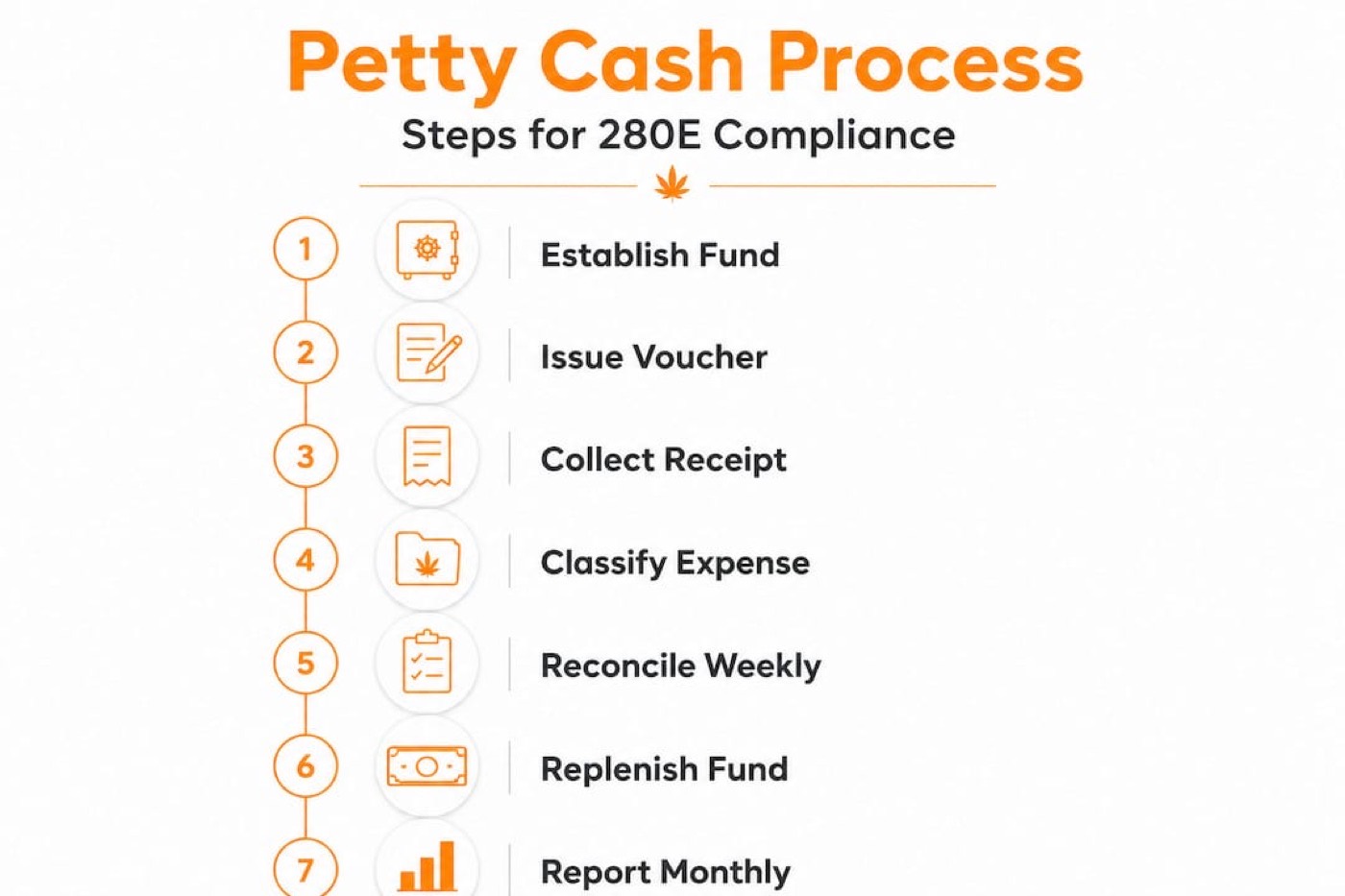
Step 1: Establish the fund. Set a fixed fund amount, typically between $100 and $500 depending on your operation size. Document the opening balance in writing, record it on the general ledger, and place the cash in the locked box. Note the date, the custodian’s name, and the approving supervisor.
Step 2: Issue a voucher before every disbursement. When an employee requests petty cash, fill out a pre-numbered voucher showing the date, the requested amount, the business purpose, and the requester’s name. The supervisor reviews and signs before any cash leaves the box.
Step 3: Collect the receipt immediately. As soon as the purchase is made, the receipt must be attached to the voucher and returned to the custodian. No receipt, no closed transaction. Make this a written policy with consequences for noncompliance.
Step 4: Classify every disbursement correctly. This is where 280E makes petty cash genuinely complex. IRS examination guidance emphasizes that internal controls and accounting systems are reviewed at the transaction level, not just in aggregate. Every payout must be coded as COGS-eligible or as a non-deductible operating expense. A bag of nutrients for cultivation may qualify as COGS under IRC 471. Office tape for the reception desk does not. Document the reasoning at the time of classification, not months later during tax prep. Because IRC 280E limits tax relief to COGS, misclassifying a non-COGS expense as inventory-related is a direct audit trigger.
Step 5: Reconcile on a fixed schedule. Weekly reconciliation is best practice. The custodian counts remaining cash, totals all vouchers and receipts, and confirms that cash plus documentation equals the fund’s opening balance. Any variance gets a written explanation immediately.

Step 6: Replenish with a check, not cash. When the fund runs low, replenish it by writing a check payable to the custodian for exactly the documented disbursement amount. This keeps the paper trail clean and creates a clear audit entry.
Step 7: Generate a monthly summary report. Compile all vouchers by expense category, total COGS-eligible versus non-deductible items, and attach to the monthly close package. This report becomes your front-line defense in any IRS inquiry. For detailed guidance on calculating cannabis COGS, having these monthly summaries already sorted by category makes year-end reporting significantly faster.
Pro Tip: Any reconciliation variance, even a dollar or two, needs a written explanation signed by the custodian and supervisor. Auditors treat unexplained variances as indicators of broader control weaknesses, not just minor math errors. “Couldn’t find the receipt” is not an acceptable explanation at audit time.
Avoiding common pitfalls: COGS eligibility and recordkeeping mistakes
Knowing the right process is only half the equation. Understanding where cannabis finance teams most often fail helps you build preventive checkpoints before those mistakes reach your books.
IRS internal controls evaluation under IRM 4.10.3 specifically targets cash-on-hand mapping to the general ledger. When examiners find petty cash records that do not tie to your GL or that cannot be explained systematically, they treat it as an indicator of broader recordkeeping weakness, which typically expands the scope of the examination.
Here are the red flags that most commonly draw IRS attention in cannabis petty cash reviews:
- No receipt attached to voucher: Even a small, undocumented payout signals that your controls are not functioning
- Petty cash used for personal items: Meals for non-business purposes, personal supplies, or informal loans to employees are disallowed and often uncoverable
- No GL linkage: Petty cash entries that don’t map to specific accounts make it impossible to verify your tax position
- Bulk or generic coding: Labeling payouts as “supplies” or “misc.” without detail makes COGS classification impossible to defend
- Irregular or missing reconciliations: Gaps in the reconciliation schedule suggest the fund is not being managed, only used
- Same person authorizing and recording: Lack of segregation is one of the top findings in cannabis financial audits
The cannabis expense categories you use in your chart of accounts should directly mirror the categories in your petty cash log. If a COGS-eligible petty cash purchase cannot be traced from voucher to receipt to inventory record to GL entry, the IRS will likely disallow it. And under 280E, losing a COGS classification is far more expensive than it would be for a regular business.
A critical checklist for every petty cash transaction should include: Was a voucher issued before cash was dispensed? Is the receipt attached and legible? Has the expense been classified to a specific GL account? Was approval obtained from a supervisor with signing authority? If any of these answers is no, correct it before the transaction ages past 48 hours.
Review and reporting: Proving compliance under audit
Everything you have built so far is only valuable if you can present it clearly under IRS scrutiny. The final layer of your petty cash system is the review and reporting routine that keeps it audit-ready year round.
IRS examination procedures evaluate your accounting system as a whole, which means your petty cash records need to integrate seamlessly with your broader financial reporting. Standalone petty cash logs that are not tied to monthly close packages or annual tax workpapers are a vulnerability.
Build a recurring review routine using this checklist:
- Weekly: Custodian reconciles fund, explains variances in writing, supervisor reviews and signs off
- Monthly: Finance manager reviews all vouchers, confirms GL coding, attaches petty cash summary to close package
- Quarterly: Controller or CFO reviews petty cash policy for changes, confirms fund limits are appropriate, checks for any pattern of variances
- Annually: Include petty cash review in your annual compliance report, document that procedures were followed, and archive all records for at least seven years
For record storage, maintain both physical and digital copies of every voucher, receipt, and reconciliation report. Digital scans stored in a clearly labeled folder structure with date-based naming conventions make it easy to pull records quickly during an examination. Cannabis bookkeeping best practices reinforce that organized, retrievable records are your most powerful audit defense.
Do not overlook cannabis tax forms when building your annual compliance package. Petty cash activity that affects COGS calculations flows directly into your tax return, and the connection between your internal records and your filed return needs to be traceable and logical.
Our perspective: Why cautious petty cash handling is non-negotiable in cannabis
Here is something we rarely see discussed plainly in industry conversations: most of the IRS audit problems cannabis businesses face do not come from deliberate fraud or major financial manipulation. They come from repeated small process failures that, taken together, paint a picture of inadequate internal controls.
The cannabis industry operates under a level of federal scrutiny that simply does not apply to most other sectors. When an examiner walks into a conventional retail business, petty cash is a minor agenda item. When they walk into a cannabis operation, bookkeeping quality and cash management discipline signal whether the entire tax position is defensible or vulnerable.
What separates thriving cannabis operations from struggling ones is often not the size of the business or even the sophistication of their accounting software. It is whether their finance team has built systems that can withstand scrutiny at every level, including the small, everyday transactions most businesses treat as afterthoughts.
Petty cash done right is not just defensive recordkeeping. It is actually a competitive advantage. Businesses with tight cash controls finish audits faster, resolve disputes more cleanly, and present stronger financial profiles to investors, lenders, and potential acquirers. The hours you invest in building a rigorous petty cash system will return multiples in reduced audit risk, cleaner books, and more defensible tax positions. Treat it as an investment in your business’s credibility, not just a compliance burden.
How we can help you raise your cannabis accounting game
Getting petty cash right is a strong start, but it is one piece of a much larger compliance picture.

At Cannabis Business Minds, we provide resources built specifically for cannabis finance professionals navigating the complexity of 280E, IRC 471, and cash-based operations. Whether you need a deep grounding in cost accounting for cannabis or want to explore the full scope of cannabis accounting services available to your operation, our platform connects you with the expert guidance your business needs. For teams focused on financial planning, our resources on budgeting for cannabis businesses help you build a forward-looking financial strategy that integrates compliance at every level. Explore the full library and find the tools that match where your business is right now.
Frequently asked questions
What is petty cash and why is it risky for cannabis businesses?
Petty cash is a small reserve fund used for minor, incidental business purchases; in cannabis, it carries elevated risk because cash-heavy operations already attract strict IRS scrutiny, and any gap in documentation can undermine your entire tax position under 280E.
Can petty cash expenses qualify as COGS for 280E purposes?
Petty cash payments may qualify as COGS if they are directly tied to inventory production and supported by contemporaneous documentation, but 280E limits tax relief to COGS only, so most general operating expenses paid through petty cash remain non-deductible.
What documentation does the IRS look for in cannabis petty cash audits?
The IRS looks for pre-numbered vouchers, receipts, approval logs, reconciliation records, and a clear trail showing that every cash disbursement ties back to a specific general ledger account.
What are the most common petty cash mistakes in cannabis finance?
The most frequent errors include missing receipts, failure to segregate duties, and no variance investigation process, all of which signal to IRS examiners that your internal controls are not functioning as designed.
Recommended
- 7 Key Eligible Business Expenses for Cannabis Companies – Cannabis Business Minds
- 7 Essential Tax Planning Tips for Dispensaries – Cannabis Business Minds
- What Is Tax Liability for Cannabis? Complete Breakdown – Cannabis Business Minds
- Cannabis Expense Categories Explained: Tax and Compliance – Cannabis Business Minds
This article is general education, not tax, legal or accounting advice. Cannabis rules change quickly; confirm how they apply to you with a qualified cannabis CPA or attorney.