Why legal compliance is critical for U.S. cannabis finance
2026 update: what rescheduling changed for 280E (reviewed October 2026)
Effective April 22, 2026, a DOJ/DEA final order moved marijuana covered by a qualifying state medical license (and FDA-approved marijuana drugs) to Schedule III. Section 280E only applies to Schedule I and II substances, so state-licensed medical cannabis activity is generally no longer subject to 280E going forward. Adult-use cannabis remains in Schedule I and fully subject to 280E. The DEA proceeding to reschedule all marijuana was temporarily stayed in October 2026, and Treasury/IRS guidance on transition years and mixed medical/adult-use businesses is still pending.
Check where your business stands in about a minute.
Compliance in cannabis is not just bureaucratic overhead. Many operators treat it as a checkbox, something to handle once a year when licenses are up for renewal. But that mindset is quietly costing businesses banking relationships, investor access, and in some cases, their operating licenses. Cannabis banking access remains deeply tied to how well operators demonstrate legal compliance, because the federal-state legal mismatch makes every financial partner a risk evaluator. This article connects legal compliance directly to the financial realities of running a cannabis business, covering banking, taxes, documentation practices, and how to stay ahead as regulations shift.
Table of Contents
- How compliance shapes cannabis banking and financial access
- The tax trap: §280E and operational consequences
- Documentation, due diligence, and exam readiness
- How changes in regulation shift compliance requirements
- Our take: Treat legal compliance as your operating system
- Strengthen your compliance with expert cannabis finance resources
- Frequently asked questions
Key Takeaways
| Point | Details |
|---|---|
| Compliance drives financial access | Without strong compliance, most banks and payment solutions won’t work with cannabis businesses. |
| §280E makes taxes complex | Federal law limits deductions, raising effective tax rates and demanding detailed COGS tracking for cannabis companies. |
| Documentation is critical | Failing to document and substantiate financial transactions can result in audits, penalties, and lost licenses. |
| Rules change, but core duties remain | Even as regulations evolve, core due diligence and reporting duties stay in place for operators and banks. |
| Treat compliance as strategy | Viewing compliance as a business foundation strengthens both operational resilience and financial opportunity. |
How compliance shapes cannabis banking and financial access
Banking is the most immediate place where legal compliance either opens doors or closes them. Most cannabis-related businesses (CRBs) operate in a grey zone where federal illegality restricts access to mainstream financial tools. When a bank decides to work with a CRB, it does not simply open an account and move on. It initiates a structured, ongoing compliance review that never really stops.

Cannabis banking compliance is structurally tied to the Bank Secrecy Act (BSA) and Anti-Money Laundering (AML) requirements. Every bank that works with a CRB must file Suspicious Activity Reports (SARs), even for routine transactions, because federal guidance essentially treats all cannabis-related transactions as suspicious by default. That creates a significant compliance burden for both the bank and the operator.
What SARs look like in practice
There are three SAR categories commonly filed for CRBs:
- Marijuana Limited SARs filed when the bank believes the business is legally operating under state law
- Marijuana Priority SARs filed when there are red flags suggesting violations of state law
- Marijuana Termination SARs filed when the bank ends the relationship due to compliance failures
Understanding which SAR category your business falls into is a direct signal of your compliance health. If your bank is filing Priority SARs, that is a warning sign that your documentation is insufficient or your operations have raised concerns.
“Banks that serve cannabis clients are not just doing a favor. They are running a compliance program. The CRB either supports that program with strong documentation and transparency, or the bank eventually exits the relationship.”
The costs of banking in this environment are real. Expect higher account maintenance fees, more frequent audits, and stricter cash management protocols. Operators with strong compliance fundamentals consistently report better banking terms and fewer account closures.
| Factor | Well-compliant CRB | Non-compliant CRB |
|---|---|---|
| SAR category | Cannabis Limited | Cannabis Priority or Termination |
| Account stability | High | Low to none |
| Monthly banking fees | Elevated but manageable | Often unworkable or denied |
| Cash management options | Broader | Cash-only or restricted |
| Access to loans/credit | Possible with documentation | Nearly impossible |
Pro Tip: Before approaching any bank, prepare a full compliance dossier. This should include your state license, operating procedures, AML policies, and cash handling protocols. Banks that work with CRBs want to see that you have already thought through their compliance concerns before they ask.
Maintaining a solid cannabis banking workflow is not just about keeping accounts open. It directly shapes your cost of capital, your ability to process payroll, and your capacity to accept card payments. Get the compliance foundation right, and the financial infrastructure follows.
The tax trap: §280E and operational consequences
If banking compliance is about access, tax compliance is about survival. IRC Section 280E is the federal tax code provision that prevents cannabis businesses from deducting most ordinary business expenses because they sell a Schedule I controlled substance. That single provision has more operational impact than almost any other compliance requirement.
Here is the core problem. A typical retail business with $1 million in revenue and $600,000 in expenses would pay taxes on $400,000 in income. A cannabis dispensary in the same position can only deduct Cost of Goods Sold (COGS), not rent, not payroll for budtenders, not marketing, not utilities. If COGS represents $350,000 of those $600,000 in expenses, the dispensary pays taxes on $650,000 in income, not $400,000.
That effective tax rate increase under §280E is why cannabis businesses routinely face effective tax rates of 60% to 70%, compared to 20% to 30% for comparable non-cannabis businesses. This is not a tax planning failure. It is a structural reality that makes meticulous tax compliance a core finance management function.
What this means for your accounting
- Separate your COGS from all other expenses with precision. COGS in a cannabis context includes the direct costs of producing or purchasing product, but you need detailed records to justify every dollar.
- Build an inventory accounting system that captures every input cost, from seeds or wholesale purchases to processing labor and packaging directly tied to production.
- Document your expense allocation methodology in writing. If an IRS auditor questions how you split costs between COGS and general operations, you need a defensible, documented method, not a verbal explanation.
- Track state tax obligations separately. Many states impose additional excise taxes on cannabis at the cultivation, wholesale, or retail level, layering on top of federal §280E exposure.
- Review your entity structure. Some operators benefit from separating their cannabis-touching entity from ancillary business functions to maximize legitimate deductions in the non-cannabis entity.
By the numbers: A cannabis retail business earning $2 million in gross revenue with a 55% effective tax rate pays approximately $1.1 million in taxes. A similar non-cannabis retailer at a 28% rate pays $560,000. That $540,000 difference is the §280E penalty in practical terms.
Tax compliance in cannabis is not a once-a-year accounting exercise. It requires continuous inventory tracking, real-time cost allocation, and quarterly estimated payments that reflect §280E limitations. Operators who treat taxes as an annual event consistently underpay estimated taxes and face penalties that compound their effective rate further.
Pro Tip: If you operate both cannabis-touching and non-cannabis activities, consider working with your accountant to establish a multi-entity structure. The non-cannabis entity can potentially deduct all ordinary business expenses, which reduces your overall tax burden legally and significantly.
Understanding why tax compliance matters at this structural level changes how finance teams prioritize their time. Daily inventory accuracy is not an operational nicety. It is a tax compliance requirement.
Documentation, due diligence, and exam readiness
Tax and banking compliance both ultimately depend on one thing: documentation. Not just having records, but having the right records, organized in ways that survive scrutiny from the IRS, state regulators, and financial institution reviewers.
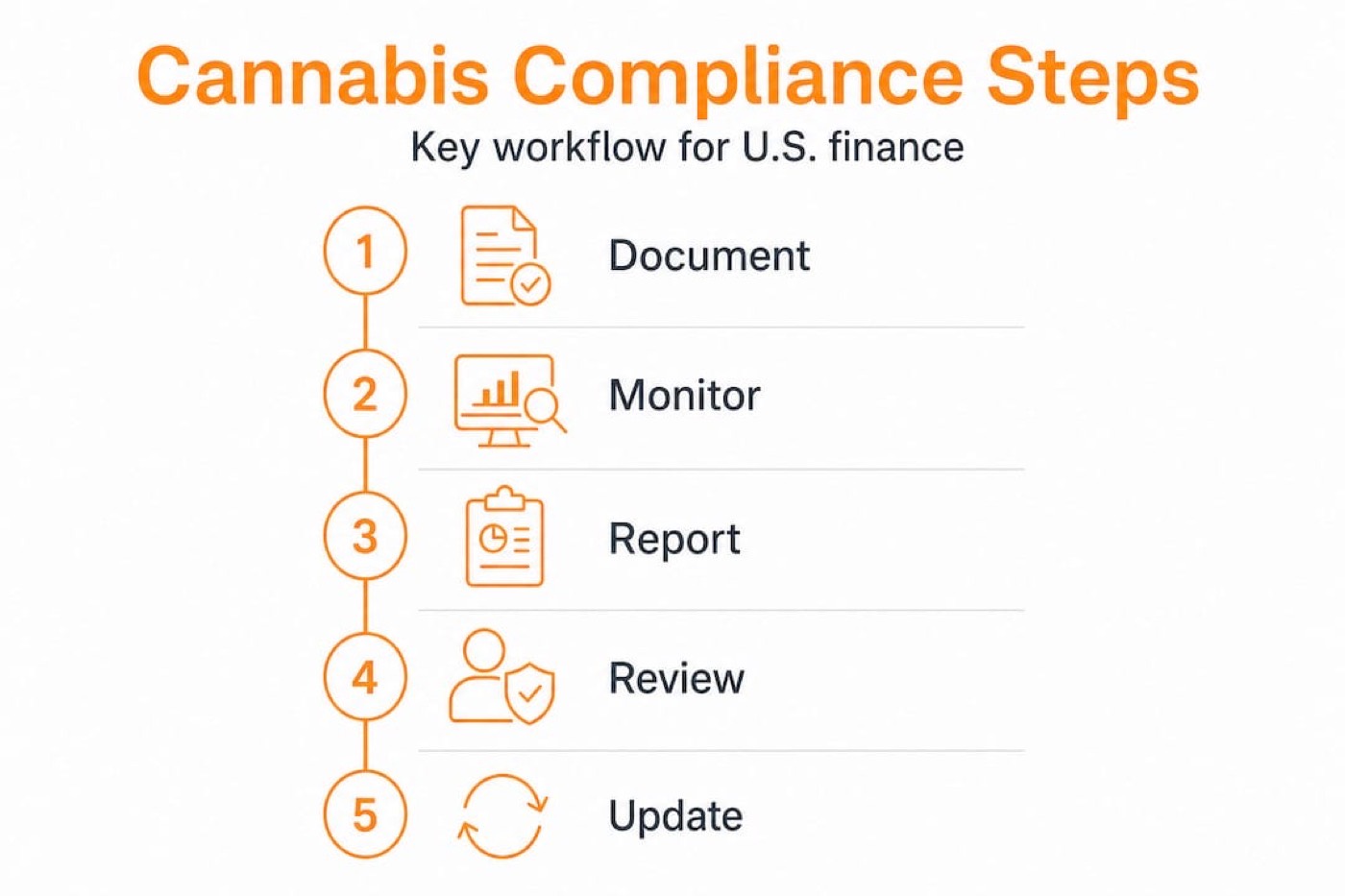
The IRS and bank counterparties scrutinize the underlying documentation trail, including inventory systems, costing methods, and audit-ready records, not just the numbers reported on returns or financial statements. That distinction matters enormously. A cannabis business can have perfectly accurate tax filings and still fail an audit if the supporting records are incomplete or inconsistent.
Here is what a defensible documentation framework looks like in practice:
- State licenses must be current, properly displayed, and tied to your specific business activities. An expired license or a license that does not match your actual operations is an immediate red flag.
- Inventory logs should reconcile daily, showing quantities purchased, quantities sold, returns, and any adjustments with explanations.
- COGS calculation worksheets need to show the inputs, the methodology, and how costs were allocated between product categories if you sell multiple types.
- Cash control records including till counts, safe logs, and armored transport manifests demonstrate that your cash handling is systematic and not a vehicle for unreported revenue.
- Employee role documentation should distinguish which employees work in cannabis-touching roles versus ancillary functions for purposes of §280E expense allocation.
“The difference between a business that survives a compliance review and one that doesn’t rarely comes down to whether they broke the rules. It usually comes down to whether they can prove they didn’t.”
Bank reviews operate similarly. When a financial institution conducts its ongoing cannabis due diligence, it wants to see that your internal controls are consistent over time. A single month of clean records is not convincing. Twelve months of consistently reconciled, well-organized records is.
Investors conducting due diligence before funding a cannabis company run through essentially the same checklist. They want to know that the business can survive regulatory scrutiny without having its financial statements recast or its licenses revoked. Poor documentation is not just a compliance risk. It is a valuation risk that directly reduces what investors will pay for your equity.
Common documentation pitfalls that cost operators money or relationships:
- Missing narratives explaining unusual transactions or adjustments
- Inconsistencies between state-mandated seed-to-sale tracking data and internal inventory records
- No written policies for how COGS is calculated or how expenses are categorized
- Outdated licenses or permits that were not renewed on time
- Payroll records that do not distinguish between cannabis-touching and non-cannabis employees
Pro Tip: Create a compliance documentation calendar. Map every license renewal date, reporting deadline, and internal audit schedule into a shared system your finance and operations teams both use. Treating compliance deadlines like financial close dates reduces the risk of missed renewals or late filings.
How changes in regulation shift compliance requirements
Regulations in cannabis are not static. The federal government’s ongoing evaluation of cannabis’s scheduling status, state-by-state legislative changes, and evolving FinCEN guidance all affect what compliance looks like year to year. Operators who treat compliance as a set-it-and-forget-it function get caught off guard.
Federal rescheduling may reduce some risk perceptions for banks, but it does not automatically eliminate BSA and AML obligations or the need for structured due diligence and SAR-related reporting. This is a critical misconception. Even if marijuana moves to Schedule III, banks will still need to conduct CRB due diligence, file SARs under existing frameworks, and monitor transactions for suspicious activity. The threshold for what counts as suspicious may shift, but the infrastructure does not disappear overnight.
What operators should watch and act on:
- Changes in product type or licensing category often trigger new compliance requirements. A cultivator who adds retail operations now faces different state reporting rules, tax structures, and potentially different banking terms.
- New FinCEN guidance can update SAR expectations without a change in federal law. Monitor these releases and communicate them to your banking contact proactively.
- State law amendments affecting allowable product types, possession limits, or licensing categories can change your compliance obligations within weeks of passage.
- Tax code developments around §280E deserve close attention. Any federal rescheduling or Congressional action could change deductibility rules, requiring immediate recalculation of your tax position.
“The operators who thrive through regulatory transitions are the ones who already have clean compliance systems. When the rules change, they update their documentation and keep moving. Everyone else scrambles.”
Proactive engagement with cannabis regulatory risk means having a process for monitoring regulatory changes, not just reacting to them. Subscribe to state agency newsletters, maintain relationships with cannabis-specialized legal counsel, and build regulatory review into your quarterly finance meetings.
Our take: Treat legal compliance as your operating system
Most operators think about compliance as a set of rules layered on top of running a business. We think that framing is wrong, and it quietly creates costly blind spots.
The businesses we see navigating cannabis finance most successfully treat compliance as their operating system, the underlying infrastructure that every financial function runs on. Licensing, recordkeeping, cost accounting, banking relationships, and investor communications are all outputs of the same compliance foundation. When that foundation is weak, all of those outputs become unreliable.
The contrarian point worth making directly: focusing exclusively on avoiding fines actually produces worse compliance outcomes. When your only goal is not getting caught, you do the minimum. You file what is required, keep records just detailed enough to pass a surface review, and scramble to fix problems only after they surface. That approach fails audits, loses banking relationships, and makes you unattractive to investors.
Operators who treat compliance as a strategic foundation invest in documentation quality, conduct internal reviews before external ones happen, and communicate proactively with their banks and accountants. They also tend to catch tax errors before they become penalties and identify regulatory changes before those changes catch them off guard.
The practical lesson from watching many cannabis businesses navigate financial scrutiny is this: compliance is not a department or a checklist. It is the culture that finance, operations, and leadership share about how decisions get made and documented every day. Build that culture intentionally, and the specific requirements of banking compliance, §280E, and audit readiness become manageable. Ignore it, and every financial challenge becomes harder than it needs to be.
Strengthen your compliance with expert cannabis finance resources
If this article clarified why legal compliance and cannabis finance are inseparable, the next step is building the knowledge base to act on that understanding.

Cannabis Business Minds provides practical, finance-focused resources built specifically for cannabis operators and their finance teams. Whether you are working through the mechanics of cost accounting for cannabis or building out your full cannabis accounting framework from scratch, our guides walk you through the specific challenges of this industry. Explore our cannabis budgeting resources to connect compliance requirements with your operational financial planning. Solid compliance is not just protection. It is the foundation of a financially resilient cannabis business.
Frequently asked questions
What are the most common compliance pitfalls for cannabis businesses?
Poor recordkeeping, inadequate COGS documentation, and failing to update compliance reports after regulatory changes are the most frequent issues. The IRS and financial counterparties evaluate the quality of your documentation trail, not just the numbers on the surface.
Does federal rescheduling mean banks will work with cannabis businesses?
Not automatically. Federal rescheduling may shift risk perceptions, but BSA and AML requirements, SAR filings, and due diligence obligations remain in place for all cannabis banking relationships regardless of scheduling status.
Why is legal compliance so expensive for cannabis companies?
The costs come from extensive documentation requirements, strict banking standards that require ongoing monitoring, and federal tax restrictions under §280E that limit deductions and require meticulous cost accounting infrastructure to manage.
What happens if a cannabis business cannot prove compliance during an audit?
It risks losing bank accounts, facing substantial tax penalties, and potentially losing its operating license. The documentation trail matters as much as accurate filings because auditors verify claims against underlying records, not just reported figures.
Recommended
- What Is Cannabis Compliance: Impact on U.S. Businesses – Cannabis Business Minds
- Cannabis Regulatory Risk Explained: Safeguarding U.S. Dispensaries – Cannabis Business Minds
- Why Cannabis Tax Compliance Matters for U.S. Businesses – Cannabis Business Minds
- Cannabis Due Diligence: Safeguarding Compliance and Value – Cannabis Business Minds
This article is general education, not tax, legal or accounting advice. Cannabis rules change quickly; confirm how they apply to you with a qualified cannabis CPA or attorney.