What is financial consolidation in cannabis: a complete guide
2026 update: what rescheduling changed for 280E (reviewed October 2026)
Effective April 22, 2026, a DOJ/DEA final order moved marijuana covered by a qualifying state medical license (and FDA-approved marijuana drugs) to Schedule III. Section 280E only applies to Schedule I and II substances, so state-licensed medical cannabis activity is generally no longer subject to 280E going forward. Adult-use cannabis remains in Schedule I and fully subject to 280E. The DEA proceeding to reschedule all marijuana was temporarily stayed in October 2026, and Treasury/IRS guidance on transition years and mixed medical/adult-use businesses is still pending.
Check where your business stands in about a minute.
Running a multi-entity cannabis operation without understanding financial consolidation is like navigating a maze with half the map missing. What is financial consolidation cannabis operators need to know? At its core, it’s the process of combining each subsidiary’s financials into one unified picture of your group. Get it wrong and you’re looking at overstated revenues, misclassified COGS, and an IRS audit waiting to happen. For cannabis businesses carrying the weight of Section 280E, this isn’t a back-office detail. It’s a core compliance function that directly shapes your tax liability and your standing with investors.
Table of Contents
- What is financial consolidation in cannabis businesses?
- Why cannabis multi-entity consolidation challenges operators
- How financial consolidation supports cannabis compliance and tax strategy
- Comparison of consolidation approaches for cannabis operators
- Best practices for cannabis financial consolidation and compliance
- What decades of cannabis finance experience teach about consolidation
- Improve your cannabis financial consolidation with expert guidance
- Frequently asked questions
Key Takeaways
| Point | Details |
|---|---|
| Financial consolidation defined | It combines all subsidiaries’ accounts into one consistent financial picture, eliminating internal transactions to avoid double counting. |
| Unique cannabis challenges | Multiple entities, transfer pricing, and 280E tax rules create complexities that require disciplined consolidation practices. |
| Intercompany eliminations matter | Proper elimination ensures reported group revenue and profits are accurate and not artificially inflated from internal sales. |
| Consolidation supports compliance | It underpins tax and regulatory compliance by aligning segment reporting with 280E COGS classifications and audit defense. |
| Upstream standardization critical | Consistent entity bookkeeping and transfer pricing documentation are essential to avoid consolidation failures and investor doubts. |
What is financial consolidation in cannabis businesses?
Financial consolidation, in plain terms, means taking the individual financial statements from every entity in your cannabis group and combining them into a single, accurate representation of the whole operation. Think of it as the financial equivalent of merging multiple GPS feeds into one map. Financial consolidation aggregates a parent company’s subsidiaries’ financial statements into one integrated set of financials with intercompany eliminations.
The part most operators miss is the eliminations step. When your cultivation entity sells flower to your manufacturing entity, that sale appears as revenue in one set of books and as a cost in another. Without eliminating that transaction at the consolidated level, your group-level revenue and COGS are both inflated. Neither number reflects what actually happened with external customers. In cannabis, consolidation includes eliminating intercompany product transfers like cultivation selling to manufacturing to avoid inflating group revenues and expenses.
Consolidation also demands consistency. Every entity must use the same chart of accounts, the same depreciation methods, and the same revenue recognition policies before their books can be meaningfully combined. If your dispensary capitalizes certain startup costs while your cultivation arm expenses them, your consolidated balance sheet is already distorted before you start.
Here’s what a properly consolidated cannabis group’s financials cover:
- Consolidated balance sheet: combines all assets, liabilities, and equity with intercompany payables and receivables eliminated
- Consolidated income statement: shows group revenue from external customers only, with intercompany sales removed
- Cash flow statement: reflects true cash movement across the group, not intragroup transfers
- Statement of changes in equity: captures minority interest and parent-level equity movements
- Elimination schedules: the supporting documentation behind every intercompany adjustment
For deeper grounding in cannabis accounting essentials, understanding this structural foundation is non-negotiable before you build anything else.
Now that we understand what consolidation means generally, let’s examine why it presents unique complications in cannabis operations.
Why cannabis multi-entity consolidation challenges operators
Cannabis isn’t retail and it isn’t manufacturing. It’s both, plus cultivation, distribution, and often a management company layered on top. That structural complexity creates consolidation headaches that most accounting teams outside the industry have never faced. Many cannabis operators struggle to consolidate because each entity’s books may be maintained by different bookkeepers, causing inconsistent intercompany transaction recording.
When each entity has its own bookkeeper coding transactions differently, the consolidation layer becomes a cleanup project rather than a reporting function. One bookkeeper records an intercompany loan repayment as income; another records the same payment as a liability reduction. By the time you reach month-end consolidation, you’re reconciling before you can even begin eliminating.

Transfer pricing adds another layer of risk. The price your cultivation entity charges your retail entity for product must reflect arm’s-length market conditions. The IRS cares deeply about this. Set that price too low and you’ve shifted taxable income in ways that invite scrutiny. Set it too high and your retail entity shows artificially low margins. Either way, you’ve created a distortion in both your segment profitability and your consolidated tax position.
Then there’s 280E. 280E disallows ordinary deductions for cannabis businesses, making accurate COGS classification and consolidation crucial for minimizing tax liability. Because 280E limits which expenses you can deduct, the classification of every dollar, whether it flows through COGS or operating expenses, carries direct tax consequences. That classification decision happens at the entity level. If it’s wrong there, consolidation multiplies the error across the group.
Common consolidation pain points cannabis operators face:
- Siloed bookkeeping with no standardized intercompany coding
- Delayed elimination schedules that create month-end scrambles
- Transfer pricing set informally without documentation or annual updates
- COGS and operating expense misclassification at the entity level compounding 280E risk
- No reconciliation between entity-level tax returns and consolidated financials
For a full breakdown of how these challenges play out in practice, tax compliance in cannabis is where you’ll find the specifics, and understanding the importance of tax compliance provides the regulatory context behind the pressure.
Pro Tip: Assign one person, whether internal or external, to own intercompany reconciliation across all entities every month. Fragmented ownership of this process is the single most common cause of consolidation failures we see.
Understanding these challenges clarifies why consolidation isn’t just an accounting formality but also a compliance keystone in cannabis finance.
How financial consolidation supports cannabis compliance and tax strategy
Clean consolidation doesn’t just satisfy auditors. It builds the foundation for defensible tax positions, investor-ready financials, and informed business decisions. Consolidation integrates accurate intercompany eliminations and consistent transfer pricing to produce defensible financial statements needed for 280E compliance.
Here’s a practical sequence for how consolidation connects to compliance and strategy in cannabis operations:
- Reconcile all intercompany balances monthly. Before you close the books, every intercompany payable must match the corresponding receivable. No exceptions. Any gap signals either a coding error or an unauthorized transaction.
- Document transfer pricing with formal studies. An arm’s-length pricing analysis for each intercompany product flow, updated annually, gives you the evidence needed if the IRS questions your segment margins.
- Produce consolidated reports for management and investors. Investors expect clean elimination schedules and plausible segment profitability margins reflecting arm’s-length transfer pricing. One look at inflated cultivation-to-retail margins tells an experienced investor your consolidation process is weak.
- Trace COGS from entity level to consolidated level. Under 280E, your COGS classification at the entity level determines what you can deduct. Your consolidated financials must reflect those same classifications without adjustment at the group layer.
- Maintain a master audit file. Collect every intercompany agreement, elimination journal entry, and transfer pricing study into one organized record. When an audit comes, you present it. The preparedness alone reduces scrutiny time and negotiation risk.
For a full picture of how these steps tie into cannabis tax filings, the alignment between entity returns and consolidated reports is where most compliance gaps appear.
Pro Tip: Ask your CPA to map every intercompany transfer price back to the corresponding COGS line in your consolidated income statement before filing. That traceability is your first line of defense in a 280E audit.
Exploring strategic finance insights can also help frame consolidation as a capital-raising tool, not just a compliance requirement. Investors use consolidated financials to evaluate enterprise value. A company with clean segment reporting and accurate eliminations consistently commands better terms than one with opaque intercompany flows.
With this foundation, let’s compare consolidation approaches and see how to apply best practices in cannabis contexts.
Comparison of consolidation approaches for cannabis operators
Not every cannabis business needs the same structure. The right approach depends on your operational footprint, your 280E exposure, and how much accounting complexity you can manage. The choice between single-entity and multi-entity structures impacts 280E exposure, tax obligations, and consolidation complexity in cannabis businesses.
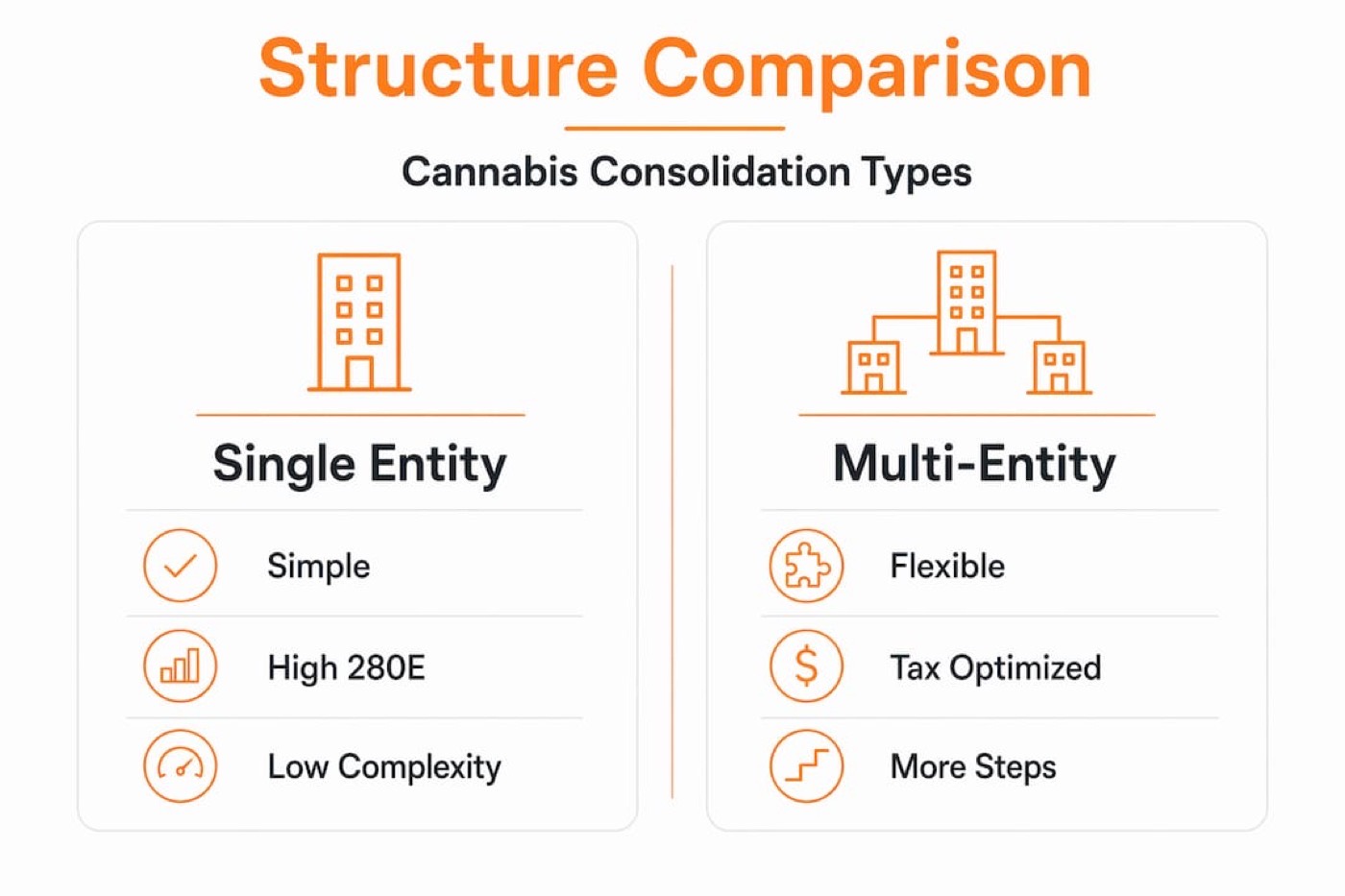
| Structure | 280E impact | Consolidation complexity | Best for |
|---|---|---|---|
| Single entity | Higher exposure, fewer optimization levers | Lower; one set of books | Early-stage operators, single license |
| Multi-entity | Allows segment-specific COGS optimization | Higher; requires eliminations and transfer pricing | Vertically integrated groups |
| Management company model | Separates cannabis-touching and non-touching activities | Moderate to high; requires allocation documentation | Operators seeking to maximize deductible expenses |
| Holding company structure | Neutral; depends on entity activity | High; requires full consolidation with minority interest | Multi-state operators and M&A targets |
Understanding these structures prepares you to apply consolidation processes effectively in cannabis operations.
Key considerations when choosing a structure:
- Multi-entity setups require more investment in bookkeeping, transfer pricing, and consolidation tools, but can significantly reduce effective tax rates under 280E
- Management company structures work only when non-cannabis services are genuinely separate and independently priced
- Single-entity simplicity comes at a cost if it blurs the line between production and retail COGS
- Any structure you choose must be supported by documented entity structure options from the start, not retrofitted after the fact
Best practices for cannabis financial consolidation and compliance
Knowing what consolidation is and why it matters gets you halfway there. Execution is where most operators lose ground. These practices reflect what actually works in cannabis accounting, not just what the textbook recommends.
Standardizing intercompany accounts and transfer pricing documentation are vital to reliable cannabis consolidation. And cannabis consolidations need stronger COGS support than other industries due to 280E, requiring traceable and consistent entity-level costing.
Actionable practices that hold up under audit pressure:
- Standardize your chart of accounts across all entities before you open any new entity. Retrofitting a chart of accounts after two years of inconsistent coding is brutally time-consuming.
- Code every intercompany transaction at the time it occurs, not at month-end. Real-time coding eliminates the reconciliation guesswork that causes consolidation delays.
- Update transfer pricing studies annually. Cannabis wholesale prices fluctuate dramatically. A transfer pricing study from 2023 doesn’t reflect the market in 2026. Stale studies are low-hanging fruit for IRS examiners.
- Allocate shared costs using documented, testable methods. Square footage, headcount, and time studies are defensible. Arbitrary percentage splits are not.
- Use consolidation software but don’t rely on it blindly. Automated eliminations can miss complex intercompany structures. Always perform an analytical review of segment margins after each close to catch anomalies.
- Formalize all intercompany agreements in writing. Intercompany loans, management fee arrangements, and product supply agreements all need signed contracts with commercial terms.
For more on how legal compliance connects to these practices, legal compliance critical outlines the regulatory stakes in plain terms.
Pro Tip: Run a quarterly intercompany variance analysis comparing what each entity billed to related parties versus what those parties recorded as costs. A mismatch of more than 5% is a red flag worth investigating before year-end.
What decades of cannabis finance experience teach about consolidation
Here’s something you won’t read in most accounting guides: the majority of cannabis consolidation failures aren’t caused by mistakes at the consolidation layer. They originate upstream in the entity-level bookkeeping. By the time you’re at the consolidation journal entry stage, the damage is already done.
This is why experienced cannabis CPAs spend more time reviewing entity-level coding policies and intercompany agreement documentation than they do reviewing the elimination schedules. Fixing the inputs fixes the output. Tweaking consolidation entries without addressing the upstream cause is just polishing a distorted mirror.
Investors who understand cannabis know this too. They read segment gross margins as a proxy for consolidation integrity. A cultivation entity showing a 70% margin on intercompany transfers when market pricing supports 40% signals either a transfer pricing problem or aggressive consolidation. Either way, it raises questions that slow down capital raises and complicate M&A due diligence.
280E also forces a discipline on cannabis finance teams that doesn’t exist in other industries. Because operating expense deductions are disallowed, COGS must be airtight. That pressure flows directly into consolidation, requiring that every COGS dollar at the entity level is traceable and consistently applied. Other industries get more tolerance on operating expense classification. Cannabis does not.
And cannabis pricing volatility makes static transfer pricing especially dangerous. A price set in January may be commercially indefensible by October. Annual updates are the minimum. Quarterly reviews are better if your market is moving. Understanding tax compliance lessons shows how this kind of proactive management pays off.
The real shift in thinking cannabis operators need to make is treating consolidation as a strategic function. It’s not something you do after the accounting is finished. It is the accounting, at the enterprise level, and it connects directly to your tax outcomes, your investor relationships, and your cash flow health.
Improve your cannabis financial consolidation with expert guidance
If this guide clarified what financial consolidation means for your cannabis operation, the next step is applying it with the right frameworks and expert support behind you.

Cannabis Business Minds gives you specialized resources built for the real complexity of cannabis finance, not generic accounting advice adapted from other industries. From cost accounting cannabis guide frameworks designed around 280E requirements to cannabis budgeting strategies that account for multi-entity cash flow, the tools here are built by and for cannabis finance professionals. Whether you’re refining your intercompany reconciliation process or building a transfer pricing policy that can withstand IRS scrutiny, cannabis accounting support connects you with the guidance that moves the needle.
Frequently asked questions
What financial statements are combined in cannabis financial consolidation?
Consolidation combines subsidiaries’ balance sheets, income statements, cash flow statements, and statements of changes in equity into one set of group financials. Consolidated statements include all four core reports with intercompany balances eliminated across each.
Why is intercompany elimination critical in cannabis consolidation?
Eliminating intercompany sales and transfers prevents overstating group revenues and costs, ensuring consolidated results reflect only external transactions. Intercompany transactions like cultivation sales to manufacturing must be eliminated so the group doesn’t overstate revenues and COGS.
How does financial consolidation impact 280E tax compliance for cannabis businesses?
Consolidation ensures accurate segment costing and proper COGS classification, both essential for legally minimizing 280E tax liabilities across multiple entities. 280E makes accurate consolidated COGS classification and transfer pricing critical for tax outcomes in cannabis multi-entity groups.
What are common consolidation pitfalls for cannabis operators?
Common pitfalls include inconsistent bookkeeping across entities, delayed intercompany reconciliation, weak transfer pricing documentation, and 280E COGS misclassification. Major consolidation failures arise from inconsistent intercompany coding and delayed eliminations, not just consolidation layer errors.
Should cannabis businesses use single or multi-entity structures for financial consolidation?
Multi-entity structures allow better 280E optimization and segment profitability tracking but increase consolidation complexity; the right choice depends on your compliance capacity and operational goals. Single-entity simplifies consolidation but can increase 280E burden, while multi-entity structures support tax strategies but require complex consolidations.
Recommended
- Cannabis Financial Planning Explained: Key U.S. Requirements – Cannabis Business Minds
- Master the Cannabis Banking Workflow for Compliance Success – Cannabis Business Minds
- Cannabis financial due diligence: compliance and growth – Cannabis Business Minds
- Cannabis Financial Reporting Guide for Full Compliance Success – Cannabis Business Minds
This article is general education, not tax, legal or accounting advice. Cannabis rules change quickly; confirm how they apply to you with a qualified cannabis CPA or attorney.