How to Build More Profit in a Cannabis Business

2026 update: what rescheduling changed for 280E (reviewed October 2026)
Effective April 22, 2026, a DOJ/DEA final order moved marijuana covered by a qualifying state medical license (and FDA-approved marijuana drugs) to Schedule III. Section 280E only applies to Schedule I and II substances, so state-licensed medical cannabis activity is generally no longer subject to 280E going forward. Adult-use cannabis remains in Schedule I and fully subject to 280E. The DEA proceeding to reschedule all marijuana was temporarily stayed in October 2026, and Treasury/IRS guidance on transition years and mixed medical/adult-use businesses is still pending.
Check where your business stands in about a minute.
Profit growth in a cannabis business is defined by operational discipline and margin control, not revenue volume alone. Most operators chasing top-line growth under IRC Section 280E and state excise tax burdens find that more sales without tighter cost controls produces thinner margins, not stronger returns. The real levers are waste elimination, inventory efficiency, pricing architecture, and customer retention. This article breaks down each lever with 2026 benchmarks and specific tactics you can apply to your operation now. Cannabisbusinessminds covers the financial and compliance frameworks that make these strategies work in practice.
How to build more profit in a cannabis business by cutting operational waste
Operators can improve margins 5–10% within 30 days by eliminating expired inventory, quality failures, and overstaffing. That is not a rounding error. It is the fastest margin recovery available without touching your price sheet.
The diagnostic starts with three categories of waste: product loss, labor inefficiency, and process failure. Product loss includes expired flower, failed batches, and shrinkage. Labor inefficiency shows up as overstaffed slow shifts, undertrained budtenders with high ticket errors, and supervisory gaps that let small problems compound. Process failure is everything else: untracked promotional giveaways, unaudited vendor credits, and receiving errors that never get reconciled.

A 20% labor efficiency improvement delivers permanent margin expansion. Price increases often lose volume without net margin gains. That asymmetry matters. Cutting waste is structurally superior to raising prices in a price-sensitive, saturated market.
Run this audit in sequence:
- Pull your last 90 days of inventory variance reports and identify SKUs with consistent shrinkage above 2%.
- Map labor hours against transaction volume by shift. Flag any shift where labor cost exceeds 20% of revenue.
- Review your promotional log. If you cannot account for every discount dollar in your POS system, you have untracked leakage.
- Audit vendor invoices against receiving records for the last 60 days. Discrepancies are recoverable cash.
- Calculate your cost per transaction by channel. Delivery and curbside often carry hidden costs that erode margin invisibly.
Pro Tip: Track inventory turnover weekly, not monthly. A SKU sitting longer than 21 days in a fast-moving category is a cash trap. Move it at cost before it becomes a write-off.
The operational costs in cannabis that operators most often undercount are the invisible ones: compliance labor, waste disposal fees, and security overhead. These belong in your cost model before you set any margin targets.
What financial benchmarks must cannabis retailers hit under 280E?
Cannabis retailers must keep net revenue above 60% of gross and gross margin above 30% to remain viable under 280E and excise tax pressure. These are not aspirational targets. They are the floor below which the business cannot sustain itself through a normal tax cycle.
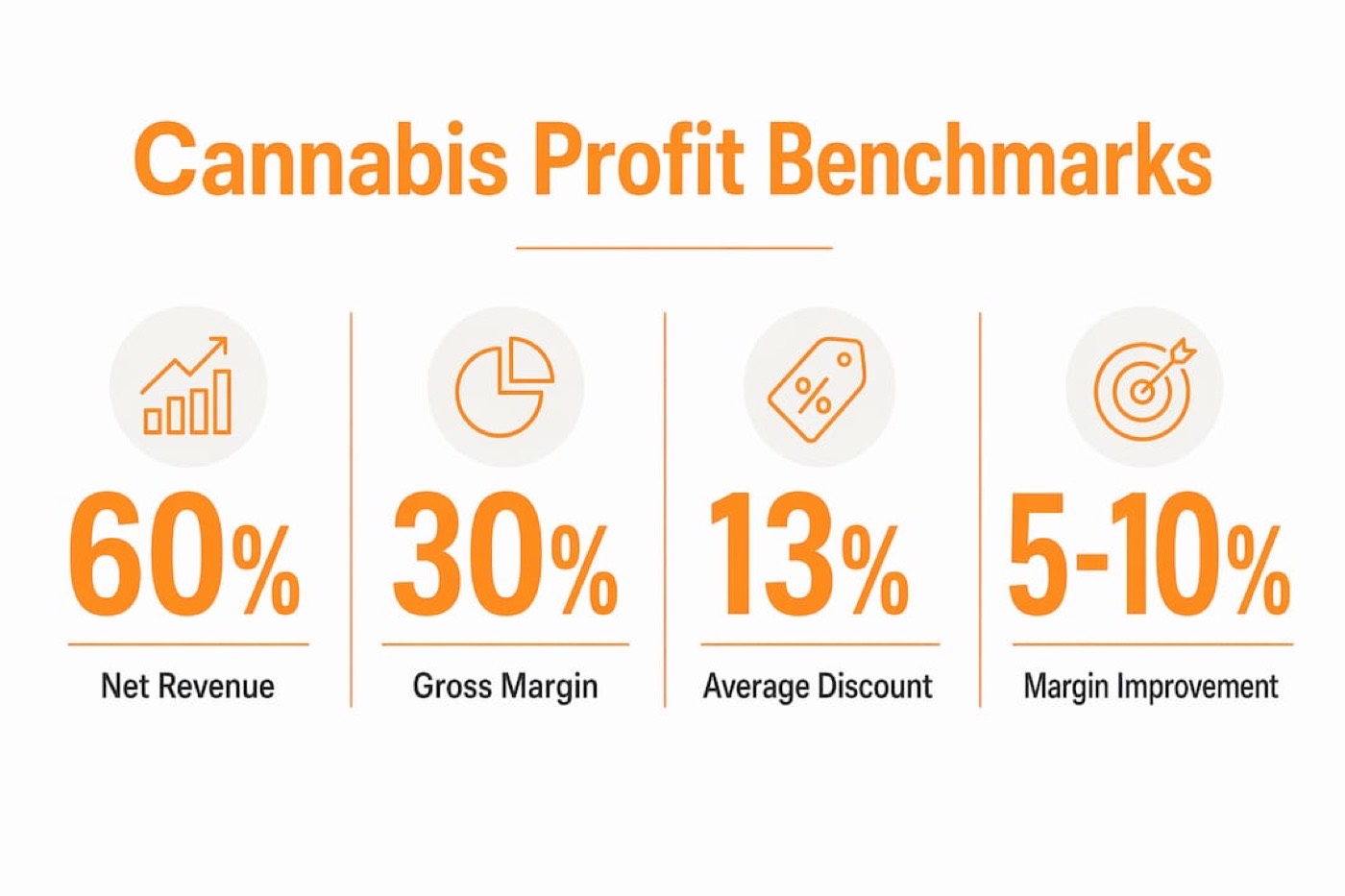
The average product discount rate across cannabis retail sits at approximately 13%. That level of discounting, applied without margin guardrails, erodes the gross margin buffer that 280E compliance requires. The 280E tax code limits deductions to Cost of Goods Sold, which means every dollar of gross margin lost to discounts is a dollar you cannot recover through operating expense deductions.
| Metric | Viable Benchmark | Warning Zone |
|---|---|---|
| Net revenue as % of gross | Above 60% | Below 55% |
| Gross margin | Above 30% | Below 25% |
| Average discount rate | Below 10% | Above 15% |
| Promotional leakage tracked | 100% | Below 80% |
| Labor as % of revenue | Below 20% | Above 25% |
Retail KPIs must be viewed relationally. No single metric defines business health. Their combined pattern reveals whether you are building toward viability or drifting toward a liquidity crisis.
Monitor discount redemptions, loyalty point burns, and promotional costs as a combined line item each week. When that combined figure exceeds 12% of gross revenue, you have a structural problem, not a marketing strategy. Untracked promotions are where margin goes to die quietly.
How does inventory management affect cannabis cash flow and profit?
Proactive inventory control is a financial lever, not a logistics function. Operators who treat inventory as a cash asset rather than a product catalog consistently outperform those who do not.
The target is a 30-day inventory turnover cycle. Anything longer traps working capital in product that is depreciating in potency and market value. Anything shorter risks stockouts that push customers to competitors. The 30-day target is the balance point between liquidity and service level.
Key cash flow controls every operator should have in place:
- Negotiate vendor payment terms of net 30 or net 45 on all non-perishable inputs. Use that float to fund operations rather than drawing on credit lines.
- Liquidate aging inventory at or near cost before the 21-day mark. The margin loss on a clearance sale is smaller than the write-off plus the carrying cost.
- Run a 13-week cash flow forecast updated weekly. This is the single most effective tool for avoiding a liquidity crisis before it becomes one.
- Separate your sales tax collections into a dedicated bank account on the day they are collected. Do not commingle them with operating cash.
- Review your vendor compliance records quarterly to catch pricing discrepancies before they compound.
Pro Tip: Using sales tax collections as informal operating credit carries penalty risk up to 25% annually. The IRS and state revenue agencies treat this as willful noncompliance. Segregate those funds the same day they are collected.
Quick wins for financial stabilization include aggressive receivable collection, aging inventory liquidation, and renegotiating vendor payment terms. These three moves alone can free meaningful working capital within 60 days.
How do you shift from discounts to retention for sustainable margin growth?
Discount stacking and blanket discounting push dispensaries into margin compression that compounds over time. The operators who survive price wars are not the ones with the lowest prices. They are the ones who stopped competing on price.
Loyal customers provide 2–3x more value than discount-seeking new customers. Retention models structurally outperform acquisition-only marketing in cannabis because the cost of acquiring a new customer in a licensed market is high and the switching cost for that customer is low.
The shift from discount-driven to retention-driven revenue requires four steps:
- Audit your current discount structure. Identify every blanket discount, stacked promotion, and loyalty redemption that runs without a margin floor. Eliminate any combination that drops gross margin below 28%.
- Build retention tiers based on visit frequency and basket size, not just total spend. A customer who visits three times per week at $40 per visit is more valuable than one who visits once per month at $200.
- Calculate unit economics by product category. Know your margin per gram on flower, per milligram on concentrates, and per unit on edibles. Use that data to steer budtenders toward higher-margin recommendations.
- Replace blanket discounts with category-specific promotions tied to margin-positive SKUs. A 15% discount on a 60% margin product is sustainable. The same discount on a 28% margin product is not.
Experience, product curation, and operational discipline drive long-term retention more than low-price volume strategies. High-volume, low-price storefronts are the most dangerous business model in a saturated 2026 market.
How does cultivation facility optimization increase yield and ROI?
Systematic facility optimization can double cannabis yields without purchasing new equipment. The ROI on fixing environmental controls before buying capital equipment is consistently higher than the reverse.
The sequence matters. Most cultivators buy equipment to solve problems that are actually caused by process failures. HVAC zoning issues, inconsistent fertigation, and inadequate supervisory verification of standard operating procedures account for the majority of yield variance in licensed facilities.
Metrics that define cultivation profitability:
- Yield per square foot: The baseline productivity measure. Track it by room, by strain, and by cycle.
- Grams per watt: Measures lighting efficiency. Declining grams per watt signals a fixture, spectrum, or canopy management problem.
- Cycle time variance: Measures process consistency. High variance means your SOPs are not being followed or are not specific enough.
- Waste as a percentage of harvest: Tracks trim loss, failed testing, and post-harvest degradation.
| Optimization Type | Typical ROI Timeline | Margin Impact |
|---|---|---|
| HVAC zoning correction | 3–6 months | High |
| Fertigation precision | 6–12 months | High |
| SOP implementation | 1–3 months | Medium |
| Capital equipment upgrade | 12–24 months | Variable |
Facility optimization ROI on precision irrigation infrastructure ranges from 6–12 months, with some facilities reporting returns up to 985% on targeted optimization projects. That figure reflects what happens when you fix the process before buying the equipment.
Empire building destroys cultivation value. Adding rooms, strains, and headcount without disciplined unit economics at the room level produces scale without profitability. The cannabis profitability paradox is that maximizing COGS categorization and unit economics discourages the rapid growth mentality that has destroyed shareholder value across the industry.
What I’ve learned about profit-building after years in cannabis finance
The operators who consistently build profit are not the ones with the best products or the most locations. They are the ones who know their numbers cold. Unit economics, labor efficiency ratios, yield variance by room, and discount leakage by promotion type. Not approximations. Exact figures.
Price increases alone rarely improve margins sustainably in cannabis. I have seen operators raise prices 10% and watch volume drop enough to net a worse outcome than before. The market is too price-transparent and too competitive for that to work as a primary strategy. What works is operational rigor applied before any pricing decision.
The tax strategy in cannabis layer is where most operators leave money on the table. Maximizing COGS categorization under 280E is not aggressive accounting. It is the correct application of the code. Operators who do not have a CPA actively managing that categorization are overpaying federal taxes and funding the IRS instead of their own margin.
The integration of finance and operations is not optional in this industry. Your controller needs to be in the room when you set your discount calendar, your cultivation manager needs to understand yield per square foot as a financial metric, and your GM needs to read a cash flow forecast. When those conversations happen, profit follows. When they do not, you are managing by intuition in a business that punishes guessing.
— JN
Cannabisbusinessminds resources for cannabis finance and profitability
Cannabisbusinessminds covers the financial and compliance frameworks that directly affect your bottom line.

The cannabis bookkeeping tips resource covers the recording and reconciliation practices that keep your financials accurate enough to make real decisions. The inventory costing guide goes deep on COGS categorization under 280E, which is the single highest-leverage financial move available to most cannabis operators. For operators building out a full financial control structure, the cost accounting guide and the cannabis budgeting resource provide the frameworks that turn operational data into margin decisions. These are not introductory materials. They are built for operators who already know the basics and need the next level.
FAQ
What is the fastest way to improve cannabis profit margins?
Eliminating operational waste, including expired inventory, overstaffing, and untracked promotions, can improve margins 5–10% within 30 days. This outperforms price increases, which often reduce volume without net margin gains.
How does 280E affect cannabis business profitability?
IRC Section 280E limits deductions to Cost of Goods Sold, which means every dollar of gross margin lost to discounts or waste cannot be recovered through operating expense deductions. Maximizing COGS categorization is the primary tax lever for cannabis operators.
What gross margin should a cannabis dispensary maintain?
Cannabis retailers must maintain gross margin above 30% and net revenue above 60% of gross to remain viable under 280E and excise tax burdens. Falling below these benchmarks signals structural margin compression.
Why are loyalty programs more profitable than discount campaigns?
Loyal customers deliver 2–3x more value than discount-seeking new customers. Retention programs build repeat purchase behavior without eroding the gross margin that discount stacking destroys.
How does cash flow forecasting protect cannabis business profit?
A rolling 13-week cash flow forecast updated weekly identifies liquidity gaps before they become crises. Operators who also segregate sales tax collections into a separate account avoid penalty exposure up to 25% annually on commingled funds.
Recommended
- How to Make More Money in Your Cannabis Business – Cannabis Business Minds
- 7 Key Examples of Cannabis Revenue Streams Explained – Cannabis Business Minds
- How to Optimize Cannabis Cash Flow for Lasting Growth – Cannabis Business Minds
- 7 Essential Dispensary Financial Best Practices Explained – Cannabis Business Minds
This article is general education, not tax, legal or accounting advice. Cannabis rules change quickly; confirm how they apply to you with a qualified cannabis CPA or attorney.