Why Cannabis Businesses Face Cash Challenges

2026 update: what rescheduling changed for 280E (reviewed October 2026)
Effective April 22, 2026, a DOJ/DEA final order moved marijuana covered by a qualifying state medical license (and FDA-approved marijuana drugs) to Schedule III. Section 280E only applies to Schedule I and II substances, so state-licensed medical cannabis activity is generally no longer subject to 280E going forward. Adult-use cannabis remains in Schedule I and fully subject to 280E. The DEA proceeding to reschedule all marijuana was temporarily stayed in October 2026, and Treasury/IRS guidance on transition years and mixed medical/adult-use businesses is still pending.
This article was written before the order took effect. Check where your business stands in about a minute.
Most American cannabis businesses operate in a unique financial environment where nearly all transactions are handled in cash. This cash dependency exposes companies to risks and costs that traditional industries rarely face, from heightened security needs to overwhelming accounting workloads. With regulatory barriers making banking services nearly impossible to obtain, cannabis finance professionals must find ways to manage compliance, taxes, and daily operations without access to standard American financial tools.
Key Takeaways
| Point | Details |
|---|---|
| Limited Banking Access | Cannabis businesses struggle to access traditional banking services due to federal regulations, leading to a cash-dependent model. |
| High Tax Burden | Section 280E creates significant tax liabilities for cannabis operators, limiting expense deductions and increasing overall tax rates. |
| Operational Risks | Cash-only operations introduce heightened security concerns, complex accounting requirements, and increased potential for mismanagement. |
| Need for Specialized Strategies | Companies must develop unique financial and cash management strategies to navigate the challenges posed by federal restrictions. |
Defining Cash Challenges in Cannabis Industry
Cannabis businesses in the United States face unprecedented financial challenges rooted deeply in federal regulatory constraints. Despite state-level legalization, most cannabis operators remain severely restricted in accessing traditional banking services, creating a complex landscape of financial management obstacles.
The core of these cash challenges stems from cannabis’s continued classification as a Schedule I controlled substance under federal law. This classification creates significant barriers for financial institutions, making them hesitant to provide standard banking services to cannabis businesses. As a result, most cannabis companies operate primarily in cash, which introduces multiple operational risks: heightened security concerns, complex accounting requirements, and increased potential for financial mismanagement.
Cash dependency becomes a critical issue for cannabis businesses. Without standard payment processing and banking infrastructure, companies must develop unique financial strategies. Federal restrictions and incomplete research funding compound these challenges, creating persistent financial barriers that impact everything from payroll management to tax compliance. Operators must navigate a financial ecosystem where traditional monetary tools are essentially unavailable, forcing them to create custom solutions for basic financial transactions.
Here is a summary of major financial challenges unique to the cannabis industry:
| Challenge | Cause | Business Impact |
|---|---|---|
| Lack of banking access | Federal prohibition, Schedule I status | High cash handling costs |
| Cash dependency | Limited payment processing options | Increased security risks |
| Section 280E restrictions | Tax deduction limitations | Higher effective tax rates |
| Manual operations | Absence of traditional finance tools | Greater error risk, slow workflow |
Pro tip: Develop robust cash management protocols that include secure transportation, advanced tracking systems, and comprehensive documentation to mitigate risks associated with cash-based operations.
Federal Laws and Banking Restrictions
The cannabis industry faces extraordinary banking challenges directly tied to federal legal restrictions. The American Bankers Association confirms that ongoing federal prohibition prevents financial institutions from freely servicing legal cannabis companies, creating a complex regulatory environment that fundamentally undermines standard business operations.
Federal classification of cannabis as a Schedule I controlled substance remains the primary barrier preventing traditional banking access. This designation makes most financial institutions extremely hesitant to provide services, effectively forcing cannabis businesses into a cash-only ecosystem. Banks risk severe federal penalties, including potential money laundering charges, if they work with cannabis-related businesses, which creates an inherent institutional reluctance to engage with the industry.
State-level legalization has not resolved these fundamental banking restrictions. Cannabis businesses must navigate a challenging landscape where standard financial tools like business checking accounts, credit card processing, loans, and electronic payments are essentially unavailable. This cash-dependent model introduces significant operational risks, including increased security vulnerabilities, complex accounting requirements, and heightened compliance challenges that traditional businesses never encounter.
Pro tip: Develop relationships with specialized cannabis-focused financial services and consider alternative banking strategies like credit unions or state-chartered banks that might have more flexibility in working with legal cannabis enterprises.
Section 280E and Tax Compliance Impact
Section 280E represents a unique and challenging tax provision that fundamentally disrupts financial planning for cannabis businesses. Tax compliance for cannabis operators is especially complicated due to this provision, which denies deductions for most expenses except cost of goods sold, creating significant financial obstacles for legal cannabis enterprises.
Under Section 280E, cannabis businesses face extraordinary tax restrictions that no other industry encounters. The Internal Revenue Code effectively treats these businesses as criminal enterprises, prohibiting them from deducting standard business expenses like rent, marketing, payroll, and administrative costs. This means cannabis companies can be taxed on gross income rather than net income, dramatically increasing their effective tax rates and creating substantial financial strain. Taxable income becomes artificially inflated, forcing businesses to pay taxes on revenue that doesn’t reflect actual profit.
The complexity of Section 280E extends beyond simple tax calculation. Cannabis businesses must develop intricate accounting strategies to maximize their allowable cost of goods sold deductions, which remain the only significant tax relief available. This requires meticulous record-keeping, sophisticated cost allocation methodologies, and potentially separating different business activities to optimize tax treatment. Companies must essentially reconstruct their entire financial reporting approach to survive under these restrictive federal guidelines.
Pro tip: Consult with a tax professional specialized in cannabis businesses to develop a comprehensive tax strategy that carefully navigates Section 280E’s complex requirements and maximizes allowable deductions.
Operational Realities of Cash-Only Businesses
Cannabis businesses face extraordinary challenges navigating a cash-dependent operational landscape. Cash-only operations present significant logistical and accounting hurdles that fundamentally disrupt standard business workflows, forcing operators to develop complex financial management strategies far beyond traditional business practices.
The cash-only model demands substantial investments in physical security infrastructure. Dispensaries and related cannabis businesses must allocate significant resources to secure cash storage, implement advanced security systems, and potentially contract armored transportation services. These additional expenses create substantial overhead that directly impacts profitability, requiring meticulous financial planning and risk management strategies that go well beyond typical retail operational considerations.
The operational complexities extend into every aspect of business management. Operating without digital payment options introduces workflow inefficiencies, elevated theft risks, and substantial barriers to credit and financial flexibility. Inventory management becomes exponentially more challenging, with manual cash tracking replacing digital payment reconciliation. Transaction processing slows dramatically, customer convenience suffers, and the potential for human error increases significantly. Cannabis businesses must essentially rebuild standard financial processes from the ground up, creating custom solutions that mitigate the inherent risks of a cash-dependent business model.
Pro tip: Invest in robust cash management technology, develop strict internal controls, and create comprehensive security protocols to minimize risks associated with cash-only operations.
Risks, Costs, and Security Implications
Cannabis businesses confront extraordinary financial challenges stemming from their cash-dependent operational model. Handling cash adds substantial overhead, consuming up to 9% of revenue through labor, auditing, transportation, and potential inventory shrinkage, dramatically impacting already slim profit margins and creating complex financial management requirements.
Security becomes a critical and expensive concern for cannabis enterprises operating exclusively in cash. The necessity of protecting large cash volumes requires significant investment in physical security infrastructure, including advanced alarm systems, reinforced storage facilities, and potentially armored transportation services. These additional security measures represent not just a financial burden but a fundamental operational challenge that traditional businesses rarely encounter, transforming routine financial management into a high-stakes risk mitigation exercise.
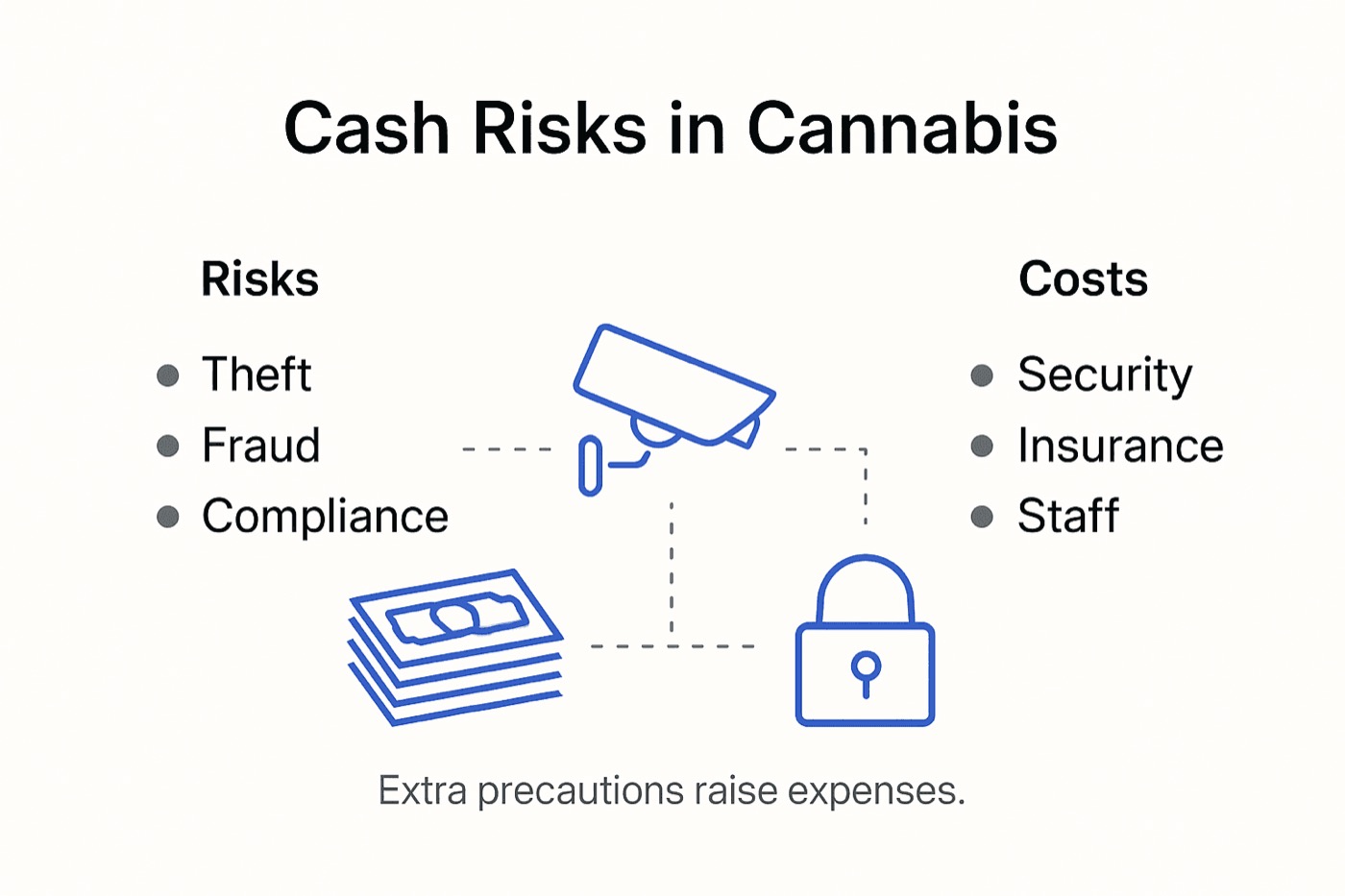
Traditional security and compliance frameworks prove insufficient for the unique challenges faced by cash-heavy cannabis businesses. Regulatory compliance demands comprehensive protocols that go far beyond standard industry practices. The potential costs of security breaches, regulatory fines, and operational disruptions create a complex risk landscape where even minor errors can result in substantial financial and legal consequences. Cannabis businesses must essentially redesign standard security and financial management approaches to survive in this uniquely challenging regulatory environment.
Below is a comparison of traditional businesses and cannabis businesses in handling finances:
| Aspect | Traditional Business | Cannabis Business (Cash-Based) |
|---|---|---|
| Banking access | Full services available | Severely restricted/limited |
| Tax deductions | Most expenses deductible | Only cost of goods sold deductible |
| Payment options | Digital and cash accepted | Primarily cash only |
| Security requirements | Standard security measures | Enhanced security, armored transport |
Pro tip: Develop a comprehensive security strategy that integrates physical security, digital monitoring, employee training, and robust internal control mechanisms to mitigate the inherent risks of cash-based operations.
Frequently Asked Questions
What are the main cash challenges faced by cannabis businesses?
Cannabis businesses primarily face challenges such as lack of access to traditional banking services, resulting in high cash dependency. This creates risks like increased security vulnerabilities, complex accounting requirements, and tax compliance issues.
How does Section 280E affect cannabis businesses?
Section 280E disallows most tax deductions for cannabis businesses, prohibiting them from deducting standard expenses like rent and payroll. This leads to significantly higher effective tax rates, artificially inflating taxable income and creating financial strain.
Why can’t cannabis businesses access standard banking services?
Most cannabis businesses cannot access conventional banking services due to the federal classification of cannabis as a Schedule I controlled substance. Financial institutions are hesitant to engage with cannabis operators due to the risk of severe penalties and regulatory scrutiny.
What operational risks do cash-only cannabis businesses encounter?
Cash-only cannabis businesses encounter various operational risks, including elevated theft risk, logistical challenges related to cash handling, and inefficiencies in inventory management. Moreover, they may face increased costs related to security measures and manual processing of transactions.
Recommended
- How to Optimize Cannabis Cash Flow for Lasting Growth – Cannabis Business Minds
- Cannabis Financial Planning Explained: Key U.S. Requirements – Cannabis Business Minds
- 7 Essential Dispensary Financial Management Tips – Cannabis Business Minds
- 7 Essential Dispensary Financial Best Practices Explained – Cannabis Business Minds
This article is general education, not tax, legal or accounting advice. Cannabis rules change quickly; confirm how they apply to you with a qualified cannabis CPA or attorney.