Why Consider Consolidated Returns for Cannabis Groups
2026 update: what rescheduling changed for 280E (reviewed October 2026)
Effective April 22, 2026, a DOJ/DEA final order moved marijuana covered by a qualifying state medical license (and FDA-approved marijuana drugs) to Schedule III. Section 280E only applies to Schedule I and II substances, so state-licensed medical cannabis activity is generally no longer subject to 280E going forward. Adult-use cannabis remains in Schedule I and fully subject to 280E. The DEA proceeding to reschedule all marijuana was temporarily stayed in October 2026, and Treasury/IRS guidance on transition years and mixed medical/adult-use businesses is still pending.
Check where your business stands in about a minute.
Consolidated tax returns are defined as a single federal filing that combines the income, losses, and credits of an affiliated corporate group under one return. For cannabis operators running multiple entities — cultivation, distribution, retail — the ability to offset profitable members’ income against losses in unprofitable ones within the same tax year is the core reason to consider this structure. The formal mechanism is IRC §1504, which governs affiliated group eligibility. Understanding why consider consolidated returns cannabis means understanding how this election interacts with Section 280E, intercompany transaction rules, and the binding nature of the election itself.
Why consider consolidated returns for cannabis: the core case
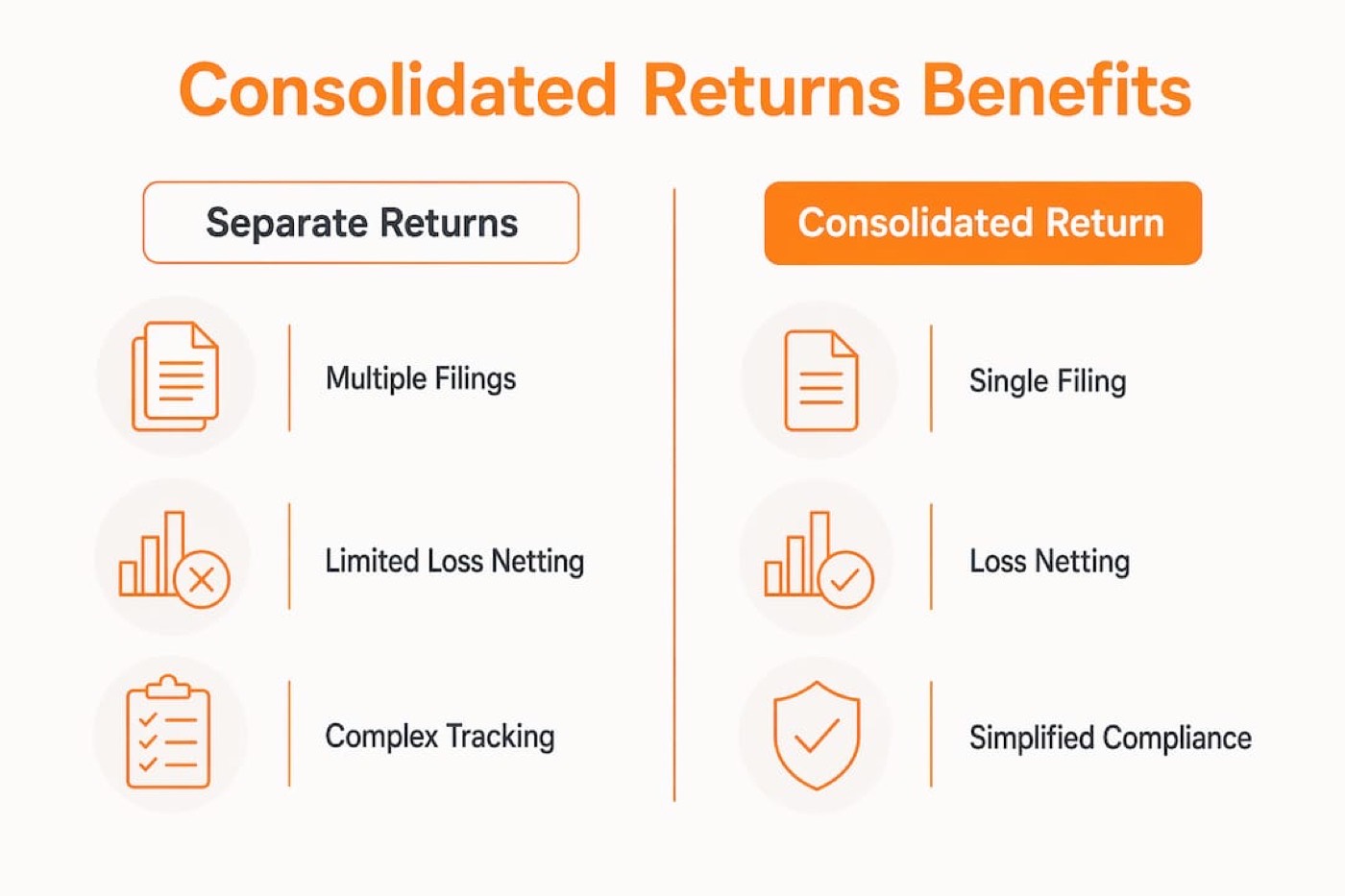
A cannabis corporate group files one consolidated federal return instead of separate returns for each entity. This matters because netting losses across affiliates reduces taxable income faster than carrying losses forward on separate returns. A cultivation subsidiary running at a loss in year one offsets the taxable income of a profitable dispensary in the same group, in the same year. That is the primary financial argument for consolidation.
The benefits of consolidated returns for cannabis groups extend beyond loss netting. A single return simplifies federal reporting, reduces the number of separate return filings, and aligns tax reporting with the economic reality of how a multi-entity cannabis business actually operates. Internal dividends, intercompany service fees, and inventory transfers between affiliates are eliminated from consolidated taxable income, preventing artificial income inflation.

The tax strategy implications are significant for groups with uneven profitability across entities. Cannabis businesses frequently have this profile: a licensed cultivation facility with high startup costs and early losses paired with a retail operation generating positive cash flow. Consolidated filing captures that asymmetry and turns it into a tax position.
What eligibility criteria determine if cannabis entities can file consolidated returns?
Eligibility under IRC §1504 is strict. The parent corporation must own at least 80% of voting power and stock value in each subsidiary included in the consolidated group. Both tests must be met simultaneously. Failing either one on any testing date removes that entity from the affiliated group.
Cannabis companies with complex capital structures face a specific problem here. Preferred equity and multiple share classes can fail the 80% tests even when the economic ownership appears clear. A convertible preferred share held by an outside investor can dilute voting power below the threshold, disqualifying the subsidiary. This is not a theoretical risk. Cannabis companies frequently use preferred equity to attract institutional capital, and that financing structure can silently break consolidated eligibility.
Practical eligibility requirements include:
- Common tax year adoption. All group members must use the same tax year. Misaligned fiscal years require adjustment before the election is valid.
- Consent filing. Each subsidiary must file a consent to be included in the consolidated group, typically attached to the first consolidated return.
- Continuous ownership testing. The 80% tests apply on a continuous basis, not just at election. Ownership changes mid-year can trigger deconsolidation.
- Domestic corporation requirement. Only domestic C corporations qualify. LLCs, S corporations, and foreign entities are excluded from the affiliated group.
Pro Tip: Track ownership percentages at every capital raise, restructuring, or equity issuance. A single preferred share tranche that crosses the wrong threshold can invalidate consolidated eligibility retroactively, creating a significant audit exposure.
How do consolidated returns affect intercompany transactions in cannabis?
Intercompany transactions between group members are eliminated or deferred for federal tax purposes. The rules exist to prevent a cannabis group from recognizing income on internal transfers that have no economic substance outside the group. Here is how the mechanics work in sequence:
- Elimination of internal sales. When a cannabis cultivation entity sells inventory to a group-affiliated dispensary, that sale is eliminated from consolidated taxable income. The revenue and corresponding cost are both removed until the inventory is sold to an external customer.
- Deferral of intercompany gains. If a cannabis group transfers a licensed facility or intellectual property between affiliates at a gain, that gain is deferred until realization outside the group. The gain is suspended, not forgiven.
- Triggering events release deferred gains. Sale to an external party, liquidation of the transferee, or deconsolidation of a member are the primary triggering events that bring deferred gains into consolidated taxable income.
- Service fee and dividend elimination. Management fees, licensing royalties, and intercompany dividends paid between affiliates are eliminated. These flows are common in cannabis groups where a parent entity charges subsidiaries for compliance, licensing, or administrative services.
- Timing alignment with economic reality. The net effect is that consolidated taxable income reflects the group’s actual economic performance with external parties, not the internal transfer pricing decisions made between affiliates.
The timing impact on income recognition is material for cannabis operators with frequent intercompany asset transfers. A group that regularly moves inventory or licenses between entities must maintain a deferred gain schedule and reconcile it against GAAP reporting, where the same transactions may be recognized differently.
Pro Tip: Build a dedicated intercompany transaction register before filing the first consolidated return. Tracking deferred gain balances by transaction, entity, and triggering event is not optional. Auditors will ask for it, and reconstructing it after the fact is expensive.
What risks and practical considerations matter before electing consolidated returns?
The consolidated return election is binding and difficult to revoke without IRS approval. Revoking requires demonstrating a substantial change in circumstances. That bar is high. Cannabis CFOs who treat consolidation as a short-term optimization tool will find themselves locked into a structure that may not fit the business three years later.
Key risks to assess before election:
- Joint and several liability. All group members are liable for the entire consolidated tax liability. If one subsidiary generates a large tax deficiency, every entity in the group is exposed. This risk requires strong intra-group compliance monitoring and entity-level oversight.
- Acquisition and restructuring traps. Adding a new entity to the group mid-year, acquiring a cannabis license holder, or spinning off a subsidiary all create compliance events. Each triggers ownership retesting and may require consent filings or method adjustments.
- GAAP versus tax timing differences. Intercompany deferrals and eliminations create timing differences between GAAP consolidated financials and consolidated taxable income. These differences require deferred tax accounting under ASC 740 and create audit complexity for multi-entity cannabis groups.
- Accounting method alignment. Consistent accounting methods are required across all group members. Cannabis entities using different inventory costing methods or depreciation schedules must align before or at the time of election, which can trigger IRC §481(a) adjustments.
Multi-year scenario modeling is the minimum standard before electing consolidated status. Model the group’s projected ownership structure, acquisition pipeline, and entity-level profitability over at least three years. The cost of getting this wrong is not just a tax adjustment. It is a locked-in structure that constrains every future transaction.
How does consolidation interact with Section 280E for cannabis businesses?
Section 280E disallows all ordinary business deductions for cannabis businesses at the federal level, except for cost of goods sold. This constraint does not disappear under a consolidated return. Consolidation helps with loss netting across entities. It does not create new deductions or remove the 280E limitation from any member of the group.
The table below shows how consolidated filing compares to separate filing under 280E conditions:
| Tax Scenario | Separate Returns | Consolidated Return |
|---|---|---|
| Loss in cultivation entity | Carried forward separately | Offsets profitable affiliate in current year |
| Intercompany inventory sale | Recognized as income at transfer | Eliminated until external sale |
| 280E deduction limit | Applies entity by entity | Applies entity by entity within consolidated group |
| Management fee income | Taxable to recipient entity | Eliminated within group |
| Deferred gain on asset transfer | Recognized at transfer | Suspended until triggering event |
The 280E overlay means cannabis groups must combine consolidated return analysis with inventory cost allocation modeling to assess actual after-tax performance. Maximizing COGS allocations at the entity level remains the primary lever for reducing taxable income under 280E. Consolidation adds loss netting on top of that, but it does not substitute for rigorous cost accounting at each entity.
The potential rescheduling of cannabis from Schedule I to Schedule III under the Controlled Substances Act would remove the 280E constraint. Groups that have structured around 280E through consolidation and cost accounting should model both scenarios. The rescheduling impact on 280E changes the after-tax math significantly and may alter whether consolidation remains the optimal structure. For non-deductible expense treatment under current law, the 280E deduction limits remain the binding constraint regardless of consolidated filing status.
The long-term commitment most cannabis groups underestimate
I have worked through consolidated return elections with multi-entity cannabis groups, and the pattern I see most often is the same: the election gets made because the current-year loss netting looks attractive, and the long-term structural implications get underweighted.
The ownership testing requirement is not a one-time check. It runs continuously. Every capital raise, every convertible note conversion, every equity restructuring is a potential deconsolidation event. Groups that do not have a designated person tracking this on a rolling basis will eventually get surprised. And the surprise usually comes during an audit, not before.
The intercompany transaction management piece is where the real complexity lives. Cannabis groups with internal inventory flows, license transfers, and management service agreements between affiliates are generating deferred gain balances every year. Those balances need to be tracked, reconciled to GAAP, and disclosed. The groups that handle this well treat it as a standing accounting function, not a year-end cleanup task.
The financial consolidation framework matters here too. Tax consolidation and GAAP consolidation follow different rules, and the differences compound over time. A cannabis group that conflates the two will produce unreliable deferred tax schedules and create problems that take multiple tax years to unwind.
Consolidation is one part of a broader cannabis tax strategy. It works best when combined with disciplined cost accounting, entity-level 280E analysis, and scenario modeling for future transactions. Used that way, it is a real structural advantage. Used as a shortcut, it creates more problems than it solves.
— JN
Build your cannabis tax knowledge with Cannabisbusinessminds
Consolidated returns are one piece of a larger tax structure. The other critical piece is how each entity within the group accounts for inventory costs under 280E.

Cannabisbusinessminds covers both sides of this equation. The cannabis inventory costing guide breaks down how finance professionals should approach COGS allocation, capitalization decisions, and cost flow assumptions at the entity level. The cost accounting guide goes deeper on method selection and compliance. For groups building a consolidated tax strategy, these resources provide the entity-level foundation that makes consolidation analysis meaningful. You can also find small business tax compliance tips that apply across the broader filing context.
FAQ
What is a consolidated tax return in cannabis?
A consolidated tax return is a single federal filing that combines the taxable income, losses, and credits of an affiliated group of C corporations under IRC §1504. Cannabis groups use it to net losses in unprofitable entities against income in profitable ones within the same tax year.
Does consolidation eliminate Section 280E limits?
No. Section 280E applies entity by entity within a consolidated group and is not removed by the consolidated election. Consolidation allows loss netting across affiliates but does not create new deductions or override the COGS-only rule.
How hard is it to revoke a consolidated return election?
The election is binding once made and requires IRS approval to revoke, which demands proof of a substantial change in circumstances. Cannabis groups should treat the election as a long-term structural commitment, not a year-by-year choice.
What triggers deconsolidation in a cannabis group?
Dropping below the 80% ownership threshold in voting power or stock value for any subsidiary triggers deconsolidation of that entity. Capital raises involving preferred equity, convertible instruments, or outside investors are the most common causes in cannabis corporate structures.
Can LLCs and S corporations join a consolidated cannabis group?
No. Only domestic C corporations qualify under IRC §1504. LLCs, S corporations, partnerships, and foreign entities are excluded from the affiliated group regardless of ownership percentage.
Recommended
- What is financial consolidation in cannabis: a complete guide – Cannabis Business Minds
- Why Cannabis Taxes Are High for U.S. Businesses – Cannabis Business Minds
- Cannabis Entity Tax Status: Key U.S. Compliance Factors – Cannabis Business Minds
- Why Cannabis Tax Compliance Matters for U.S. Businesses – Cannabis Business Minds
This article is general education, not tax, legal or accounting advice. Cannabis rules change quickly; confirm how they apply to you with a qualified cannabis CPA or attorney.