Skills for a Cannabis CFO: 2026 Industry Guide
2026 update: what rescheduling changed for 280E (reviewed October 2026)
Effective April 22, 2026, a DOJ/DEA final order moved marijuana covered by a qualifying state medical license (and FDA-approved marijuana drugs) to Schedule III. Section 280E only applies to Schedule I and II substances, so state-licensed medical cannabis activity is generally no longer subject to 280E going forward. Adult-use cannabis remains in Schedule I and fully subject to 280E. The DEA proceeding to reschedule all marijuana was temporarily stayed in October 2026, and Treasury/IRS guidance on transition years and mixed medical/adult-use businesses is still pending.
Check where your business stands in about a minute.
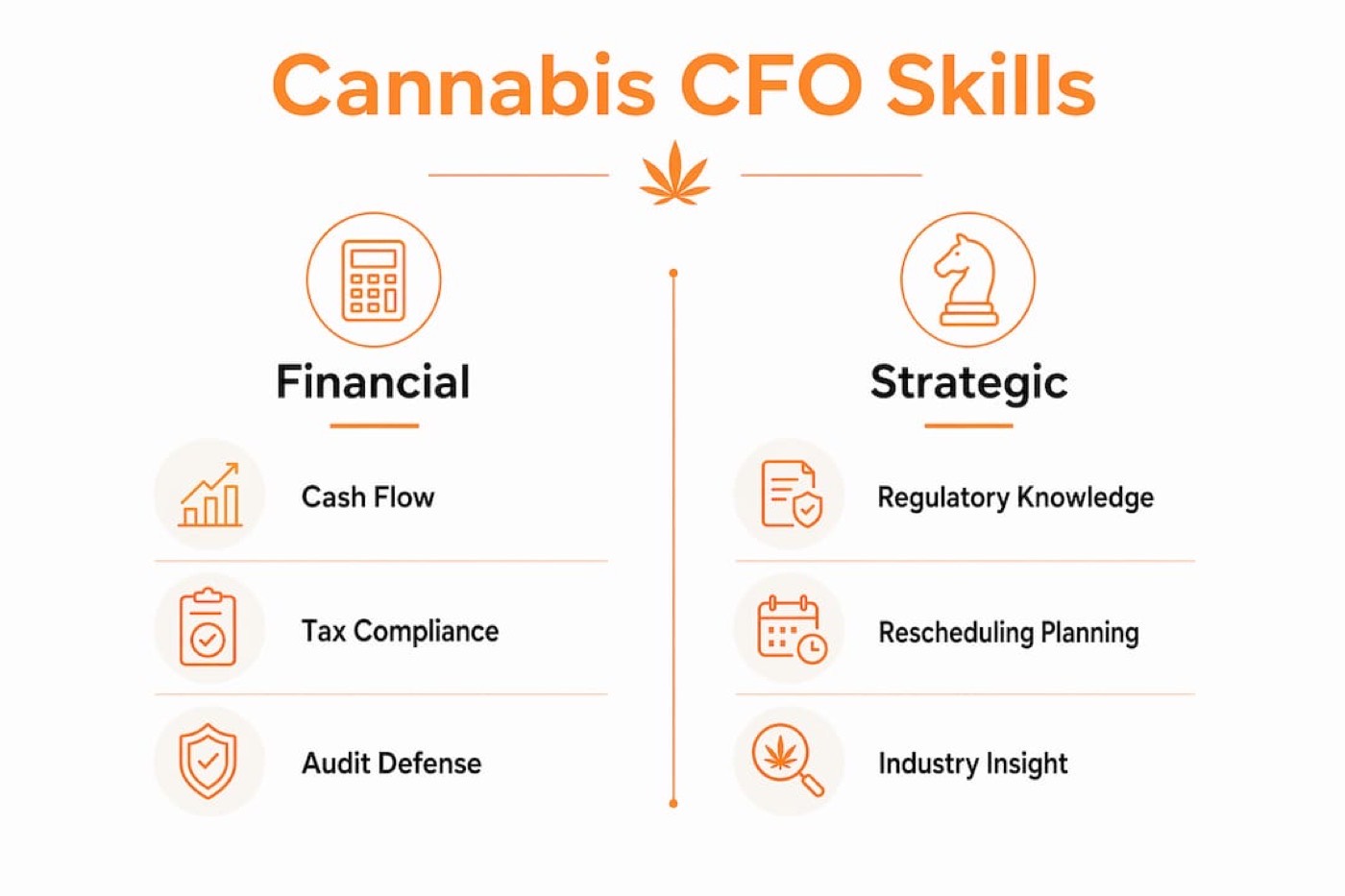
A cannabis CFO is defined by the ability to manage financial operations under conditions that would disqualify most conventional finance executives: no federal banking access, a tax code that denies standard business deductions, and a regulatory environment that shifts faster than annual planning cycles can absorb. The skills for a cannabis CFO go well beyond standard financial management. They require deep command of Section 280E, scenario-based cash flow forecasting, multi-state compliance coordination, and the kind of IRS audit defense that most CPAs never encounter. This guide breaks down exactly what those competencies look like in practice, and what qualifications actually signal readiness for the role.
What skills must a cannabis CFO master for 2026?
Cannabis financial management at the CFO level starts with cash flow architecture. A 13-week rolling cash flow model, updated every Monday, with cash separated by source, is the baseline. That separation matters because operations, capital expenditures, debt service, and taxes each carry different risk profiles and timing constraints. Blending them into a single cash line is how cannabis operators run out of runway without seeing it coming.
The model also needs stress layers. Downside revenue scenarios of 15–20% and liquidity stress tests for wholesale account delinquency at 60 days are the current standard for durable cannabis forecasting. That level of conservatism reflects real market conditions: wholesale pricing compression, slow-paying retail accounts, and limited access to emergency credit.

Cost classification is the next critical skill. Every dollar of cost must be correctly assigned as either a cost of goods sold item or a non-COGS operating expense. That distinction directly determines 280E tax exposure. Misclassification in either direction creates either an overstated tax bill or an audit target.
Capital expenditure management adds another layer. Cannabis CFOs stage capex to regulatory milestones rather than business projections alone. A license delay or a state inspection failure can freeze a facility build for months. Tying capital deployment to confirmed regulatory events, not anticipated ones, protects liquidity.
- Build a 13-week rolling cash flow model updated weekly with variance analysis
- Separate cash sources: operations, capex, debt service, and taxes
- Model downside scenarios at 15–20% revenue reduction
- Stress test for 60-day wholesale account delinquency
- Stage capex to confirmed regulatory milestones, not projections
Pro Tip: Quarterly audit retrieval drills — selecting a random period and pulling all supporting documentation as if under audit — surface control breakdowns before regulators do. Run them before year-end close, not after.
How does regulatory compliance shape a cannabis CFO’s skill set?
Section 280E is the defining constraint of cannabis finance. It disallows deductions for ordinary business expenses because cannabis remains federally classified as a Schedule I controlled substance. The CFO’s job is to build a defensible COGS allocation that maximizes deductible costs without crossing into positions the IRS will reject.
Management company structures are one common approach. A separate management entity charges the operating cannabis company a fee for administrative services, and that fee sits outside the 280E disallowance. The fee must be arm’s-length, between 8% and 15% of operating company revenue. Fees above that range, especially structures above 40% with minimal staffing, will not survive audit scrutiny.
The 2026 rescheduling transition adds a new layer of complexity. If cannabis moves to Schedule III, §263A elections and cost allocation timing become the central tax planning variables. Prior cost allocations built around 280E may create timing disadvantages under the new framework. A cannabis CFO must model both scenarios simultaneously and document the position taken.
- Understand 280E COGS allocation at the line-item level, not just conceptually
- Structure management fees within the 8%–15% arm’s-length range
- Coordinate DEA registration requirements with state-level tax compliance
- Build documentation that supports IRS audit defense, not just tax filing
- Model the Schedule III transition impact on existing cost allocation elections
- Prepare facility and quality management systems for federal oversight readiness
Pro Tip: Tax position defense in cannabis requires operational knowledge, not just accounting knowledge. A CFO who has never walked a cultivation floor will struggle to justify cost allocations under IRS questioning. Operational familiarity is not optional.
The legal compliance framework for cannabis finance also includes state-specific excise taxes, track-and-trace reporting obligations, and licensing fee structures that vary by jurisdiction. Multi-state operators face compounded complexity. A CFO managing operations in California, Colorado, and Illinois simultaneously is managing three distinct tax regimes, three licensing frameworks, and three sets of reporting deadlines.
Which strategic planning skills separate top cannabis CFOs?
The best cannabis CFOs treat tax relief as survival capital, not profit. Deleveraging high-interest nontraditional debt above 10% takes priority over expansion when tax savings materialize. That discipline is rare. Most operators see a tax reduction and immediately redirect funds toward new locations or equipment. The CFOs who build durable businesses use that capital to reduce financial fragility first.
Strategic planning in cannabis also requires managing investor expectations with precision. Investors in cannabis often come from industries where growth metrics dominate. A cannabis CFO must reframe the conversation around cash preservation, compliance investment, and regulatory milestone achievement. That requires clear documentation of capital allocation decisions and the reasoning behind them.
- Use scenario-based forecasting to present investors with range outcomes, not point estimates
- Document capital allocation decisions with explicit rationale tied to regulatory milestones
- Prioritize debt reduction over expansion when operating under banking restrictions
- Allocate a defined budget to compliance infrastructure before discretionary spending
- Evaluate fractional versus full-time CFO structures based on company revenue and complexity
The fractional CFO question is real for early-stage operators. A company generating under $5 million in annual revenue often cannot justify a full-time CFO salary. A fractional arrangement with a cannabis-specialized finance executive delivers the same regulatory and tax expertise at a fraction of the cost. The tradeoff is availability during high-demand periods like audit season or licensing renewals. Knowing when to make that transition is itself a strategic skill.
What qualifications best prepare a cannabis CFO candidate?
Formal credentials matter, but they are not sufficient on their own. The table below outlines the qualifications that appear most frequently in cannabis CFO roles and what each one signals to an operator evaluating candidates.
| Qualification | What it signals | Cannabis-specific value |
|---|---|---|
| CPA license | Technical accounting competency and regulatory familiarity | Required for defensible 280E positions and audit readiness |
| MBA (Finance concentration) | Capital allocation and strategic planning capability | Useful for investor relations and multi-entity structuring |
| Advanced taxation degree | Deep tax law knowledge beyond standard CPA curriculum | Critical for §263A elections and rescheduling transition planning |
| Multi-state cannabis experience | Operational understanding of varied regulatory environments | Directly applicable; no substitute for lived experience |
| Prior ownership or advisory role | Operational perspective that informs cost classification | Strengthens IRS audit defense credibility |
A CPA with no cannabis experience and a cannabis operator with no accounting credentials are both incomplete fits. The strongest candidates combine formal accounting training with demonstrated cannabis financial management experience, ideally including direct involvement in an IRS examination or state audit.
Candidates transitioning from other regulated industries, such as pharmaceutical distribution, alcohol beverage, or financial services, bring transferable compliance instincts. The regulatory mindset carries over. The cannabis-specific tax mechanics do not. Expect a learning curve on 280E mechanics and state-specific excise structures regardless of prior regulated industry experience.
Hands-on training in cannabis tax law, including 280E tax positions and inventory costing methods, closes that gap faster than general finance experience alone. Operators evaluating candidates should test for this directly, not assume it comes with a CPA credential.
The role has outgrown what most operators expect
The cannabis CFO role has shifted fundamentally in the past three years. What started as a bookkeeping and compliance function is now a full tax defense and operational finance position. Most cannabis firms stop at basic bookkeeping. The ones that survive federal scrutiny have a CFO who understands how to defend a cost allocation under questioning, not just how to record it.
The rescheduling transition makes this more acute. Proactive modeling of the 280E-to-§263A shift is not optional for operators with significant prior cost allocation history. A CFO who waits for regulatory clarity before modeling the transition will be months behind when the rules change. The operators I have seen navigate regulatory shifts well all had one thing in common: they ran the numbers before they had to.
The cash flow discipline piece is equally underestimated. Banking restrictions mean cannabis operators cannot rely on a line of credit to bridge a slow month. The 13-week model is not a best practice. It is the difference between catching a liquidity problem in week four and discovering it in week eleven. CFOs who treat cash forecasting as a monthly exercise are running blind.
The compliance investment framing also matters. Spending on quality management systems, facility upgrades, and federal oversight readiness before rescheduling is complete is not premature. It is the only position that makes sense given the audit risk profile of the industry.
— JN
Cannabisbusinessminds resources for cannabis finance professionals
Cannabisbusinessminds publishes specialized guides built for cannabis finance professionals who need more than general accounting knowledge.
The platform covers cannabis bookkeeping practices tailored to 2026 regulatory requirements, inventory costing methods specific to cannabis operations, and budgeting frameworks designed for the cash constraints cannabis operators face. For CFOs building or auditing their tax positions, the cost accounting guide covers COGS allocation, §263A elections, and multi-entity structuring in plain language. These resources are built for professionals who already know the basics and need the cannabis-specific layer.
FAQ
What is the most critical skill for a cannabis CFO?
Deep command of Section 280E cost allocation is the most critical skill. A defensible COGS position directly determines tax liability and audit exposure, making it the foundation of every other financial decision.
Does a cannabis CFO need a CPA license?
A CPA license is the standard credential for cannabis CFO roles, particularly for operators facing IRS scrutiny. It signals the technical accounting competency required to build and defend complex tax positions.
How does the 2026 rescheduling affect cannabis CFO responsibilities?
Rescheduling to Schedule III shifts the primary tax framework from Section 280E to §263A, requiring CFOs to model both scenarios simultaneously and document prior cost allocation decisions before the transition takes effect.
What cash flow model do cannabis CFOs use?
A 13-week rolling cash flow model, updated weekly with cash separated by source, is the current standard. It must include downside revenue scenarios of 15–20% and liquidity stress tests for 60-day wholesale account delinquency.
When should a cannabis company hire a full-time CFO?
A full-time CFO becomes necessary when multi-state operations, significant IRS audit risk, or investor reporting requirements exceed what a fractional arrangement can reliably cover. Revenue scale and regulatory complexity are the two primary triggers.
Recommended
- The cannabis CFO’s essential role in financial success – Cannabis Business Minds
- Does Your Cannabis Business Need a CFO in 2026? – Cannabis Business Minds
- Top Skills for Cannabis Accountants: 2026 Career Guide – Cannabis Business Minds
- Does Your Cannabis Business Need a CFO in 2026? – Cannabis Business Minds
This article is general education, not tax, legal or accounting advice. Cannabis rules change quickly; confirm how they apply to you with a qualified cannabis CPA or attorney.