Cannabis Accounting and AI: What Finance Pros Must Know
2026 update: what rescheduling changed for 280E (reviewed October 2026)
Effective April 22, 2026, a DOJ/DEA final order moved marijuana covered by a qualifying state medical license (and FDA-approved marijuana drugs) to Schedule III. Section 280E only applies to Schedule I and II substances, so state-licensed medical cannabis activity is generally no longer subject to 280E going forward. Adult-use cannabis remains in Schedule I and fully subject to 280E. The DEA proceeding to reschedule all marijuana was temporarily stayed in October 2026, and Treasury/IRS guidance on transition years and mixed medical/adult-use businesses is still pending.
Check where your business stands in about a minute.
Cannabis accounting and AI integration is defined as the use of artificial intelligence platforms to automate bookkeeping, reconciliation, and compliance workflows across cannabis financial operations. The industry runs on cash, operates under IRC Section 280E, and answers to METRC simultaneously. That combination makes manual accounting a liability, not just an inefficiency. AI tools built for cannabis connect POS systems, seed-to-sale tracking, and general ledgers in real time, cutting month-end close from weeks to days. This guide covers what those systems actually do, where they fall short, and what your finance team needs in place before any of it works.
How AI-powered systems automate cannabis accounting processes
AI integration in cannabis finance does one thing well: it eliminates the gap between operational data and financial records. Automated systems integrate POS, seed-to-sale, and ledgers to update financial records instantly, removing the lag that turns reconciliation into a forensic exercise. Treez launched Winston specifically as an AI teammate for cannabis retail, designed to connect operational and financial data streams without manual exports.
The core functions these platforms handle include:
- Automated invoice syncing: Vendor bills post directly to the ledger when received, matched against purchase orders without manual entry.
- Real-time bank feeds: Cash transactions post as they clear, not at month-end.
- METRC reconciliation: Inventory transfers in METRC are matched against cost of goods sold entries automatically.
- Variance flagging: The system flags discrepancies between POS sales and bank deposits before they become audit findings.
- Fee mapping: Payment processing fees route to the correct expense accounts, preventing margin distortion.
Up to 80% of manual accounting tasks can be automated through AI, which means a two-person finance team can handle the transaction volume that previously required four. That math matters in a margin-compressed industry. Cloud-based AI platforms now offer cannabis operators enterprise-grade accounting capabilities at SMB price points, including 280E cost tracking and seed-to-sale compliance built into the workflow.
Pro Tip: Before selecting any AI platform, map every data source your operation produces: POS terminal, METRC, bank accounts, and payroll. A platform that cannot ingest all four natively will create manual workarounds that defeat the purpose.

For a broader view of where AI fits within the current accounting environment, Cannabisbusinessminds covers 2025 accounting trends that contextualize these platform shifts.
What does AI-driven cash management look like for cannabis compliance?
Cash management is where cannabis operators get banked or debanked. AI does not change the rules. It enforces them consistently.
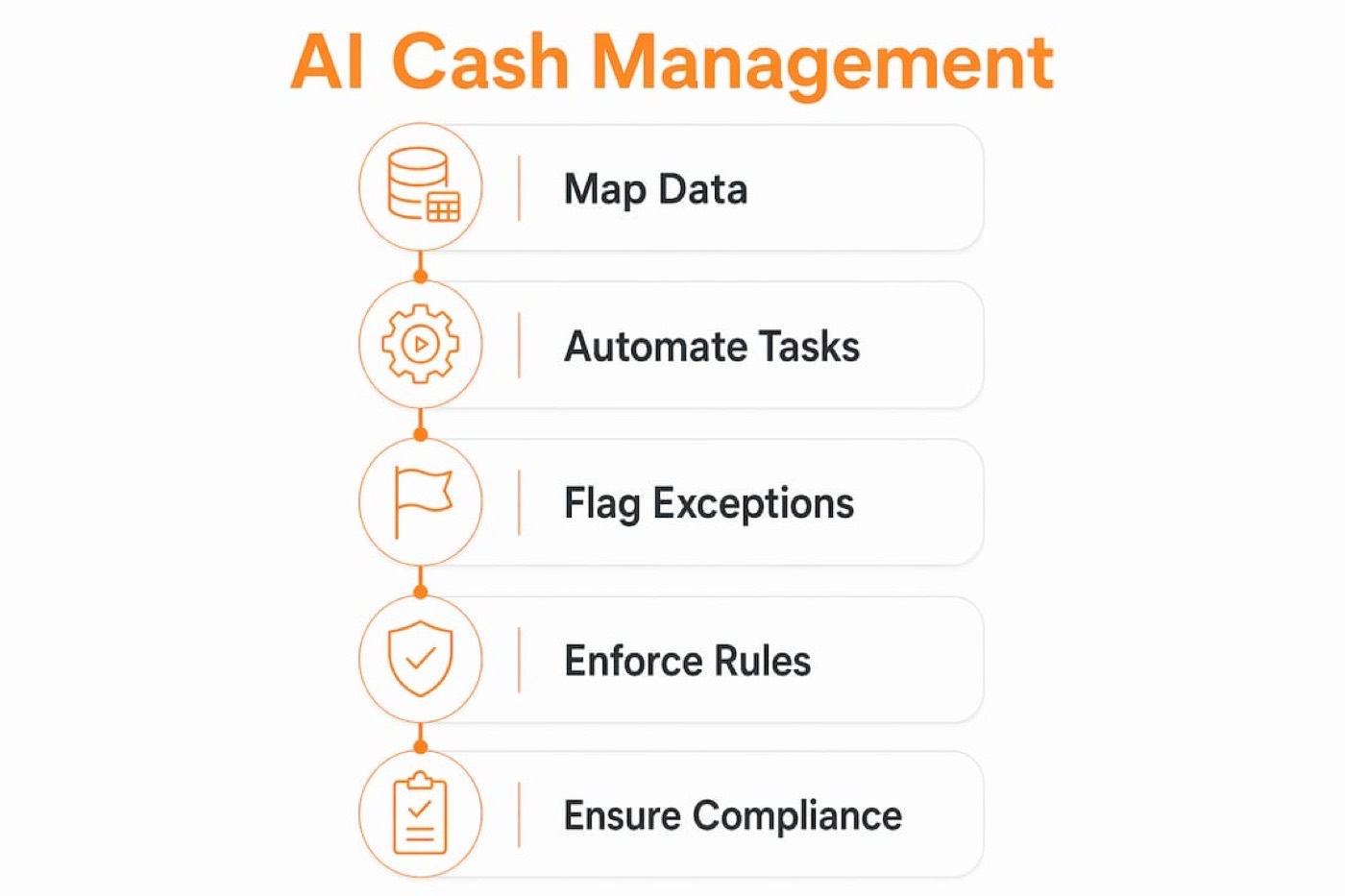
Dispensaries must maintain strict cash-handling thresholds and document daily three-way reconciliations across POS sales, physical cash counted, and bank deposits. Audit binders containing these logs are the primary tools used in regulatory reviews. AI automates the production of those binders. The reconciliation still has to happen. The difference is whether a human is manually building a spreadsheet at 11 p.m. or reviewing a system-generated report at 9 a.m.
The steps AI enforces in a compliant cash management cycle:
- POS close: System captures total sales by tender type at end of shift.
- Cash count: Vault count is entered into the platform and compared against POS cash totals automatically.
- Variance log: Any discrepancy above threshold triggers an alert and requires a documented explanation before the day closes.
- Deposit preparation: System generates a deposit slip matched to the reconciled cash total.
- Bank confirmation: Deposit posts to the ledger when the bank confirms receipt, completing the three-way match.
- Audit binder update: All documentation archives automatically, date-stamped and user-attributed.
Financial institutions prioritize documented cash controls and consistent deposit practices over cash volume when evaluating cannabis operators. That is the part most operators miss. Banks are not worried about how much cash you handle. They are worried about whether you can prove you handled it correctly every single day. Cash deposits must follow consistent schedules and be supported by written procedures, reconciliations, and segregation of duties.
Pro Tip: Set your AI platform to flag any deposit that deviates from your established schedule by more than 24 hours. Inconsistent deposit timing is one of the first signals banks use to assess operational risk.
How does AI support 280E compliance and cost allocation?
Section 280E is the tax provision that disallows deductions for businesses trafficking Schedule I or II controlled substances. Cannabis operators can only deduct cost of goods sold. Every dollar misclassified above the COGS line costs real tax dollars. AI helps, but the methodology decision is entirely human.
Key areas where AI supports 280E compliance:
- Cost tracing: AI tracks cultivation labor, packaging materials, and direct production costs to specific inventory batches, building the COGS basis transaction by transaction.
- Allocation documentation: The platform maintains a running record of how overhead is allocated between plant-touching and non-plant-touching activities, which is the core of any 280E defense.
- Tax accrual integration: AI tools can accrue estimated tax liability in real time based on current gross profit, giving CFOs a live view of their 280E exposure rather than a year-end surprise.
- Scenario modeling: Finance teams can run cost allocation scenarios before filing to see how different methodologies affect taxable income.
Documenting and defending 280E cost allocation methodology is required before filing returns. Operators should maintain formal position papers outlining whether they use cost tracing or pro-rata methods. AI can generate the supporting data, but a CPA has to sign off on the methodology. The IRS does not accept “the software decided” as a defensible position. For a deeper look at how cost allocation connects to tax basis, Cannabisbusinessminds has a dedicated resource on cannabis tax basis.
The critical audit trail for cannabis dispensaries is the daily three-way match of POS sales, METRC inventory transfers, and bank deposits with detailed variance logs. Automated systems must map payment processing fees to expense accounts correctly. A misrouted fee that inflates COGS creates a tax error. A misrouted fee that understates COGS triggers overpayment.
What are the best practices for implementing AI in cannabis accounting?
The biggest implementation failure is not technical. It is operational. Finance teams assume AI will fix broken processes. It amplifies them.
| Factor | Strong foundation | Weak foundation |
|---|---|---|
| Cash handling | Written SOPs, daily counts, segregation of duties | Ad hoc counts, single handler, no documentation |
| Data sources | All systems integrated, real-time feeds | Manual exports, delayed reconciliation |
| Human oversight | Daily review of AI-generated reports | Monthly review, exceptions ignored |
| METRC accuracy | Transfers logged same day, matched to financials | Transfers logged in batches, reconciled quarterly |
| Fee mapping | Expense accounts configured before go-live | Default chart of accounts, uncategorized fees |
Poor data quality and operational breakdowns compromise AI benefits, producing garbage-in, garbage-out results that undermine accounting accuracy. Pre-existing operational discipline on cash handling and segregation of duties is required for successful AI integration. That is not a vendor caveat. That is the actual failure mode.
AI tools cannot fully replace human judgment in compliance-heavy reconciliation, especially at the intersection of METRC data and financial records. Human oversight remains critical for audit defensibility and nuanced COGS documentation. The daily verification step is non-negotiable. Someone on your team reviews the automated reconciliation every morning. Exceptions get documented. Patterns get escalated. The AI handles volume. The human handles judgment.
For operators building out their cannabis bookkeeping practices, Cannabisbusinessminds covers the foundational controls that make AI adoption viable.
What future AI capabilities will reshape cannabis financial management?
The current generation of AI tools handles transaction processing and reconciliation. The next generation handles prediction and regulatory response.
- Predictive cash flow modeling: A 13-week rolling cash flow model, updated weekly with actual balances and scenario layers including a downside case with 15–20% revenue reduction, is already the standard for cannabis CFOs. AI will automate the scenario updates and flag when actuals deviate from the base case in real time.
- Compliance monitoring: AI tools are beginning to ingest regulatory updates from state cannabis control boards and flag when operational procedures need adjustment. This reduces the lag between a regulatory change and a policy update.
- Firm-level scalability: Accounting firms serving cannabis clients are using AI to handle the transaction volume across multiple client entities simultaneously, making specialized cannabis accounting more accessible at lower price points.
- Audit preparation automation: AI platforms are building audit-ready report packages that compile the three-way match documentation, variance logs, and METRC reconciliations into a single export formatted for regulatory review.
The limit of automation in cannabis finance is not computational. It is legal. Tax positions, cost allocation methodologies, and audit responses require human judgment and professional sign-off. AI accelerates the work that precedes those decisions. It does not make them.
AI in cannabis finance: where I draw the line
The operators who get the most out of AI in their accounting are not the ones with the most sophisticated platforms. They are the ones who did the boring work first. Written cash-handling procedures. Segregated duties. A chart of accounts that actually reflects how the business operates. When those foundations exist, AI multiplies the output of a lean finance team. Without them, AI multiplies the errors.
Where I see finance teams go wrong is treating AI adoption as a technology project rather than an operational one. They buy the platform, connect the bank feeds, and assume the reconciliations will be clean. Then they discover that their POS system has been miscategorizing tender types for six months, their METRC transfers are two weeks behind, and their chart of accounts has seventeen accounts labeled “miscellaneous.” The AI faithfully automates all of that chaos.
The 280E piece is where I am most direct with clients. AI can build you a beautiful cost allocation schedule. It can trace cultivation labor to specific batches and allocate overhead across plant-touching and non-plant-touching activities with precision. But the methodology decision, the position paper, and the audit defense are yours. The IRS will question the human who signed the return, not the software that generated the schedule. Keep that accountability structure clear inside your organization.
Real-time financial visibility is the genuine win here. When your AI platform is running correctly, you know your cash position, your COGS margin, and your 280E exposure every morning. That is a different business than one that finds out its tax liability in march when the CPA sends the draft return. The strategic value is not in the automation itself. It is in what you do with the information it surfaces.
— JN
Cannabisbusinessminds resources for cannabis accounting and AI
Cannabisbusinessminds has built a library of resources specifically for cannabis finance professionals who need more than general accounting guidance.

The cannabis inventory costing guide is the logical next resource after implementing AI in your accounting workflow. Inventory costing directly determines your COGS basis, which is the foundation of every 280E calculation. Getting it wrong at the costing level means every downstream calculation is wrong too. Cannabisbusinessminds also covers cannabis accounting fundamentals, budgeting frameworks, and tax compliance strategies built for the specific regulatory environment U.S. cannabis operators face in 2026. These resources are written for finance professionals who already know accounting and need cannabis-specific application, not introductory material.
FAQ
What is cannabis accounting and AI integration?
Cannabis accounting and AI integration is the use of artificial intelligence platforms to automate bookkeeping, reconciliation, and compliance workflows across POS, METRC, and general ledger systems. The goal is real-time financial visibility with reduced manual data entry.
Can AI replace a cannabis CPA or controller?
AI automates transaction processing and reconciliation but cannot replace human judgment in compliance-heavy decisions. Tax positions, 280E cost allocation methodology, and audit responses require professional sign-off.
How does AI help with 280E compliance?
AI tracks cultivation labor, packaging costs, and overhead allocations to build a defensible COGS basis. The methodology and position paper still require a CPA. AI generates the supporting data; the human defends the position.
What do banks look for in cannabis cash management?
Banks prioritize documented cash controls and consistent deposit practices over cash volume. Written procedures, daily three-way reconciliations, and segregation of duties are the operational signals that maintain banking relationships.
What is the biggest risk when implementing AI in cannabis accounting?
Poor data quality is the primary risk. Operational breakdowns in cash handling and METRC accuracy produce garbage-in, garbage-out results that undermine accounting accuracy regardless of platform quality.
Recommended
- 7 Key Cannabis Accounting Trends for 2025 – Cannabis Business Minds
- Cannabis Inventory Costing: What Finance Pros Must Know – Cannabis Business Minds
- Why Choose Specialized Cannabis Accounting for Your Business – Cannabis Business Minds
- Master Cannabis Accounting Best Practices for 2025 Success – Cannabis Business Minds
This article is general education, not tax, legal or accounting advice. Cannabis rules change quickly; confirm how they apply to you with a qualified cannabis CPA or attorney.