Why Audit Readiness Matters for Cannabis Businesses
2026 update: what rescheduling changed for 280E (reviewed October 2026)
Effective April 22, 2026, a DOJ/DEA final order moved marijuana covered by a qualifying state medical license (and FDA-approved marijuana drugs) to Schedule III. Section 280E only applies to Schedule I and II substances, so state-licensed medical cannabis activity is generally no longer subject to 280E going forward. Adult-use cannabis remains in Schedule I and fully subject to 280E. The DEA proceeding to reschedule all marijuana was temporarily stayed in October 2026, and Treasury/IRS guidance on transition years and mixed medical/adult-use businesses is still pending.
Check where your business stands in about a minute.
Most cannabis operators treat audits as a fire drill. Someone calls, panic sets in, staff scrambles to locate records, and the business spends a week doing in a rush what should have been done continuously. That reactive pattern is exactly why audit readiness matters in cannabis more than in almost any other industry. Between IRS scrutiny under Section 280E, state seed-to-sale tracking requirements, and license renewal checkpoints, a cannabis business that isn’t perpetually audit-ready is perpetually at risk. This article breaks down what audit readiness actually looks like, where operators fall short, and what it costs them when they do.
Table of Contents
- Why audit readiness matters in cannabis: regulatory risk and stakes
- What audit readiness actually means for cannabis operators
- Why third-party audits are underused and why that needs to change
- Practical steps for continuous audit readiness
- Financial audit readiness: COGS, inventory, and Section 280E
- My take: audit readiness is your competitive edge
- Build your audit readiness foundation with Cannabisbusinessminds
- FAQ
Why audit readiness matters in cannabis: regulatory risk and stakes
The regulatory environment for cannabis operators in 2026 is not getting more lenient. State enforcement agencies are increasing inspection frequency, the IRS has not softened its position on Section 280E, and any business operating across state lines faces overlapping compliance obligations with no margin for documentation gaps.
The financial consequences of noncompliance are not theoretical. Cannabis compliance violations result in fines from $5,000 to $40,000 plus operational penalties, and the range widens based on violation severity. License suspension and embargo actions are on the table for repeat offenders or for businesses that cannot produce required records on demand.
The IRS adds another layer entirely. 59% of cannabis business tax returns in a recent audit sample required IRC 280E adjustments, and inventory valuation and COGS documentation remain the primary enforcement focus for federal examiners in 2026. That number should stop you cold. More than half of audited returns had material errors tied directly to issues that proper recordkeeping would have caught and corrected before examination.
Here is what an unready cannabis business faces when regulators knock:
- License risk: State regulators can suspend or revoke licenses for documentation failures, not just operational ones.
- Embargo actions: Products can be held or seized during an audit if traceability records cannot confirm chain of custody.
- Tax recalculations: IRS examiners who cannot verify COGS will recalculate using methods that heavily favor the government.
- Operational disruption: A facility pulled into an unplanned audit with disorganized records can lose productive days or weeks.
The cannabis industry audits that end badly almost always share one feature: the operator treated compliance documentation as a periodic event rather than a permanent operational state.
What audit readiness actually means for cannabis operators
Audit readiness is not a binder you put together the week before an inspection. It is the condition your business operates in every day. The practical definition: your facility, records, and staff are prepared to respond to an audit request within 24 to 48 hours without altering normal operations.
Facilities must be audit-ready on short notice to avoid operational disruption, which means maintaining a prepared audit pack with batch records, Certificates of Analysis (COAs), and traceability maps at all times. That pack is not a static document. It updates in real time as production, transfers, and sales occur.
The core elements of operational audit readiness for a cannabis business include:
- Continuous documentation: Every transaction, transfer, waste event, and inventory adjustment is recorded in real time, not reconstructed after the fact.
- Internal controls: Segregation of duties, dual authorization for inventory adjustments, and documented approval chains for financial entries.
- Real-time inventory accuracy: System records must match physical counts. Discrepancies that sit unresolved are liabilities in any audit.
- Audit pack maintenance: Batch records, COAs, and traceability maps must be immediately accessible, organized by product and date range.
- Staff training: Every person who might interact with an auditor needs to know what to say, and more importantly, what not to speculate on.
Blind cycle counts reduce bias in inventory tracking by requiring staff to count without knowing expected quantities first. That one practice, applied consistently, prevents the kind of systematic rounding errors that turn into material discrepancies during a regulatory examination.
Pro Tip: Create a standing “audit response” folder in your compliance software that auto-populates with the most recent 90 days of batch records, COAs, and inventory adjustment logs. When a regulator calls, you pull one folder, not thirty.
Understanding your cannabis audit trail basics is the foundation everything else sits on. Without a clean, timestamped trail from seed to sale, none of the other documentation matters.
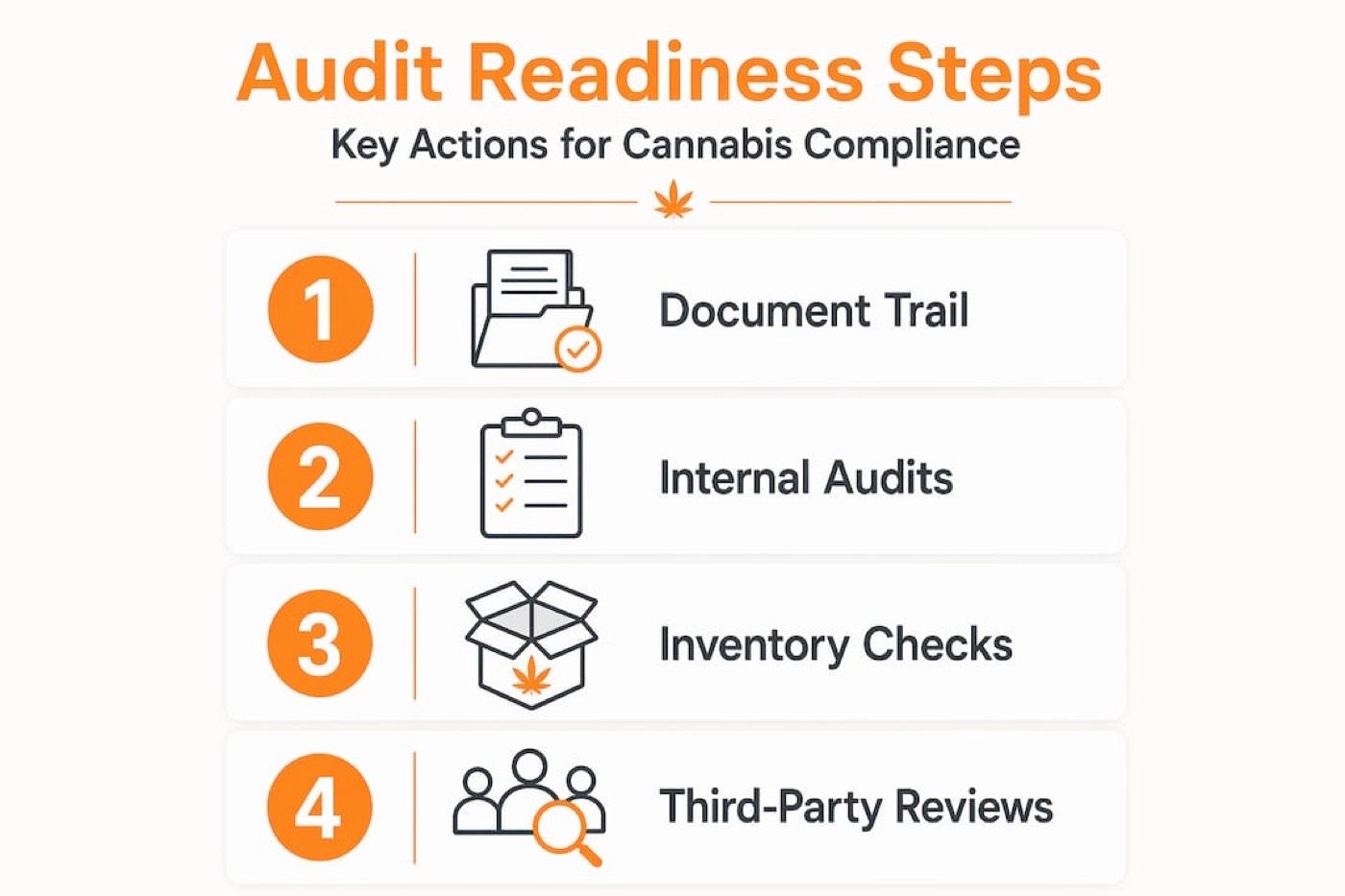
Why third-party audits are underused and why that needs to change
Internal audits catch what your team knows to look for. Third-party audits catch what your team has normalized or stopped seeing. That distinction is the entire argument for why external review belongs in your annual compliance calendar.
Third-party audits provide objectivity, credibility, and clarity, uncovering compliance gaps before regulators do. They strengthen systems and build consumer trust, and they prepare operators for the kind of scrutiny that comes with federal regulatory increases. The word “underused” in that framing is accurate. Most cannabis operators resist external audits because they fear finding problems. That is backwards thinking. Finding a problem internally is correctable. A regulator finding it first is a violation.
Here is how internal and third-party audits compare across the dimensions that matter:
| Dimension | Internal audit | Third-party audit |
|---|---|---|
| Objectivity | Limited by familiarity and bias | Independent and unfiltered |
| Credibility with regulators | Low to moderate | High |
| Ability to find systemic gaps | Moderate | High |
| Investor and lender confidence | Minimal impact | Significant positive signal |
| Cost | Lower upfront | Higher upfront, lower long-term risk |
| Staff communication insights | Limited | Reveals real operational behavior |
The investor confidence angle is real and often underweighted. Allowing auditors to see true day-to-day operations without staged preparations uncovers genuine compliance issues and enables meaningful remediation. Investors conducting due diligence on a cannabis acquisition or funding round want to see third-party audit history. A business that has none is a business that has been avoiding accountability.
“The cannabis industry must shift from reactive to proactive compliance, using audits as an ongoing strategic tool rather than a crisis response mechanism.”
Practical steps for continuous audit readiness
Embedding audit readiness into daily operations is not complicated. It is disciplined. The businesses that do it well have removed the concept of “audit prep” from their vocabulary because every day is already audit prep.
-
Schedule quarterly internal audits. Pick a fixed quarter date, rotate the internal auditor if you have the staff, and treat findings with the same urgency you would assign to a regulator’s observation. Document everything.
-
Run mock inspections twice a year. Have your compliance officer or a trusted outside consultant walk through your facility as if they are a state regulator. Note what they cannot find, what takes too long to produce, and where staff responses are inconsistent.
-
Implement CAPA tracking. Every finding from an internal audit or mock inspection becomes a documented Corrective and Preventive Action (CAPA) item with an owner, a due date, and a verification step. Minor observations must be documented internally even when they do not trigger formal CAPA requirements. That documentation discipline is what separates audit-ready operations from reactive ones.
-
Use a risk-based audit focus. Risk-based audits that concentrate on high-regulatory-risk areas improve compliance efficiency and reduce effort spent on low-risk processes. Focus your internal review hours on inventory accuracy, cash handling, transfer documentation, and COGS records. Those are the areas regulators prioritize.
-
Integrate your systems. Your POS, seed-to-sale tracking, and accounting software should share data in real time. Manual reconciliations between disconnected systems are error-prone and are audit liabilities. Disconnected systems also make it impossible to produce the traceability maps and financial reconciliations an audit requires on short notice.
-
Train your team on audit communication. Stating you will find the answer is always preferable to guessing during a regulatory examination. A staff member who speculates inaccurately during an audit creates a record problem that is harder to correct than the original question.
Pro Tip: Assign a single point of contact for every audit or inspection. That person retrieves documents, answers questions, and controls the pace of information flow. Auditors talking to multiple staff members simultaneously creates inconsistent statements.
Review your compliance baselines for 2026 annually and update your internal audit checklist to reflect any regulatory changes that occurred in the prior 12 months.
Financial audit readiness: COGS, inventory, and Section 280E
The financial side of cannabis audits is where the largest dollar exposure lives. The IRS does not audit cannabis businesses for sport. It audits them because the data shows widespread COGS overstatement and inventory valuation inconsistency, and the penalties for failure are severe.

IRS audits often fail due to inability to substantiate COGS, leading to harsh penalties up to 75%. Auditors look for cost studies, methodologies, and floor plans that demonstrate how overhead is allocated between cost of goods sold and non-deductible selling, general, and administrative expenses. If you cannot produce that documentation, the IRS recalculates using assumptions that benefit the government.
The specific financial documentation gaps that generate the most audit risk include:
- Inconsistent valuation methods: Switching between FIFO, LIFO, and weighted average without documented justification creates a paper trail that looks like manipulation, even when it is not.
- Undocumented intercompany transactions: Transfers between related entities with no pricing documentation or arm’s-length analysis are a primary IRS target.
- Missing segregation of duties: One person controlling inventory counts and the general ledger entries for those counts is a control failure that auditors flag immediately.
- Unsupported overhead allocations: Every dollar allocated to COGS under Section 280E must be traceable to a production or cultivation function, not an administrative one.
Segregation of duties, consistent inventory valuation methods, and documented intercompany pricing models are the key defenses in IRS audits. These are not exotic practices. They are basic financial controls that cannabis businesses often skip because they are growing fast and building infrastructure reactively.
A clean financial infrastructure reduces IRS audit risk and supports long-term business stability. Get your cannabis accounting practices aligned with these standards before an examiner asks you to explain them under oath.
My take: audit readiness is your competitive edge
I’ve worked through enough cannabis operator financials to know the difference between a business that will survive a regulatory examination and one that won’t. It has nothing to do with how well-intentioned the owners are. It has everything to do with whether the infrastructure was built to be examined.
Audit readiness is a strategic advantage that increases investor confidence and business valuation. That framing is correct, but operators need to hear the inverse version too. A business without audit readiness is worth less. Not just on paper. In practice, because it carries embedded risk that any informed buyer, lender, or regulator will discount for.
In my experience, the biggest mindset trap in cannabis compliance is treating it as a cost center. The hours spent building audit-ready documentation, training staff, and running mock inspections feel like overhead until the day a state inspector walks in unannounced. At that point, those hours are worth more than any marketing spend in the building.
The mature operators I’ve seen don’t talk about “getting ready for audits.” They talk about their compliance calendar the same way they talk about their grow cycle. It’s a known part of the operation. That shift in framing is where real operational stability comes from. Cannabis due diligence reviews during acquisitions expose this gap immediately. The businesses that command premium valuations are the ones that hand over clean documentation within 24 hours. The ones that scramble are the ones that get repriced.
— JN
Build your audit readiness foundation with Cannabisbusinessminds

Cannabisbusinessminds has built a library of resources specifically for cannabis operators and compliance officers who need more than general accounting advice. If the financial audit section above surfaced gaps you recognize in your own operation, start with the cannabis cost accounting guide, which covers inventory valuation methods, COGS documentation standards, and Section 280E cost allocation in detail. For operators building or upgrading their compliance program from scratch, the cannabis compliance workflow guide walks through the documentation and process requirements specific to dispensary operations. The tax exposure overview covers how IRS audit triggers connect to the financial controls discussed in this article. Every resource on Cannabisbusinessminds is written for operators who already understand the basics and need the next level of specificity.
FAQ
What is audit readiness in cannabis?
Audit readiness in cannabis means your business can respond to a regulatory or IRS examination within 24 to 48 hours without disrupting normal operations. It requires continuous documentation, real-time inventory accuracy, and maintained compliance records rather than periodic preparation.
Why do cannabis audits focus so heavily on COGS?
Because Section 280E limits cannabis deductions to cost of goods sold, the IRS scrutinizes COGS documentation intensively. More than half of audited returns required 280E adjustments, often because operators could not substantiate their cost allocation methodology.
How often should cannabis operators conduct internal audits?
Quarterly internal audits paired with two annual mock inspections represent the baseline for most cannabis operations. High-volume or multi-license businesses should increase frequency for inventory and COGS reviews given the financial exposure involved.
What is the biggest risk of failing a cannabis audit?
License suspension or revocation is the most severe outcome, but financial penalties from $5,000 to $40,000 per violation and IRS tax recalculations with penalties up to 75% are the more common consequences. Operational disruption during an unplanned audit also carries real revenue cost.
Do third-party audits help with investor confidence?
Yes. Third-party audit history is a standard component of cannabis due diligence. Operators who can produce independent compliance verification command stronger valuations and face fewer barriers in fundraising and acquisition discussions.
Recommended
- Complete Guide to Why Cannabis Audits Matter – Cannabis Business Minds
- Role of Audits in Cannabis: Complete Industry Guide – Cannabis Business Minds
- Cannabis Chart Audit: Ensuring Compliance and Accuracy – Cannabis Business Minds
- Master the Cannabis Banking Workflow for Compliance Success – Cannabis Business Minds
This article is general education, not tax, legal or accounting advice. Cannabis rules change quickly; confirm how they apply to you with a qualified cannabis CPA or attorney.