Cannabis compliance baselines: U.S. strategies for 2026
Many cannabis operators treat compliance as a checklist to complete once and file away. That mindset is now genuinely dangerous. Regulatory requirements are shifting faster than most businesses can track, with the federal rescheduling of medical cannabis to Schedule III creating new baseline expectations while state and local rules continue to fragment. Whether you run a single dispensary or a multi-state operation, your compliance baseline is not a static document. It is a living, operational framework that determines whether you keep your license, pass your next audit, and survive the enforcement wave that federal alignment will likely bring.
Table of Contents
- What is a compliance baseline in the cannabis industry?
- Core compliance mechanics: Meeting baseline requirements
- Navigating state, federal, and local regulatory layers
- Addressing compliance edge cases and risk scenarios
- Why setting your compliance baseline higher is now essential
- Connect your compliance strategy with expert support
- Frequently asked questions
Key Takeaways
| Point | Details |
|---|---|
| Compliance baseline definition | It is the minimum legal standard and operational protocol all cannabis businesses must meet to remain licensed. |
| State vs. federal regulations | Businesses must reconcile varying state rules and new federal baselines, especially after 2026 Schedule III shifts. |
| Operational mechanics | Routine inventory checks, surveillance, lab testing, labeling, and self-audits are essential to compliance. |
| Risk mitigation strategies | Anticipate edge cases like tech failures and jurisdictional conflict by using proactive audit and legal review plans. |
| Exceeding minimum standards | Voluntary compliance with higher standards creates security, reduces enforcement risk, and builds business value. |
What is a compliance baseline in the cannabis industry?
After setting the context, let’s clarify what a compliance baseline actually means for cannabis operators.
A compliance baseline in the cannabis industry refers to the minimum set of regulatory standards, protocols, and operational requirements that cannabis businesses must meet to legally operate in a given U.S. state or jurisdiction. Think of it as the floor, not the ceiling. Meeting the baseline keeps your doors open. Exceeding it keeps your license secure when regulations shift.
What makes cannabis compliance baselines especially complex is that they are not uniform. A dispensary operating in California faces a fundamentally different set of baseline requirements than one in Colorado, Missouri, or Florida. State agencies set the primary rules, but county and city ordinances layer additional requirements on top. A cannabis retailer in Los Angeles, for example, must satisfy both California’s Bureau of Cannabis Control standards and Los Angeles city zoning and social equity requirements simultaneously.
“Compliance baseline in the cannabis industry refers to the minimum set of regulatory standards, protocols, and operational requirements that cannabis businesses must meet to legally operate in a given U.S. state or jurisdiction.” This definition anchors every operational decision a cannabis business should make.
Here’s a quick breakdown of what baseline requirements typically cover across different jurisdictions:
| Compliance Area | State-Level Requirement | Local-Level Requirement |
|---|---|---|
| Licensing | State license renewal and fees | City business license and zoning approval |
| Inventory tracking | METRC or state seed-to-sale system | May require additional local reporting |
| Surveillance | 24/7 cameras with 30 to 90 day retention | Some cities require exterior camera coverage |
| Lab testing | Accredited third-party testing required | Rarely adds local testing requirements |
| Labeling | State-mandated warnings and THC disclosure | Some localities add language requirements |
Understanding why cannabis audits matter becomes obvious once you see how many layers operators must satisfy simultaneously. A gap in any one of these areas can trigger a compliance violation that puts your entire license at risk.
Core compliance mechanics: Meeting baseline requirements
Now that we’ve defined compliance baselines, let’s break down the daily mechanics required to meet these standards.
Compliance is not a monthly task. It is woven into every shift, every transaction, and every product that moves through your facility. The core mechanics include daily inventory reconciliation, 24/7 surveillance with 30 to 90 day retention, third-party lab testing from ISO 17025 accredited laboratories, accurate labeling with required warnings and THC content disclosures, and regular self-audits supported by operational checklists.
Let’s break down what each of these looks like in practice.
- Daily inventory reconciliation: Every gram sold, transferred, or destroyed must be logged and matched against your seed-to-sale tracking system. Discrepancies of even small amounts can trigger investigations in states like Colorado, Oregon, and Michigan.
- Surveillance requirements: Your camera system must maintain continuous coverage of all point-of-sale areas, storage rooms, and entry points. Footage must be retrievable for state inspectors without delay. Retention windows vary by state, ranging from 30 days to as long as 90 days.
- Lab testing protocols: Products must be tested by an ISO 17025 accredited laboratory for potency, pesticides, microbials, and heavy metals before reaching consumers. Some states now require testing at multiple production stages, not just the final product.
- Labeling and packaging compliance: Labels must include accurate THC and CBD percentages, required health warnings, batch numbers, and licensed facility information. A single mislabeled product can result in a recall and a compliance citation.
- Self-audits and operational checklists: Most state agencies expect operators to maintain internal audit logs. Reviewing your cannabis chart audit compliance practices regularly helps identify gaps before a state inspector does.
Pro Tip: Build your compliance checklists directly into your point-of-sale and inventory software so staff complete them as part of their regular workflow rather than as a separate administrative task. Embedding compliance into operations dramatically reduces human error.
One of the most underrated components of baseline compliance is documentation discipline. Your recordkeeping requirements are not just a formality. They are your primary defense during inspections and audits. Operators who maintain organized, timestamped records consistently move through inspections faster and with fewer citations than those who reconstruct records after the fact.
Navigating state, federal, and local regulatory layers
With baseline processes established, it’s vital to understand how regulatory layers shift and interact, especially after 2026 changes.

Cannabis regulation in the United States has never operated on a single track, and that complexity is now accelerating. The DOJ’s rescheduling of marijuana to Schedule III, effective in 2026, means that state-licensed medical cannabis businesses can now pursue DEA registration and align with emerging federal standards. Recreational cannabis, however, remains in a patchwork state with no clear federal pathway.
This creates two very different compliance realities depending on your license type.
| License Type | Federal Status (2026) | Primary Regulatory Authority |
|---|---|---|
| Medical cannabis | Schedule III, DEA registration possible | DEA, FDA, state health agencies |
| Recreational cannabis | Still federally unscheduled | State cannabis control boards |
| Hemp and CBD | Legal under 2018 Farm Bill | FDA, USDA, state agriculture |
For medical operators, the rescheduling opens the door to banking relationships, insurance options, and potential FDA oversight that did not previously exist. But it also introduces new compliance expectations. Gap analyses against FDA Good Agricultural and Collection Practices (GACP), OSHA workplace safety standards, and current Good Manufacturing Practices (cGMP) are no longer optional for forward-thinking operators. They are preparation for what enforcement will likely look like within the next two to three years.
Key actions operators should take right now to navigate these shifting layers include:
- Conducting a formal gap analysis comparing your current operations against FDA and OSHA baseline standards
- Reviewing your state license terms for any provisions tied to federal scheduling status
- Consulting legal counsel on DEA registration eligibility if you hold a medical cannabis license
- Monitoring local ordinances quarterly, since cities and counties often update zoning, security, and operational rules independently of state agencies
Following dispensary compliance tips from professionals who track both state and federal developments gives you a meaningful advantage over operators reacting to changes after the fact. Similarly, the intersection of compliance and customer data management is growing. Your data privacy compliance obligations are expanding in states like California and Virginia, adding another layer to the baseline your business must maintain.
Addressing compliance edge cases and risk scenarios
To complement baseline requirements, understanding and planning for compliance edge cases helps prevent operational disruption.
Most compliance failures do not come from operators ignoring obvious rules. They come from edge cases, unexpected situations where systems fail, jurisdictions conflict, or enforcement behaves inconsistently. Emerging compliance issues for 2025 and 2026 include uneven state enforcement patterns, local versus state rule conflicts, METRC synchronization failures, failed batch remediation and recalls, and the operational complexity of multi-jurisdiction businesses.
Here are the most critical edge cases and how to build mitigation into your operations:
- Uneven enforcement patterns: Some states conduct proactive inspections on a schedule while others respond reactively to complaints. Businesses in reactive enforcement states sometimes relax their compliance posture, which creates serious exposure when a complaint triggers an unannounced visit. Treat every day as an inspection day.
- METRC synchronization failures: Colorado regulations require METRC discrepancies to be resolved within 15 minutes. A software glitch, internet outage, or user error can push you into violation territory fast. Maintain an offline reconciliation backup and designate a compliance officer responsible for METRC monitoring during every shift.
- Local versus state rule conflicts: A city may prohibit delivery services that the state explicitly permits. An operator who follows state rules without checking local ordinances can face city-level fines or license challenges. Always verify at both levels before expanding services.
- Failed batch remediation: If a product batch fails lab testing, remediation is an option in some states. But the protocol for remediation, retesting, and documentation is exacting. Skipping any step or using an unapproved remediation method creates a separate compliance violation on top of the original failure.
- Multi-jurisdiction operations: Businesses operating in two or more states face compounded risk because compliance standards differ significantly. A policy that satisfies Nevada’s requirements may violate Oregon’s, particularly around packaging, labeling, and employee training documentation.
Understanding the role of audits in cannabis operations is your most reliable tool for catching edge cases before they become enforcement actions. A well-designed audit trail lets you reconstruct any transaction or operational decision with timestamps and documentation, which is exactly what inspectors and legal counsel need when edge cases become disputes.
Pro Tip: Schedule a quarterly “compliance stress test” where you simulate common edge cases, such as a METRC outage or an unannounced delivery system inspection, and run through your response protocols. Teams that practice edge case responses make far fewer critical errors when real scenarios occur.
Why setting your compliance baseline higher is now essential
Here is the uncomfortable reality that most compliance guides avoid: minimum standards are political floors, not operational safety nets. They represent what regulators could agree on at the time of drafting, not what will protect your business over the next three to five years as federal enforcement aligns with rescheduling.
The contrast between patchwork state regulations and emerging federal baselines is sharp. GACP, cGMP, and OSHA standards were not written with cannabis in mind, but they are the frameworks federal agencies will use as they gain jurisdiction over medical cannabis operations. Operators who voluntarily align with these standards now will face far less operational disruption when federal enforcement becomes a reality.
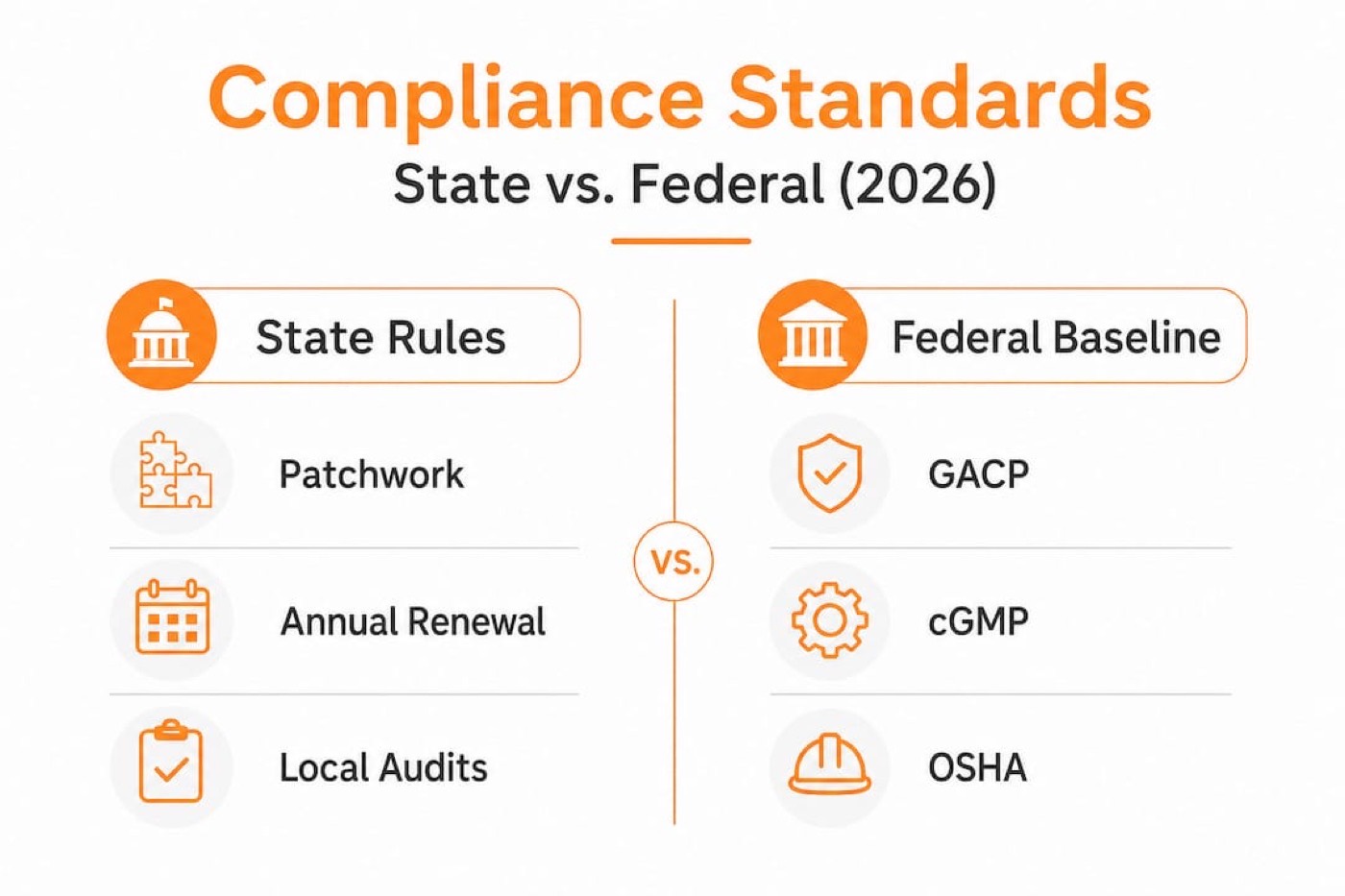
There’s also the question of audits. Internal self-assessments catch what your team knows to look for. External audits catch what your team has normalized or overlooked. The two are not interchangeable, and operators who rely exclusively on internal reviews consistently score worse on state inspections than those who bring in outside reviewers annually. Establishing a robust audit preparation workflow before an inspector arrives is one of the highest-leverage investments a cannabis business can make.
Forward-thinking compliance is also a genuine competitive advantage. When banking partners, investors, and potential acquirers evaluate cannabis businesses, compliance posture is a primary filter. A business that voluntarily exceeds minimum standards demonstrates operational maturity that commands better valuations and opens doors to capital that minimum-compliant operators simply cannot access. This is not theoretical. Multi-state operators that pursued voluntary cGMP alignment years before it was required consistently attracted institutional investment at a point when competitors were still fighting for bank accounts.
Connect your compliance strategy with expert support
For cannabis operators ready to move beyond minimum requirements, having access to the right educational resources and expert frameworks makes the difference between reactive scrambling and strategic confidence.
Cannabis Business Minds offers in-depth resources that connect foundational knowledge with the operational realities you face every day. Start with a clear understanding of what cannabis compliance actually requires at every level of your operation. From there, explore how regulatory risk applies specifically to your license type and jurisdiction. And if you’re evaluating a new market or partner, our due diligence compliance resources provide the structured framework you need to assess risk before you commit. Every resource is built for the financial and operational professionals navigating cannabis compliance in real time.
Frequently asked questions
How often should cannabis businesses conduct internal audits?
Cannabis businesses should conduct internal self-audits at least monthly, with external audits performed annually or whenever a significant regulatory change occurs in their jurisdiction.
What are the consequences of failing to meet compliance baselines?
Failing to meet compliance baseline requirements can result in fines, forced operational changes, license suspension, or permanent license revocation, depending on the severity and the jurisdiction.
How has federal rescheduling of medical cannabis impacted baseline compliance?
The Schedule III rescheduling allows state-licensed medical cannabis businesses to pursue DEA registration and align with emerging federal standards, while recreational businesses remain subject to unchanged state-by-state patchwork regulation.
What operational risks most often threaten cannabis compliance?
The most common threats include surveillance system gaps, inventory discrepancies in seed-to-sale tracking, labeling errors on finished products, and jurisdictional conflicts between state regulations and local ordinances that operators fail to reconcile.
Recommended
- What Is Cannabis Compliance: Impact on U.S. Businesses – Cannabis Business Minds
- Data privacy compliance guide for cannabis businesses – Cannabis Business Minds
- 7 Key Cannabis Accounting Trends for 2025 – Cannabis Business Minds
- Cannabis Regulatory Risk Explained: Safeguarding U.S. Dispensaries – Cannabis Business Minds
This article is general education, not tax, legal or accounting advice. Cannabis rules change quickly; confirm how they apply to you with a qualified cannabis CPA or attorney.