What Is Cannabis Business Entity? Key Choices and Impacts

2026 update: what rescheduling changed for 280E (reviewed October 2026)
Effective April 22, 2026, a DOJ/DEA final order moved marijuana covered by a qualifying state medical license (and FDA-approved marijuana drugs) to Schedule III. Section 280E only applies to Schedule I and II substances, so state-licensed medical cannabis activity is generally no longer subject to 280E going forward. Adult-use cannabis remains in Schedule I and fully subject to 280E. The DEA proceeding to reschedule all marijuana was temporarily stayed in October 2026, and Treasury/IRS guidance on transition years and mixed medical/adult-use businesses is still pending.
This article was written before the order took effect. Check where your business stands in about a minute.
Most American cannabis businesses operate in an environment where federal and state laws rarely align, creating persistent challenges from the start. Over 60 percent of states have legalized some form of cannabis, yet the federal government still classifies it as a controlled substance. For dispensary owners and finance managers, choosing the right business entity is more than a paperwork decision. Understanding the unique legal risks and tax obstacles, including Section 280E, will shape the future and safety of your American operation.
Key Takeaways
| Point | Details |
|---|---|
| Understand Legal Structures | Choosing the right cannabis business entity is crucial for liability protection, tax efficiency, and operational flexibility due to the federal-state legal conflict. |
| Monitor Tax Implications | Cannabis businesses face unique tax challenges under Section 280E, significantly affecting the ability to deduct expenses and increasing tax burdens. |
| Be Compliant | Ongoing compliance with varying state regulations is essential for maintaining operational legitimacy and avoiding penalties, necessitating a solid compliance management system. |
| Manage Risk Effectively | Developing a comprehensive compliance and risk management strategy is vital to address potential legal and financial risks within the heavily regulated cannabis industry. |
Defining a Cannabis Business Entity in the U.S.
In the complex landscape of cannabis regulation, establishing a business entity requires navigating intricate legal frameworks that differ substantially between federal and state levels. A cannabis business entity fundamentally represents a legal organizational structure designed to conduct cannabis-related operations within the specific regulatory constraints of the United States. Cannabis policy variations across jurisdictions create unique challenges for entrepreneurs seeking to formalize their business structures.
At its core, a cannabis business entity must account for the fundamental conflict between federal and state laws. While cannabis remains a Schedule I controlled substance under federal law, numerous states have legalized medical and recreational cannabis operations. This legal dichotomy means businesses must carefully select an entity type that provides legal protection, tax efficiency, and operational flexibility. The most common structures include limited liability companies (LLCs), corporations, partnerships, and cooperative models, each offering distinct advantages in liability protection, taxation, and management complexity.
The selection of a business entity directly impacts critical operational aspects such as taxation, personal asset protection, and regulatory compliance. For cannabis businesses, this choice becomes even more nuanced due to IRS restrictions like Section 280E, which significantly limits standard business expense deductions for organizations dealing with federally controlled substances. State cannabis legislation databases underscore the importance of understanding local regulations, as licensing requirements and permitted business structures can vary dramatically between jurisdictions.
Pro tip: Consult a specialized cannabis business attorney who understands both state and federal regulatory landscapes before finalizing your business entity selection to ensure maximum legal protection and operational efficiency.
Comparing Entity Types: LLCs, Corporations, Partnerships
Cannabis businesses face unique challenges when selecting an appropriate business entity, with each structure presenting distinct advantages and potential legal complexities. Business organization structures reveal critical differences that can significantly impact operational flexibility, tax liability, and legal protection for cannabis entrepreneurs.
Limited Liability Companies (LLCs) often emerge as the preferred entity for cannabis businesses due to their flexible management structures and robust personal asset protection. LLCs provide pass-through taxation, which allows business income to be taxed at the individual member level, potentially reducing overall tax burden. They offer greater protection against personal liability compared to partnerships, while maintaining simpler administrative requirements than traditional corporations. Corporations, by contrast, provide strong shareholder liability protection but involve more complex governance requirements, mandatory annual meetings, and potentially higher tax obligations.
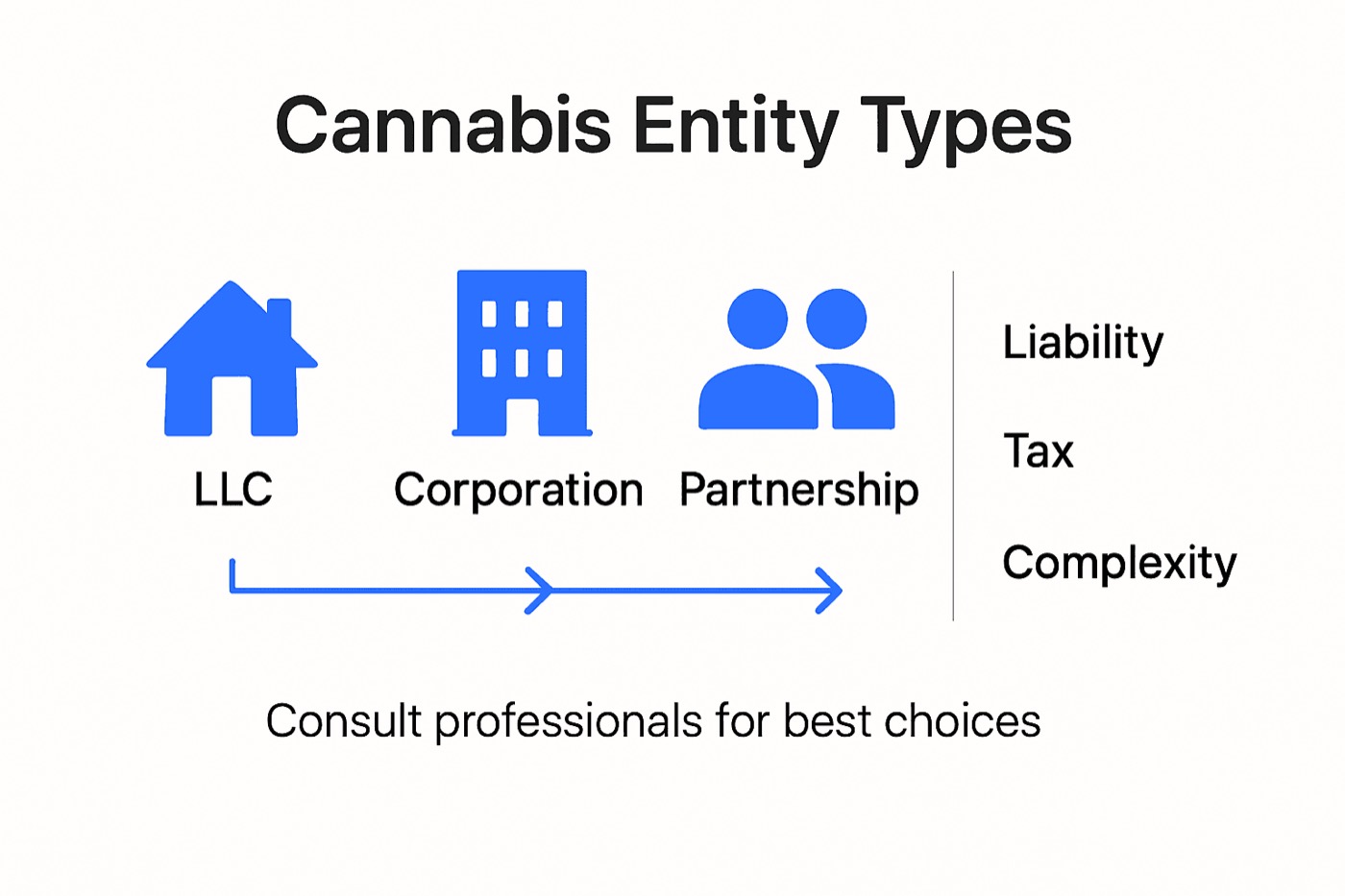
Partnerships represent another potential structure, with general partnerships offering minimal administrative overhead but exposing partners to unlimited personal liability. Limited partnerships provide a hybrid approach, allowing some partners to limit their financial risk while maintaining operational involvement. For cannabis businesses specifically, the choice of entity must carefully balance regulatory compliance, tax efficiency, and potential future investment or expansion strategies.
Here’s how common cannabis business entities differ across key factors:
| Entity Type | Liability Protection | Tax Treatment | Startup Complexity |
|---|---|---|---|
| LLC | Strong personal asset protection | Pass-through taxation | Moderate, flexible setup |
| Corporation | Extensive shareholder protection | Double taxation possible | High, strict formalities |
| Partnership | Varies by structure | Pass-through income | Low for general, higher for limited |
| Cooperative | Collective member risk sharing | Special tax provisions | Complex, less common |
Pro tip: Consult a cannabis-specialized tax professional and attorney to perform a comprehensive analysis of your specific business goals and local regulatory environment before finalizing your business entity selection.
Legal Compliance and Section 280E Impacts
Navigating the complex legal landscape of cannabis businesses requires a deep understanding of Section 280E, a critical Internal Revenue Code provision that significantly impacts financial operations. Federal tax restrictions create substantial challenges for cannabis businesses by prohibiting standard business expense deductions for organizations dealing with Schedule I controlled substances, effectively increasing their effective tax rates dramatically.
The origins of Section 280E trace back to efforts preventing drug trafficking organizations from claiming business expense deductions. For cannabis businesses, this means they cannot deduct typical expenses like rent, utilities, marketing, and employee salaries that would normally be permitted for other industries. Taxable income calculations become substantially more complex, with businesses required to only deduct direct cost of goods sold, dramatically reducing potential tax write-offs. Detailed analysis of Section 280E reveals that this provision creates an effective tax rate that can exceed 70% for some cannabis businesses, making strategic financial planning critical.
To mitigate the harsh impacts of Section 280E, cannabis businesses must develop sophisticated accounting strategies. Some businesses utilize separate legal entities to segment plant-touching and non-plant-touching operations, allowing certain ancillary services to claim standard business deductions. Others focus on meticulously documenting cost of goods sold and exploring creative accounting methods that remain compliant with IRS regulations while maximizing available deduction opportunities.
Pro tip: Work with a cannabis-specialized tax professional who understands the nuanced accounting requirements of Section 280E to develop a comprehensive tax strategy that minimizes your effective tax burden while maintaining strict legal compliance.
Formation, Licensing, and Ongoing Responsibilities
Establishing a cannabis business involves navigating a complex web of regulatory requirements that vary dramatically across different jurisdictions. State cannabis legislation databases reveal the intricate landscape of compliance that entrepreneurs must master, with each state presenting unique operational frameworks and licensing protocols.
The cannabis business formation process typically begins with securing appropriate local and state licenses, which demand rigorous documentation, background checks, and substantial financial investments. These licenses are not universal but highly specialized, often categorized by specific operational functions like cultivation, processing, distribution, and retail sales. Each license type carries distinct requirements for initial application, including detailed business plans, comprehensive security protocols, financial disclosures, and proof of substantial capitalization. Municipal regulatory frameworks further complicate this process by introducing additional local zoning restrictions, land use requirements, and operational guidelines that can significantly impact business viability.
Ongoing responsibilities extend far beyond initial licensing, requiring continuous compliance monitoring, regular reporting, tracking of inventory through state-mandated systems, maintaining strict security protocols, and adapting to rapidly evolving regulatory landscapes. Cannabis businesses must implement robust compliance management systems that can document every aspect of their operations, from seed-to-sale tracking to comprehensive financial record-keeping. This demands significant investment in technology, staff training, and ongoing legal and regulatory expertise to maintain licensing and avoid potentially devastating penalties.
Pro tip: Develop a comprehensive compliance calendar that tracks all licensing renewal dates, required reporting periods, and regulatory update deadlines to ensure continuous operational legitimacy and minimize the risk of unintentional violations.
Risks, Liabilities, and Common Mistakes
Cannabis businesses confront a complex minefield of potential legal and financial risks that demand sophisticated risk management strategies. Cannabis business risk management requires understanding the multifaceted challenges unique to this highly regulated industry, where federal prohibition creates extraordinary operational vulnerabilities.
The primary risks stem from the fundamental legal disconnect between state-level legalization and federal prohibition. Operational risks include potential asset seizure, banking restrictions, limited access to financial services, and potential criminal prosecution. Businesses must navigate challenges such as restricted access to traditional banking, challenges in securing loans or insurance, and potential federal intervention. Liability exposure extends beyond standard business risks, with potential personal liability for business principals in scenarios involving regulatory violations, tax complications, or federal enforcement actions.
Common mistakes in cannabis business formation often involve inadequate compliance preparation, insufficient documentation, poorly structured financial systems, and incomplete understanding of both state and federal regulatory requirements. Entrepreneurs frequently underestimate the complexity of seed-to-sale tracking, fail to maintain meticulous financial records, or miscalculate tax obligations under Section 280E. These oversights can result in substantial financial penalties, license revocation, or even criminal investigations. Successful cannabis businesses invest heavily in compliance infrastructure, robust legal counsel, and sophisticated accounting systems that can withstand intense regulatory scrutiny.
Summary of major risks and preventive measures for cannabis businesses:
| Major Risk | Real-World Impact | Prevention Tactic |
|---|---|---|
| Banking restrictions | Limited access to loans & accounts | Partner with cannabis-friendly banks |
| Section 280E tax issues | High effective tax rates | Professional cannabis tax strategy |
| Regulatory noncompliance | Fines or license loss | Invest in compliance systems |
| Insufficient documentation | Legal or financial penalties | Maintain detailed records |
Pro tip: Develop a comprehensive compliance and risk management strategy that includes regular third-party audits, ongoing staff training, and maintaining a contingency fund specifically dedicated to addressing potential regulatory challenges.
Frequently Asked Questions
What is a cannabis business entity?
A cannabis business entity is a legal organizational structure established to conduct cannabis-related operations within the varying regulatory frameworks of the United States. It accounts for the conflict between federal and state laws regarding cannabis operations.
What are the common types of business entities for cannabis operations?
The most common types of business entities for cannabis operations include Limited Liability Companies (LLCs), corporations, partnerships, and cooperative models, each offering different levels of liability protection, tax treatment, and operational complexity.
How does Section 280E impact cannabis businesses?
Section 280E prohibits cannabis businesses from deducting standard business expenses, significantly increasing their effective tax rate. Businesses can only deduct the direct costs associated with the goods sold, complicating taxable income calculations.
Why is compliance important for cannabis businesses?
Compliance is critical for cannabis businesses due to the highly regulated nature of the industry. Ongoing responsibilities include securing necessary licenses, adhering to financial reporting requirements, and maintaining proper documentation to avoid fines or loss of licenses.
Recommended
- 7 Types of Cannabis Entities Every Accountant Should Know – Cannabis Business Minds
- Cannabis Entity Tax Status: Key U.S. Compliance Factors – Cannabis Business Minds
- Tax Exposure Cannabis – Impact on US Businesses – Cannabis Business Minds
- Why Cannabis Taxes Are High for U.S. Businesses – Cannabis Business Minds
- Complete Guide to Coaching Meaning in Business – Tariq Juneja
This article is general education, not tax, legal or accounting advice. Cannabis rules change quickly; confirm how they apply to you with a qualified cannabis CPA or attorney.