Master cannabis inventory control: a compliance guide
2026 update: what rescheduling changed for 280E (reviewed October 2026)
Effective April 22, 2026, a DOJ/DEA final order moved marijuana covered by a qualifying state medical license (and FDA-approved marijuana drugs) to Schedule III. Section 280E only applies to Schedule I and II substances, so state-licensed medical cannabis activity is generally no longer subject to 280E going forward. Adult-use cannabis remains in Schedule I and fully subject to 280E. The DEA proceeding to reschedule all marijuana was temporarily stayed in October 2026, and Treasury/IRS guidance on transition years and mixed medical/adult-use businesses is still pending.
Check where your business stands in about a minute.
One audit notice can unravel months of careful work. Dispensary managers across the U.S. know that an unresolved discrepancy between physical stock and system records is not just a bookkeeping headache, it is a potential license-ending event. State regulators do not grade on a curve, and the consequences of poor inventory control range from steep fines to criminal referrals. This guide walks you through exactly how to build and execute a compliant, efficient inventory control process, from intake to audit, so your operation stays protected and scalable.
Table of Contents
- Understanding the cannabis inventory control landscape
- Preparation: Tools, records, and systems needed for compliance
- Execution: Step-by-step process for compliant cannabis inventory control
- Verification: Reconciling, auditing, and troubleshooting inventory discrepancies
- Why most dispensaries underestimate inventory control (and how to get ahead)
- Streamline your inventory control with expert resources
- Frequently asked questions
Key Takeaways
| Point | Details |
|---|---|
| Real-time integration required | POS systems must integrate with state tracking like METRC or BioTrack for compliance. |
| Manual tracking is risky | Manual or spreadsheet inventory control cannot meet audit standards and can lead to violations. |
| Frequent reconciliation crucial | Daily reconciliation between physical inventory and digital records prevents compliance issues. |
| Proper documentation essential | Keep thorough, organized records for all transactions and adjustments to survive audits. |
| Scalable processes pay off | Building robust systems now saves time, money, and audit risk as your operation grows. |
Understanding the cannabis inventory control landscape
Cannabis is one of the most heavily tracked consumer goods in the United States. Unlike most retail products, every unit of cannabis that enters or exits your dispensary must be recorded in a state-mandated tracking system before anything else happens. This is the foundation of seed-to-sale compliance.
Most U.S. states rely on either METRC (Metrc LLC’s Marijuana Enforcement Tracking Reporting Compliance system, used in 20+ states) or BioTrack, requiring real-time POS integration for every transaction, transfer, and adjustment. These platforms act as the government’s eyes inside your operation. Think of them less as software tools and more as live regulatory filings. Every sale, every transfer, every waste event creates a record that state inspectors can pull at any time.
The risk with manual processes is not just inefficiency. Manual processes fail compliance entirely, because METRC and BioTrack function as authoritative ledgers, meaning any discrepancy between your records and theirs becomes your liability. A POS system with a direct API (application programming interface) connection to your state system is the only defensible setup. You can learn more through this effective cannabis inventory guide and the broader cannabis inventory tracking overview to see how compliance expectations are structured across different states.
“Your state tracking system is not a reporting tool you update periodically. It is the official record of your inventory, updated in real time. Any gap between your physical stock and that record is, in the eyes of regulators, a violation.”
Here is a quick look at how the two primary systems compare:
| Feature | METRC | BioTrack |
|---|---|---|
| States using it | 20+ states | Several states, incl. WA and NM |
| Tag-based tracking | Yes, RFID tags required | Yes, barcode-based |
| Real-time POS API | Required | Required |
| Transfer manifests | Mandatory | Mandatory |
| Inspection access | State regulators direct access | State regulators direct access |
Key compliance risks to keep in mind:
- Unlogged transfers between facilities
- POS transactions not pushed to the state system in real time
- Physical counts that differ from electronic records by any amount
- Adjustments made without documented approval
- Waste events not logged with required witness signatures
Pro Tip: Schedule a monthly review with your POS vendor to confirm that API sync logs show zero failed pushes. A failed sync that goes unnoticed for two weeks is far harder to explain to a regulator than one caught the same day.
Preparation: Tools, records, and systems needed for compliance
Before your team handles a single package, your infrastructure must be in place. This is not just about software subscriptions. It is about building a system where every action is traceable, every record is retrievable, and every user is accountable.

Seed-to-sale tracking requires active METRC or BioTrack access, a POS system with a verified API integration, barcode or RFID scanners at every intake and sale point, and a secure internet connection with a backup. These are non-negotiable. A scanner that fails at intake forces manual entry, which opens the door to errors that compound over time.
For records, your cannabis recordkeeping requirements extend well beyond what the POS captures. You need:
- Purchase orders and vendor invoices for every delivery received
- Transfer manifests from licensed distributors, matched to your intake records
- Adjustment logs with timestamps, reasons, and approving manager signatures
- Waste and destruction records with required witness documentation
- User access logs showing who touched the system and when
Review the dispensary records checklist to make sure your filing system covers every document category regulators expect.
Here is a comparison of setup approaches to consider:
| Approach | Compliance strength | Cost | Audit readiness |
|---|---|---|---|
| Fully integrated POS + METRC/BioTrack | High | Medium to high | Excellent |
| Semi-automated with manual sync | Medium | Low to medium | Poor to fair |
| Spreadsheet-only | Non-compliant | Low | Unacceptable |
User permissions deserve special attention. Every staff member who touches inventory should have a unique login, with access limited to only the functions their role requires. A budtender does not need adjustment authorization. A manager reviewing audit logs should not also be the person who approves their own adjustments. Segregation of duties is an accounting principle that applies equally well here. It reduces both error and fraud risk, and it shows regulators that your system has built-in checks.
Pro Tip: Export your user access log from your POS at the end of every week and save it to a folder with the date. If a discrepancy ever appears, you will know exactly who was logged in and what actions were taken at the time.
Execution: Step-by-step process for compliant cannabis inventory control
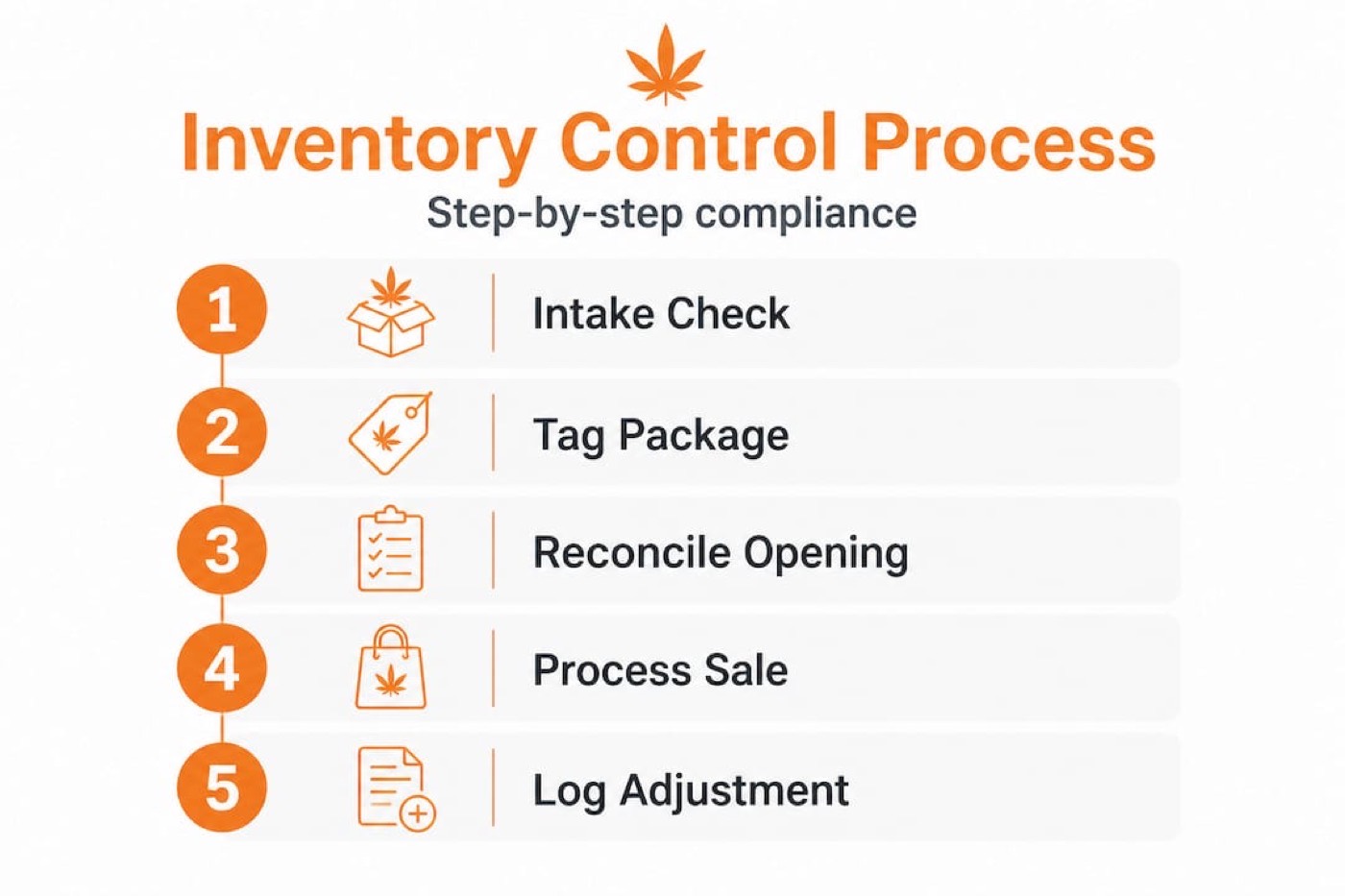
With your systems ready and your records infrastructure in place, here is how to execute compliant inventory control across the full product lifecycle.
Step 1: Intake and delivery verification
When a transfer arrives, do not sign anything until you have physically verified every package against the transfer manifest. Count units, check packaging seals, and confirm that every tag number on the physical product matches what the manifest shows. Log the receipt in your state tracking system before the driver leaves. Any discrepancy must be documented and reported immediately, not corrected quietly.
Step 2: Tag and shelf assignment
Each package should be tagged, assigned a location in your storage system, and entered into your POS inventory with the correct product category, weight, and price. The seed-to-sale requirement covers this moment explicitly. The tag number in the state system must match the tag on the physical package on the shelf.
Step 3: Daily opening reconciliation
Before your first sale, a designated staff member should compare the opening physical count to the system’s expected on-hand quantity. This catches any overnight discrepancies before they become end-of-day problems. Log the reconciliation result in your audit file.
Step 4: Real-time sale processing
Every sale must be processed through your POS, which should push the transaction to METRC or BioTrack in real time. The POS API integration is what makes this automatic. If your POS is showing a sale but the state system is not updating, you have a technical failure that requires immediate attention, not a workaround.
Step 5: Adjustment logging
If a product is damaged, mislabeled, or needs a weight correction, document the reason, get manager approval, log the adjustment in both the POS and the state system, and retain the supporting documentation. Never adjust inventory without a paper trail. Check your approach against reconciling cannabis inventory best practices to ensure your process is defensible.
Step 6: Waste and destruction
Any product designated for destruction must follow your state’s specific protocol. Most states require a dual-witness process, a destruction log, and a notification submitted to the state tracking system before and after the event. Skipping any step here is a direct compliance violation.
Step 7: End-of-day close reconciliation
Compare your physical count to your system’s closing quantity. Any variance must be explained, documented, and submitted through the proper channel. Use your cannabis audit trail documentation to support every reconciliation entry.
“The dispensaries that survive audits are not the ones that never make mistakes. They are the ones that documented every mistake and corrected it through the proper process.”
Common execution mistakes to avoid:
- Allowing staff to adjust inventory without manager sign-off
- Batching end-of-day sync instead of real-time pushes
- Failing to update the state system when a product is moved between storage areas
- Using verbal approval for adjustments instead of written documentation
Pro Tip: Create a simple laminated intake checklist and post it at your receiving area. Staff turnover is high in cannabis retail, and a physical checklist prevents even a new employee from skipping a critical step on a busy delivery day.
Verification: Reconciling, auditing, and troubleshooting inventory discrepancies
Execution gets you through the day. Verification keeps you compliant over time. The gap between the two is where most dispensaries run into trouble.
The authoritative ledger nature of METRC and BioTrack means that what is in those systems is what regulators consider true. Your job in verification is to make sure your physical reality matches that record every single day, not just before an announced inspection.
Audit methods compared:
| Method | Accuracy | Time required | Best for |
|---|---|---|---|
| Full physical count | Very high | High | Monthly or post-incident |
| Spot check (random SKUs) | Medium | Low | Daily or weekly |
| Integrated reporting | High (with good data) | Very low | Ongoing monitoring |
| Third-party audit | Very high | High | Annual compliance review |
Best practice reconciliation frequency:
- Daily: Closing count versus system close-of-day quantity for all active SKUs
- Weekly: Full count of high-value or high-movement products
- Monthly: Complete physical inventory against state system totals
- Quarterly: Internal audit with documented sign-off from management
Troubleshooting common discrepancies:
- Double entry: If a product was received and scanned twice, you will show more units in the system than physically exist. Pull your intake logs and match tag numbers.
- Mislabeling: A product filed under the wrong SKU will cause one category to show excess and another to show a shortage. Cross-reference tag numbers with product descriptions.
- Missed transfers: If a product was moved between locations without a logged transfer, both locations’ counts will be off. Always create a transfer record before physical movement.
When you find a discrepancy, the response process matters as much as the correction. Document what you found, when you found it, who discovered it, what the likely cause was, and what corrective action was taken. Some states require formal reporting of discrepancies above a certain threshold. Check your state’s specific rules. The dispensary compliance tips resource covers how to handle these situations without escalating them into violations.
Pro Tip: Build a simple discrepancy log in a shared spreadsheet or within your POS, separate from the state system entries. Tracking patterns over time, like discrepancies that always appear on Friday evenings, helps you identify process breakdowns before a regulator does. You can also use this log to streamline dispensary bookkeeping and reduce reconciliation time each month.
Why most dispensaries underestimate inventory control (and how to get ahead)
Here is the part most compliance guides skip. The real risk is not that dispensary managers do not care about inventory control. It is that too many treat it as a box-checking exercise rather than a core business system.
Regulators have gotten much more sophisticated. They are not just looking for missing grams. They are looking for patterns. A dispensary that shows a small, consistent variance on a specific product category every month is a flag for diversion even if each individual variance seems minor. The cumulative story your records tell matters more than any single count.
The dispensaries we see struggle most with audits share one trait. They built their inventory process around what seemed like the minimum viable compliance setup and never revisited it as they scaled. A two-register operation can survive a somewhat loose process. A ten-register multi-location dispensary with the same process will fail, not because they got careless, but because the complexity outgrew the system.
The smarter approach is to build for the operation you want to be, not the one you are today. That means investing in POS systems with strong API reliability records, training staff on the why behind every procedure, and treating your cannabis bookkeeping best practices as a connected system rather than a separate accounting concern.
Inventory control and financial reporting are not separate functions in cannabis. The cost of goods sold (COGS) on your financials flows directly from your inventory records. If your inventory is messy, your tax filing will be messy too, and under Section 280E of the Internal Revenue Code, that is a problem with compounding financial consequences.
Build the process once, build it right, and review it every quarter. That discipline is what separates dispensaries that scale from those that stall.
Streamline your inventory control with expert resources
Ready to take the next step in systematizing your dispensary’s compliance and efficiency?

Cannabis Business Minds is built specifically for dispensary managers and finance professionals who need more than general advice. The platform covers the full compliance picture, from understanding what cannabis compliance actually requires at the operational level to building financial systems that hold up under scrutiny. Whether you are reviewing your current process or building one from scratch, the cannabis budgeting resources and the detailed cost accounting for cannabis guide give you the frameworks to connect inventory management directly to your financial reporting. Strong inventory control is where compliance and profitability meet, and the right resources make both achievable.
Frequently asked questions
What software do I need for cannabis inventory control compliance?
You need a POS system that is fully integrated with METRC or BioTrack through a verified API connection, depending on your state’s mandated seed-to-sale platform. No other software configuration meets compliance standards.
How often should I reconcile my inventory in a dispensary?
Best practice is daily reconciliation at minimum, comparing your physical close count to the system’s on-hand quantity, with full physical counts performed at least monthly to catch cumulative errors early.
What happens if my inventory doesn’t match the system records?
You must document the discrepancy immediately, investigate the root cause, correct the record through the proper adjustment process, and report it to your state regulator as required, since METRC and BioTrack are the official records and unexplained variances can trigger enforcement action.
Can I use spreadsheets for cannabis inventory control?
No. Manual spreadsheets are not compliant because they cannot sync in real time with state tracking systems, making every transaction recorded only in a spreadsheet an unverifiable and legally unacceptable entry.
What records should I keep for a cannabis inventory audit?
Keep transaction logs, vendor invoices, transfer manifests, adjustment justifications with approvals, waste and destruction records, and user access logs, all organized by date and retained for the period your state requires, typically three to five years.
Recommended
- 7 Essential Cannabis Dispensary Compliance Tips for Success – Cannabis Business Minds
- Data privacy compliance guide for cannabis businesses – Cannabis Business Minds
- Cannabis Audit Trail Explained: Compliance Essentials – Cannabis Business Minds
- Effective Cannabis Inventory: Complete Guide for U.S. Operators – Cannabis Business Minds
This article is general education, not tax, legal or accounting advice. Cannabis rules change quickly; confirm how they apply to you with a qualified cannabis CPA or attorney.