Cannabis Depreciation Process Explained for Finance Pros

2026 update: what rescheduling changed for 280E (reviewed October 2026)
Effective April 22, 2026, a DOJ/DEA final order moved marijuana covered by a qualifying state medical license (and FDA-approved marijuana drugs) to Schedule III. Section 280E only applies to Schedule I and II substances, so state-licensed medical cannabis activity is generally no longer subject to 280E going forward. Adult-use cannabis remains in Schedule I and fully subject to 280E. The DEA proceeding to reschedule all marijuana was temporarily stayed in October 2026, and Treasury/IRS guidance on transition years and mixed medical/adult-use businesses is still pending.
Check where your business stands in about a minute.
The cannabis depreciation process requires capitalizing asset costs into inventory under IRC Section 471 rather than expensing depreciation as a period cost. That distinction is not semantic. Section 280E bars cannabis businesses from deducting most ordinary business expenses, so the only path to reducing federal taxable income runs through cost of goods sold. Depreciation capitalized into inventory becomes part of COGS. Depreciation left on the P&L as overhead does not. Firms like GreenGrowth CPAs and Northstar Financial Advisory have built entire compliance practices around this single structural difference, and the IRS has audited cannabis operators specifically because they get it wrong.
How does IRC Section 471 govern the cannabis depreciation process?
Section 471 is the statutory foundation for cannabis inventory costing, and it pulls depreciation into a different accounting treatment than any other industry. Under Section 471, indirect production costs, including equipment depreciation, facility rent, and utilities, must be capitalized into inventory rather than expensed in the period incurred. This is the regulatory mechanism that makes depreciation capitalization into COGS both legal and necessary for cannabis operators.

The practical effect is significant. When depreciation flows into inventory, it reduces taxable income only when inventory is sold. This timing difference matters for tax planning and for financial statement accuracy. A cannabis cultivator with $200,000 in annual equipment depreciation that properly capitalizes that cost into inventory will see a materially lower tax liability than one that parks the same depreciation in operating expenses where 280E renders it nondeductible.
The cost categories that qualify for capitalization under Section 471 include:
- Equipment depreciation directly tied to production operations
- Facility rent and occupancy costs for production spaces
- Utilities consumed in growing, processing, or manufacturing
- Labor costs for production employees
- Indirect costs with a documented production nexus
The allocation method matters as much as the category. Production space allocation by square footage is the most defensible approach. If 80% of a facility is production canopy, 80% of facility costs, including depreciation on building improvements, allocate to COGS. That ratio must be documented, not assumed.
Pro Tip: Build your Section 471 cost study before filing, not after an audit notice. The study documents your allocation methodology, floor plans, and depreciation schedules in a format the IRS can review without ambiguity.
When does depreciation start for cannabis assets?
Depreciation begins when an asset is placed in service and operational, not when it is purchased or delivered. Depreciation timing starts at operational placement, a rule that catches cannabis operators off guard when they are building out facilities. An HVAC system purchased in November but not operational until February starts depreciation in February, not November. That one-quarter difference can shift a deduction into the next tax year entirely.
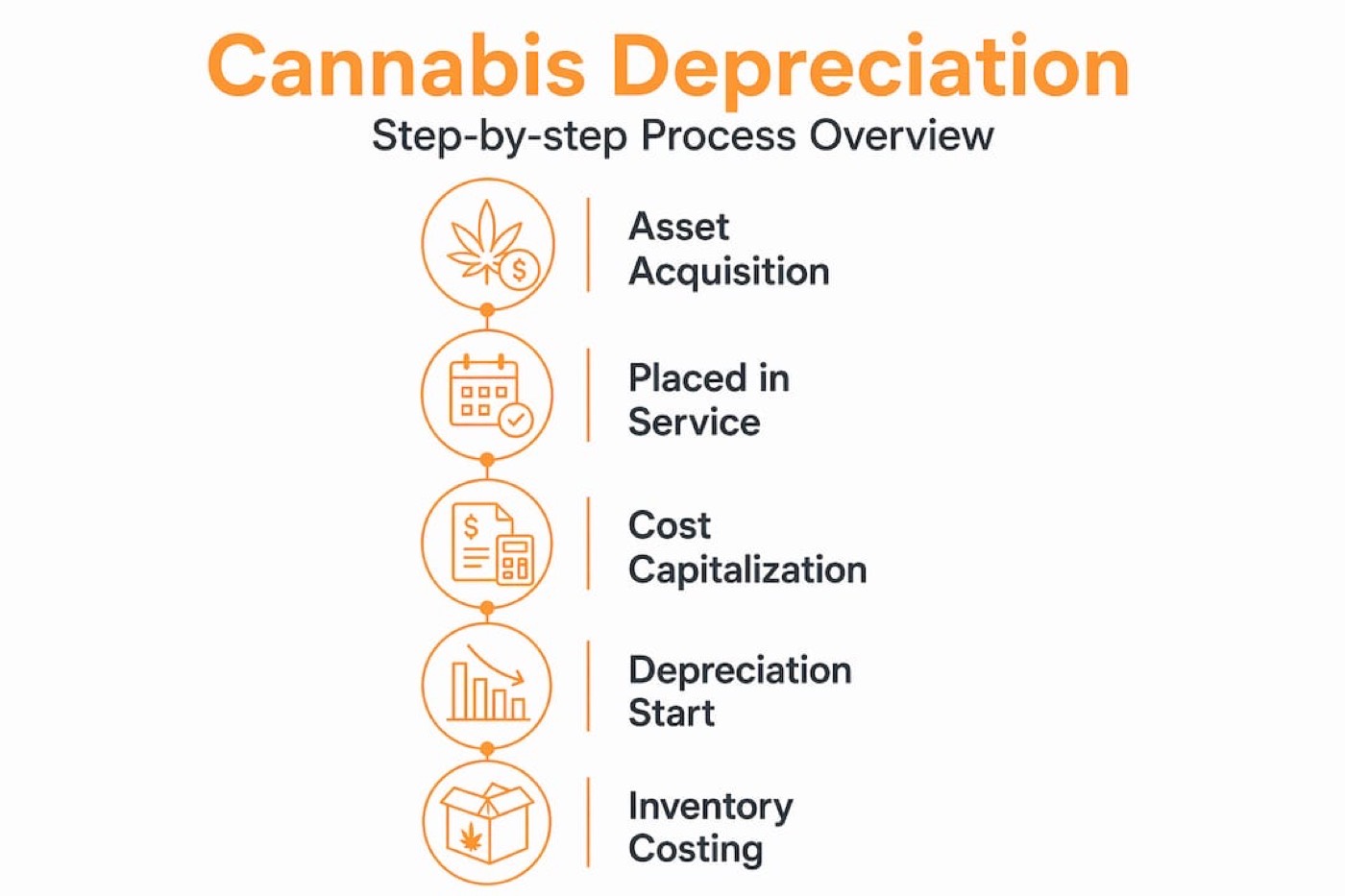
Assets under construction sit in a construction-in-progress account and generate no depreciation until they transition to placed-in-service status. This is where fixed asset timing controls tax year benefit and where sloppy accounting creates both overstated and understated deductions. Overstating depreciation by starting it too early invites IRS scrutiny. Understating it by leaving assets in CIP too long costs you a legitimate deduction.
For shared assets, the rules get more specific:
- Identify every asset used in both production and administrative functions, including HVAC, security systems, and vehicles.
- Document actual usage by function using time logs, activity records, or metered data.
- Calculate the production percentage based on documented usage, not a blanket assumption.
- Apply that percentage to the asset’s annual depreciation to determine the COGS-allocable portion.
- Retain all supporting documentation in a format that survives a five-year audit lookback.
The audit risk from 100% allocable assumptions on shared assets is real. An IRS examiner will ask for the usage log. If it does not exist, the allocation fails and the deduction gets reclassified as a nondeductible 280E expense.
Pro Tip: Tag each fixed asset at acquisition with its production, administrative, or shared designation. Changing that classification after the fact looks like a post-hoc adjustment and weakens your audit position.
What is cost segregation and how does it accelerate cannabis depreciation?
Cost segregation is an engineering-based tax strategy that reclassifies building components from the standard 39-year straight-line recovery period to shorter MACRS categories of 5, 7, or 15 years. For cannabis operators with capital-intensive build-outs, cost segregation accelerates depreciation recovery by front-loading deductions into earlier tax years, which improves cash flow and reduces near-term tax liability.
The process requires an engineering study that reviews blueprints, construction records, and property documentation to identify components eligible for reclassification. Common qualifying components in cannabis facilities include:
- HVAC systems and specialized ventilation
- Electrical systems serving production equipment
- Lighting fixtures in grow rooms
- Security and surveillance systems
- Plumbing tied to production processes
- Specialty flooring and wall finishes in processing areas
The comparison between standard and accelerated recovery is stark:
| Asset Component | Standard Recovery | Cost Segregation Recovery |
|---|---|---|
| Building shell | 39 years | 39 years |
| HVAC (production) | 39 years | 7 years |
| Electrical (production) | 39 years | 5 years |
| Security systems | 39 years | 5 years |
| Land improvements | 15 years | 15 years |
| Specialty fixtures | 39 years | 5 or 7 years |
Cost segregation leverages engineering expertise to generate real tax savings, but the IRS scrutinizes these studies in cannabis audits. The engineering report must be defensible on its own merits. Weak documentation or unsupported classifications will not survive examination. The cost of a credible study from a qualified firm runs between $5,000 and $15,000 for a mid-size facility, and the tax savings typically justify that investment in the first year.
How to document depreciation for 280E compliance and maximize COGS deductions
Documentation is where cannabis depreciation compliance either holds or collapses. A Section 471 cost study formalizes the entire allocation methodology, including floor plans, utility analysis, time and activity studies, depreciation schedules, and written allocation methods. Without it, your depreciation allocations are assertions, not evidence.
The documentation framework that survives IRS scrutiny follows this structure:
- Maintain a fixed asset subledger that links each asset to its production, administrative, or shared designation and maps depreciation to the correct cost pool.
- Use utility sub-metering to document actual energy consumption by production versus non-production areas. Estimated splits do not hold up.
- Keep time-and-activity logs for any equipment or labor with shared use. Weekly logs are sufficient; monthly summaries are not granular enough.
- Retain floor plans with measured square footage for each functional area, updated whenever the facility layout changes.
- Build a chart of accounts that separates COGS, 280E nondeductible expenses, and non-cannabis expenses into distinct categories from day one.
Without a clear paper trail, the IRS reclassifies costs from COGS to nondeductible expenses. That reclassification is not reversible after the fact without amended returns and a fight. The tax exposure from misclassified depreciation compounds over multiple years, and cannabis businesses face higher IRS audit risk than most industries, which means the probability of examination is not theoretical.
Fixed asset subledger management is the operational control that ties production equipment depreciation to inventory costing. Depreciation that sits in a general overhead account without a clear linkage to COGS will be treated as a period expense, not a product cost. That is the difference between a deductible cost and a 280E casualty.
Pro Tip: Run a quarterly reconciliation between your fixed asset subledger and your inventory costing model. Discrepancies found in Q2 are fixable. Discrepancies found during an audit are not.
What I’ve learned about cannabis depreciation that most articles miss
Most articles on understanding cannabis depreciation treat it as a calculation problem. Get the method right, apply the rate, done. That framing misses the real issue entirely.
The depreciation calculation is the easy part. Any accountant can run straight-line or MACRS on a spreadsheet. The hard part is the allocation architecture that sits underneath it. Which assets are production assets? What percentage of a shared asset is production use? When exactly did that extraction unit go into service? Those questions require operational controls, not accounting formulas.
I have seen cannabis operators with technically correct depreciation schedules lose deductions on audit because the allocation methodology was not documented before the return was filed. The IRS does not accept a retroactively constructed rationale. The documentation has to predate the position.
Cost segregation is genuinely valuable in this industry, but I am cautious about operators who pursue it without first getting their Section 471 cost study right. Accelerating depreciation into earlier years only helps if that depreciation is properly allocated to COGS. Accelerated depreciation sitting in overhead is still nondeductible under 280E.
The practical discipline here is treating depreciation as an inventory costing problem from the moment an asset is acquired. Tag it, allocate it, document it, and link it to COGS before the tax year closes. Retrofitting that work after the fact is expensive and often incomplete.
— JN
How Cannabisbusinessminds supports cannabis depreciation compliance

Cannabisbusinessminds publishes finance-focused resources built specifically for cannabis accounting professionals who need more than generic tax guidance. The cannabis inventory costing guide covers the full depreciation-to-COGS framework, including allocation methods, documentation standards, and the Section 471 cost study process. For operators building out their accounting infrastructure, the cost accounting guide addresses how to structure your chart of accounts and fixed asset subledger to support defensible COGS calculations. Both resources are written for finance professionals who already understand accounting and need cannabis-specific application, not introductory material.
FAQ
What does the cannabis depreciation process actually mean?
The cannabis depreciation process refers to capitalizing equipment and facility depreciation into inventory costs under IRC Section 471, rather than expensing it as a period cost. This treatment allows depreciation to flow through COGS and reduce taxable income, which is the primary mechanism for tax relief under Section 280E.
Can cannabis businesses deduct depreciation under Section 280E?
Cannabis businesses cannot deduct depreciation as an ordinary business expense under Section 280E. However, depreciation properly capitalized into inventory under Section 471 reduces taxable income by increasing COGS, which is the only deduction pathway available to Schedule I cannabis operators.
When does depreciation start for a cannabis facility asset?
Depreciation starts when an asset is placed in service and operational, not when it is purchased. An HVAC system installed but not running until the following quarter begins depreciation in the quarter it becomes operational, per IRS rules applied by firms including GreenGrowth CPAs.
What is a Section 471 cost study and why does it matter?
A Section 471 cost study is a formal documentation package that records your allocation methodology, floor plans, utility analysis, depreciation schedules, and written rationale for how indirect costs are assigned to inventory. The IRS requires this level of documentation to substantiate COGS deductions during an audit.
How does cost segregation help cannabis businesses with depreciation?
Cost segregation reclassifies building components from a 39-year recovery period to shorter MACRS categories of 5, 7, or 15 years, accelerating depreciation deductions into earlier tax years. The strategy requires an engineering study and is most effective when the accelerated depreciation is properly allocated to COGS under Section 471.
Recommended
- Cannabis Inventory Costing: What Finance Pros Must Know – Cannabis Business Minds
- Cannabis Tax Basis: What Every Finance Pro Must Know – Cannabis Business Minds
- Explaining non-deductible cannabis expenses: A U.S. guide – Cannabis Business Minds
- 7 Key Eligible Business Expenses for Cannabis Companies – Cannabis Business Minds
This article is general education, not tax, legal or accounting advice. Cannabis rules change quickly; confirm how they apply to you with a qualified cannabis CPA or attorney.