Data privacy compliance guide for cannabis businesses
Most cannabis business owners assume that because they’re not a hospital or pharmacy, data privacy laws don’t really apply to them. That assumption is expensive. Most dispensaries are not “covered entities” under HIPAA (Health Insurance Portability and Accountability Act), meaning the federal health data law most people think of first simply doesn’t govern your retail transactions. But that doesn’t mean your customer and patient data is sitting in a regulatory vacuum. State breach notification laws, licensing requirements, and vendor liability create a web of obligations that every cannabis operator needs to understand before a breach forces the issue.
Table of Contents
- Understanding data privacy compliance in cannabis
- Key requirements for cannabis data privacy
- Typical risks, edge cases, and what most miss
- Practical steps to build a compliant culture
- The uncomfortable truth about cannabis data privacy: Culture beats checklists
- Get expert support for cannabis compliance
- Frequently asked questions
Key Takeaways
| Point | Details |
|---|---|
| HIPAA rarely applies | Most dispensaries must follow state laws, not federal HIPAA rules, but privacy risks are still real. |
| State breach laws matter | All U.S. states require fast breach notification, even for retail cannabis businesses. |
| Vendor risks are critical | Third-party tech partners can be the weakest link in your compliance chain. |
| Build a privacy culture | Consistent staff training and leadership buy-in are more effective than checklists alone. |
| Proactive compliance prevents fines | Embedding privacy practices now prevents lawsuits and regulatory penalties down the road. |
Understanding data privacy compliance in cannabis
Data privacy compliance, in the context of a cannabis business, means having the policies, technical safeguards, and operational procedures in place to protect any personally identifiable information you collect. That includes customer names, purchase histories, medical registry numbers, email addresses, and any other data gathered through your point-of-sale (POS) system, loyalty programs, or intake forms.
Here’s where most operators get confused. HIPAA governs “covered entities,” which are healthcare providers, health plans, and healthcare clearinghouses that transmit health information electronically. A dispensary that processes retail transactions, even one that serves medical patients, is generally not a covered entity. The cannabis compliance overview landscape is far broader than HIPAA alone, and treating HIPAA as the only relevant law is one of the most common and costly mistakes in this industry.
So what does apply? State consumer privacy laws, state breach notification statutes, and data security regulations tied to your cannabis license are the real governing frameworks for most operators. Some states with mature cannabis programs have begun layering in additional privacy requirements specific to dispensaries and cultivators.
The table below breaks down which cannabis business contexts are and aren’t typically covered by HIPAA:
| Business Type | HIPAA Coverage? | Why |
|---|---|---|
| Retail adult-use dispensary | No | Not a covered entity; no insurance billing |
| Medical dispensary (retail only) | Usually no | Retail transactions don’t trigger HIPAA |
| Cannabis clinic billing insurance | Yes | Functions as a healthcare provider |
| Telemedicine cannabis recommendation | Possibly | Depends on billing and data transmission |
| Cultivator or manufacturer | No | No patient data involved |
| Third-party POS vendor | Possibly | May qualify as a Business Associate |
The critical takeaway: your data risk doesn’t disappear just because HIPAA doesn’t apply. State laws still require you to protect customer data, notify affected individuals after a breach, and maintain reasonable security practices. Ignoring this because “we’re not a hospital” is a trap that has cost cannabis businesses significant fines and reputational damage.
“Compliance isn’t just about what law applies to you today. It’s about building systems that protect your customers regardless of which regulatory framework is watching.”
Building a compliance culture starts with acknowledging that data privacy is a real operational obligation, not a technicality reserved for healthcare companies.
Key requirements for cannabis data privacy
Once you accept that data privacy compliance is your responsibility, the next question is: what exactly do you need to do? The answer involves a combination of technical safeguards, administrative policies, and ongoing staff practices.
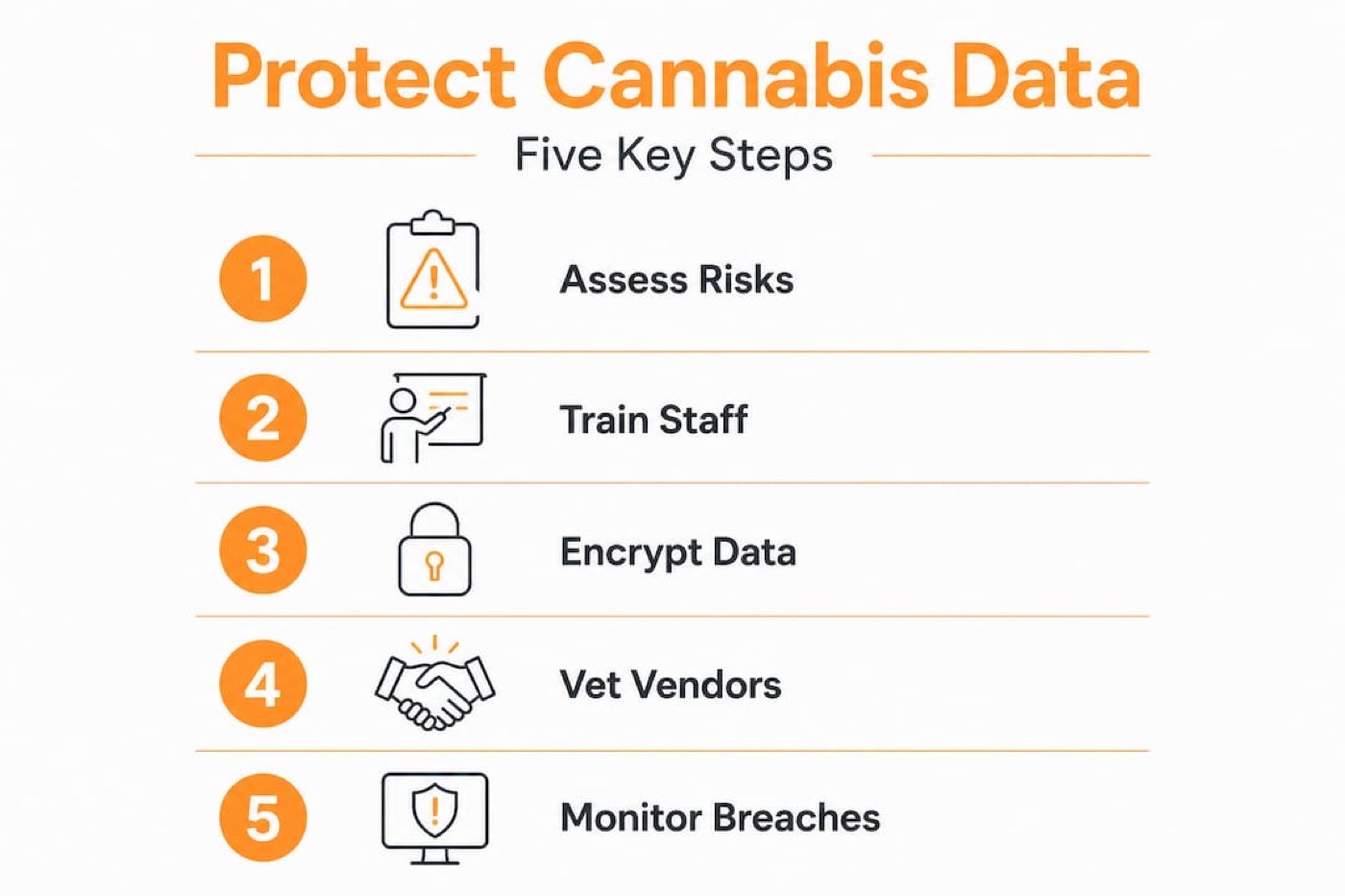
The core mechanics of a privacy program include the minimum necessary standard for handling protected health information, administrative and physical and technical safeguards, Business Associate Agreements (BAAs) with vendors, encryption, breach notification procedures, staff training, risk assessments, and clear privacy notices for customers.
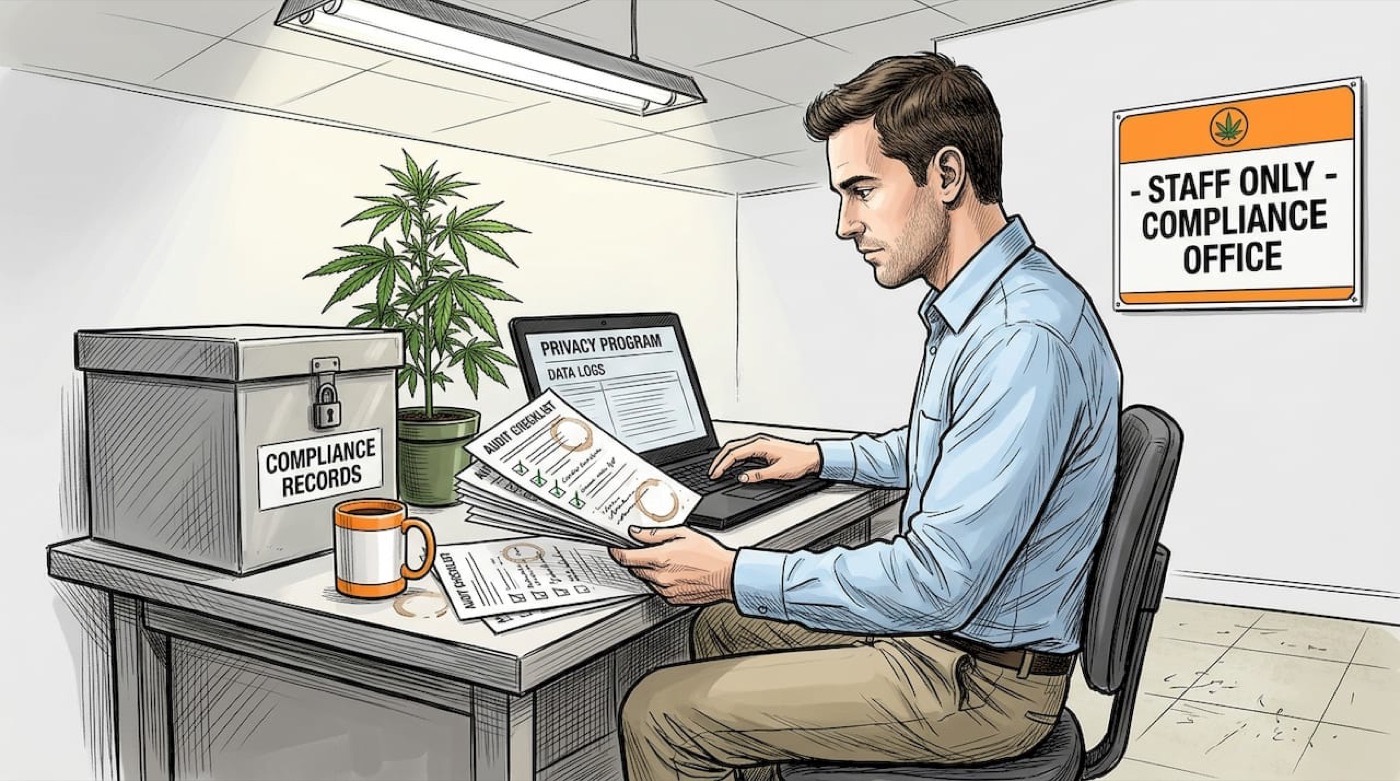
Even if HIPAA doesn’t directly apply to your dispensary, these mechanics represent industry best practice and, in many states, legal requirements under state data protection law.
Here’s a summary of core requirements and who owns them in a typical cannabis operation:
| Requirement | What It Means | Responsible Party |
|---|---|---|
| Encryption | Protect stored and transmitted customer data | IT or POS vendor |
| Breach notification | Alert customers and state within required timeframe | Compliance officer or owner |
| Privacy notices | Inform customers what data you collect and why | Management |
| Staff training | Ensure employees know how to handle sensitive data | HR and compliance |
| Vendor agreements | Require security standards from all third parties | Legal or ownership |
| Risk assessments | Identify vulnerabilities before they become breaches | Compliance or outside counsel |
Implementing a privacy program doesn’t have to be overwhelming. Here’s a practical numbered process to get started:
- Conduct a data inventory. List every type of data you collect, where it’s stored, who has access, and how long you keep it. You can’t protect what you haven’t mapped.
- Perform a risk assessment. Identify where your data is most vulnerable. This includes your POS system, loyalty program platforms, email marketing tools, and any cloud storage.
- Draft and publish privacy notices. Customers have a right to know what you’re collecting. Your notice should be plain-language, posted in-store and online, and updated whenever your practices change.
- Execute vendor agreements. Every third-party vendor that touches customer data needs a written agreement specifying their security obligations. For medical data, this is a BAA; for retail data, it’s a data processing agreement.
- Train your staff. Every employee who handles customer information, from budtenders to managers, needs to understand basic data hygiene and what to do if they suspect a breach.
- Set up breach response procedures. Know exactly what steps you’ll take if a breach occurs: who gets notified, in what order, and within what timeframe.
- Schedule regular reviews. Privacy programs go stale. Review your policies and technical controls at least annually, or whenever you add a new vendor or system.
Pro Tip: Always encrypt electronic data, even when your state doesn’t explicitly require it. Encryption dramatically reduces your liability in a breach scenario because it can render stolen data unreadable. It’s one of the cheapest forms of insurance available to cannabis operators, and it signals to regulators that you take compliance seriously.
Good cannabis recordkeeping requirements and data privacy go hand in hand. The same discipline that keeps your seed-to-sale records clean will serve you well in building a privacy program. And following dispensary compliance tips that address both operational and data security needs will put you ahead of most competitors.
Typical risks, edge cases, and what most miss
Standard compliance checklists cover the basics. But the risks that actually sink cannabis businesses tend to be the ones nobody warned them about. Here’s where things get genuinely dangerous.
Registry data versus transaction data. These are not the same thing, and the difference matters enormously. Registry data is highly protected under state medical cannabis laws, while transaction data has weaker retail-level protections. Many operators treat all their data the same way, which either means they’re over-protecting low-risk information or, more dangerously, under-protecting high-risk patient registry data. Know which category your data falls into and apply the appropriate controls.
Common traps that cannabis business owners miss:
- Tracking pixels and analytics tools. Using Facebook Pixel or Google Analytics on your dispensary website can inadvertently collect and share health-related data with advertising platforms. Several class-action lawsuits have targeted healthcare-adjacent businesses for exactly this practice.
- Loyalty program data. Purchase histories tied to individual customers create detailed profiles of consumption behavior. In a state where cannabis remains stigmatized or where federal law still classifies it as a Schedule I substance, that data is sensitive in ways that go beyond typical retail.
- Employee data. Your team’s personal information, including background check results and direct deposit details, is also subject to data privacy obligations. Many operators focus entirely on customer data and forget that employee records carry their own risks.
- Cloud storage defaults. Many POS and seed-to-sale systems store data in the cloud with default settings that may not meet your state’s security requirements. Verify the security configuration with every vendor.
- Law enforcement requests. Cannabis businesses receive data requests from law enforcement more frequently than most industries. You are generally entitled to demand a court order or valid legal process before disclosing customer data. Handing over records without proper legal authority exposes you to liability from your own customers.
Every single U.S. state has a breach notification law requiring businesses to notify affected individuals and often state authorities when a data breach occurs. This applies to cannabis operators regardless of HIPAA status. Timelines vary by state, ranging from 30 to 90 days, but the obligation is universal.
The regulatory risk in cannabis landscape is also shifting rapidly. Federal rescheduling discussions could bring new privacy frameworks into play for cannabis businesses that currently operate under state-only oversight. Operators who have built strong privacy programs now will be far better positioned to adapt than those scrambling to catch up.
Pro Tip: Vet every third-party vendor for their security protocols before signing a contract. Your liability doesn’t end at your firewall. If your POS vendor gets breached and customer data is exposed, your business faces the notification obligations and reputational fallout, not theirs. Ask vendors for their SOC 2 reports, penetration testing results, and breach history before you commit.
Practical steps to build a compliant culture
Technical controls and written policies are necessary. They’re not sufficient. The businesses that avoid costly privacy failures are the ones where every employee, from the front desk to the back office, understands that protecting customer data is part of their job.
Staff training, risk assessments, and privacy notices are the mechanics that make a privacy program real rather than theoretical. But mechanics alone don’t create culture. Culture comes from repetition, accountability, and leadership.
Here’s how to build that culture step by step:
- Start at onboarding. Every new hire should receive privacy training before they ever access a customer record. This sets the expectation from day one that data protection is a condition of employment, not an afterthought.
- Make training specific, not generic. Generic “don’t share passwords” training is forgettable. Train your budtenders on exactly what to do if a customer asks about their purchase history. Train your managers on how to handle a law enforcement data request. Specific scenarios stick.
- Run mock breach drills. Simulate a data breach scenario with your team at least once a year. Walk through who gets notified, in what order, and what documentation is required. Teams that have practiced respond faster and make fewer errors when a real breach occurs.
- Establish a clear reporting chain. Employees need to know exactly who to contact if they suspect a breach or see a colleague mishandling data. Ambiguity in the reporting chain leads to delayed responses and compounded liability.
- Review and update policies regularly. Privacy laws change. Your vendor lineup changes. Your data collection practices change. Schedule a quarterly review of your privacy program to catch gaps before they become violations.
- Tie compliance to performance. Include data privacy adherence in performance reviews. When employees know it’s evaluated, they take it seriously.
“Data privacy is everyone’s job. A breach doesn’t care which department was responsible. Your customers and your regulators certainly won’t.”
Staying current on cannabis report compliance requirements will also help you stay ahead of evolving privacy obligations, since many state reporting frameworks are beginning to incorporate data security standards directly into licensing conditions.
The uncomfortable truth about cannabis data privacy: Culture beats checklists
Here’s the perspective that most compliance guides won’t give you. The majority of data privacy failures in cannabis businesses don’t happen because operators were ignorant of the rules. They happen because operators treated compliance as a checkbox exercise rather than a business value.
A dispensary can have a beautifully formatted privacy policy, a signed vendor agreement, and an annual training log, and still suffer a catastrophic breach because a manager shared login credentials over text, or because nobody reviewed the POS vendor’s security settings after a software update. Checklists confirm that you did something once. Culture determines what happens every day when nobody is watching.
Cannabis businesses face a uniquely high-stakes version of this problem. Federal illegality means that a privacy breach doesn’t just expose you to state fines. It can attract federal attention, complicate your banking relationships, and create a public relations crisis in a market where consumer trust is already fragile. The reputational cost of a breach in cannabis can be existential in a way it simply isn’t for a mainstream retailer.
Rapid regulatory change amplifies the risk. The cannabis compliance principles that apply today may shift significantly if federal rescheduling proceeds. Businesses that have built genuine privacy cultures will adapt. Businesses that built checkbox compliance programs will find their checklists obsolete overnight.
The most practical thing you can do right now is appoint a privacy champion. Not just a compliance officer with a title, but a real person with actual authority to pause a vendor contract, halt a marketing campaign, or escalate a concern to ownership. Privacy champions who have power change behavior. Titles without authority change nothing.
Get expert support for cannabis compliance
Navigating data privacy compliance while managing the rest of your cannabis operation is genuinely complex, and the stakes are high enough that guesswork is not a strategy.
Cannabis Business Minds provides practical, industry-specific resources to help you build compliance programs that actually work. Whether you’re working through cannabis regulatory risk guidance or looking to strengthen your operational foundation with cannabis compliance resources, the platform is built specifically for cannabis finance and compliance professionals who need reliable, actionable information. If you’re building out your recordkeeping systems alongside your privacy program, the guidance on recordkeeping for cannabis compliance is a strong next step.
Frequently asked questions
Does HIPAA apply to all cannabis dispensaries?
No, HIPAA only applies if the dispensary qualifies as a covered entity, which typically means a medical operation that bills insurance. Most retail dispensaries, including most medical dispensaries, do not meet this threshold.
What data is most at risk in cannabis businesses?
Patient registry data and any personal health information carry the highest sensitivity, but transaction data is also at significant risk through third-party vendor breaches and inadequate POS security.
What should I do if there’s a data breach at my cannabis business?
Notify affected individuals and the relevant state authorities immediately. All 50 states require breach notification, with timelines that typically range from 30 to 90 days depending on the state.
Are vendor software providers a compliance risk for cannabis data?
Yes, significantly. Third-party vendor breaches involving POS systems and seed-to-sale platforms are a major source of data exposure. Require written security agreements and vet vendors thoroughly before granting them access to customer data.
How often should staff be trained on data privacy compliance?
Training should begin at onboarding and continue with annual refreshers at minimum. High-risk roles that handle patient registry data or manage vendor relationships should receive more frequent, role-specific training.
Recommended
- 7 Essential Cannabis Dispensary Compliance Tips for Success – Cannabis Business Minds
- What Is Cannabis Compliance: Impact on U.S. Businesses – Cannabis Business Minds
- Cannabis Regulatory Risk Explained: Safeguarding U.S. Dispensaries – Cannabis Business Minds
- Master the Cannabis Banking Workflow for Compliance Success – Cannabis Business Minds
This article is general education, not tax, legal or accounting advice. Cannabis rules change quickly; confirm how they apply to you with a qualified cannabis CPA or attorney.