Capital Expenditure in Cannabis: What Finance Pros Must Know
2026 update: what rescheduling changed for 280E (reviewed October 2026)
Effective April 22, 2026, a DOJ/DEA final order moved marijuana covered by a qualifying state medical license (and FDA-approved marijuana drugs) to Schedule III. Section 280E only applies to Schedule I and II substances, so state-licensed medical cannabis activity is generally no longer subject to 280E going forward. Adult-use cannabis remains in Schedule I and fully subject to 280E. The DEA proceeding to reschedule all marijuana was temporarily stayed in October 2026, and Treasury/IRS guidance on transition years and mixed medical/adult-use businesses is still pending.
Check where your business stands in about a minute.
Capital expenditure in cannabis is defined as a long-lived asset investment that gets capitalized on the balance sheet rather than expensed in the period it occurs. These are the purchases that support operations for years: facility build-outs, cultivation equipment, extraction labs, and retail fixtures. Understanding what is capital expenditure cannabis means recognizing that these decisions affect your depreciation schedule, your tax basis under IRC 280E, and your cash flow for the life of the asset. Get the classification wrong and you create audit exposure that compounds every filing cycle.
What is capital expenditure in cannabis operations?
Capital expenditures in cannabis are large, one-time investments in long-lived assets that support operations for years, including lighting systems, HVACD infrastructure, irrigation networks, and extraction equipment. The accounting treatment is straightforward in theory: you capitalize the cost, place it on the balance sheet, and depreciate it over its useful life. The cannabis-specific complexity starts when you layer IRC 280E on top of that treatment.

The distinction between a capital expense and an operating expense matters more in cannabis than in almost any other industry. Cannabis operational costs that are expensed immediately reduce taxable income in the current period. Capital expenses cannabis businesses incur get spread across depreciation schedules, which means the tax benefit arrives slowly. Under 280E, many operating expenses are not deductible at all, which makes the capitalization decision a tax strategy question, not just an accounting one.
The core categories of cannabis capital investment are physical assets with multi-year useful lives. These include the building shell and tenant improvements, mechanical systems, cultivation technology, processing infrastructure, and point-of-sale or security systems. Soft costs such as architectural fees, licensing application costs, and consulting fees tied directly to placing an asset in service can also qualify as capitalizable costs under Treasury guidance.
Pro Tip: Track every soft cost tied to a specific asset from day one. Architectural fees, engineering assessments, and permit costs that are directly attributable to a capital project belong on the asset’s cost basis, not in general and administrative expenses.
What are the primary capital expenditure categories in cannabis?
Cannabis capital costs break down across three operational segments: cultivation, processing, and retail. Each segment carries distinct asset types and cost profiles.
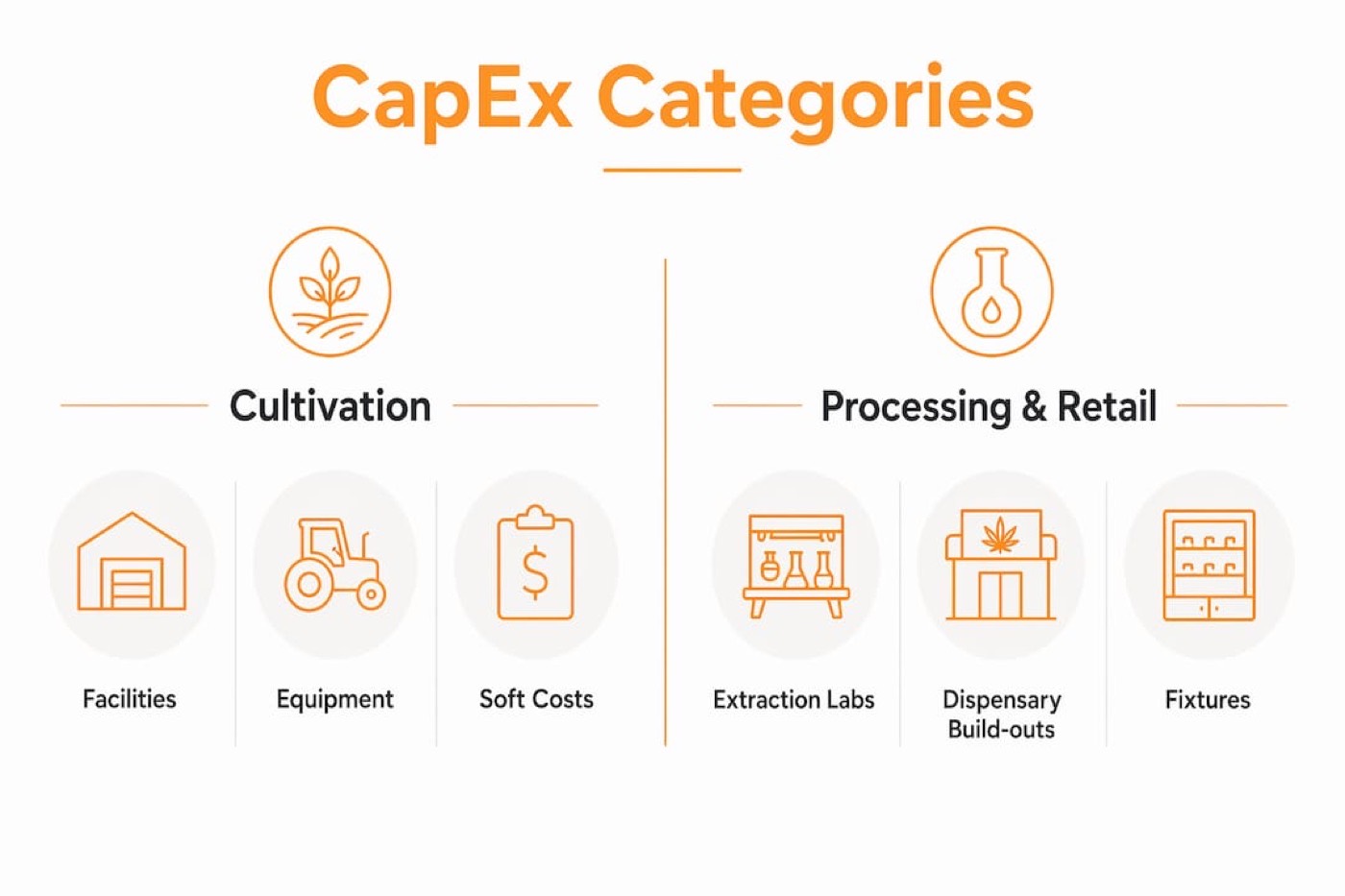
Cultivation facility assets
Indoor cultivation build-outs run $250–$450 per square foot for full facility construction. That range reflects structural work, HVACD systems, electrical capacity upgrades, lighting arrays, benching systems, and irrigation infrastructure. The spread is wide because facility condition, local labor costs, and canopy density targets all shift the number significantly.
Key cultivation CapEx line items include:
- HVACD systems: The single largest mechanical cost in most indoor grows, covering dehumidification, CO2 management, and temperature control
- Lighting: LED systems have largely replaced HPS in new builds, with full-facility LED arrays representing a substantial upfront capital outlay
- Irrigation and fertigation: Automated systems with sensors and dosing equipment qualify as depreciable equipment
- Benching and racking: Fixed benching systems are capitalized; mobile systems may qualify for accelerated depreciation under Section 179
Processing and extraction assets
A mid-size California manufacturing facility requires $500,000–$1.5 million in startup capital, with extraction lab build-outs alone running $200,000–$600,000 and equipment costs of $100,000–$300,000. These numbers reflect CO2 or hydrocarbon extraction systems, post-processing equipment, packaging lines, and environmental controls required by state regulations.
Retail and dispensary assets
Dispensary build-outs range from $300,000 to $1.5 million or more depending on square footage, market, and design requirements. Capital expenses here include security systems, display fixtures, point-of-sale infrastructure, vault construction, and ADA-compliant modifications.
| Asset category | Typical CapEx range | Depreciation class |
|---|---|---|
| Indoor cultivation build-out | $250–$450/sq ft | 15–39 year (leasehold/structural) |
| Extraction lab build-out | $200,000–$600,000 | 15–39 year |
| Extraction equipment | $100,000–$300,000 | 5–7 year |
| Dispensary build-out | $300,000–$1.5M+ | 15–39 year |
| Lighting and HVACD | Varies by sq ft | 5–15 year |
How does capital expenditure affect cannabis tax treatment under IRC 280E?
IRC 280E is the defining constraint on cannabis tax strategy. It prohibits deductions for ordinary business expenses because cannabis remains a Schedule I controlled substance under federal law. The only costs that reduce federal taxable income are those included in cost of goods sold (COGS). That single rule reshapes every capital investment decision a cannabis operator makes.
Capitalizing build-out costs tied directly to production defers tax liability and matches costs with revenue through depreciation. For cultivators, this is the more tax-advantaged path. Operational equipment that can be expensed immediately may reduce short-term taxable income more aggressively, but only when it qualifies as a COGS component. The line between what belongs in COGS and what does not is where most 280E audit disputes originate.
Capitalizing build-outs aligned with COGS is more tax-advantageous for cultivators. Operational equipment may be better expensed to reduce short-term taxable income. The decision depends on whether the asset is directly tied to production or to a non-production function that 280E disallows entirely.
Depreciation schedules add another layer. Tenant improvements typically depreciate over 15 years under the qualified improvement property rules, while equipment depreciates over 5–7 years. Bonus depreciation and Section 179 elections are available to cannabis businesses for federal purposes, but the interaction with 280E requires careful modeling. Accelerating depreciation on a non-COGS asset does not help if that asset’s costs are already non-deductible.
Key tax treatment considerations for cannabis capital expenses:
- COGS allocation: Only assets directly tied to production generate deductible depreciation under 280E
- Capitalization elections: Consistent capitalization policies must be documented and applied across all assets
- Audit risk: Misclassifying an operating expense as a capital cost, or vice versa, creates a permanent tax position that survives the filing deadline
- State conformity: Several states decouple from 280E, meaning state depreciation treatment may differ from federal
Pro Tip: Coordinate with your CPA before placing any asset in service. The depreciation method and COGS allocation you select at the time of capitalization becomes your tax position. Changing it later requires an accounting method change under Rev. Proc. 2015-13, which carries its own compliance burden.
For a detailed breakdown of how non-deductible cannabis expenses interact with capital investment decisions, Cannabisbusinessminds covers the full 280E framework.
What are typical CapEx budgeting benchmarks for cannabis facilities in 2026?
Realistic capital budgeting starts with understanding that most states require proof of liquid capital between $150,000 and $500,000 just to obtain a cannabis license. That liquidity requirement exists before a single dollar of build-out begins. It sets the floor for cannabis funding requirements, not the ceiling.
The table below reflects 2026 cost benchmarks across operation types:
| Operation type | Total CapEx range | Key cost drivers |
|---|---|---|
| Small indoor cultivation (under 5,000 sq ft) | $1.25M–$2.25M | Build-out, lighting, HVACD |
| Mid-size manufacturing/extraction | $500,000–$1.5M | Lab build-out, extraction equipment |
| Dispensary (single location) | $300,000–$1.5M+ | Fixtures, security, POS, vault |
| Vertically integrated operation | $3M–$10M+ | All of the above combined |
A 10–20% contingency buffer is the standard recommendation for cannabis build-outs. That buffer exists for a reason. Retrofit projects can escalate from a $3 million estimate to $30 million after engineering assessments reveal structural and mechanical surprises. New builds carry fewer unknowns, but permitting delays and contractor availability in regulated markets add cost regardless.
Working capital planning must account for the gap between CapEx completion and first revenue. Cannabis operations face licensing timelines, inspection requirements, and regulatory approvals that extend the pre-revenue period well beyond what most owners model. Budget for 6–12 months of operating expenses on top of your capital outlay.
Key budgeting line items beyond build-out and equipment:
- State and local licensing fees (often $10,000–$250,000+ depending on license type and state)
- Security system installation and monitoring contracts
- Technology infrastructure: seed-to-sale tracking, ERP, and POS systems
- Professional fees: legal, accounting, and consulting tied to the capital project
- Pre-opening payroll and training costs
Pro Tip: Build your CapEx budget from contractor bids, not industry averages. Per-square-foot benchmarks are useful for sanity checks, but your actual number depends on your local labor market, existing infrastructure, and regulatory requirements. Averages hide the variance that kills cash flow.
For a structured approach to cannabis financial planning, Cannabisbusinessminds provides budgeting frameworks built for regulated operations.
What practical challenges should cannabis owners expect when managing capital expenditures?
Capital allocation in cannabis locks in early and is often irreversible after tax filing deadlines. Rushing decisions without full tax analysis leads to suboptimal cash flow and audit exposure that compounds over the asset’s life. This is not a recoverable mistake.
The most common CapEx management failures in cannabis operations:
- Emotional attachment to build quality: Owners frequently over-specify facilities beyond what revenue projections support. A $450/sq ft build-out in a market where competitors operate at $280/sq ft is a capital efficiency problem that shows up in EBITDA margins for years.
- Ignoring warranty documentation: Facilities with high fixture counts face roughly 4% fixture failure rates. Without organized serial number tracking and warranty records, operators pay retail replacement costs for parts that should be covered. This is a direct, avoidable cash drain.
- Missing Q1 tax coordination: CapEx decisions locked in after Q1 tax filings become permanent tax positions. The depreciation method, COGS allocation, and capitalization elections you make in Q1 affect cash flow and audit risk for the full asset life.
- Inadequate documentation for audit defense: Every capital project needs a complete file: contracts, invoices, change orders, certificates of occupancy, and asset allocation schedules. The IRS does not accept verbal explanations of cost basis.
Strategic capital investment in cannabis also requires understanding how cannabis depreciation interacts with your overall tax position before you sign a construction contract.
The operators who manage CapEx well treat it as a tax strategy decision first and a construction project second. They model depreciation scenarios before breaking ground, not after the certificate of occupancy arrives.
Why most cannabis CapEx plans fail before the asset is placed in service
The failure point is almost always the same: owners treat capital expenditure as a construction problem and hand it to a contractor. Finance gets involved after the fact, when the tax positions are already locked.
I have seen this play out in extraction lab builds where the owner capitalized the entire project as a single asset, missed the component depreciation opportunity, and left accelerated deductions on the table for years. The contractor delivered a functional lab. The tax position was a mess.
The other pattern I see consistently is the retrofit trap. An operator buys an existing building at a discount, assumes the savings offset renovation costs, and then discovers structural deficiencies that turn a $3 million project into something far larger. The cost escalation on retrofits is not a rare edge case. It is a predictable outcome when engineering assessments are skipped to save time.
Capital investment in cannabis is not forgiving. The combination of 280E restrictions, multi-year depreciation schedules, and state-level regulatory costs means every dollar of CapEx carries a tax consequence that compounds. The operators who build profitable businesses treat capital allocation as a finance function, not a facilities function. They model the depreciation impact on EBITDA before approving a project, and they coordinate with their CPA on COGS allocation before the asset is placed in service. That discipline is what separates operators who scale from those who are perpetually cash-constrained.
— JN
Financial resources for cannabis CapEx planning from Cannabisbusinessminds
Cannabis finance professionals managing capital expenditure decisions need more than general accounting guidance. They need frameworks built for 280E constraints, state-specific depreciation rules, and the cash flow realities of regulated operations.

Cannabisbusinessminds provides cannabis bookkeeping guidance built specifically for finance professionals tracking capital expenses, depreciation schedules, and COGS allocations across cultivation, processing, and retail operations. The platform also covers cost accounting for cannabis with the depth that 280E compliance requires. If your capital expenditure tracking is not integrated with your tax strategy, these resources close that gap directly.
FAQ
What is capital expenditure in cannabis?
Capital expenditure in cannabis is a long-lived asset investment that gets capitalized on the balance sheet and depreciated over its useful life, rather than expensed immediately. Examples include facility build-outs, cultivation equipment, extraction systems, and retail fixtures.
How does IRC 280E affect cannabis CapEx?
IRC 280E prohibits deductions for most business expenses, so only capital costs tied directly to COGS generate deductible depreciation. Assets allocated outside of production functions produce no federal tax benefit under 280E.
What are typical cannabis capital expenditure costs in 2026?
Indoor cultivation build-outs run $250–$450 per square foot, extraction lab build-outs cost $200,000–$600,000, and dispensary build-outs range from $300,000 to $1.5 million or more, with a 10–20% contingency buffer recommended for all project types.
Can cannabis businesses use Section 179 or bonus depreciation?
Cannabis businesses can elect Section 179 and bonus depreciation on qualifying equipment for federal purposes, but the benefit only applies to assets allocated to COGS under 280E. Non-production assets remain non-deductible regardless of the depreciation method elected.
What documentation is required for cannabis CapEx audit defense?
Every capital project requires contracts, invoices, change orders, certificates of occupancy, and asset allocation schedules. Serial number tracking and warranty documentation also reduce maintenance costs and support audit positions on asset classification and useful life.
Recommended
- Understanding Cannabis Financial Forecasting Explained – Cannabis Business Minds
- The cannabis CFO’s essential role in financial success – Cannabis Business Minds
- Cannabis Financial Planning Explained: Key U.S. Requirements – Cannabis Business Minds
- 7 Key Cannabis Accounting Trends for 2025 – Cannabis Business Minds
This article is general education, not tax, legal or accounting advice. Cannabis rules change quickly; confirm how they apply to you with a qualified cannabis CPA or attorney.