Why Document Supply Chain Cannabis: Compliance and Profit
2026 update: what rescheduling changed for 280E (reviewed October 2026)
Effective April 22, 2026, a DOJ/DEA final order moved marijuana covered by a qualifying state medical license (and FDA-approved marijuana drugs) to Schedule III. Section 280E only applies to Schedule I and II substances, so state-licensed medical cannabis activity is generally no longer subject to 280E going forward. Adult-use cannabis remains in Schedule I and fully subject to 280E. The DEA proceeding to reschedule all marijuana was temporarily stayed in October 2026, and Treasury/IRS guidance on transition years and mixed medical/adult-use businesses is still pending.
Check where your business stands in about a minute.
Cannabis supply chain documentation is the structured recording of every product movement, transaction, and transformation from cultivation through retail sale. Without it, your license is at risk. The question of why document supply chain cannabis operations is not philosophical. It is regulatory, financial, and operational. Every state with a legal cannabis market requires operators to maintain traceable records through systems like Metrc or BioTrack, and gaps in those records trigger audits, fines, or license suspension. Finance professionals entering this space need to understand that supply chain documentation is not a back-office task. It is a continuous compliance deliverable with direct impact on your books.
Why document the cannabis supply chain at every stage
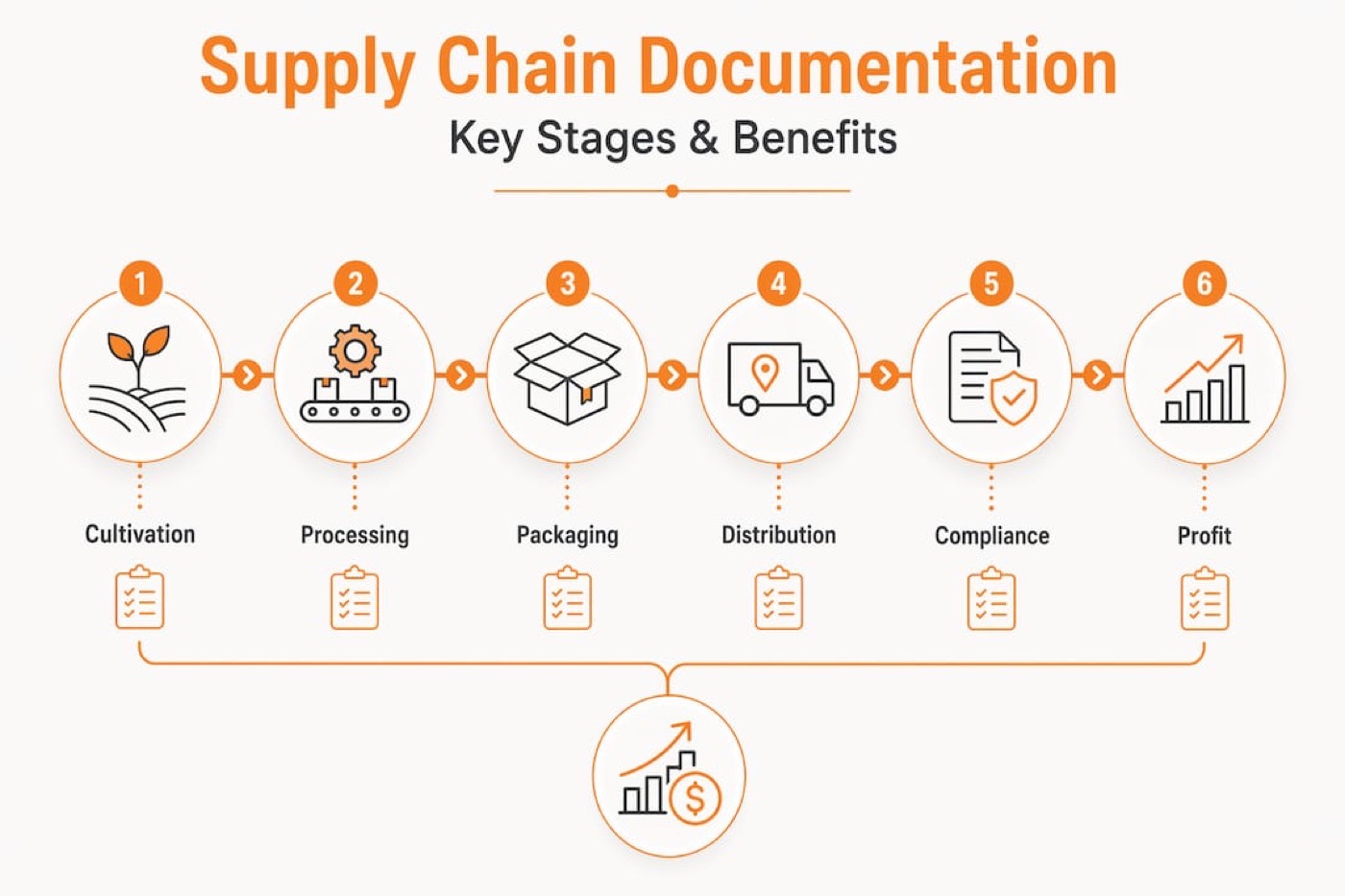
Cannabis supply chain management covers six distinct stages: cultivation, processing, packaging, distribution, wholesale, and retail. Each stage generates data that regulators require you to capture in real time. The cannabis traceability requirements in most U.S. states mandate that every product movement be logged with batch numbers, transfer manifests, lab test results, and chain-of-custody records.

State-mandated track-and-trace systems like Metrc and BioTrack are the regulatory layer. They receive data from your operations and compare it against physical inventory counts. If your records do not match, you have a problem. The operational layer sits on top of that: ERP systems, warehouse management tools, and point-of-sale platforms that generate the data feeding into those state systems.
The specific elements that must be recorded include:
- Batch and lot numbers tied to each harvest or production run
- Transfer manifests for every product movement between licensed facilities
- Lab test results linked to the specific batch being sold or transferred
- Packaging certifications with verified Certificates of Compliance
- Inventory adjustments with documented reasons for any discrepancy
Real-time data synchronization is where most operators fail. A manifest created in your ERP that does not push to Metrc within the required window creates a compliance gap. That gap is not theoretical. It shows up in your next state inspection.
Pro Tip: Treat lot data as a structured object within your ERP, not a text field. Lot data as ERP objects maintains chain-of-custody integrity and makes reconciliation against Metrc far faster during audits.
How does poor documentation create compliance and financial risk?
The consequences of documentation failures are concrete and measurable. Inventory drift over 2% from state track-and-trace counts triggers mandatory reporting and potential audits. That threshold is tighter than most operators realize, and it applies to every licensed location independently.
The financial exposure extends beyond regulatory fines. Cargo theft losses in 2025 reached $725 million across industries due to undocumented and unsecured distribution. In cannabis, where cash transactions remain common and product is high-value, undocumented transfers create both theft exposure and regulatory liability simultaneously.
Documentation failures also surface in audit-specific ways that accountants recognize immediately:
- Thermal paper labels fade within 6 to 12 months, creating data loss before the 2-year retention periods mandated by most state regulations
- Outdated packaging certifications without linked lab test reports cause audit failures that are entirely preventable
- Manual reconciliation errors compound over time, making it nearly impossible to reconstruct accurate inventory history for a state investigation
The labor cost of manual documentation is also a real line item. Operators using manual compliance methods spend over 40 hours weekly on tasks that software could automate. That is a full-time employee dedicated to data entry, and that employee is still producing error-prone records.
What operational benefits come from integrated documentation?
The benefits of documenting the cannabis supply chain extend well past avoiding fines. Accurate, real-time inventory records reduce product shrinkage and waste. When your ERP knows exactly what is on hand, you stop over-ordering inputs and stop writing off expired product that sat undetected in a storage room.
First-in, first-out (FIFO) enforcement is one of the clearest operational wins. FIFO is a regulatory expectation in most cannabis markets and a financial best practice under IRC 471. Without documented lot-level inventory, FIFO is impossible to enforce. You are guessing at product age, and that guess can produce both a compliance violation and an inventory write-down in the same period.
Integrated documentation also accelerates order fulfillment. When your sales team can see real-time inventory tied to batch numbers and lab results, they can commit to orders with confidence. When your warehouse can pull from a documented pick list that auto-generates a Metrc transfer manifest, the process takes minutes instead of hours.
The steps to get there are sequential:
- Standardize lot and batch data as structured fields in your ERP, not free-text notes
- Integrate your ERP with Metrc using a certified integration layer, not manual uploads
- Automate transfer manifest generation so every physical movement triggers a corresponding digital record
- Link lab results to batch records at the point of receipt, not at the point of sale
- Schedule daily reconciliation between ERP inventory and Metrc counts before the drift threshold is breached
Tools like Distru have built AI-driven order processing that generates compliant manifests automatically. Operators who sync Metrc, ERP, and physical inventory reduce bottlenecks and license risks by treating compliance as a deliverable rather than a separate function.
Pro Tip: Run your Metrc reconciliation daily, not weekly. Weekly reconciliation means you are always discovering problems after the regulatory window has already closed.
Manual vs. software-driven documentation: which approach holds up?
The honest comparison between manual and software-driven cannabis supply chain documentation comes down to three variables: labor cost, error rate, and audit survivability.
| Factor | Manual documentation | Software-driven documentation |
|---|---|---|
| Weekly labor hours | 40+ hours per operator | Under 10 hours with automation |
| Error rate | High; compounding over time | Low; system-enforced validation |
| Metrc sync | Manual upload; delay risk | Real-time API integration |
| Audit trail quality | Inconsistent; paper-dependent | Structured; timestamped; exportable |
| Lab result linkage | Manual attachment; often missing | Auto-linked at batch receipt |
| FIFO enforcement | Estimated; unreliable | Lot-level; system-enforced |
| Scalability | Breaks under volume | Scales with transaction volume |
Manual methods are not just inefficient. They are structurally incompatible with the compliance audit log requirements that regulators and courts expect. A paper manifest with a faded thermal label does not constitute an enduring audit trail. It constitutes a gap.
Generic ERP systems present a different problem. They can handle lot tracking and inventory management, but they were not built for Metrc integration or cannabis-specific transfer manifest logic. Cannabis-specific platforms like Distru or cannabis modules within systems like Sage and NetSuite close that gap. The cannabis audit trail your state regulator expects is timestamped, immutable, and tied to a licensed facility. Generic systems rarely produce that output without significant customization.
Treating packaging and logistics as back-office functions until something fails is the pattern that produces the worst audit outcomes. By the time a discrepancy surfaces in a state inspection, the documentation gap is already months old and nearly impossible to reconstruct accurately.
What I’ve learned about compliance as a business foundation
Most cannabis operators I have worked with treat documentation as a compliance tax. They do the minimum required to pass the next inspection and move on. That posture is expensive.
The operators who build market advantage treat documentation as infrastructure. Their Metrc counts match their ERP counts match their physical counts, every day. When a state auditor walks in, they export a clean report in under an hour. When a wholesale buyer asks for a certificate of analysis tied to a specific batch, they send it in minutes. That speed and accuracy is a competitive differentiator, not just a compliance checkbox.
The fragmentation problem is real. I have seen operations running Metrc manually, a separate spreadsheet for inventory, a different system for lab results, and a paper-based manifest process. Each system is technically functional. Together, they are a liability. The reconciliation alone consumes resources that should be generating revenue.
Pharmaceutical-grade documentation standards covering batch release and supplier qualification are where mature cannabis markets are heading. If you are building systems now, build to that standard. The operators who do will not need to rebuild when regulators raise the bar. The ones who do not will face that rebuild under pressure, during an audit, with their license on the line.
The cannabis recordkeeping requirements are not going to get simpler. Build the system that survives the next version of the rules, not just the current one.
— JN
How Cannabisbusinessminds supports your documentation strategy

Supply chain documentation does not exist in isolation from your financial statements. Every batch record, transfer manifest, and inventory adjustment feeds directly into your cost of goods sold, your IRC 471 inventory costing, and your Section 280E calculations. Getting the documentation right means getting the numbers right.
Cannabisbusinessminds covers the intersection of compliance and finance in depth. If you are working through how inventory documentation affects your cost accounting, the cannabis inventory costing guide breaks down what finance professionals need to know about lot-level costing, FIFO, and audit-ready records. For operators evaluating technology options, the compliance technology resource covers how integrated platforms reduce both regulatory risk and accounting errors. Documentation is where compliance and finance meet. That is exactly where Cannabisbusinessminds operates.
FAQ
Why is supply chain documentation required in cannabis?
State cannabis regulations require operators to maintain real-time records of every product movement through track-and-trace systems like Metrc or BioTrack. Gaps in those records trigger mandatory reporting, audits, and potential license suspension.
What happens if cannabis inventory drifts from Metrc counts?
If inventory drifts more than 2% from state track-and-trace counts, it triggers mandatory reporting and potential audits. That threshold applies per licensed location and is monitored continuously by state regulators.
Can manual documentation pass a cannabis compliance audit?
Manual documentation creates structural gaps, including faded thermal labels, missing lab result linkages, and delayed Metrc uploads, that regulators and courts do not accept as enduring audit trails. Software-driven systems produce timestamped, exportable records that meet audit standards.
How does supply chain documentation affect cannabis accounting?
Every transfer manifest, batch record, and inventory adjustment feeds into cost of goods sold calculations, IRC 471 inventory costing, and Section 280E deduction analysis. Inaccurate supply chain records produce inaccurate financial statements.
What systems are used for cannabis supply chain documentation?
The primary regulatory layer is state-mandated track-and-trace systems like Metrc and BioTrack. Operators layer cannabis-specific ERP platforms such as Distru on top of those systems to automate manifest generation, lot tracking, and real-time inventory reconciliation.
Recommended
- Master cannabis inventory control: a compliance guide – Cannabis Business Minds
- Why legal compliance is critical for U.S. cannabis finance – Cannabis Business Minds
- Cannabis cost allocation: Guide for compliance and profit – Cannabis Business Minds
- Cannabis COGS explained: your essential compliance guide – Cannabis Business Minds
This article is general education, not tax, legal or accounting advice. Cannabis rules change quickly; confirm how they apply to you with a qualified cannabis CPA or attorney.