Why Strategic Planning Cannabis Businesses Can’t Ignore
2026 update: what rescheduling changed for 280E (reviewed October 2026)
Effective April 22, 2026, a DOJ/DEA final order moved marijuana covered by a qualifying state medical license (and FDA-approved marijuana drugs) to Schedule III. Section 280E only applies to Schedule I and II substances, so state-licensed medical cannabis activity is generally no longer subject to 280E going forward. Adult-use cannabis remains in Schedule I and fully subject to 280E. The DEA proceeding to reschedule all marijuana was temporarily stayed in October 2026, and Treasury/IRS guidance on transition years and mixed medical/adult-use businesses is still pending.
Check where your business stands in about a minute.
Strategic planning in cannabis is the disciplined process of stress-testing assumptions, anticipating regulatory demands, and aligning financial and operational models to sustain growth and compliance. Most operators treat it as a pitch deck exercise. That is the first mistake. In 2026, with price compression accelerating, investor scrutiny tightening, and state-level compliance requirements multiplying, why strategic planning cannabis businesses prioritize matters more than ever. The operators who survive year two are not the ones with the best product. They are the ones who modeled the downside before they signed a lease.
Why strategic planning is the core survival tool in cannabis
Cannabis is not a normal business environment. The regulatory exposure is higher, the tax treatment is punitive under IRC Section 280E, and the margin compression in mature markets is faster than most founders model. Regulatory complexity is the primary strategic risk for new cannabis businesses, requiring early mapping of state-specific licensing, zoning, and compliance well before licensing windows open.
The risks that make planning non-negotiable fall into three categories:
- Regulatory risk. State licensing timelines shift. Zoning restrictions tighten after initial approval. Compliance monitoring requirements expand. Operators who do not build regulatory checkpoints into their operating calendar get caught flat-footed when rules change mid-cycle.
- Financial risk. Margin compression is structural in maturing cannabis markets. Wholesale flower prices have dropped significantly in states like Oregon and Michigan as supply outpaces demand. Operators who modeled year-one revenue without accounting for price erosion took distributions that gutted their cash reserves by year two.
- Capital access risk. Investor scrutiny has intensified in 2026, requiring rigor in financial documentation. Lenders and equity investors now expect transparent proformas, documented assumptions, and evidence of scenario modeling before they engage seriously.
“Strategic plans are survival tools that pressure-test unit economics against real-world cannabis market volatility rather than just investor decks.” — Green Growth CPAs
The insolvency pattern in cannabis is predictable. Year one looks viable because licensing costs are sunk, revenue is new, and the market is still absorbing supply. Year two is where the math breaks. Operators who ignored downside modeling did not see it coming. Operators who planned for it had reserves and contingency decisions already mapped.
How to build a cannabis business plan that stress-tests real scenarios

A cannabis business plan that does not include a downside case is not a plan. It is a projection. The difference matters because failing to model a 30% flower price drop significantly increases insolvency risk by year two. That is not a theoretical number. It reflects what happened in Oregon, Colorado, and Michigan as those markets matured.
Here is a practical framework for building a plan that holds up under pressure:
- Define your unit economics at three price points. Model revenue at your expected price, at 15% below, and at 30% below. For each scenario, recalculate gross margin, operating expenses, and cash runway. If the 30% scenario produces negative cash flow within 18 months, your cost structure needs adjustment before you open.
- Incorporate 280E into every cash flow projection. Ignoring 280E tax impacts on cash flow results in unexpected tax liabilities and financial stress after year one. The effective tax rate for cannabis operators under 280E is often 60% to 70% of taxable income. Model that from day one, not after your first tax filing.
- Build a 90-day cash reserve into your capital structure. This is not optional padding. It is the buffer that keeps you operational when a licensing delay, a compliance audit, or a price correction hits simultaneously.
- Model labor cost increases annually. Minimum wage increases, benefits inflation, and turnover costs in cannabis retail are higher than most operators budget. Build in a 5% to 8% annual labor cost escalation and test whether your margins hold.
- Reverse-engineer your goals into resource requirements. If your goal is $2 million in revenue by year two, work backward to determine what staffing, inventory, and marketing spend that requires. Then check whether your capital raise covers it with the downside buffer intact.
| Scenario | Flower price change | Gross margin impact | Cash runway (months) |
|---|---|---|---|
| Base case | 0% | Stable | 18+ |
| Moderate compression | -15% | Reduced 8-12 pts | 10-14 |
| Severe compression | -30% | Reduced 18-22 pts | Under 6 |
Pro Tip: Run your downside scenario before you finalize your capital raise target. If the 30% compression case burns through your reserves in under six months, raise more capital or cut fixed costs before you launch, not after.
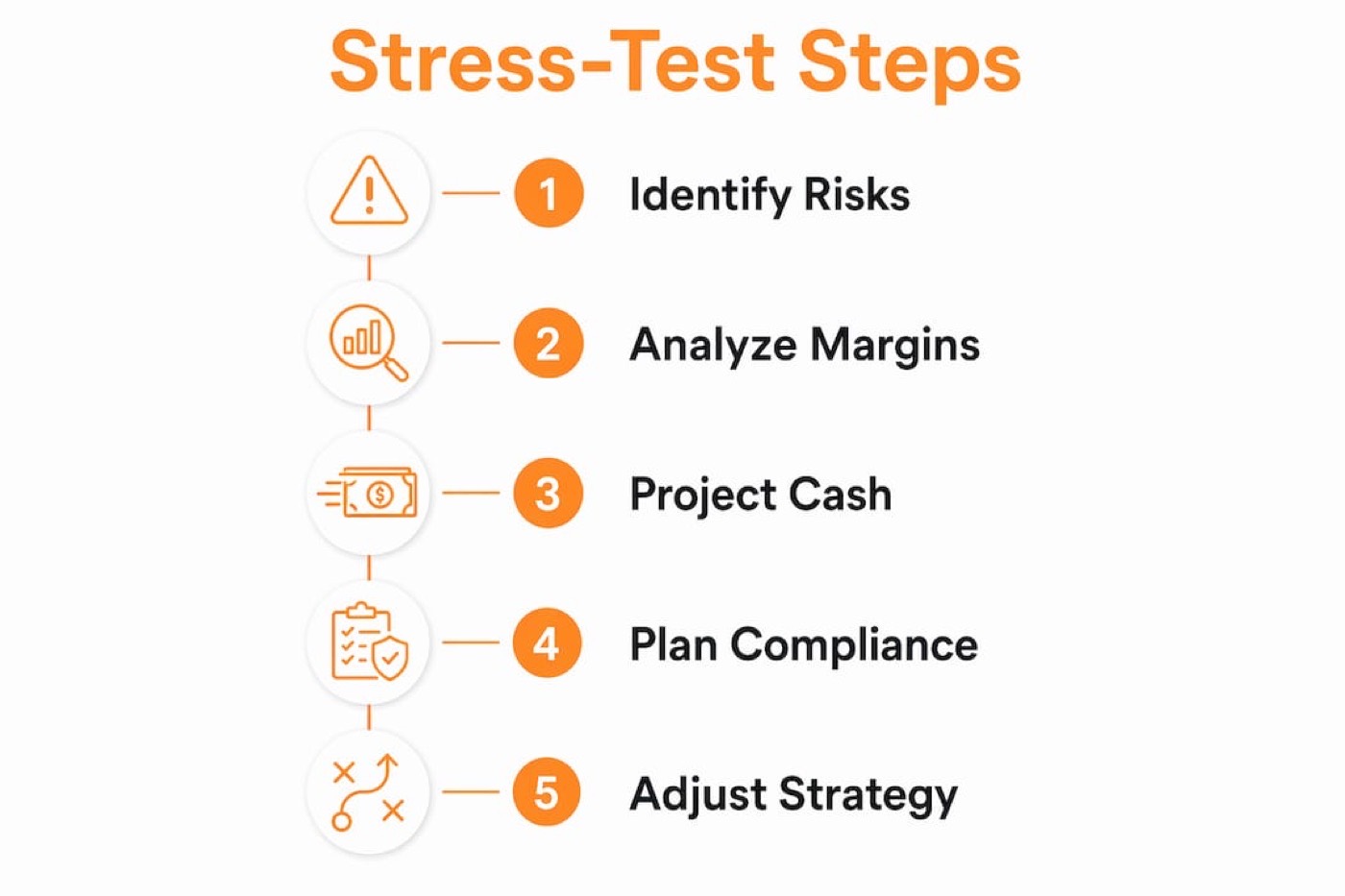
Cannabis operators who incorporate downside scenarios make smarter staffing, distribution, and positioning decisions early, which directly improves sustainability. That is the practical benefit of planning that goes beyond the pitch deck.
Why compliance and entity structure belong in the strategic plan from day one
Most cannabis founders treat entity structuring as a legal formality handled at formation. It is not. Correcting entity structuring errors after formation is costly or impossible, which means the decisions made before you open determine your exposure for the life of the business.
The compliance and structural elements that belong in your strategic plan include:
- Separate license-holding entities. Structuring cannabis entities with separate licenses and assets prevents costly IRS audit problems and protects business value. If you hold your license in the same entity as your real estate or intellectual property, a compliance violation can expose all of it.
- Cannabis-specific employee handbooks and training programs. Generic HR policies do not address cannabis-specific issues like seed-to-sale tracking compliance, cash handling protocols, or state-mandated employee disclosures. These gaps create liability that shows up in audits and employment disputes.
- Insurance as a continuity tool. Product liability, general liability, and directors and officers coverage in cannabis are not standard. Carriers price cannabis risk differently, and coverage gaps are common. Map your insurance requirements against your operational risks annually, not at inception only.
- Compliance SOPs embedded in daily operations. Strong infrastructure and compliance embedding from the outset distinguish successful scaling cannabis companies. Compliance that lives only in an onboarding checklist fails the moment a new employee skips a step.
Pro Tip: Build a compliance calendar that maps every state reporting deadline, license renewal date, and inspection window into your operational schedule. Treat missed compliance dates as financial events, because in cannabis, they are.
The 280E impact on financial modeling deserves specific attention here. Because cannabis businesses cannot deduct most ordinary business expenses at the federal level, your effective tax rate is structurally higher than a comparable non-cannabis business. That reality must be built into your reserve planning, your distribution policy, and your investor reporting from the start.
What role does financial discipline play in accessing capital?
Capital access in cannabis in 2026 is tighter than it was in 2019 or 2021. The operators who are raising successfully share one characteristic: their financial documentation is credible. Disciplined financial reporting and transparent proformas reduce friction with investors and improve capital raising outcomes under tighter margins.
What credible financial documentation looks like in practice:
- Rolling 13-week cash flow forecasts. Not annual projections. Weekly visibility into cash position, payables, and receivables is what separates operators who catch problems early from those who discover them at payroll.
- Variance analysis against budget. Every month, document where actuals diverged from plan and why. Investors and lenders read variance explanations as a signal of management quality. Unexplained variances are a red flag.
- Documented assumptions behind every proforma line. If your revenue projection assumes a 12% market share in year two, document the basis for that assumption. Unsupported numbers in a proforma tell investors you are guessing.
- Strategic documentation that preserves optionality. Strategic planning preserves optionality and flexibility, allowing cannabis businesses to respond to changing markets without premature commitments. That means your plan should not lock you into a single growth path. Document the conditions under which you would pursue a partnership, a license sale, or an acquisition instead of organic growth.
“Optionality created through disciplined planning is the core strategic advantage in a consolidating, evolving cannabis market.” — AAFCPAs
Financial clarity also supports the tax strategy decisions that determine whether a cannabis business is actually profitable after federal tax obligations. Operators who treat financial reporting as a compliance burden rather than a management tool consistently underperform on capital raises and exit valuations.
What most cannabis operators get wrong about strategic planning
I have reviewed enough cannabis business plans to identify the failure patterns clearly. The most common one is treating the plan as a fundraising document rather than an operational tool. Once the capital raise closes, the plan goes in a drawer. Six months later, the operator is making staffing and pricing decisions without any reference to the assumptions that justified the raise in the first place.
The second pattern is underestimating margin compression and 280E simultaneously. Both are predictable. Both are modelable. Yet operators consistently build proformas that assume stable prices and treat federal taxes as a line item they will figure out later. Relying solely on traditional financial metrics leads to strategic blind spots. Cannabis leaders must incorporate qualitative and regulatory KPIs alongside revenue and margin. Customer retention rates, regulatory inspection outcomes, and brand loyalty metrics tell you things that a P&L does not.
The third pattern is confusing a compliance checklist with a compliance culture. You can have every SOP documented and still fail an inspection because your staff does not understand why the procedures exist. Compliance that is not trained, tested, and reinforced operationally is a liability dressed up as a control.
The mindset shift that separates resilient operators from struggling ones is simple: standard financial metrics alone miss critical performance indicators. Build your KPI framework before you open, not after your first bad quarter. And update your strategic plan quarterly, not annually. The cannabis market moves faster than a 12-month review cycle can track.
— JN
Build your cannabis strategy on a foundation that holds
Cannabisbusinessminds provides the financial and compliance resources cannabis operators need to build plans that hold up under real market pressure. The cannabis budgeting framework covers cash flow planning, reserve modeling, and budget variance analysis tailored to the cannabis operating environment. For operators managing cost of goods sold under IRC 471 and 280E constraints, the inventory costing guide breaks down the specific accounting treatment that affects your taxable income and your margin reporting. These are not generic business resources. They are built for the regulatory and financial realities cannabis operators face in 2026.
FAQ
Why is strategic planning different for cannabis businesses?
Cannabis businesses operate under IRC Section 280E, which disallows most ordinary business expense deductions at the federal level, creating effective tax rates that can reach 60% to 70% of taxable income. Combined with state-specific licensing requirements and price volatility, the financial and regulatory exposure requires more rigorous planning than a standard business.
What is the biggest strategic planning mistake cannabis operators make?
Failing to model a 30% drop in flower prices significantly increases insolvency risk by year two, according to Green Growth CPAs. Operators who build projections on stable pricing without a downside case consistently run out of cash reserves when market compression hits.
How does 280E affect cannabis financial planning?
Section 280E prohibits cannabis businesses from deducting ordinary business expenses at the federal level, which means net taxable income is substantially higher than accounting income. Every cash flow forecast and distribution decision must account for this tax liability before funds are allocated elsewhere.
What KPIs should cannabis businesses track beyond revenue?
Standard financial metrics miss critical indicators in cannabis. Operators should track customer retention rates, regulatory inspection outcomes, brand loyalty metrics, and compliance incident frequency alongside gross margin and revenue to get a complete picture of business health.
How often should a cannabis business update its strategic plan?
Quarterly reviews are the minimum in a market where pricing, regulation, and competition shift as fast as cannabis does. Annual planning cycles are too slow to catch margin compression or regulatory changes before they create a cash crisis.
Recommended
- Role of Tax Strategy in Cannabis Profitability – Cannabis Business Minds
- Understanding Cannabis Financial Forecasting Explained – Cannabis Business Minds
- Cannabis Financial Planning Explained: Key U.S. Requirements – Cannabis Business Minds
- Comprehensive Cannabis Business Budgeting Guide – Cannabis Business Minds
This article is general education, not tax, legal or accounting advice. Cannabis rules change quickly; confirm how they apply to you with a qualified cannabis CPA or attorney.