Cannabis Bookkeeping Tips for Finance Pros in 2026

2026 update: what rescheduling changed for 280E (reviewed October 2026)
Effective April 22, 2026, a DOJ/DEA final order moved marijuana covered by a qualifying state medical license (and FDA-approved marijuana drugs) to Schedule III. Section 280E only applies to Schedule I and II substances, so state-licensed medical cannabis activity is generally no longer subject to 280E going forward. Adult-use cannabis remains in Schedule I and fully subject to 280E. The DEA proceeding to reschedule all marijuana was temporarily stayed in October 2026, and Treasury/IRS guidance on transition years and mixed medical/adult-use businesses is still pending.
Check where your business stands in about a minute.
Cannabis bookkeeping is defined as the practice of maintaining audit-proof financial records that separate deductible cost of goods sold from expenses disallowed under IRC Section 280E. Every cannabis business owner operating in the U.S. faces this constraint. The IRS does not treat your operation like a standard business, and your books need to reflect that reality from day one. These cannabis bookkeeping tips cover the tools, controls, and reporting structures that produce defensible numbers capable of surviving federal tax audits, state compliance inspections, and investor scrutiny. QuickBooks integrated with seed-to-sale platforms like Metrc is the starting point. The methodology behind the numbers is what determines your exposure.
What are the best cannabis bookkeeping tips for software and integrations?
No single software product solves cannabis bookkeeping out of the box. QuickBooks Online and QuickBooks Desktop are the most widely deployed general ledger platforms in the industry, but neither natively handles 280E cost allocation, Metrc reconciliation, or cannabis-specific inventory costing. You need a stack, not a single tool.
The core integration chain connects your point-of-sale system, your seed-to-sale compliance platform (Metrc in most states), and your general ledger. Each system captures a different layer of the transaction. POS records the sale. Metrc records the plant-to-product chain. The GL records the financial impact. When those three systems do not reconcile, you have an audit problem.

Cannabis-specific platforms like Flowhub, Dutchie, and Green Bits handle POS and Metrc integration. For cost accounting, firms often layer in tools like Canix or build custom chart-of-accounts structures inside QuickBooks that mirror department-based reporting. The cannabis inventory tracking layer is where most operators cut corners and pay for it later.
| Feature | QuickBooks + Custom COA | Cannabis-Specific ERP |
|---|---|---|
| 280E expense tracking | Manual setup required | Often built-in |
| Metrc integration | Third-party connector needed | Native in some platforms |
| Department-based reporting | Configurable | Standard |
| Inventory costing (FIFO/WAC) | Limited native support | Stronger support |
| Audit trail documentation | Moderate | Strong |
| Cost | Lower upfront | Higher upfront |
Pro Tip: Choose software that supports department-level profit and loss reporting from day one. Retrofitting your chart of accounts after an IRS inquiry is expensive and often incomplete.
How does IRC Section 280E affect cannabis tax reporting and cost studies?
IRC 280E pushes effective tax rates above 70% for many cannabis operators by eliminating deductions for ordinary business expenses. Rent, payroll for non-production staff, marketing, and most G&A costs are nondeductible at the federal level. Only expenses properly classified as cost of goods sold survive. That single constraint shapes every bookkeeping decision you make.
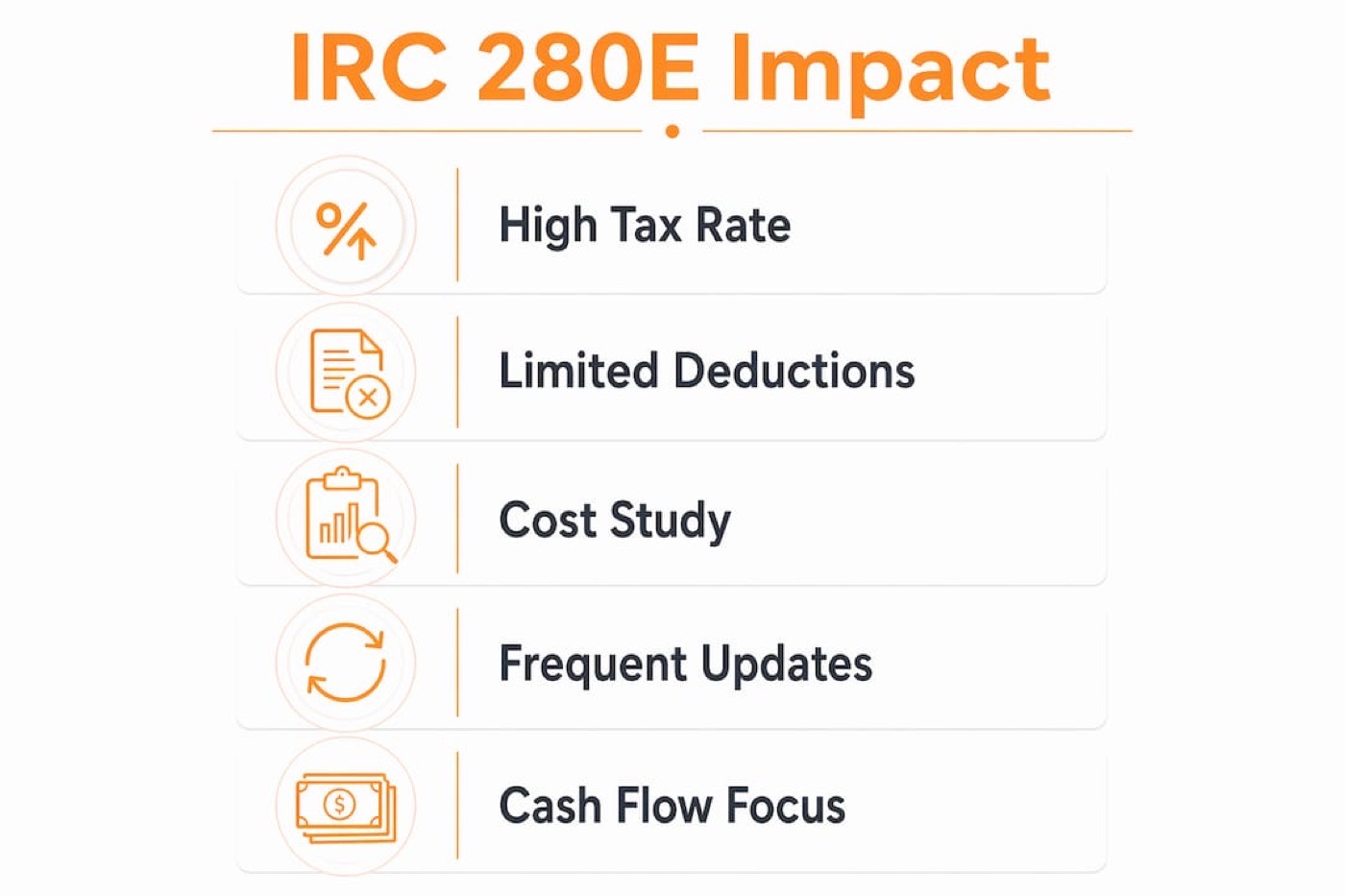
The mechanism for managing 280E exposure is a formal cost study. A 280E cost study is a methodology-driven report that documents facility use by square footage, labor time allocation by department, and utility estimates tied to production versus retail activity. It is not a spreadsheet estimate. It is a defensible methodology that reclassifies expenses from disallowed operating costs into COGS, and it needs to hold up under IRS examination.
Department-based bookkeeping separates cultivation, processing, and retail into distinct cost centers with their own P&L. This structure is the operational backbone of any 280E defense. Without it, you cannot demonstrate which expenses belong to production and which belong to the disallowed side of the ledger.
Key elements of a compliant 280E cost study and bookkeeping structure:
- Floor plan documentation: Square footage allocated to cultivation, processing, storage, and retail, updated when layout changes
- Labor time studies: Actual time-and-activity logs for each employee role, mapped to production versus non-production functions
- Utility sub-metering or estimates: Electricity, water, and HVAC costs allocated by department based on usage data or reasonable estimates
- Vendor invoice mapping: Every purchase coded to the correct department at the point of entry, not reclassified at year-end
- 280E disallowed expense accounts: Explicit GL accounts for nondeductible costs so they are never accidentally included in COGS
Pro Tip: Update your cost study every 12–18 months or whenever your facility layout, staffing model, or product mix changes materially. A stale cost study is an IRS challenge waiting to happen.
What cash management controls does a cannabis business need?
Cannabis operations are predominantly cash businesses. That creates theft risk, reconciliation complexity, and regulatory scrutiny that most industries never face. The answer is process discipline, not just policy.
Dual-custody cash counts at shift start take approximately 3 minutes per count and require two employees to verify the opening drawer simultaneously. Daily reconciliations for a $20,000 cash volume operation add 15–20 minutes of labor per day. That time is not optional. It is the minimum required to catch discrepancies before they compound.
The three-way match process is the gold standard for dispensary cash accountability. It links your physical cash count, your bank deposit slip, and your POS expected total for the same period. All three numbers must agree. When they do not, the variance triggers an investigation protocol, not a journal entry adjustment.
Standard cash management policies for 2026 cannabis operations include:
- Dual-custody counts at every shift start and end, with both employees signing the count sheet
- Daily variance documentation with a written explanation for any discrepancy above your defined threshold (typically $5–$20)
- Vault access logs recording every entry with employee ID, timestamp, and purpose
- Bank deposit preparation by a separate employee from the one who counted the cash
- Weekly cash position reporting to ownership or the CFO, not just the store manager
- Monthly reconciliation of all cash accounts to bank statements with sign-off from a finance lead
Vault controls and access logs are not just internal controls. In many states, they are regulatory requirements tied to your license. Missing documentation here creates both a financial risk and a compliance exposure.
How do inventory control and cash forecasting drive cannabis profitability?
Inventory is a financial lever, not just an asset on the balance sheet. The amount of cash tied up in slow-moving SKUs directly reduces your ability to pay vendors, cover payroll, or fund expansion. Managing it actively is a core finance function, not a retail operations task.
The standard target is 30 days of inventory supply on hand, with regular audits of slow-moving SKUs to identify products consuming cash without generating turns. Vendor payment terms are a direct extension of this. A net-30 term with a supplier effectively gives you 30 days of float. Negotiating net-45 or net-60 on high-volume SKUs improves your working capital position without touching your credit line.
The 13-week rolling cash flow model with weekly updates is the industry standard for cannabis operators. A static model built once per quarter is worse than useless. It gives false confidence. Effective operators update actual cash balances weekly, run variance analysis against the prior week’s forecast, and stress-test the model against a 15–20% revenue drop scenario.
| Metric | Target | Review Frequency |
|---|---|---|
| Inventory days on hand | 30 days | Weekly |
| Slow-moving SKU threshold | No turns in 21+ days | Weekly |
| Cash flow forecast horizon | 13 weeks rolling | Weekly update |
| Revenue stress test | 15–20% drop scenario | Monthly |
| Vendor payment terms | Net-30 to Net-60 | Per contract cycle |
| Variance analysis | Actual vs. forecast | Weekly |
Pro Tip: When your actual cash balance deviates more than 10% from your forecast in any given week, that is a signal to investigate the assumption, not just update the number. The variance tells you where your model is wrong.
What are the most common cannabis bookkeeping challenges and how do you fix them?
The most persistent misconception in cannabis finance is that profitability equals cash flow. A dispensary can show net income on its P&L and still be unable to make payroll. The gap is usually explained by sales tax collections being used for operating expenses. Misusing sales tax funds can trigger state penalties up to 25% annually. Those funds are not revenue. They are a liability the moment they are collected.
Stale cost studies and outdated cash flow models are the second most common failure point. Operators build a 280E cost study at license issuance and never update it. Two years later, their staffing model has changed, they have added a processing room, and the original methodology no longer reflects reality. The IRS does not accept a cost study that does not match your current operations.
Audit trail integrity is where bookkeeping meets compliance. Your cannabis audit trail must link POS transaction data, Metrc plant and product records, and your general ledger entries for the same period. Gaps in that chain are the first thing an auditor looks for.
Common reconciliation issues and how to address them:
- Daily cash variances over threshold: Pull the POS transaction log and compare it to the physical count sheet. Identify the shift, the drawer, and the employee. Document the investigation regardless of outcome.
- Metrc-to-GL discrepancies: Run a weekly reconciliation between Metrc inventory reports and your GL inventory accounts. Discrepancies usually trace to timing differences in transfer recording.
- Vendor invoice coding errors: Implement a two-step approval process where the person who codes the invoice is not the person who approves payment. Miscoding COGS versus operating expenses has direct 280E consequences.
- Sales tax liability mismatches: Reconcile your sales tax payable account monthly against your POS tax collection reports. Never let that account go negative.
My position on where cannabis bookkeeping actually breaks down
Most cannabis operators do not have a bookkeeping problem. They have a process discipline problem that shows up in the books. I have reviewed financials for dispensaries generating $5 million in annual revenue that could not produce a clean three-way cash reconciliation for a single week. The books were technically maintained. The controls were not.
The operators who survive IRS scrutiny are not necessarily the ones with the most sophisticated software. They are the ones who update their cost studies, run their 13-week forecasts with real numbers, and treat the audit trail as a living document rather than a year-end exercise. The cannabis inventory costing methodology matters, but only if the underlying data feeding it is clean.
Where I see the most avoidable damage is in the gap between what operators think their books show and what they actually show. A chart of accounts structured for a standard retail business does not work for a cannabis operation under 280E. Neither does a cash flow model that gets updated quarterly. The frequency and specificity of your financial processes determine your exposure, not just the software you use.
The cannabis finance professionals who build durable operations treat bookkeeping as a control system, not a reporting function. That shift in framing changes what you prioritize, what you automate, and what you review personally. The books are not a historical record. They are your first line of defense.
— JN
Deepen your cannabis finance knowledge with Cannabisbusinessminds
Cannabisbusinessminds publishes in-depth resources built specifically for cannabis finance professionals who need more than general accounting guidance.

If you are working through 280E cost allocation, inventory costing methods, or building out your first rolling cash flow model, the Cannabisbusinessminds library covers each of these in detail. Start with the cannabis inventory costing guide for a precise breakdown of FIFO, weighted average cost, and their 280E implications. For operators building out their full financial control framework, the cannabis cost accounting guide covers expense classification, department-based reporting, and audit-ready documentation standards. For broader context on managing business finances compliantly, Legal Stepz provides a useful cross-industry reference. These resources are written for practitioners, not generalists.
FAQ
What is cannabis bookkeeping and why does it differ from standard bookkeeping?
Cannabis bookkeeping is the practice of maintaining financial records that comply with IRC Section 280E, which prohibits deductions for most operating expenses in cannabis businesses. Standard bookkeeping does not require this level of expense segregation between COGS and disallowed costs.
How does IRC Section 280E affect my cannabis business tax rate?
IRC 280E pushes effective tax rates above 70% for many cannabis operators by eliminating deductions for ordinary business expenses outside of cost of goods sold. Proper cost studies and department-based bookkeeping are the primary tools for managing that exposure.
What is a 280E cost study and when do I need one?
A 280E cost study is a methodology-driven report documenting facility use, labor time allocation, and utility estimates to defensibly classify expenses as COGS. You need one at license issuance and should update it every 12–18 months or when your operations change materially.
What is the three-way match process in cannabis cash management?
The three-way match links your physical cash count, bank deposit slip, and POS expected total for the same period. All three figures must reconcile daily to maintain cash accountability and catch discrepancies before they compound.
How often should I update my cannabis cash flow forecast?
A 13-week rolling forecast should be updated weekly with actual cash balances and variance analysis against the prior week’s projection. A static quarterly model does not reflect the cash volatility typical in cannabis operations.
Recommended
- 7 Key Cannabis Accounting Trends for 2025 – Cannabis Business Minds
- 7 Essential Cannabis Bookkeeping Best Practices for Success – Cannabis Business Minds
- Master Cannabis Accounting Best Practices for 2025 Success – Cannabis Business Minds
- Cannabis Inventory Costing: What Finance Pros Must Know – Cannabis Business Minds
This article is general education, not tax, legal or accounting advice. Cannabis rules change quickly; confirm how they apply to you with a qualified cannabis CPA or attorney.