Why Implement Cash Controls in Your Cannabis Business

2026 update: what rescheduling changed for 280E (reviewed October 2026)
Effective April 22, 2026, a DOJ/DEA final order moved marijuana covered by a qualifying state medical license (and FDA-approved marijuana drugs) to Schedule III. Section 280E only applies to Schedule I and II substances, so state-licensed medical cannabis activity is generally no longer subject to 280E going forward. Adult-use cannabis remains in Schedule I and fully subject to 280E. The DEA proceeding to reschedule all marijuana was temporarily stayed in October 2026, and Treasury/IRS guidance on transition years and mixed medical/adult-use businesses is still pending.
Check where your business stands in about a minute.
Cash controls in cannabis operations are defined as the documented procedures, segregation of duties, and reconciliation systems that govern how physical currency is counted, recorded, deposited, and audited at every stage of a transaction cycle. The reason to implement cash controls in cannabis is not abstract compliance theater. It is the difference between a business that survives a regulatory inspection and one that loses a license worth between $500,000 and $5 million. With 38 states plus D.C. having legalized cannabis use while federal Schedule I classification still blocks most conventional banking, cannabis operators carry more physical cash than nearly any other legal industry. Without formal controls, that cash disappears through theft, reconciliation errors, and tax exposure faster than most operators expect.
Why implement cash controls in cannabis operations
Cash controls in cannabis are not a single policy. They are a system of interlocking procedures that catch errors and deter theft at multiple points in the cash cycle.
Dual custody counting requires two employees to count and verify every cash drawer, safe drop, and deposit independently. Neither employee can complete the process alone, which eliminates the single point of failure that enables most internal theft. Dual custody counting and rotating counters are recognized best practices precisely because they create an audit trail that holds up under regulatory scrutiny.

Point-of-sale drawer procedures govern how much cash a drawer holds at the start of a shift, when drops occur, and how the drawer is verified at shift change. A standard protocol sets a fixed starting bank, requires a drop to the safe when the drawer exceeds a threshold, and mandates a blind count by the incoming employee before the outgoing employee’s count is revealed. This blind count is the control. Without it, the second counter simply confirms the first.
Safe and vault custody restricts access to a named list of authorized personnel. Access logs, whether digital or physical, document every entry. Restricted access alone does not prevent theft, but it narrows the suspect pool and creates accountability.
Daily reconciliation compares POS totals, safe logs, and deposit records against each other. Reconciliation gaps create compliance and tax risks because every cannabis POS transaction simultaneously updates state compliance systems like METRC and financial records. A variance that goes uninvestigated is a liability in both systems.
Segregation of duties must apply to processes, not just job titles. The person who observes the count should not be the person who records it. The person who records it should not be the person who approves the deposit. Segregation across process steps is what makes controls structurally sound rather than cosmetically compliant.
Pro Tip: Set a written variance threshold, typically $10 to $20 per drawer, above which a formal investigation is required and documented. Operators who skip this step accumulate small unresolved variances that compound into audit findings.
Why are banking and regulatory risks so high without cash controls?
The federal Schedule I classification means most FDIC-insured banks will not serve cannabis businesses without extensive due diligence. The ones that do are operating under Bank Secrecy Act obligations that require them to file Suspicious Activity Reports and monitor cash handling patterns continuously. Banks evaluate cannabis operators not on cash volume but on predictability, documentation, and the quality of cash handling processes. An operator who cannot produce clean reconciliation records, consistent deposit schedules, and written SOPs will not keep a cannabis banking relationship long.
The regulatory risk is more direct. State cannabis regulators treat cash control failures as compliance violations. Inadequate controls can trigger license suspension or revocation. The financial exposure from losing a cannabis license ranges from $500,000 to $5 million per license, depending on market and license type. That is not a recoverable loss for most operators.
“Treat cash management as essential infrastructure, not just compliance. Small daily errors in cash handling compound into large losses if unchecked.” — Northstar Financial Advisory
The theft risk is equally concrete. Median employee theft losses in cannabis cash-intensive businesses reach $100,000 per scheme, with detection delays averaging 18 months when daily reconciliations are absent. Daily reconciliation catches the same theft within 24 hours. That is not a marginal improvement. It is the difference between a recoverable loss and a business-ending one.
The cannabis business cash challenges that operators face are structural, not accidental. Federal restrictions force cash accumulation. Cash accumulation without controls creates theft exposure. Theft exposure without documentation creates regulatory exposure. The chain is predictable and preventable.
What are the financial benefits of strong cash control systems?
The direct financial benefits of implementing cash controls fall into four categories: loss prevention, audit readiness, banking access, and transaction value.
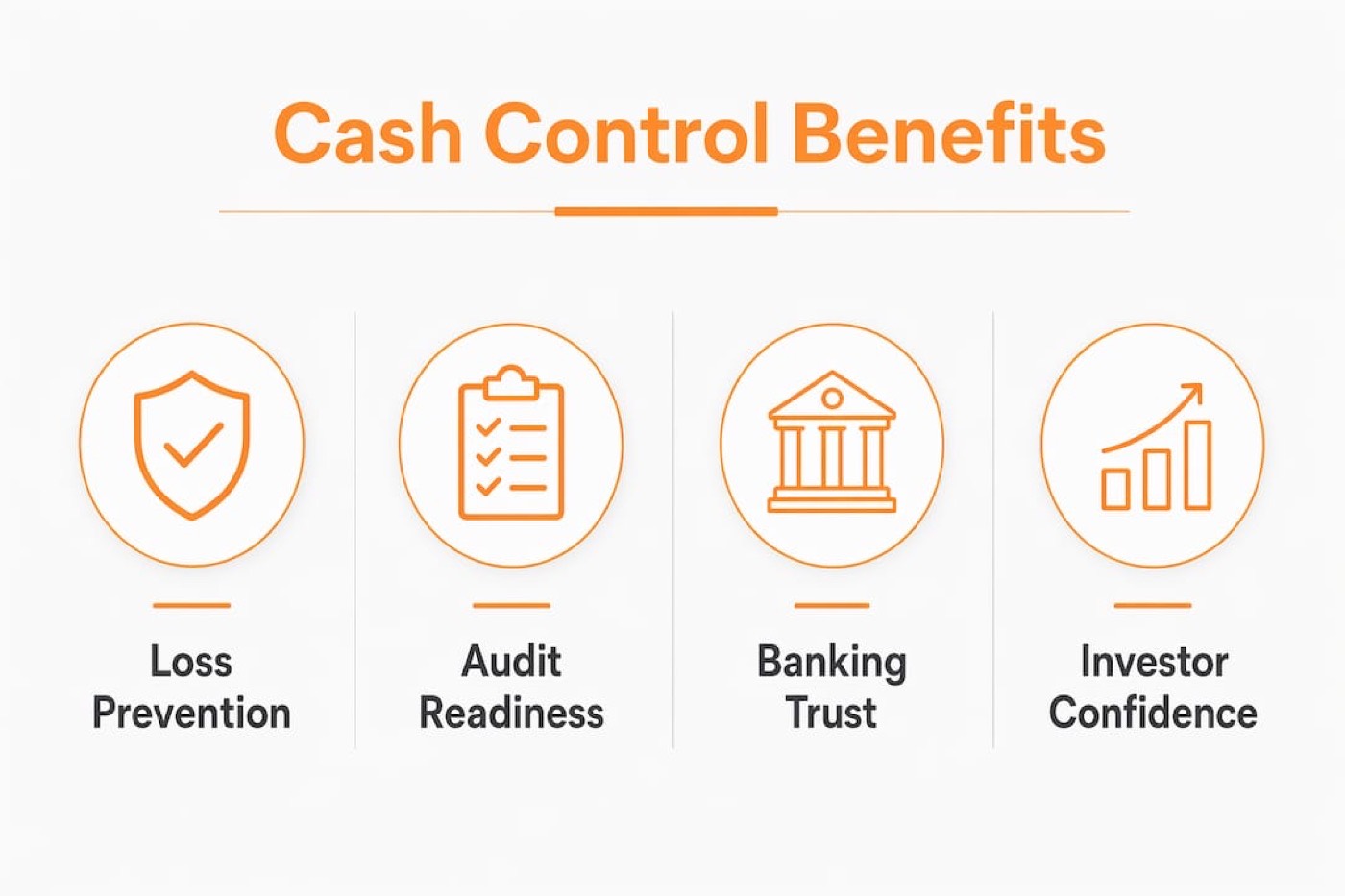
Loss prevention is the most immediate. Daily reconciliation and variance logging catch errors before they compound. Lax controls lead to audit failures, IRS scrutiny, and six-figure cash losses. The setup cost for a professional cannabis cash management program runs between $25,000 and $60,000 initially, with ongoing costs of $15,000 to $30,000 annually. Against a median theft loss of $100,000 per scheme, the math is straightforward.
| Factor | Without cash controls | With cash controls |
|---|---|---|
| Theft detection timeline | ~18 months | Within 24 hours |
| Median theft loss | $100,000+ | Significantly reduced |
| Regulatory risk | License suspension possible | Documented compliance |
| Banking relationship | Unstable or unavailable | Predictable, documentable |
| M&A or financing valuation | Risk-discounted | Audit-ready |
Audit readiness directly affects tax reporting accuracy. Under IRC 280E, cannabis businesses cannot deduct most ordinary business expenses, which makes revenue accuracy critical. An overstated revenue figure from unreconciled cash creates a tax liability that cannot be unwound easily. Clean cash records are not optional for tax purposes in this industry.
Banking and investor relationships depend on documented controls. Cash controls as banking readiness are a critical element of convincing financial partners and reducing transaction risks. Investors conducting diligence on a cannabis acquisition will discount valuation when cash controls are weak. Weak controls increase perceptions of shrinkage, tax risk, and regulatory exposure, lowering deal confidence directly.
Pro Tip: Before any financing round or M&A process, run a mock cash audit using your own SOPs. Gaps found internally cost nothing to fix. Gaps found by a buyer’s diligence team cost you on price.
How do cannabis businesses implement effective cash control protocols?
Implementation follows a defined sequence. Operators who skip steps early pay for it during audits.
- Write SOPs before training anyone. Standard operating procedures for cash handling must specify drawer starting amounts, drop thresholds, dual custody requirements, safe access protocols, deposit schedules, and variance investigation procedures. A verbal policy is not a control.
- Train every cash handler on the written SOP. Document the training with signed acknowledgment forms. Regulatory inspectors ask for training records. Operators who cannot produce them face findings regardless of how well staff actually performs.
- Integrate POS, inventory, and accounting systems. Every cannabis POS transaction updates METRC and financial records simultaneously. Reconciliation must account for all payment types including cash, ACH, and PIN debit, which require distinct accounting treatments for timing and fees to avoid distorting financial statements and tax filings.
- Schedule surprise audits. Announced audits test documentation. Surprise audits test behavior. Run both. Variance investigations from surprise audits are the most reliable signal of where controls are breaking down.
- Establish consistent deposit schedules. Predictable daily deposit routines and clear variance documentation build trust with banks. Erratic deposit patterns are treated as operational and regulatory risk signals by banking compliance teams.
- Retain documentation per state requirements. Most state cannabis regulations require transaction and reconciliation records for a minimum of three to five years. Build document retention into the SOP, not as an afterthought.
- Use armored transport for large deposits. Beyond a threshold set by your insurance carrier, armored transport is both a safety measure and a documentation tool. The carrier’s receipt is an independent record of the deposit amount and timing.
The cannabis audit preparation workflow for dispensaries maps directly onto these steps. Operators who build their cash controls around audit readiness from day one spend far less time and money preparing for inspections later.
What pitfalls do operators most commonly face with cash controls?
The failures that show up most often in cannabis cash operations are not exotic. They are predictable and preventable.
- Underestimating reconciliation labor. Daily reconciliation for a multi-register dispensary takes time. Operators who do not budget for it cut corners, which defeats the purpose of having controls at all.
- Ignoring segregation of duties in small teams. A five-person operation cannot fully segregate every function, but it can rotate who counts, who records, and who approves. Failing to rotate creates a single point of failure.
- Inconsistent documentation. A control that is not documented did not happen from a regulatory standpoint. Variance logs with missing entries, unsigned count sheets, and undated drop records are findings waiting to be written.
- Mishandling multiple payment types. Cash, ACH, and PIN debit each settle differently and carry different fee structures. Lumping them together in reconciliation distorts revenue figures and creates tax risk.
- Misaligning deposits with sales reporting. Deposits must match reported sales within the reconciliation period. Timing differences that are not documented and explained create the appearance of unreported revenue.
- Cultural resistance to controls. Long-tenured employees who operated without formal controls often resist them. This is a management problem, not a training problem. Controls must be enforced consistently from the top down or they erode quickly.
The role of audits in cannabis is precisely to surface these gaps before regulators do. Operators who treat internal audits as a burden rather than a diagnostic tool consistently find themselves unprepared when external scrutiny arrives.
Cash controls are infrastructure, not overhead
I have reviewed cannabis financials where the operator had a functioning POS, a decent accounting system, and a banking relationship, and still could not tell me within $5,000 what their cash position was on any given day. That is not a technology problem. It is a controls problem.
The operators who treat cash controls as a compliance checkbox build systems that look right on paper and fail in practice. The ones who treat controls as financial infrastructure build systems that actually catch theft, produce clean audit trails, and hold up under regulatory review. The difference shows up in the numbers within the first quarter.
Banks notice it too. Documented cash handling procedures and predictable deposit schedules are the primary markers banks use to assess whether a cannabis operator is worth the compliance risk of maintaining as a customer. Operators who cannot demonstrate that discipline lose banking access. Losing banking access in a cash-intensive industry is not an inconvenience. It is an existential operational problem.
The investment in formal cash controls, $25,000 to $60,000 to set up properly, is not optional overhead. It is the cost of protecting a license that took years and millions of dollars to obtain. Operators who skip it are not saving money. They are self-insuring against a risk they have not quantified.
— JN
Deepen your cannabis financial management knowledge

Cash controls do not operate in isolation. They feed directly into inventory costing, cost of goods sold calculations, and ultimately your tax exposure under IRC 280E. If your reconciliation records are clean but your inventory costing methodology is not, you are still exposed. Cannabisbusinessminds covers both sides of that equation. The cannabis inventory costing guide walks through the costing methods finance professionals must understand to connect cash controls to accurate COGS reporting. The cannabis accounting section provides the broader financial management framework that makes disciplined cash controls operationally effective rather than just procedurally correct.
FAQ
What are cash controls in cannabis businesses?
Cash controls are documented procedures governing how currency is counted, recorded, dropped, deposited, and reconciled in cannabis operations. They include dual custody counting, segregation of duties, daily reconciliation, and variance investigation protocols.
Why do cash controls matter more in cannabis than other industries?
Federal Schedule I classification blocks most conventional banking access, forcing cannabis businesses to operate with high cash volumes and limited financial infrastructure. Without formal controls, theft and reconciliation errors go undetected for months, and regulatory violations can result in license revocation.
How much does it cost to implement cannabis cash controls?
Professional cannabis cash management programs cost between $25,000 and $60,000 to set up, with ongoing costs of $15,000 to $30,000 annually. Against a median employee theft loss of $100,000 per scheme, the investment pays for itself on the first prevented incident.
How do cash controls affect cannabis banking relationships?
Banks evaluate cannabis operators on the predictability and documentation of their cash handling, not on cash volume. Operators with written SOPs, consistent deposit schedules, and clean reconciliation records are significantly more likely to maintain stable banking relationships.
What happens if a cannabis business has weak cash controls?
Weak controls increase theft exposure, create IRS scrutiny risk, and signal regulatory non-compliance. In M&A or financing contexts, they lower deal valuation. In regulatory inspections, they can trigger license suspension or revocation, with financial losses ranging from $500,000 to $5 million per license.
Recommended
- Why Cannabis Businesses Face Cash Challenges – Cannabis Business Minds
- How to Optimize Cannabis Cash Flow for Lasting Growth – Cannabis Business Minds
- Why Reconcile Cash for Cannabis: A Finance Guide – Cannabis Business Minds
- How to Handle Cannabis Petty Cash for 280E Compliance – Cannabis Business Minds
This article is general education, not tax, legal or accounting advice. Cannabis rules change quickly; confirm how they apply to you with a qualified cannabis CPA or attorney.