How to classify cannabis expenses for tax compliance
2026 update: what rescheduling changed for 280E (reviewed October 2026)
Effective April 22, 2026, a DOJ/DEA final order moved marijuana covered by a qualifying state medical license (and FDA-approved marijuana drugs) to Schedule III. Section 280E only applies to Schedule I and II substances, so state-licensed medical cannabis activity is generally no longer subject to 280E going forward. Adult-use cannabis remains in Schedule I and fully subject to 280E. The DEA proceeding to reschedule all marijuana was temporarily stayed in October 2026, and Treasury/IRS guidance on transition years and mixed medical/adult-use businesses is still pending.
Check where your business stands in about a minute.
Misclassifying a single expense category can cost your cannabis business tens of thousands of dollars in disallowed deductions, back taxes, and IRS penalties. Section 280E of the Internal Revenue Code blocks almost all ordinary business expense deductions for cannabis operators, because cannabis remains a Schedule I controlled substance at the federal level. The one meaningful lifeline available is the cost of goods sold (COGS) calculation governed by IRC Section 471, which allows qualifying inventory costs to reduce your taxable income. Get classification right, and you protect your margins. Get it wrong, and you’re handing money to the IRS that could fund your next grow cycle.
Table of Contents
- Understanding Section 280E, 471, and cannabis expense types
- Mapping and classifying your cannabis expenses step-by-step
- Allocating indirect costs and building COGS: Proven methods and pitfalls
- Maintaining compliance and defending your COGS positions
- Why most cannabis COGS strategies fail audits (and how to avoid their fate)
- Take the next step: Power your cannabis accounting with expert resources
- Frequently asked questions
Key Takeaways
| Point | Details |
|---|---|
| Know expense categories | Direct, indirect, and SG&A expenses each have different tax treatments under Section 280E and IRC 471. |
| Map and allocate accurately | Create an expense map and use objective methods to allocate indirect costs into COGS. |
| Document everything | Supporting documentation is crucial for defending COGS classifications in an IRS audit. |
| Stay consistent | Consistent year-over-year accounting treatment protects your business and maximizes allowed deductions. |
Understanding Section 280E, 471, and cannabis expense types
Section 280E is the rule that makes cannabis taxation uniquely punishing. It prohibits deductions for ordinary and necessary business expenses when those expenses are tied to trafficking in a controlled substance. For dispensaries, cultivators, and processors, this means selling expenses, marketing costs, accounting fees, and even rent for your retail floor are typically nondeductible at the federal level.
The critical exception is COGS. COGS for cannabis is computed using inventory accounting rules under IRC Section 471 and its related regulations. This means production costs that would normally be capitalized into inventory under standard accounting rules can still reduce your federal taxable income, even under 280E.
Section 280E generally blocks deductions for ordinary business expenses but allows COGS computations under IRC 471. Think of IRC 471 as the tax code’s built-in pressure valve specifically designed for inventory-based businesses. For cannabis, it is the only federally recognized route to meaningful expense relief.
Understanding how expenses break into categories is where the real work starts. Here is a comparison of the three major expense types and their tax treatment:
| Expense category | Examples | Tax treatment under 280E |
|---|---|---|
| Direct production costs | Seeds, raw cannabis, direct labor | Included in COGS via IRC 471 |
| Indirect production costs | Facility utilities, equipment depreciation | Includible in COGS if properly allocated |
| Selling, General and Admin (SG&A) | Marketing, retail labor, accounting | Generally nondeductible under 280E |
To understand the full range of cannabis expense categories and how they interact with tax law, each expense type must be approached with a distinct strategy.
Key distinctions to keep front of mind:
- Direct costs are those physically tied to producing inventory, like cultivation labor or extraction materials.
- Indirect costs benefit production but are shared across multiple functions, such as electricity for a building with both grow and retail space.
- SG&A costs serve the business overall but have no production relationship, which is exactly why they are disallowed.
“The COGS computation under IRC 471 is the primary lever for reducing federal taxable income for cannabis businesses, making accurate cost classification a financial imperative, not just a compliance checkbox.”
Mapping and classifying your cannabis expenses step-by-step
With the categories and rules in place, here is how to actually classify expenses in your books. A defensible 280E approach is methodology-driven: map costs, segregate production versus non-production, allocate indirect production costs using measurable bases, and support allocations with documentation. This is not a once-a-year exercise. It is an ongoing discipline.
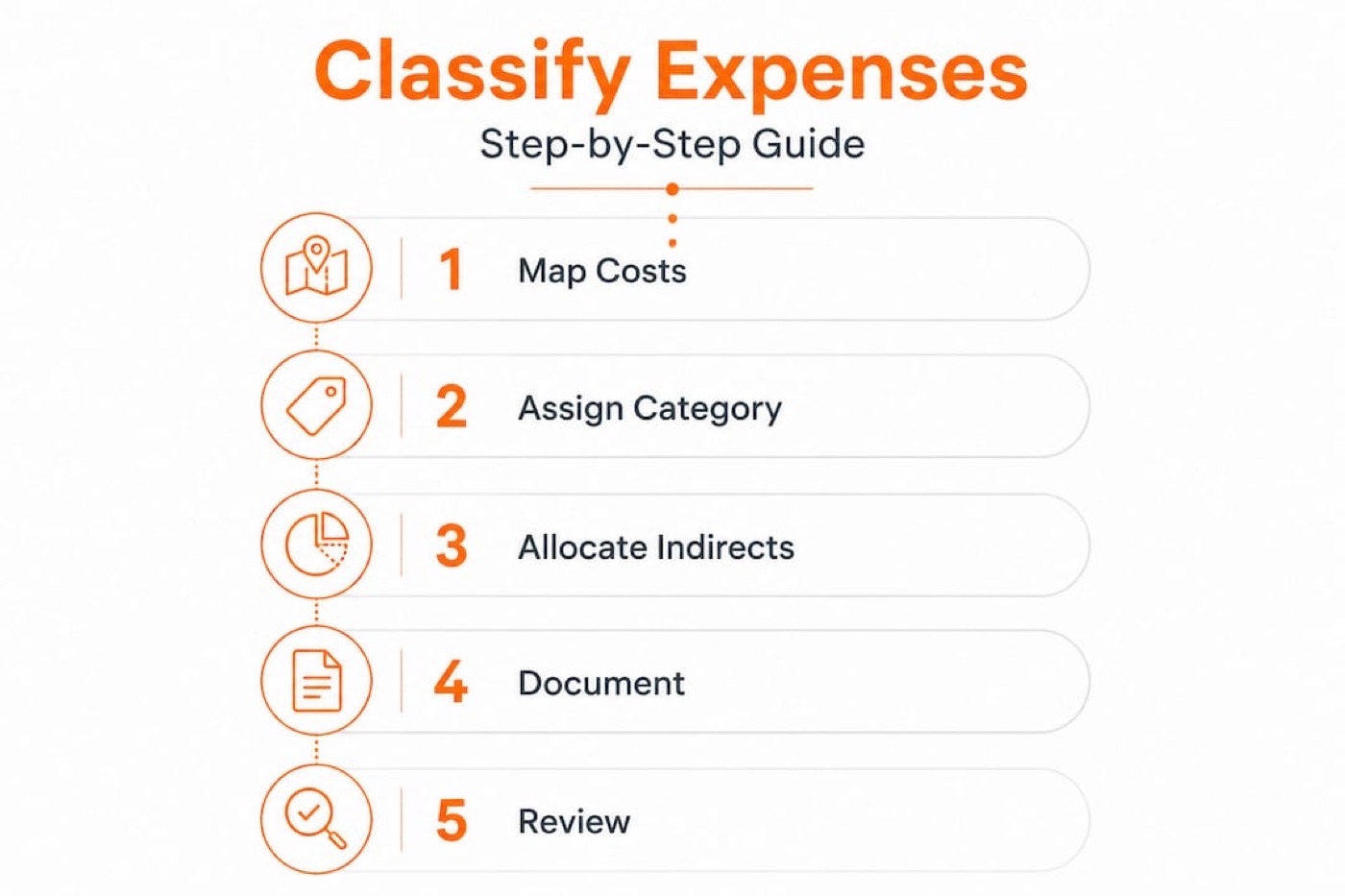
Step 1: Build your expense map. Start by listing every expense your business incurs, from payroll to utilities to packaging. Assign each one to a functional activity, either production, mixed-use, or SG&A. Be honest. If your CFO spends 100% of their time on financial reporting and zero percent on overseeing production, their salary is SG&A.

Step 2: Classify by category. Sort each item into direct production, indirect production, or SG&A. Direct costs go straight into COGS. Indirect costs require allocation. SG&A costs are nondeductible and should be tracked separately.
Step 3: Allocate indirect costs. For expenses that straddle production and non-production activities, use an objective, measurable allocation basis. Square footage, machine hours, and headcount ratios are all commonly accepted drivers.
Step 4: Document everything. Every allocation needs supporting documentation. This includes facility floor plans showing production versus retail square footage, time studies showing how employees split their time, and equipment logs showing utilization hours.
Here is a practical reference for common cannabis expenses:
| Expense | Classification | Documentation needed |
|---|---|---|
| Cultivation labor | Direct production | Time records, payroll reports |
| Extraction equipment | Indirect production | Depreciation schedule, utilization log |
| Shared facility utilities | Indirect production | Square footage allocation worksheet |
| Retail floor labor | SG&A | Job description, time records |
| Marketing and advertising | SG&A | Invoices, campaign records |
| Packaging (for product) | Direct production | Purchase orders, inventory records |
Numbered workflow for day-to-day classification:
- Receive or record an expense in your accounting system.
- Tag it to a cost center (production, mixed-use, or SG&A).
- For mixed-use items, apply your pre-approved allocation method.
- Save supporting documentation attached to the transaction record.
- Review monthly to catch misclassifications before year-end.
Sound cannabis cost allocation methods are not just good accounting practice. They are your first line of defense in an IRS audit. Consistent application year over year builds a track record that is far harder to challenge than a one-time analysis done during tax prep.
Pro Tip: Maintain the same allocation methodology from one tax year to the next. Switching methods without documented justification is a red flag that invites IRS scrutiny and undermines the credibility of prior filings. Your documenting cannabis expenses approach must be repeatable and explainable.
Allocating indirect costs and building COGS: Proven methods and pitfalls
Once you have classified expenses, it is time to allocate those indirect costs using proven, audit-ready methods. This is where many cannabis operators, even sophisticated ones, lose ground with the IRS.
Choosing the right allocation basis is the first critical decision. The allocation basis must reflect the actual relationship between the cost and production activity. Some commonly accepted bases include:
- Square footage: Works well for facility costs like rent, utilities, and cleaning. Calculate the percentage of total floor space dedicated to production and apply it to the shared cost.
- Machine hours: Ideal for equipment-related costs like depreciation and maintenance. Track actual hours of use in production versus other functions.
- Labor hours or headcount: Useful for supervisory salaries or HR-related costs when employees serve multiple departments.
- Production volume: Applies to costs that scale directly with output, like certain packaging materials or quality control expenses.
Allocating equipment depreciation and maintenance to batches based on actual utilization is a strong, audit-defensible approach in manufacturing and extraction settings. For example, if your CO2 extraction machine runs 1,200 hours annually and 900 of those hours are dedicated to licensed cannabis processing, then 75% of that machine’s depreciation expense is eligible for inclusion in COGS.
Numbered allocation steps for indirect costs:
- Identify all shared or mixed-use expenses for the period.
- Select an allocation basis that objectively measures each cost’s production relationship.
- Calculate the production percentage using your chosen basis.
- Apply that percentage to the total indirect expense to determine the COGS-eligible portion.
- Record the allocation calculation in a workpaper and attach it to your tax file.
The consistency of COGS methods matters as much as the methods themselves. Inventory record preservation and consistent application of your approach are not optional. They are requirements.
Calculating cannabis COGS correctly also requires understanding which indirect expenses qualify. Common includible items are facility depreciation for production space, production-related insurance, utilities for grow rooms and extraction labs, and quality control labor. Common pitfalls include trying to include retail floor insurance, front-desk staff costs, or marketing-related technology subscriptions in COGS. These never qualify.
“The IRS has consistently challenged cannabis COGS positions where operators relied on estimates and informal records rather than documented, consistently applied allocation methods. Unsupported numbers, even reasonable-looking ones, lose in audit.”
Indirect cannabis expenses require the most attention and carry the highest audit risk precisely because they exist in a gray zone between production and administration. The more objective your allocation basis, the harder it is for an examiner to disallow your position.
Pro Tip: Build a simple spreadsheet that recalculates your indirect allocations each month based on actual usage data. A static, year-end calculation that uses estimated figures is far weaker than a dynamic monthly tracker with real data backing each number.
Maintaining compliance and defending your COGS positions
Proper allocation is not the end. Here is how to keep your system robust and ready for an audit.
One of the most frequently overlooked risk areas is the consistency between your financial statements and your tax return. Costs may only be included in tax COGS if they are treated consistently with the capitalization and inventoriable treatment required by your chosen inventory model. If you expense a cost on your financial statements but try to capitalize it for tax purposes, you are creating a defensibility problem. The IRS will look for alignment between book and tax treatment.
Key documentation best practices every cannabis finance team should follow:
- Maintain allocation workpapers for every indirect cost included in COGS. These should show the calculation, the basis used, and the supporting data.
- Keep facility floor plans on file, updated whenever space usage changes. A layout drawing showing production versus retail zones is straightforward documentation that carries real weight.
- Preserve time and activity records for all employees with mixed production and non-production functions. Even a simple weekly time log is better than no record at all.
- Document new assets immediately. When you purchase new equipment or renovate a facility, update your depreciation schedules and allocation methods before the first expense hits your books.
- Retain your methodology documentation year over year so you can show an examiner the same approach has been applied consistently for multiple periods.
Segregation and allocation are critical when a business has multiple activities, and IRC 471 provisions are what optimize COGS and direct expense deductions for qualifying inventory costs. This is especially important for vertically integrated operators running cultivation, processing, and retail under one license or entity structure.
Connecting your compliance work to broader financial hygiene, such as cannabis petty cash compliance practices and maintaining an accurate list of eligible business expenses, creates a more complete and defensible position across the entire tax return.
Pro Tip: Schedule a quarterly COGS review on your team calendar. Use it to verify that new expenses have been correctly classified, allocation methods are still accurate, and any changes in operations are reflected in your documentation. A 30-minute quarterly review is far less painful than scrambling to reconstruct records during an IRS examination.
Why most cannabis COGS strategies fail audits (and how to avoid their fate)
Here is the uncomfortable reality. Many cannabis operators approach COGS with genuine effort and still lose in audits. The problem is rarely intentional fraud. It is structural. Operators build a COGS methodology at the start of the year or during tax prep, then leave it on autopilot. Twelve months later, operations have changed, new equipment has been purchased, floor space has been reallocated, and employee roles have shifted. But the COGS documentation still reflects the world as it existed on day one.
Shortcuts and estimation without objective support undermine nearly every IRS challenge. When an examiner asks why you allocated 60% of your utility costs to production, “that seemed about right” is not an answer that survives scrutiny. A square footage calculation supported by a dated floor plan, on the other hand, is an answer that holds.
The single most overlooked step in any serious cannabis tax strategy is continuous allocation documentation. Not set-and-forget. Not year-end cleanup. Continuous. Even large multi-state operators with dedicated accounting teams regularly fall short on this point. The documentation infrastructure gets built once and never updated, and the cracks only show up when an audit letter arrives.
The most practical fix is one that seems almost too simple: assign one specific team member to own monthly COGS allocation support. Not the entire tax strategy. Just the monthly task of collecting actual utilization data, updating allocation worksheets, and filing supporting records. This single accountability point, applied consistently over 12 months, produces a COGS documentation package that is genuinely audit-ready rather than retrospectively assembled.
Take the next step: Power your cannabis accounting with expert resources
Navigating 280E and IRC 471 is demanding work, but you do not have to figure it out from scratch on your own.

Cannabis Business Minds offers purpose-built resources to help you build and maintain compliant, defensible accounting systems. Start with our cannabis cost accounting guide to build your classification framework from the ground up. Use our cannabis budgeting tools to connect your cost structure to financial planning. And if you are ready for hands-on support, our cannabis accounting services team works directly with operators to implement and maintain audit-ready COGS systems tailored to your specific operation.
Frequently asked questions
What cannabis expenses can be included in COGS for federal tax?
Only production-related costs that meet IRC 471 inventory rules, such as raw materials and direct labor, qualify for inclusion in COGS under Section 280E. Retail, administrative, and selling costs do not qualify regardless of how they are labeled.
What are examples of indirect costs that can be allocated into cannabis COGS?
Equipment depreciation, shared utilities, and production facility costs are typical examples. These are includible when allocated by utilization using objective, documented methods that demonstrate a clear production relationship.
How do you document cannabis expense classifications for audits?
Maintain detailed expense maps, allocation workpapers, time and activity logs, and facility floor plans. A cost study that documents employee activities, facility zones, utility usage, and equipment depreciation schedules provides the strongest audit foundation.
What happens if you expense an indirect cost for book but want to include it in tax COGS?
You may lose the ability to include it. Certain indirect costs are only includible in tax COGS if they are capitalized for financial reporting, not expensed. Book and tax treatment must align under your chosen inventory accounting method.
Recommended
- How to Document Expenses for Cannabis: A Step-by-Step Guide – Cannabis Business Minds
- Cannabis Expense Categories Explained: Tax and Compliance – Cannabis Business Minds
- How to Calculate Cannabis COGS for Compliance Success – Cannabis Business Minds
- 7 Key Eligible Business Expenses for Cannabis Companies – Cannabis Business Minds
This article is general education, not tax, legal or accounting advice. Cannabis rules change quickly; confirm how they apply to you with a qualified cannabis CPA or attorney.