Cannabis cost allocation: Guide for compliance and profit
2026 update: what rescheduling changed for 280E (reviewed October 2026)
Effective April 22, 2026, a DOJ/DEA final order moved marijuana covered by a qualifying state medical license (and FDA-approved marijuana drugs) to Schedule III. Section 280E only applies to Schedule I and II substances, so state-licensed medical cannabis activity is generally no longer subject to 280E going forward. Adult-use cannabis remains in Schedule I and fully subject to 280E. The DEA proceeding to reschedule all marijuana was temporarily stayed in October 2026, and Treasury/IRS guidance on transition years and mixed medical/adult-use businesses is still pending.
Check where your business stands in about a minute.
Many U.S. cannabis operators assume cost allocation is a straightforward accounting task, similar to what any retail or manufacturing business handles. That assumption is costly. Because cannabis remains federally illegal, your business faces a tax framework that impacts taxation and compliance in ways that no other industry confronts. Section 280E of the Internal Revenue Code blocks most ordinary deductions, IRC 471 governs inventory valuation, and state-level rules add another layer of complexity. Misallocate your costs and you face inflated tax bills, audit exposure, and compliance penalties that can threaten the entire operation.
Table of Contents
- What makes cost allocation unique in cannabis
- Core principles of cannabis cost allocation
- Legal and compliance pitfalls: What most overlook
- Optimizing financial outcomes: Practical strategies
- The uncomfortable truth: Why compliance and profit both depend on allocation accuracy
- Unlock compliance and profit: Expert resources for cannabis businesses
- Frequently asked questions
Key Takeaways
| Point | Details |
|---|---|
| Cannabis allocation is complex | Strict laws and unique cost categories make cannabis allocation far more challenging than other industries. |
| Accurate allocation is critical | Correct cost allocation ensures legal compliance, lowers taxes, and protects profit margins. |
| Avoid common pitfalls | Misclassifying expenses is a leading cause of tax risk and audit trouble—stay vigilant. |
| Use proven frameworks | Established accounting methods and eligibility checklists prevent errors and maximize deductions. |
| Leverage expert resources | Industry guides and professional advice help cannabis businesses optimize for both compliance and profitability. |
What makes cost allocation unique in cannabis
Cost allocation matters in every industry, but cannabis sits in a legal gray zone that turns routine accounting decisions into high-stakes compliance calls. The core problem is Section 280E, which prohibits businesses trafficking in Schedule I or II controlled substances from deducting ordinary business expenses. That means the same operating costs a traditional retailer writes off freely are off-limits for you, unless they are directly tied to inventory and cost of goods sold.
What separates cannabis cost allocation from standard business accounting comes down to a few critical factors:
- Federal restrictions: 280E eliminates deductions for most selling, general, and administrative expenses. Only costs of goods sold (COGS) remain largely intact for deduction purposes.
- State law variation: Each licensed state has its own set of allowable expense categories and reporting standards. California, Colorado, and Illinois all treat certain allocations differently.
- Inventory valuation rules: Under IRC 471, cannabis operators must use specific inventory capitalization methods, which directly influence what gets included in COGS and what does not.
- Dual-purpose costs: Many cannabis expenses serve both production and administrative functions. A manager who oversees cultivation and also handles HR work is a classic example. Allocating that person’s salary requires careful documentation.
- Audit sensitivity: IRS audits of cannabis companies focus heavily on cost allocation. An agent who spots inconsistencies between reported COGS and actual operational activity will dig deep.
“The single biggest financial error we see in cannabis audits is misclassification of indirect costs. Operators treat non-production expenses as COGS, which creates both tax risk and inaccurate financial reporting.”
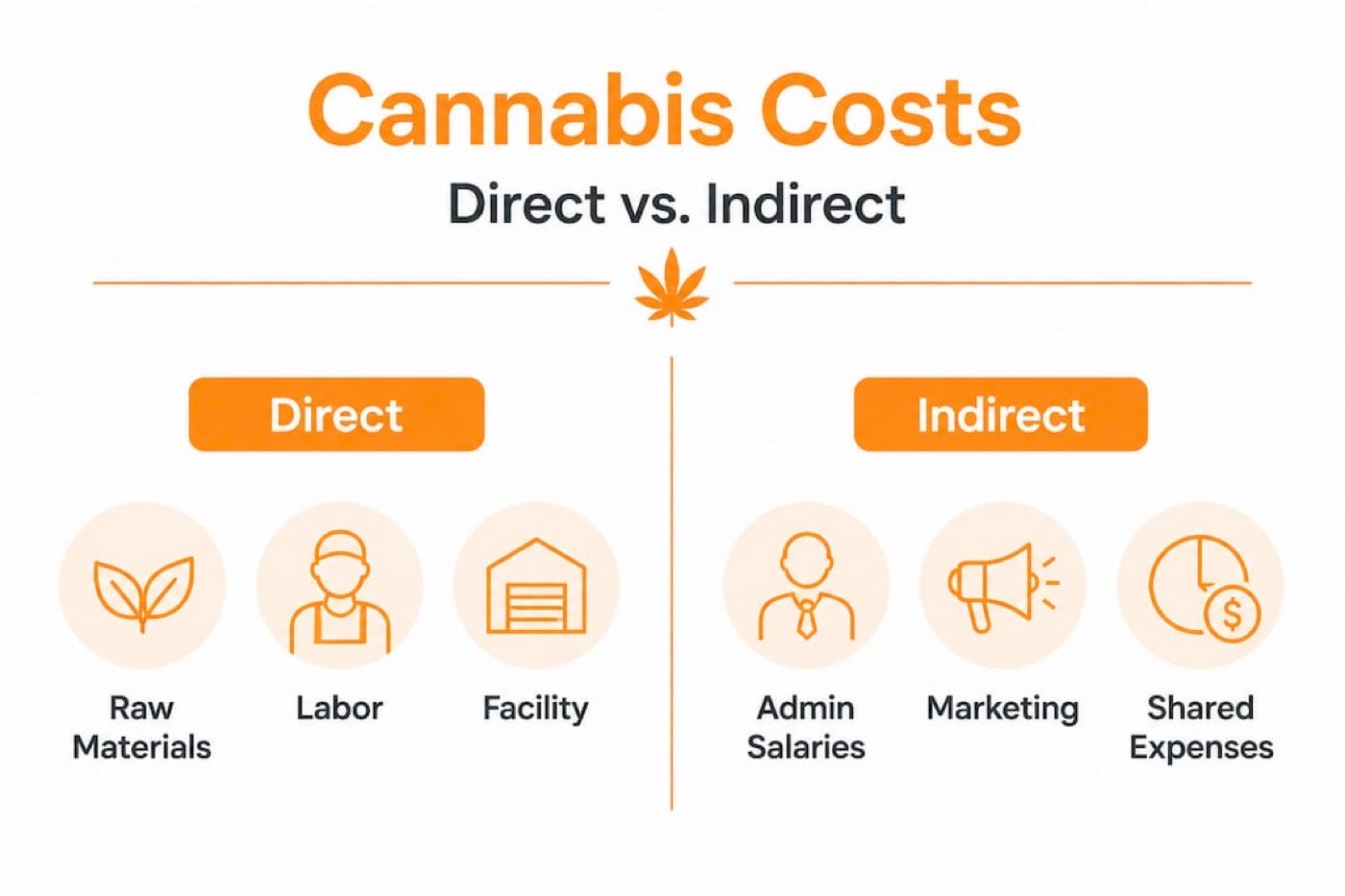
Understanding the operational cost types specific to cannabis gives you the foundation to allocate correctly. Direct costs, indirect costs, and overhead each carry different treatment under federal tax law, and confusing them is where most operators run into serious trouble.
Pro Tip: Separate your chart of accounts into COGS-eligible and non-eligible categories from day one. Retroactively reclassifying expenses during an audit is both expensive and risky.
Core principles of cannabis cost allocation
Once you understand why cannabis allocation is different, the next step is mastering the foundational concepts that govern how it works in practice. Industry-accepted methods and legal considerations for cannabis cost allocation center on a few key building blocks that every operator must understand before making any accounting decisions.
Direct costs are expenses you can trace directly to the production or acquisition of cannabis products. These include raw materials, direct labor in cultivation or processing, packaging directly applied to finished product, and testing fees tied to specific batches. Direct costs flow cleanly into COGS and are generally deductible under 280E.

Indirect costs are expenses that support production but cannot be traced to a single product unit. Think utilities for a facility used partly for growing and partly for administration, or equipment maintenance for machinery shared across departments. These require allocation ratios, and getting those ratios wrong is where businesses lose money.
Here is a sequential process that brings structure to your allocation decisions:
- Identify all cost centers in your operation, from cultivation and processing to retail and administration.
- Classify each expense as direct, indirect, or purely administrative using documented criteria.
- Choose an allocation method appropriate for your business model. The three most recognized approaches are: specific identification (traces cost to exact inventory units), absorption costing (spreads fixed overhead across all units produced), and activity-based costing (assigns costs based on actual activities that drive expenses).
- Calculate allocation ratios using defensible data, such as square footage dedicated to production versus administration, or labor hours by department.
- Document everything. Allocation decisions must be supported by records that can withstand IRS scrutiny.
- Reconcile monthly to catch drift between estimates and actuals before year-end.
A useful reference for building these processes is a solid cost accounting guide that maps each step to cannabis-specific scenarios. Pairing that with a strong understanding of GAAP standards ensures your financial statements hold up for investors and regulators alike.
Pro Tip: Absorption costing tends to maximize COGS for cannabis operators because it pulls more production-related overhead into deductible categories. Work with a cannabis-specialized CPA to confirm whether it fits your entity type and inventory model.
One statistic worth noting: cannabis businesses using structured cost allocation frameworks report significantly lower effective tax rates compared to peers using informal or improvised methods. The difference between a well-structured COGS calculation and a sloppy one can translate to six figures in tax liability for a mid-size dispensary.
Legal and compliance pitfalls: What most overlook
Understanding principles is one thing. Avoiding the real-world traps that send cannabis operators into IRS trouble is another. Common legal mistakes in cannabis cost allocation fall into predictable patterns, and recognizing them early saves you from expensive corrections.
The most frequent errors include:
- Over-allocating to COGS: Some operators load as many expenses as possible into COGS to maximize deductions under 280E. If those costs do not genuinely qualify, this creates fraudulent reporting risk.
- Under-allocating production costs: Others are overly conservative and leave legitimate production costs out of COGS entirely, overpaying taxes unnecessarily.
- Misclassifying employee roles: A budtender who occasionally helps with inventory receiving is not automatically a production employee. Role definitions must be precise and consistently documented.
- Ignoring mixed-use assets: Equipment, facilities, and software used across production and administration must have a defensible allocation ratio, not a rough estimate.
- Failing to update allocations: If your business grows, opens a new location, or shifts product mix, your allocation ratios need to be recalibrated. Static ratios applied to a dynamic operation drift into inaccuracy quickly.
The table below shows how cannabis cost allocation risk compares to a traditional retail business in key compliance areas:
| Compliance area | Traditional retail | Cannabis business |
|---|---|---|
| Deductible operating expenses | Broadly allowed | Severely restricted by 280E |
| COGS complexity | Standard product cost | Must absorb indirect production costs |
| Audit risk for misclassification | Moderate | High, with significant tax penalties |
| State vs. federal reporting alignment | Mostly aligned | Often conflicting |
| Documentation requirements | Standard | Elevated, requires detailed records |
Consulting a GAAP compliance guide helps you establish standards that keep your financial reporting consistent across both state and federal requirements. Inconsistencies between what you report to your state regulator and what you file with the IRS are a classic audit trigger.
Pro Tip: Request an annual internal review of your allocation methodology. Cannabis law and IRS guidance evolve, and a method that was defensible two years ago may not hold up today.
Optimizing financial outcomes: Practical strategies
Compliance is the floor, not the ceiling. Once your allocations are legally defensible, smart strategy can further reduce your tax burden and improve operational visibility. Industry-accepted methods point to several approaches that operators consistently use to gain a financial edge.
Here is a practical framework for optimization:
- Map every expense to its function, not just its cost category. A security system in your grow room is a production cost. The same system in your executive suite is not.
- Review eligible expenses regularly against current IRS guidance to capture any newly clarified deduction categories.
- Benchmark your COGS ratio against industry peers. If your cost of goods sold is unusually low relative to revenue, that is a flag both internally and to auditors.
- Use software built for cannabis accounting rather than adapting generic platforms. Purpose-built tools track allocation ratios in real time and reduce manual error.
- Train department managers on how their decisions affect cost allocation. A cultivation manager who understands that equipment purchases need use documentation will create better records without being asked.
The table below compares eligible versus non-eligible expenses under current federal interpretation:
| Expense type | Generally eligible for COGS | Generally not eligible |
|---|---|---|
| Raw materials and seeds | Yes | |
| Direct cultivation labor | Yes | |
| Production facility utilities (proportional) | Yes | |
| Packaging applied at production | Yes | |
| Marketing and advertising | Not eligible | |
| Administrative salaries | Not eligible | |
| Retail store expenses | Not eligible | |
| CEO compensation | Not eligible | |
| Legal and accounting fees | Generally not eligible |
Additional tactics that deliver real results include:
- Negotiate production contracts that clearly separate materials costs from service fees. This makes allocation cleaner and more defensible.
- Document time allocation for employees who work across COGS and non-COGS functions. A simple time-tracking system creates audit-ready records.
- Track an eligible expenses list and cross-reference it every quarter against your actual expense ledger.
- Build financial discipline into your operations using proven financial best practices designed specifically for dispensaries and cannabis producers.
Pro Tip: Activity-based costing often reveals hidden production costs that operators are leaving out of COGS. Running an ABC analysis once a year frequently uncovers legitimate deductions worth thousands of dollars.
The uncomfortable truth: Why compliance and profit both depend on allocation accuracy
Here is what most articles on this topic will not tell you directly. Many cannabis operators treat cost allocation as a year-end accounting task rather than an ongoing operational discipline. That mindset is where real damage happens.
When allocation is an afterthought, you end up reconstructing records under pressure, making judgment calls without documentation, and hoping your estimates hold up. They often do not. The cannabis tax burden is already punishing. Adding sloppy allocation to that equation turns a high-tax environment into a potentially business-ending one.
What experienced operators and their finance teams understand is that cost allocation is actually a profit strategy disguised as compliance work. Every dollar of legitimate production cost you correctly allocate to COGS is a dollar that reduces your taxable income. Multiply that across a full fiscal year for a business generating several million in revenue, and you are looking at material differences in your effective tax rate and your cash position.
The businesses that win in cannabis are not necessarily the ones with the best products or the most locations. They are the ones with financial infrastructure that captures every legal advantage. Allocation accuracy is the foundation of that infrastructure. It informs pricing decisions, supports investor reporting, and determines whether your business looks healthy or distressed on paper.
There is also a cultural dimension here. Finance teams at cannabis companies sometimes operate in isolation from operations. Cultivation managers do not understand why their labor hours matter to accounting. Retail managers do not see how their headcount decisions affect COGS ratios. Closing that communication gap is one of the highest-return investments a cannabis business can make. When everyone understands how their daily decisions connect to financial reporting, allocation quality improves across the board without adding complexity or cost.
The operators who treat allocation as a front-office responsibility, rather than a back-office chore, consistently outperform peers on both compliance metrics and profitability. That is not a coincidence.
Unlock compliance and profit: Expert resources for cannabis businesses
Cost allocation in cannabis is not something you figure out once and forget. The regulatory environment shifts, your business evolves, and the stakes stay high year after year. The good news is that you do not have to work through this alone.

Cannabis Business Minds offers a detailed cost accounting industry guide that walks operators and finance professionals through every major allocation decision, with frameworks built for the realities of 280E and IRC 471. Whether you are setting up your accounting structure for the first time or auditing an existing system for risk, these resources are designed to give you actionable direction. For businesses that want professional support alongside educational resources, our cannabis accounting services page connects you with specialized expertise matched to your operation’s needs. Staying compliant and competitive in this industry takes the right knowledge, applied consistently.
Frequently asked questions
What are the most commonly misallocated cannabis costs?
Indirect costs like administrative salaries, marketing, and shared facility expenses are frequently misclassified in cannabis, leading to compliance risks and inaccurate tax filings.
How does cost allocation affect cannabis tax liability?
Incorrect allocation reduces the costs eligible for COGS treatment, which inflates taxable income. Accurate allocation is essential because cannabis tax exposure under 280E is already significantly higher than in most industries.
What are the best practices for cannabis cost allocation?
Using approved accounting frameworks, validating expense eligibility regularly, and applying a documented step-by-step allocation method are the core practices that support both compliance and profit optimization.
Which expenses are eligible for deduction in cannabis companies?
Direct costs tied to inventory and production, including raw materials, direct labor, and proportional facility costs, are generally eligible. Cannabis expense categories like marketing, administrative salaries, and retail expenses typically are not deductible under 280E.
How can cannabis businesses avoid compliance risks in cost allocation?
Reviewing cost classifications regularly, using legal frameworks appropriate for cannabis operations, and referencing current industry guidance are the most effective ways to reduce audit exposure and maintain defensible records.
Recommended
- 7 Key Types of Operational Costs in Cannabis Explained – Cannabis Business Minds
- Cost Accounting Cannabis: Complete U.S. Industry Guide – Cannabis Business Minds
- Comprehensive Cannabis Business Budgeting Guide – Cannabis Business Minds
- 7 Key Eligible Business Expenses for Cannabis Companies – Cannabis Business Minds
- Cannabis Marketing Types 2026: 42:1 ROI With Compliance
This article is general education, not tax, legal or accounting advice. Cannabis rules change quickly; confirm how they apply to you with a qualified cannabis CPA or attorney.