Dispensary revenue recognition guide for compliance

2026 update: what rescheduling changed for 280E (reviewed October 2026)
Effective April 22, 2026, a DOJ/DEA final order moved marijuana covered by a qualifying state medical license (and FDA-approved marijuana drugs) to Schedule III. Section 280E only applies to Schedule I and II substances, so state-licensed medical cannabis activity is generally no longer subject to 280E going forward. Adult-use cannabis remains in Schedule I and fully subject to 280E. The DEA proceeding to reschedule all marijuana was temporarily stayed in October 2026, and Treasury/IRS guidance on transition years and mixed medical/adult-use businesses is still pending.
Check where your business stands in about a minute.
Dispensary owners who treat daily cash deposits as recognized revenue are setting themselves up for an IRS audit, a cash flow crisis, or both. Revenue recognition in cannabis retail is not just an accounting formality. It is a compliance requirement with real financial consequences, particularly under federal rules like IRC §280E, which already limits your deductions and places your books under heightened scrutiny. This guide walks you through exactly what dispensary revenue recognition requires, what tools and documentation you need to do it correctly, and how to build a process that holds up under examination and gives you clear visibility into your actual financial performance.
Table of Contents
- Why dispensary revenue recognition is different
- What you need before you start: Tools and requirements
- Step-by-step process: How to recognize dispensary revenue with confidence
- Verification, troubleshooting, and benchmarks
- Why revenue recognition is often misunderstood in cannabis — and what actually works
- Navigate compliance with proven cannabis finance resources
- Frequently asked questions
Key Takeaways
| Point | Details |
|---|---|
| Cash and revenue timing differ | Recognized sales and received cash rarely align, so plan cash flow and compliance accordingly. |
| Documentation is critical | Thorough, real-time records are as important as official policy for IRS defense and internal controls. |
| Follow stepwise processes | Consistent workflows from sale to reconciliation prevent errors and build audit-ready books. |
| Benchmark for reasonableness | Compare your margins to the industry’s 45–55% benchmark range for reliable financial health checks. |
Why dispensary revenue recognition is different
To understand how to recognize revenue correctly, it’s crucial to grasp why dispensary businesses face distinct challenges compared to other retail operations.
Most retailers deal with clean, straightforward payment flows. You sell a product, a card is swiped, and the funds clear in one to two business days. Cannabis dispensaries rarely enjoy that simplicity. Even in states with mature cannabis markets, many dispensaries still operate with a heavy cash component because traditional banking access remains inconsistent across the country. Where card processing does exist, specialized payment processors often introduce settlement lags of several days or more, which means the cash arrival date can be completely disconnected from the date the sale was made.
This gap matters enormously for accounting. Under Generally Accepted Accounting Principles (GAAP), revenue is recognized when the performance obligation is satisfied, which in retail means at the point of sale. Not when the cash lands in your account. Cash-receipt timing can diverge materially from GAAP revenue recognition in cannabis dispensaries, and treating recognized revenue as cash received can cause serious liquidity forecasting errors if you are not careful.

Beyond timing, you also have federal compliance pressure that no other legal retail sector faces at the same scale. Under IRC §280E, cannabis businesses cannot deduct ordinary business expenses the way other retailers can, which means your gross income figure carries disproportionate weight when the IRS reviews your return. Any error in revenue recognition, whether it is an understatement or an overstatement, draws attention. A misrecognized sale is not just an accounting mistake. It can become an audit trigger.
Common misconceptions that trip up finance teams include:
- Assuming the POS daily summary equals recognized revenue without adjusting for voids, refunds, or timing differences
- Treating deferred payment arrangements or loyalty redemptions as immediate recognized revenue
- Conflating gross receipts with net sales, particularly when excise taxes are collected at the register
- Overlooking multi-tender transactions where part of a sale is paid in cash and part via app-based payment with a delayed settlement
Strong dispensary accounting processes address each of these scenarios explicitly, because what you do not define in your accounting policy will eventually be handled inconsistently by whoever is reconciling the books that month.
“The cannabis industry’s cash-heavy nature is not just a banking inconvenience. It is an audit risk multiplier when revenue recording practices are sloppy or informal.”
What you need before you start: Tools and requirements
With the unique challenges in mind, here’s what you’ll need ready before you can effectively recognize revenue.
Before you implement a process, you need the right foundation. Many dispensaries try to fix their revenue recognition by purchasing better software, and while a good point-of-sale system absolutely helps, software alone will not solve a process or documentation problem. Here is what must be in place:
Standard operating procedures (SOPs) for sales and cash. Every transaction type, including in-store cash sales, delivery orders, card-based payments, and loyalty redemptions, needs a documented procedure covering how and when that revenue is recorded. Without SOPs, your team will make individual judgment calls, and those calls will not be consistent.
A POS and reporting system with channel-level detail. Your system needs to produce daily sales reports broken down by payment method and transaction type. This granularity is what allows you to reconcile recognized revenue against actual cash receipts by channel, not just in total.
Complete documentation. This means receipts, end-of-day cash logs, deposit slips, settlement confirmations from payment processors, and any invoices for delivery or wholesale transactions. Strong documenting cannabis expenses habits apply equally to revenue-side documentation.
Internal controls and reconciliation schedules. Segregation of duties between the person handling cash and the person recording transactions is essential. Daily reconciliation between the POS report and physical cash is non-negotiable for any cash-heavy operation.
A current revenue recognition policy memo. This is a written document that explains specifically how your dispensary defines recognized revenue, when recognition occurs for each transaction type, and how exceptions are handled.
When compliance risk is high, such as in §280E environments with cash-heavy operations, optimizing internal documentation around revenue completeness, accuracy, and channel timing can be just as important as the policy memo itself. The memo tells the IRS your intent; the documentation proves you executed it.
| Requirement | Why it matters | Common gap |
|---|---|---|
| SOPs for each transaction type | Consistency across staff and shifts | Informal verbal procedures |
| POS channel-level reporting | Reconciliation accuracy | Summary-only reports |
| Daily cash logs and deposit slips | Audit trail for cash revenue | Sporadic or informal logs |
| Payment processor settlement reports | Timing difference tracking | Not integrated into accounting |
| Revenue recognition policy memo | Defines your accounting position | Outdated or too generic |
For solid cannabis recordkeeping practices that complement your revenue process, it helps to build your document retention policy at the same time you build your revenue policy. They work together.
Pro Tip: Update your revenue recognition policy memo every time you add a new payment method, a new sales channel, or open a new location. What worked for a single-store cash operation may not hold up for a multi-location operation with delivery and online ordering.
Step-by-step process: How to recognize dispensary revenue with confidence
Now that you’re prepared, here’s a concrete walkthrough for recognizing revenue in a way that is both compliant and useful for business management.
Step 1: Record each sale at the point of transaction. When a customer completes a purchase, your POS should capture the transaction amount, payment method, and timestamp. This is the moment revenue is recognized under GAAP, not when you deposit the cash or when the processor settles the funds.
Step 2: Separate the sales tax and excise tax components. In most states, cannabis excise taxes collected at the register are a liability, not revenue. Your system must segregate these amounts so your recognized revenue reflects the actual transaction price, not the gross amount including taxes you owe the state.
Step 3: Reconcile the POS daily summary to physical cash and settlement reports. At the end of each day, your cash in the register should match the POS cash sales total after accounting for the opening float. Card and app payments should be matched against processor settlement notifications, noting any timing lag for next-day or multi-day settlements.
Step 4: Record a receivable for unsettled payments. When a card or digital payment has been authorized but not yet settled, record it as a receivable rather than as cash. This keeps your balance sheet accurate and prevents you from misreading your cash position. Cash-receipt timing can diverge materially from GAAP revenue recognition, and this step is where that divergence gets captured correctly.
Step 5: Post to your general ledger by transaction type. Book recognized revenue by sales category (flower, edibles, concentrates, accessories) if your business model or reporting needs require it. This level of detail is useful for margin analysis and also helps if an audit examines the reasonableness of your revenue breakdown.
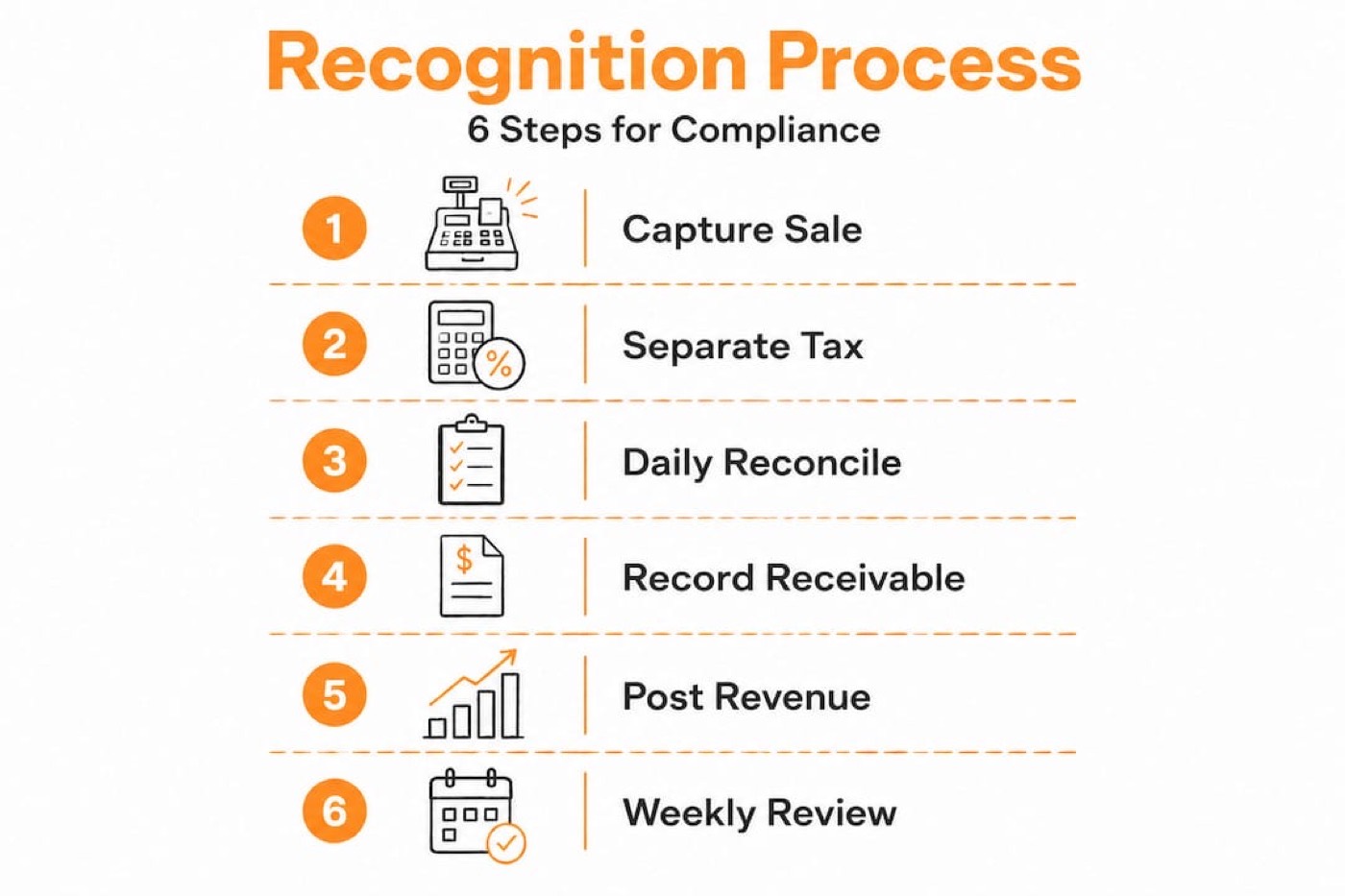
Step 6: Perform a weekly reconciliation of recognized revenue versus cash received. Look at the difference between what was recognized in the books and what actually cleared your bank account. A consistent, explainable lag is expected. An unexplained or growing gap is a problem that needs investigation.
Here is a comparison of the two approaches most dispensaries use:
| Approach | Revenue recognition timing | Audit defensibility | Cash flow accuracy |
|---|---|---|---|
| Cash-basis recording | When cash is deposited | Low under GAAP | Appears accurate short-term |
| Accrual-basis (GAAP) | At point of sale | High | Requires separate cash tracking |
Good cannabis invoice best practices matter here too, especially for delivery orders or wholesale transactions where there may be a delay between order fulfillment and payment.
Pro Tip: Build a 13-week rolling cash flow forecast that uses actual bank receipt dates, not recognized revenue dates. This gives you a realistic picture of your liquidity position and prevents you from spending money you have earned but not yet collected. This forecast runs parallel to your income statement and serves as your operational cash management tool. For more on financial process discipline, the cannabis accounting tips available through Cannabis Business Minds offer a practical starting point.
Verification, troubleshooting, and benchmarks
After applying the workflow, it’s vital to verify that your process stands up to audit and industry standards.
Running the process is not enough. You need to confirm it is producing accurate, defensible results. Verification is where most dispensaries fall short, not because they do not care, but because they assume the process is working if nothing breaks visibly.
Benchmark your gross margin. Typical cannabis dispensary gross margin ranges broadly from 45% to 55%, with some variation depending on state, product mix, and competitive environment. If your recognized revenue and cost of goods sold (COGS) produce a gross margin significantly outside this range, investigate before an auditor does. A gross margin of 70% might indicate unrecognized COGS or overstated revenue. A 25% margin may signal that excise taxes are being incorrectly categorized as COGS.
Reconcile recognized revenue to cash received monthly. Most timing differences should clear within 30 days. If you have recognized revenue sitting in accounts receivable beyond that window with no explanation, it may represent a recording error, a voided sale not captured in your books, or a processor dispute.
Common errors to look for:
- Duplicate entries from the same transaction posted in both the POS system and manually
- Refunds recorded in a later period than the original sale, causing revenue overstatements
- Loyalty point redemptions treated as revenue instead of as a reduction of the sale price
- Delivery order revenue recorded when the order is placed rather than when it is fulfilled
For multi-location operators, the complexity grows significantly. Consolidated reporting can be complex for multi-entity operators, where intercompany eliminations and transfer pricing can distort gross margin presentation at the entity level. If your management company charges a fee to your operating dispensary, for instance, that intercompany transaction must be eliminated in consolidated reporting or your revenue and expense figures will both be overstated.
Perform internal audits quarterly. Select a sample of transactions from each week of the quarter, trace them from the POS record through to the bank deposit or settlement report, and confirm each was booked correctly. A quarterly internal audit takes discipline to schedule but dramatically reduces your risk profile. The cannabis financial reporting guide covers the standards you should hold your internal audit against.
Pro Tip: When you complete each quarterly internal audit, document your findings even if everything checks out. A clean audit trail showing that you actively monitor your own processes is exactly the kind of evidence that helps in an examination. The cannabis financial reporting checklist can help standardize what you review each quarter.
Why revenue recognition is often misunderstood in cannabis — and what actually works
Here is where we want to challenge something that most guides in this space get wrong.
The cannabis accounting industry, broadly speaking, tends to focus heavily on policy documentation. Write a good revenue recognition memo, adopt the right accounting method, and you are compliant. That framing is not wrong, but it is dangerously incomplete.
In practice, what separates dispensaries that survive an IRS examination from those that face penalties is not the quality of their policy memos. It is the quality of their daily execution and documentation. When compliance risk is high under §280E and in cash-heavy operations, internal documentation around revenue completeness, accuracy, and channel timing is at least as important as the policy memo itself. The memo is your intention. The documentation is your proof.
We also see a consistent pattern where internal controls are treated as something you set up once and forget. Cannabis banking relationships change. Payment processors come and go. State regulations shift. Any one of these changes can break your revenue recognition workflow if you are not actively monitoring it. A dispensary that adopted a card-based payment system in 2023 and never updated its reconciliation procedure to account for settlement lags is running a process that no longer matches reality.
The other lesson that rarely gets discussed is this: software does not replace judgment. Your POS may produce beautiful daily reports, but someone who understands revenue recognition principles still needs to review those reports critically. Does the total make sense given foot traffic and average transaction value? Is the product mix reasonable? Are there anomalies that suggest a POS configuration error or a recording mistake?
Strong cannabis bookkeeping best practices are grounded in human oversight of automated systems, not replacement of that oversight. And when something does go wrong, having a documented cannabis audit preparation workflow means you can respond quickly and confidently rather than scrambling to reconstruct records under pressure.
Navigate compliance with proven cannabis finance resources
If you’re ready to strengthen your dispensary’s compliance and financial health, consider these resources and next steps.
Cannabis Business Minds is built specifically for dispensary owners and finance professionals navigating the complexity of cannabis accounting and tax compliance. Whether you are starting from scratch with specialized cannabis accounting fundamentals or need to go deeper into product-level profitability through our cost accounting guide, the resources here are written with your operational reality in mind.

Revenue recognition accuracy connects directly to every other financial decision you make, from budgeting to investor reporting to tax planning. Our budgeting for dispensaries resource shows you how to build a financial plan that starts with correctly recognized revenue and builds forward from there. Explore the full library to find the guidance that fits where your business is today.
Frequently asked questions
What is the difference between recognized revenue and cash received in a dispensary?
Recognized revenue records the sale when the transaction happens, but cash may arrive days or weeks later due to processing settlement lags or end-of-day deposit timing. Cash-receipt timing can diverge materially from GAAP revenue recognition, making it essential to track both figures separately.
Why is accurate dispensary revenue recognition important for IRS compliance?
Accurate revenue recognition ensures your reported income aligns with IRS standards and supports audit readiness, particularly given the heightened scrutiny cannabis businesses face under §280E. When compliance risk is high, internal documentation around revenue accuracy is as critical as the accounting policy itself.
How can I check if my dispensary’s revenue numbers are reasonable?
Compare your gross margin to industry benchmarks, typically in the 45% to 55% range, and reconcile your sales records to cash flow regularly to catch timing differences or recording errors before they compound.
Do I need different revenue recognition policies for each store or location?
Multi-location operations may need tailored controls and reporting structures to prevent errors when consolidating financials. Consolidated reporting can be complex for multi-entity operators, where intercompany transactions can distort gross margin if not handled correctly.
Recommended
- Dispensary Licensing Explained: Complete Compliance Guide – Cannabis Business Minds
- Dispensary operations optimization guide for managers – Cannabis Business Minds
- Cannabis Accounting – Cannabis Business Minds
- Step by Step Dispensary Accounting: Master Financial Management – Cannabis Business Minds
This article is general education, not tax, legal or accounting advice. Cannabis rules change quickly; confirm how they apply to you with a qualified cannabis CPA or attorney.