Dispensary operations optimization guide for managers
Running a dispensary without optimized workflows is like trying to fill prescriptions by hand in a modern pharmacy. The bottlenecks pile up fast, compliance gaps widen, and every busy shift becomes a liability. Most dispensary managers know something feels inefficient, but pinpointing exactly where time and money leak out requires a structured approach. This guide walks you through a proven framework for identifying pain points, selecting the right tools, standardizing processes, and maintaining audit readiness so your operation runs cleaner, faster, and with far less regulatory risk.
Table of Contents
- Identify operational pain points and optimization goals
- Select and integrate tools for automation and compliance
- Standardize core workflows for efficiency and accuracy
- Maintain compliance and prepare for audits
- Why most dispensaries overlook workflow optimization and what actually works
- Take your dispensary operations to the next level
- Frequently asked questions
Key Takeaways
| Point | Details |
|---|---|
| Automate compliance tasks | Using POS systems that sync with METRC/BioTrack reduces errors and saves time. |
| Standardize workflows | Clear and updated procedures minimize mistakes and speed up daily operations. |
| Prepare for audits proactively | Regular internal checks and audit-ready reports protect against compliance risks. |
| Address bottlenecks early | Identify and resolve workflow slowdowns before they impact your business. |
Identify operational pain points and optimization goals
Before you can fix anything, you need to know what’s actually broken. Most dispensaries share a predictable set of inefficiencies, and the first step is making them visible.
Common bottlenecks in dispensary workflows include manual inventory tracking, slow compliance checks at the point of sale, and fragmented reporting that requires staff to pull data from multiple sources. These aren’t minor inconveniences. They compound over time, especially when customer volume spikes. Manual processes amplify errors during high-traffic events like 4/20, when transaction speed and accuracy are both under maximum pressure simultaneously.

Here’s a quick comparison of what manual versus automated workflows typically look like in practice:
| Workflow area | Manual process | Automated process |
|---|---|---|
| Inventory tracking | Staff counts, spreadsheet entry | Real-time POS sync with seed-to-sale |
| Compliance reporting | Manual data pulls, delayed filing | Scheduled automated reports |
| Low stock alerts | Visual checks, verbal updates | Automated threshold notifications |
| Audit preparation | Scrambled record gathering | Pre-built audit logs, always current |
| Customer wait time | Inconsistent, often long | Streamlined checkout, faster throughput |
The metrics you should track to measure operational health are straightforward: transaction speed (time from customer check-in to purchase completion), compliance pass rate (percentage of transactions and records that meet state requirements on first review), and stock-out frequency (how often a product is unavailable when a customer requests it). These three numbers tell you a lot about where your operation stands.
Key areas to assess during your initial review:
- Customer flow data: Where do customers wait longest? Check-in, product selection, or checkout?
- Inventory discrepancy rate: How often do physical counts differ from system records?
- Staff error frequency: How many transactions require correction or supervisor override?
- Reporting lag: How long does it take to generate a compliance report after a request?
Pro Tip: Pull your point-of-sale timestamps and map the average time between each stage of a customer’s visit. You’ll often find invisible wait points that don’t show up in staff feedback but are clearly visible in the data. This kind of analysis is a core part of dispensary management essentials that separates reactive managers from proactive ones.
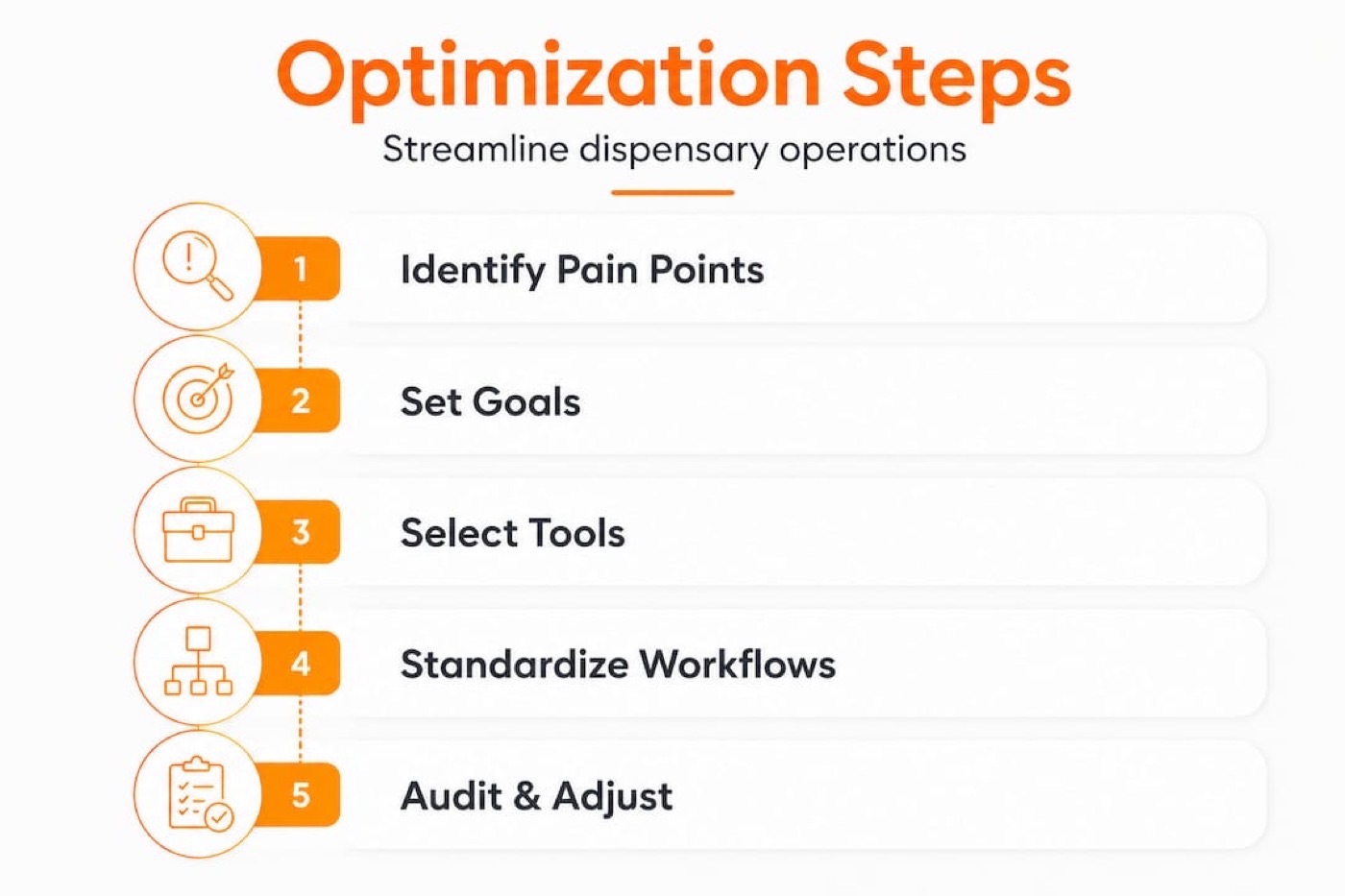
Once you’ve identified the pain points, set specific, measurable goals. “Improve efficiency” is not a goal. “Reduce average transaction time from 8 minutes to 5 minutes within 90 days” is a goal you can actually track and achieve.
Select and integrate tools for automation and compliance
With your pain points mapped and goals defined, the next step is choosing technology that does the heavy lifting. The cannabis industry has no shortage of software options, but not all of them are built for compliance-first environments.
The non-negotiable features for any dispensary management system include real-time inventory sync with your state’s seed-to-sale tracking platform, automated compliance alerts for low stock and product expirations, and audit-ready reporting that generates clean records without manual intervention. Integrated POS systems with real-time METRC/BioTrack syncing and automated alerts are the current standard for dispensaries that want to stay ahead of regulatory scrutiny.
Here’s how the major compliance tracking systems compare at a high level:
| Platform | Primary use | Integration capability | Audit log quality |
|---|---|---|---|
| METRC | Seed-to-sale tracking | Broad POS compatibility | Strong, state-mandated |
| BioTrack | Seed-to-sale tracking | Good POS compatibility | Strong, used in multiple states |
| Integrated POS | Sales, inventory, compliance | Syncs with METRC/BioTrack | Varies by vendor |
A practical integration workflow looks like this:
- Audit your current systems: Document what data lives where and identify gaps between your POS, inventory software, and compliance reporting tools.
- Select a compliant POS platform: Choose a system with native integration to your state’s required tracking platform (METRC or BioTrack).
- Configure real-time sync: Work with your vendor to establish two-way data flow so every transaction updates inventory and compliance records simultaneously.
- Run parallel testing: Operate both old and new systems side by side for at least two weeks to catch discrepancies before going fully live.
- Train staff thoroughly: Focus training on exception handling, not just standard transactions. Staff need to know what to do when the system flags an error.
- Automate report generation: Schedule daily and weekly compliance reports to run automatically so nothing falls through the cracks.
Keeping thorough required dispensary records isn’t optional, and the right technology makes it far easier to maintain those records consistently. Similarly, having a clear audit preparation workflow built into your system means you’re never scrambling when a regulator calls.
Pro Tip: Set up automated daily compliance reports to run at the end of each business day and land in your inbox before you start the next morning. This creates a consistent review rhythm and catches discrepancies while they’re still easy to correct.
Standardize core workflows for efficiency and accuracy
Technology alone won’t fix a disorganized operation. The systems you install are only as good as the processes they support. Standardized operating procedures (SOPs) are the backbone of a well-run dispensary, and they need to cover every stage of the product and customer journey.
A complete dispensary workflow covers five core stages:
- Product intake: Verify incoming shipments against purchase orders, log products into the seed-to-sale system immediately upon receipt, and flag any discrepancies before products enter inventory.
- Storage management: Assign products to designated storage locations, maintain temperature and humidity logs where required, and conduct regular cycle counts to verify system accuracy.
- Point-of-sale process: Verify customer ID and purchase limits before every transaction, apply all required compliance checks within the POS system, and complete seed-to-sale reporting in real time.
- Customer education: Train staff to provide accurate product information, document any recommendations made during consultations, and maintain records of medical patient interactions where state law requires it.
- Reporting and reconciliation: Run end-of-day reconciliation reports, compare POS data against seed-to-sale records, and escalate any discrepancies to a manager before closing.
Tech integration between POS and seed-to-sale systems resolves the tension between speed and accuracy that manual workflows create. When your systems talk to each other automatically, staff can focus on the customer rather than on data entry.
Additional documentation practices that belong in every dispensary SOP:
- Chain-of-custody tracking: Every product movement from intake to sale should be logged with timestamps and staff identifiers.
- Corrective action workflows: When an error occurs, there should be a documented process for identifying the cause, correcting the record, and preventing recurrence.
- Compliance change management: When state regulations update, SOPs should be reviewed and revised within a defined timeframe, typically 30 days or less.
- Staff sign-off requirements: Employees should acknowledge receipt and understanding of updated SOPs in writing, creating a training record.
Research consistently shows that error rates drop sharply when workflows are standardized and documented. The reason is simple: when staff follow a defined process, there are fewer decision points where individual judgment can introduce variation or mistakes. Connecting your SOPs directly to your report filing for compliance process ensures that the data you report is as clean as the process that generated it. For a broader view of how to build a culture of accuracy, the compliance success tips available through Cannabis Business Minds offer practical frameworks that go beyond basic checklists.
Maintain compliance and prepare for audits
Compliance isn’t a quarterly event. It’s a daily practice. Dispensaries that treat compliance as something they prepare for only when an audit is announced are the ones that get caught with gaps they didn’t know existed.
A strong compliance maintenance checklist includes:
- Data accuracy reviews: Verify that POS records match seed-to-sale data at least weekly, not just at month-end.
- Record retention protocols: Confirm that all required records (transaction logs, employee records, inventory reports) are stored securely and for the required retention period under your state’s rules.
- Reporting cadence: Establish a fixed schedule for all required regulatory reports and assign ownership to a specific team member.
- Expiration monitoring: Use automated alerts to flag products approaching expiration dates so they can be handled appropriately before they create a compliance issue.
- Access controls: Review who has permission to modify records in your POS and seed-to-sale systems quarterly, and remove access for former employees immediately upon separation.
“Audit-ready reporting is a safeguard, not a last resort.”
That quote captures the mindset shift that separates high-performing dispensaries from those that scramble when regulators show up. Integrated POS systems with audit-ready reporting make this mindset achievable at the operational level, not just aspirational.
Internal audits are one of the most underused tools in dispensary management. Performing a mock audit every quarter, using the same criteria your state regulators apply, gives you a realistic picture of where your records and processes stand. The process is straightforward: pull a random sample of transactions, verify the chain-of-custody documentation, check that seed-to-sale records match, and review employee compliance training logs. Document your findings and assign corrective actions with deadlines.
Reviewing your audit preparation steps on a regular schedule, rather than only when an audit is imminent, turns compliance into a muscle rather than a fire drill. Pairing that with a thorough understanding of audit record requirements ensures you know exactly what regulators will look for before they arrive.
Why most dispensaries overlook workflow optimization and what actually works
Here’s an uncomfortable truth: most dispensary managers know their workflows aren’t optimal, but they don’t change them because change feels riskier than the status quo. When you’re running a busy retail operation under heavy regulatory scrutiny, the instinct to avoid disruption is understandable. But that instinct is exactly what keeps operations stuck.
The conventional wisdom in cannabis retail is that compliance is the constraint and efficiency is the goal you pursue after you’ve satisfied regulators. That framing is backwards. When compliance is built into your workflows from the start, it actually speeds things up. You stop double-checking records manually. You stop scrambling to reconstruct data before audits. You stop losing staff time to error correction. Compliance-first workflows are faster workflows.
What actually works is treating optimization as an ongoing operational discipline rather than a one-time technology project. A new POS system doesn’t optimize your dispensary. The processes, training, and review cycles you build around that system are what drive real improvement. Dispensaries that upgrade their technology without upgrading their processes simply automate their existing inefficiencies.
Proactive audit simulation is one of the highest-return activities a dispensary manager can invest time in. Running a mock audit before a regulator does reveals gaps while you still have time to fix them without consequences. It also builds staff confidence and familiarity with compliance expectations, which reduces errors during actual regulatory visits.
The most effective structural change you can make is appointing a dedicated process champion on your team. This is someone whose explicit responsibility is to monitor workflow performance, flag emerging compliance changes, and drive continuous SOP updates. This doesn’t require a new hire. It’s a role that can be layered onto an existing senior staff member. The key is that it’s a formal responsibility, not an informal expectation. A strong dispensary management strategy always includes clear ownership of operational improvement, not just day-to-day task completion.
Real optimization is iterative. You identify a problem, implement a solution, measure the result, and adjust. Then you do it again. That cycle, repeated consistently, is what separates dispensaries that grow and scale from those that plateau and struggle.
Take your dispensary operations to the next level
Operational efficiency and compliance mastery don’t happen in isolation. They require ongoing learning, the right financial frameworks, and access to expert guidance tailored to the cannabis industry’s unique regulatory environment.

Cannabis Business Minds provides the structured resources dispensary managers and consultants need to go beyond the basics. Whether you’re building out your dispensary budgeting strategies to align financial planning with operational goals, working through a cannabis cost accounting guide to get a clearer picture of your true operating costs, or deepening your knowledge of understanding dispensary management at a strategic level, the platform offers in-depth guides built specifically for cannabis professionals navigating complex financial and compliance landscapes. These aren’t generic business resources. They’re built for the realities of cannabis operations.
Frequently asked questions
What are the most common compliance errors in dispensary operations?
Manual data entry, failure to sync real-time inventory with METRC/BioTrack, and delayed reporting are the most frequent compliance pitfalls. Manual processes amplify errors especially during high-volume periods when staff are under pressure to move quickly.
How can dispensaries improve audit readiness?
Implementing automated POS with audit-ready reporting and performing regular mock audits ensures preparedness for regulatory reviews. Treating compliance records as a living document rather than a periodic task is the most reliable path to consistent audit readiness.
Which technologies should dispensaries prioritize for automation?
Integrated POS systems with real-time METRC/BioTrack syncing and automated inventory management should be the top priority for any dispensary looking to reduce manual workload and compliance risk.
Why do workflow errors increase during busy periods like 4/20?
Manual processes struggle to keep pace during high customer volume, leading to mistakes in compliance recording and inventory management. Automated systems maintain accuracy regardless of transaction volume, which is exactly why integration matters most on your busiest days.
Recommended
- Understanding What is Dispensary Management for Cannabis – Cannabis Business Minds
- 7 Essential Dispensary Financial Management Tips – Cannabis Business Minds
- Dispensary Licensing Explained: Complete Compliance Guide – Cannabis Business Minds
- How to Budget for Dispensaries: Step-by-Step Success – Cannabis Business Minds
This article is general education, not tax, legal or accounting advice. Cannabis rules change quickly; confirm how they apply to you with a qualified cannabis CPA or attorney.